Training & Development

Social Media to Support Your Organization

Last week I was invited to participate in the Southlake Chamber of Commerce’s UNT Professional Develop Fridays. I wrapped up the series by discussing how to effectively plan and organize social media resources for to build a community for businesses and organizations in the city.

This workshop focussed on strategies and practical applications of how social media platforms can be utilized to enhance organizations, with regards to:

  • Effective communication and marketing methods
  • Customer engagement and community development
  • Development of a communication strategy to support organizational goals
  • Implementation of social media tools to enhance goods & services

We discussed how their organizations in Southlake could “get social” (Twitter notes from the session: #SocialSouthlake) by connecting business strategies to broader communication plans and community management ideas.

Discussion points from this workshop included:

  • Be an active participant in social media platforms – explore before you plan
  • Set goals that are realistic with social media – pick 1-3 platforms to start with and use them well.
  • Map out a strategic plan for social media implementation (see worksheet) connected with your business plan.
  • Research your community and partners in the industry – get to know your audience and others participating in your potential community
  • Consider methods that build and growth your community offline and online
  • Designate a community manager, or a few to lead your development and planning
  • Identify champions from your community, i.e. individuals who are active participants from within the community, who will support your social media implementation and growth
  • Plan content directly connected to your purpose and mission
  • Effective methods to measure and track progress related to goals


Additional resources from this session can be found here: http://bit.ly/SocialSouthlake

Thanks for the invite @Southlake_CC … be sure to keep it social. 🙂
Social Media

Curating Tweets: Social Media Content and Marketing Planning

With the 2014 CASE Social Media Survey results recently published, I thought I’d curate a few of my tweets shared regarding social media content creation and marketing practices. Although this sounds similar to my dissertation research on social media guidance, it is not. This exercise was to provide a few quick resources for an education organization as they redesign their communication (social media, publications, website, etc.) plan and develop a more effective social media content calendar (Example 1 or Example 2).

calendar

Content Creation


Content Sharing Strategy


Social Media Marketing 


SEO & Metrics


Email


Facebook


Twitter


Blogging & Blog Content


A number of these are relate to content sharing, marketing & targeting an audience; however this is not an all inclusive list. I have not included using other social media platforms, like YouTube, LinkedIn, or Instagram, or even provided “suggested reading” books and articles on this topic (yet).

For now, if you have any tweets and websites about said topic, please feel to comment on this post or UPDATE THIS GOOGLE DOCUMENT if you have suggestions. Please feel free to add to and share!

Social Media, SocioTech

#iConf14 Social Media Expo Winners!

I am just back from the 2014 iConference (#iConf14) hosted by Humboldt-Universität zu Berlin  in Berlin, Germany. The iSchools offer a stellar conference for scholars and researchers to share and discuss critical information issues that impact our society.

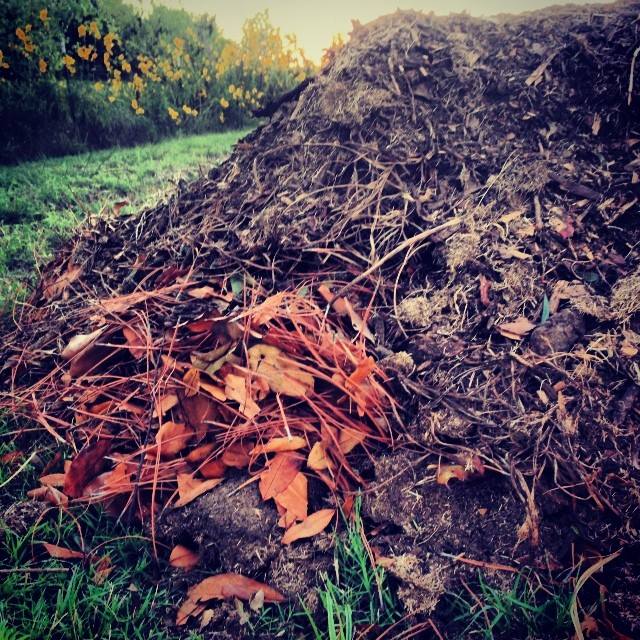
400 pounds

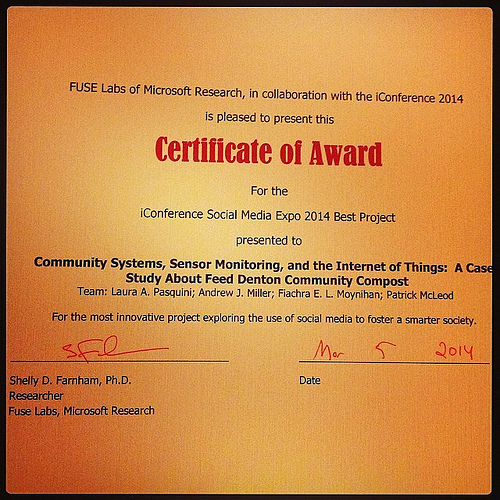
Let me give you the dirt (literally) on our collaborative project we completed for the 2nd Annual Social Media Expo: Community Systems, Sensor Monitoring, and the Internet of Things: A Case Study About Feed Denton Community Compost

compost_1

The University of North Texas team demonstrated how an interdisciplinary group from Decision Science, Computer Education Cognitive Science, Information Science, and Applied Technology & Performance Improvement can propose a design solution for a smart city/community for the iConference Social Media Expo. Our abstract paper and video for the competition outlined how social data, the Internet of Things, and smart design can improve sustainability in a community for Compost Denton.

SocialMediaExplo_ID_444_Figure_2

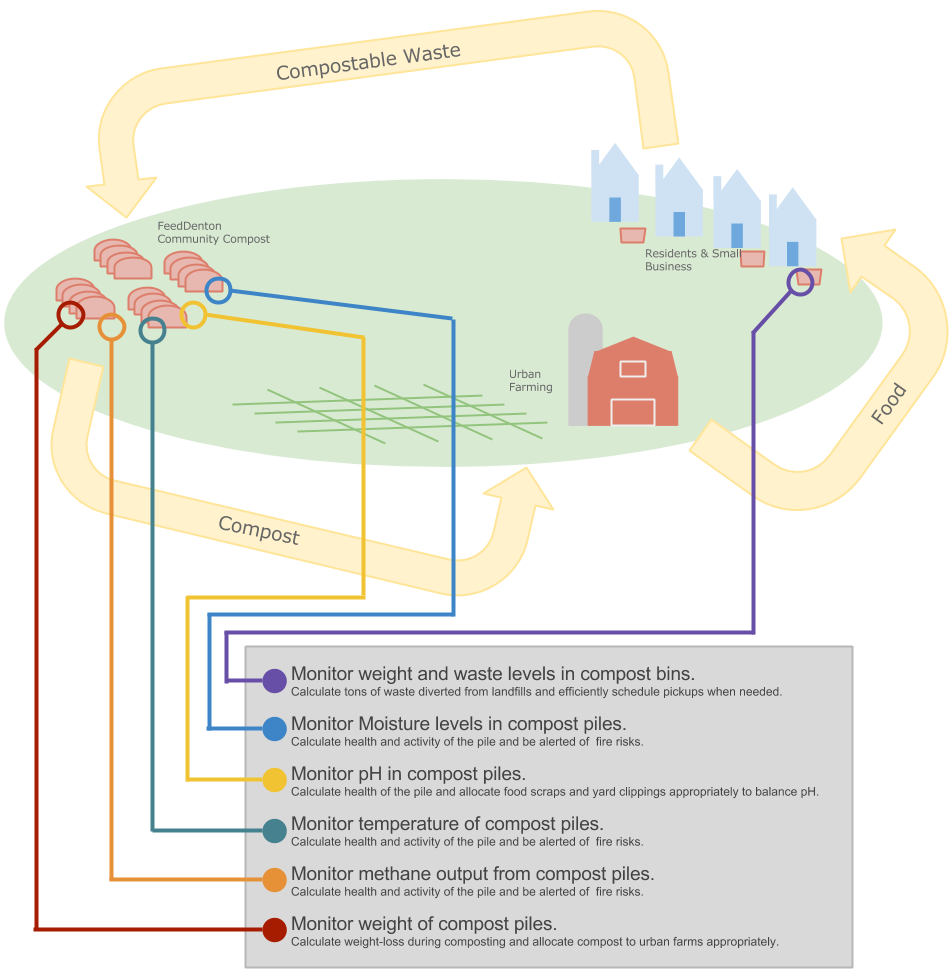
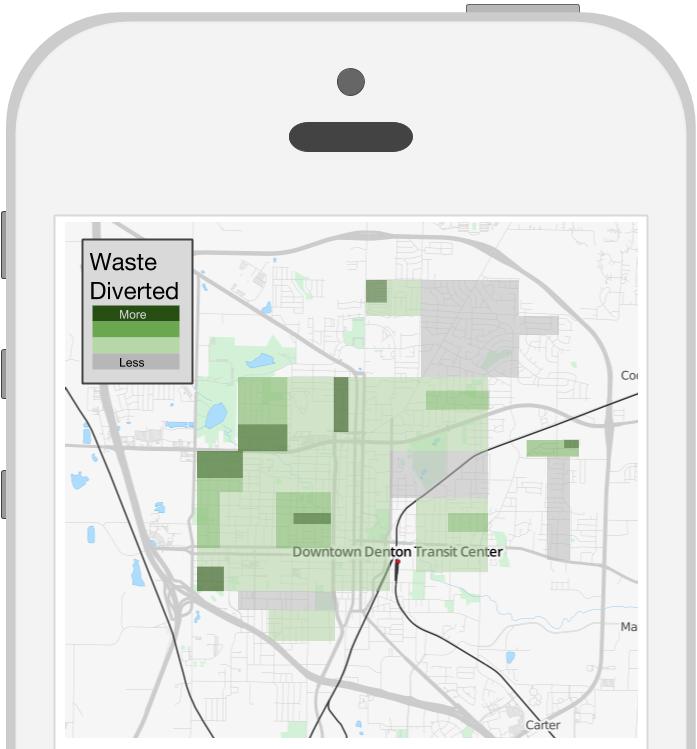
In thinking about information and how data is shared, our team proposed a unique design to make composting and data actionable. In conjunction with a pilot compost project in Denton, TX, our group suggested the use of augmenting this environmental start-up using Arduino sensors, smart technologies, data visualizations, and social media to encourage participation and inform the community about their ecological impacts. When data is socially shared, community members have the ability to see the larger picture for sustainable living by tracking individual and community composting progress.

gamification_loop

Thanks to the efforts made by local volunteers who initiated the Feed Denton Community compost pilot projects, we were able to consider how technological solutions can support and improve this model. Moving forward, we hope to support the business development plan and social media design to help scale and grow the Compost Denton initiative.

Here is the slide deck and our abstract that shares our proposed way to use social data for implementation and gamification for composting in a local community.

Guess who won? A message from the iConference 2014 daily news update:

“Congratulation also to the University of North Texas Social Media Expo team on
winning the 2014 Best Project Award. The winning entry was titled Community
Systems, Sensor Monitoring, and the Internet of Things: A Case Study About
Feed Denton Community Compost.
 It was authored by Laura A. Pasquini; Andrew J.
Miller; Fiachra E. L. Moynihan; Patrick McLeod. More at
http://ischools.org/the-iconference/awards/

Group Win Take1

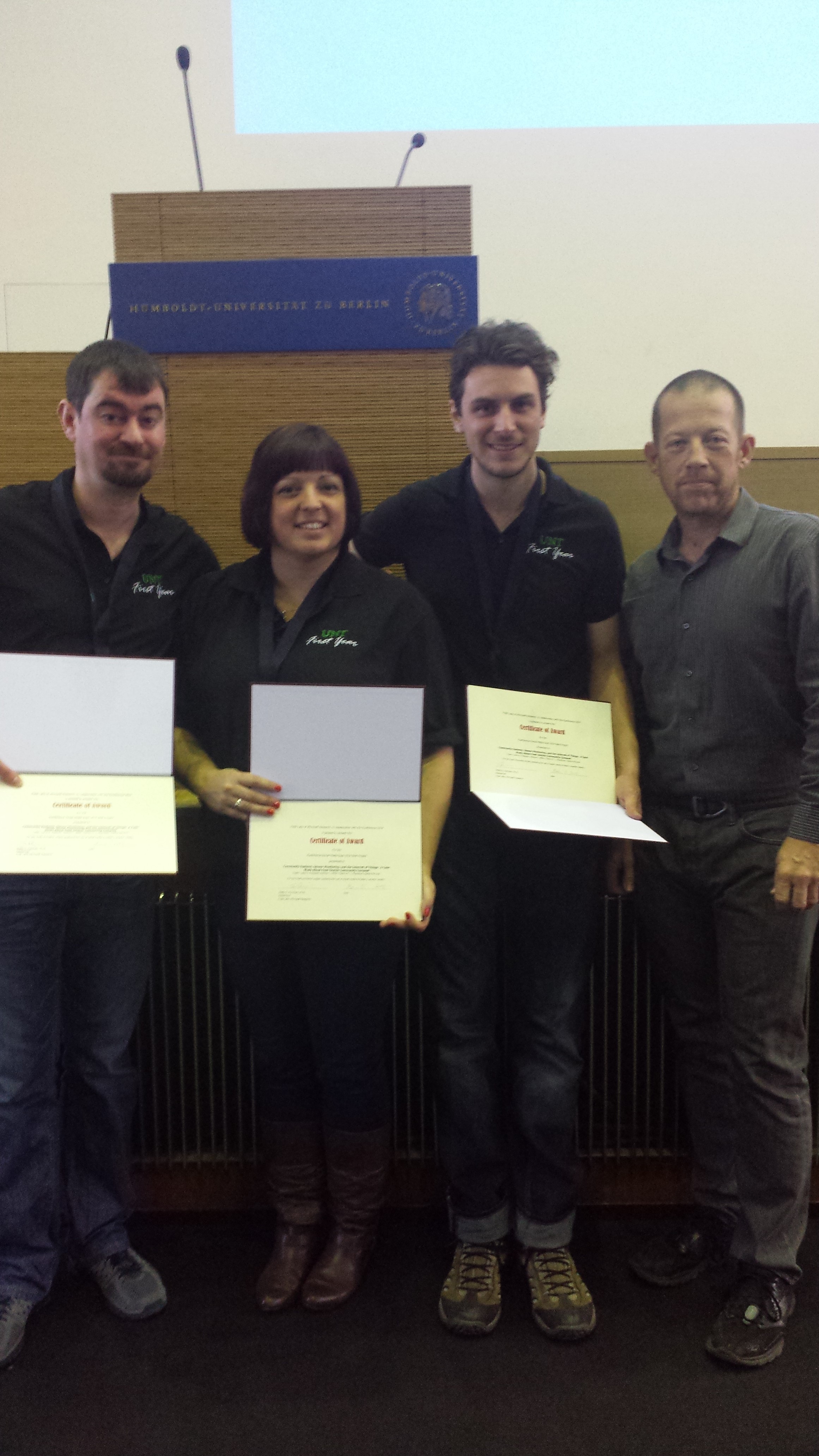
From L-R: Fiachra E. Moynihan (@FiachraM), Laura A. Pasquini (@laurapasquini), & Andrew J. Miller (@findandrew) with their College of Information faculty sponsor, Dr. Jeff M. Allen (@drjeffallen). Not in photo – Patrick McLeod (@misternaxal).

award

Guthen Tag.  Danke für das Kommen zu unserem Social-Media-Präsentation heute. Thank you for your support and this opportunity:

  • Dr. Jeff Allen, our faculty sponsor from Department of Learning Technologies in the College of Information at University of North Texas
  • Shelley Farnham, Organizer/Coordinator/Researcher of the Social Media Expo from FUSE Social Labs at Microsoft Research (along with others who reviewed/judged the expo abstracts)
  • Humbolt-Universitadt zu Berlin our iConference 2014 host with the most.


Abstract: This case study provides on the Feed Denton Community Compost Project. This ethnographic research will review how the collecting of social data and implementation of information communication technologies can provide a smart city infrastructure for this sustainable community of practice through sensor monitoring and the Internet of Things.
Keywords: social media; community of practice; Internet of Things; social data; sustainability
Copyright: Copyright is held by the authors.

Reference:

Pasquini, L. A., Miller, A. J., Moynihan, F. E., & McLeod, P. (2014). Community systems, sensor monitoring, and the Internet of Things: A case study about Feed Denton Community Compost. iConference 2014 proceedings.  (pp. 1-8). In M. Kindling & E. Greifendeder (Eds.) (2014). Berlin, Germany:  iSchools. DOI 10.9776/14010 Retrieved from https://www.ideals.illinois.edu/handle/2142/48831

blogs, Reflections

TechKNOW Tool 2013 – Blog Posts In Review

In the process of auditing my social media and web life, I thought I’d take a gander at what I blogged about in 2013. What the heck was I reflecting and sharing in 2013?

Screen Shot 2013-12-20 at 8.26.57 AM

Photo from  marsmettnn tallahase on Flickr

TechKNOW Tools received a number of views on older blog posts; however the key themes that were clicked on for 2013 included: academic writing, research gathering, teaching support, role transition, job search/application, conference sharing, learning design, and social media auditing.

Thanks for reading, and following along. I’ll be sure to share more in 2014. 🙂

Title


Digital Clean Up: Social Media Audit & How Not to Be Hacked
Lucky 13: Top Blog Post Views for Summer 2013
The PhD: Troubles Talk… and Moan… and So On
Using Verbs for Specific Learning Outcomes
Supporting Student Success at #UFTL13
#EDUSprint 1: Beyond MOOCs – IT as a Force of Change
Do You Have Social Media Goals?
The Dissertation Proposal. #phdchat
Your Higher Ed Website + Search: “Social Media Guidelines” or “Social Media Policy” = A Database for My Dissertation Research
Help My #ugstSTORY Class Tell Their Story
Gathering #SocialMedia Guidelines from Higher Education #SoMe #edusomedia #highered
#SXSWedu Panel: Social Media in Higher Ed – Where Are We Going? #smHE
#AdvTech at #nacada13…More Than Just a Hashtag!
#AcWriMo In Review: My Output
#AcWriMo & Accountability to Write
#AcWriMo Peer Pressure: Time, Challenge/Support & Cheerleaders
My #AcWriMo Goals for November
I’m “On the [Job] Market”: The Application Process
Passing the Torch: Leadership Transition in Our Professional Organizations
The Vitae: Brewing Academic Experience for Your CV
Social Media

Digital Clean Up: Social Media Audit & How Not to Be Hacked

As a digital ethnographer and networked researcher, I tend to play in different social (media) spaces. I typically try out new websites and platforms that I hear about from other scholars, practitioners, and researchers. Most of you know I can be found in a few key social media spaces (I’m looking at you Twitter, WordPress, SlideShare & Flickr); however I do use a number of other social platforms to collect, archive, research, collaborate, and write.

2013.04.04_Cleanup_DataImage from responsys.com

Over the past week, I started conducting my own social media audit for what I use and how it’s being used. Part of this is process is to keep track of files and resources, and also think about what I’m sharing and using online. In being purposeful with social media and my web tools, I wanted to see what I am using or not using. Recently I have been cleaning up a few of my digital spaces, to take inventory and assess how I’m using these spaces personally and professionally.

For example, I updated a title on a LinkedIn employment role by adding “Graduate Student” to my Research Affiliate position for the Center for Knowledge Solutions (which I have been contributing for the last couple of years), and I received a number of “congratulations” for the “new” job:

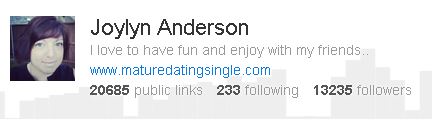
Screen Shot 2013-12-15 at 11.47.33 AMThen I discovered my name had changed on my Delicious account. I use this account to archive my tweets & tags for what I share on Twitter, so I was surprised to find my new found love for “fun and enjoy with my friends” while advertising mature dating single websites:

Delicious HackThis was quickly fixed within hours thanks to the Delicious Team, and I’m back to my normal nerdy self on this social bookmarking website:

Screen Shot 2013-12-13 at 9.03.00 PM

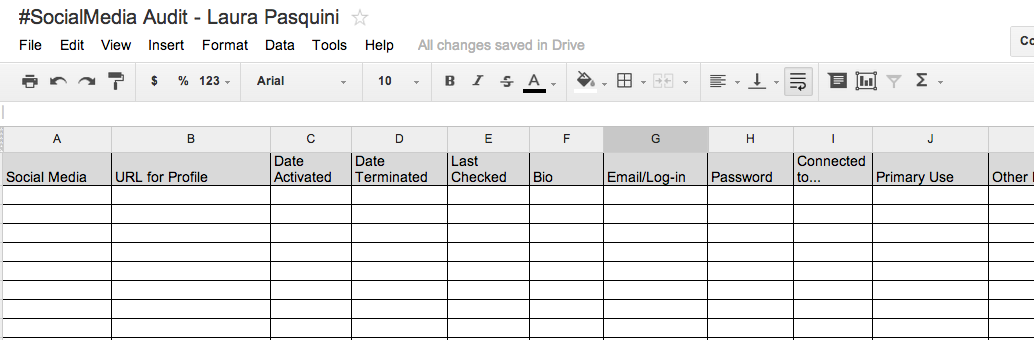
This incident reminded me it was time to review my social media spaces to see what I use and what I need to lose. It is easy to take advantage websites like JustDelete.me to kill off your pages; however I wanted to take stock of what I am using and document how I am using it. To assess my digital footprint and identity, I started my own social media audit spreadsheet o’ fun with the following columns:

  • URL for the profile
  • recordupdate passwords
  • review account settings (privacy)
  • date activated
  • date terminated (if deleted or archived)
  • verify information is correct
  • update bio, picture, etc.
  • review platform access & connections
  • assess unused or less accessed social media spaces to delete
  • identify how these social media platforms are being utilized

Screen Shot 2013-12-15 at 12.50.53 PM

Have you conducted your own social media audit lately? If so, how have you review and cleaned up your online accounts on your various social media platforms? How do you keep track of what social media spaces you use? Please share any tips & tricks. Thanks!