Higher Education, Social Media, StudentAffairs

Reflecting on Values & Identity from #Dalton13

Over the past few days at the 2013 Dalton Institute, I have been encouraged to think about the cross-section of how our cultural norms, use of technology, and institutional practices intersect to support students. Educational reform for higher education is not new; however it was refreshing to have a group of graduate students, faculty, scholars, and practitioners to be part of a thoughtful collective to think deeper about these challenges.

Although the institute’s focus was self-promotion, social media, and student development, it was great to hear a number of conversations emerge about the disruptive forces and potential opportunities to embrace change in Student Affairs. The philosophical narratives and analysis of technology’s impact on identity was enriched by listening to personal perspectives and such varied experiences.
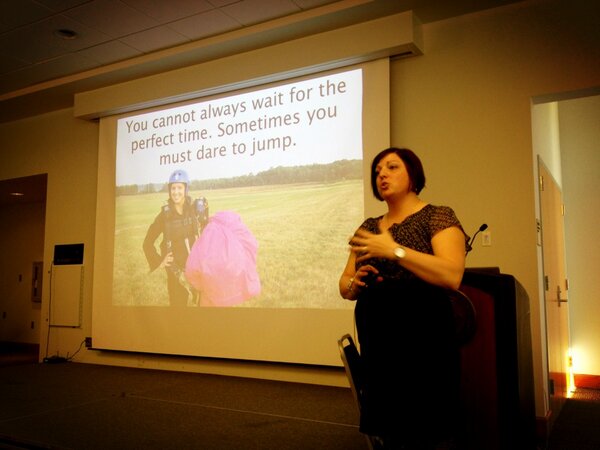
Dare to Jump

Photo c/o @DaltonInstitute {Thanks @vanessaballer!}

As the final keynote of the institute, I gave my “triple threat” perspective as a student, instructor, and professional in higher education. My goal was to share ideas and practices to develop a richer learning experiences; specifically ones that I have valued as an active scholar. So, doing my best to follow the amazing #dalton13 featured speakers – I shared my own narrative, critiques, and insights on how emerging technology can support and challenge student development. I gave some tangible examples and ideas of how to move beyond the gadget, application, or “next big tech thing” by considering ways educators can be actively pushing their learners. I talked about everything from exploration to collaboration, specifically by empowering students to be part of the solution to our institutional challenges.

My #Dalton13 Keynote – Notes & Then Some! (thanks for the photos & tweets #dalton13 backchannel!)

I appreciated the conversations (although some were far too brief!) around identity and student values that  I had with a number of #Dalton13 attendees, especially the FSU HESA graduate students. Although a number of ideas were shared at the institute, I am still left thinking and reflecting about these key questions:

  • How are student values demonstrated in a digital environment?
  • Can educators have an impact on the character development of learners?
  • Is student development really impacted by technology? How so?
  • Does there need to be a shift in how we support our student population on campus?
  • How can our graduate programs do a better job of challenging and supporting scholar-practitioners with “self-promotion” questions?
  • Will higher education cultural norms and institutional practices be changed, or will we be left behind?

#phdchat, PhD, Professional Development

Have Conferences, Will Travel

Apparently when it rains, it pours – for conference proposal acceptances, that is. Since this semester is light on course work, heavy on dissertation proposal research, and I have a amazingly supportive supervisor/department, I will be fortunate enough to be able to attend a few conferences this term.

Laura Pasquini Where is Shee

Here is the rundown for my tentative CONFERENCE travel schedule:

Dalton Institute 2013 http://studentvalues.fsu.edu/2013-Dalton-Institute
Florida State University, Tallahassee, FL  January 30-February 2nd   Follow: #dalton13 Invited Keynote: Student Development 2.0: Optimizing Social Media to Connect Your Campus

AHRD Conference http://www.ahrd.org/ 
Washington, DC   Feb 13-17, 2013
Abstract paper: “A Review of Theoretical Frameworks Explaining Formal Mentoring Relationships”; Thanks to my co-author Mariya Gavrilova-Aguilar who will be presenting

iConference 2013  http://www.iconference.ischools.org/iConference13/2013index/
@iSchools & UNT Host, Fort Worth, TX   February 12-15, 2013  Follow:#iconf13   Our #UNT Social Media Expo team (Andrew Miller, Leila Mills, Mark Evans & I) qualified for the grant from Microsoft Research FUSE Labs on our paper: “Towards a Methodology of Virtually Augmenting a Knowledge Sharing Community of Practice: A Case Study of the Local Food System of Denton, Texas”

South by Southwest (SXSW) Education Conference & Festival http://sxswedu.com/
Panel Discussion: Social Media in Higher Ed – where are we going? with @Bcroke, @tjoosten, & @bradpopiolek
Austin, TX  March 4-7, 2013  Follow: #sxswEDU


Emerging Technologies for Online Learning – Sloan C http://sloanconsortium.org/conference/2013/et4online/welcome
Las Vegas, NV   April 9-11, 2013   Follow: #et4online                               @et4online Conference Planning committee; graduate student instigator


Futures of Academic Publishing: UNT’s 4th Symposium on Open Access https://openaccess.unt.edu/symposium/2013

May 30-31, 2013   Dallas, TX


NACADA 2013 International Conference http://www.nacada.ksu.edu/Events-Programs/Events/International-Conference.aspx
Maastricht, Netherlands   June 5-7, 2013
Workshop: Communication 2.0 Plans: Effectively Engaging Students Online
*Possible poster and panel session involving the #AdvTech survey and Social Media in Higher Education research.*


10th Annual Sloan Consortium – Blended Learning Conference & Workshop http://sloanconsortium.org/conference/2013/blended/welcome 

Milwaukee, WI    July 8-9, 2013


Invited Workshop: Supporting Blended Learner’s Need to Develop Social and Connected Skills Through Digital Pedagogy

Let me know if you will be attending, presenting, or frequenting any of the above conferences. I expect to meet up with the usual [professional/scholarly] suspects I collaborate with, and I look forward to new colleague connections and learning during this conference season.

G*STEP, Professional Development

G*STEP: Graduate Student Teaching Excellence Program

As part of the “Professional Development” section for my portfolio requirements (in lieu of comprehensive exams, I will defend a professional portfolio in order to become a PhD. Candidate before the semester over – I will blog about this in the near future), I am completing a variety of professional workshops, pre-conferences, colloquiums, and training events in my field to enhance my doctoral course work. I was just accepted to the Graduate Student Teaching Excellence Program (G*STEP) program, with approximately 85 other University of North Texas graduate students, who will complete the G*STEP certificate over the next 12 months.

As indicated by the image, the goal of the G*STEP program is to initiate mentoring, encourage personal growth, and support effective teaching and learning practices for graduate students. This non-credit certificate program was developed by the Toulouse Graduate School, the Center for Learning Enhancement, Assessment, and Redesign (CLEAR),the Provost’s office, Undergraduate Studies, UNT Libraries, and the UNT Program of Higher Education to promote effective teaching in higher education at UNT.

UNT would like to reach their FOUR BOLD GOALS for teaching effectiveness, which can be grouped into these three key factors:

  1. Providing organized and clear instruction that contributes to understanding and promotes learning
  2. Creating a learning environment that is inclusive, respectful and engaging
  3. Guiding and encouraging self-directed learning resulting in a wider understanding and contribution to the learning process.

Although I already have teaching experience, in both the K-12 and higher education classroom, I thought the G*STEP program would improve my instructional craft, enhance my pedagogical methods, and connect me to other graduate students in various disciplines – to learn about their teaching practices, challenges and resources. The only cost to the program is purchasing Teaching Tips: Strategies, Research, and Theory for College and University Teachers and committing my time/effort to the program for the duration of the twelve months.  As I plug through the online modules (8 total) and face-to-face meetings (6 total), I will be sure to share my contributions, reflections and progress here.

Higher Education, Professional Development

The Productive & Disruptive Innovation of EDU

The Innovator’s DNA: Mastering the Five Skills of Disruptive Innovators, identifies key behaviors to find innovative solutions to impact organizations, products, and services. Christensen and Gregersen (2011) share five skills that leaders need to innovate their way out of problems and into opportunities:
  1. Question – ask challenging questions that take on common wisdom to create new directions
  2. Observe – watch the behavior of customers, suppliers and competitors the way an anthropologist would identify new ways of doing things
  3. Network – talk to people with different life experiences and perspectives to spark new ideas
  4. Experiment – construct interactive experiences and build prototypes to provide unorthodox responses and gain new insights
  5. Associate – draw unexpected connections between questions, problems or ideas from unrelated fields
In education, both K-12 and higher ed, we need to spend a more time mastering these disruptive skills and improving our productivity. By adding these tools, educators will be able to consider different possibilities to support our learners and find new solutions to educational issues. This new approach to education requires innovation, organizational collaboration, and teamwork on the fly. It’s great to see that there are innovative ideas brewing, such as #change11,  BigIdeas and #EmergentEDU.
How are YOU using these 5 disruptive skills for education?
Collaboration, nacada, NACADA Tech, Professional Development, web 2.0

NACADA Region 8 Technology Seminar

Kudos to Eric Stoller for kicking of 2010 with NACADA Region 8 Technology Seminar in Seattle, WA. It’s been a while since the 1st #NACADAtech seminar, and it was good to be part of the technology in advising action.

Eric asked if I would like to contribute, and I gladly wanted to join in the fun. Last Sunday, I presented (virtually) a session for academic advisors interested in  collaborating with wikis. Skype’s screen sharing application made getting involved in this session cost-effective and simple. 🙂

There was a lot of information packed into this day & 1/2 seminar, but I could tell by the Twitter feed & comments in the session that many ideas were sparked & I could tell the wheels were spinning. It’s great to connect with other advisors to get some inspiration and share thoughts about best technological practices for the advising profession.