Higher Education, Social Media, StudentAffairs

Reflecting on Values & Identity from #Dalton13

Over the past few days at the 2013 Dalton Institute, I have been encouraged to think about the cross-section of how our cultural norms, use of technology, and institutional practices intersect to support students. Educational reform for higher education is not new; however it was refreshing to have a group of graduate students, faculty, scholars, and practitioners to be part of a thoughtful collective to think deeper about these challenges.

Although the institute’s focus was self-promotion, social media, and student development, it was great to hear a number of conversations emerge about the disruptive forces and potential opportunities to embrace change in Student Affairs. The philosophical narratives and analysis of technology’s impact on identity was enriched by listening to personal perspectives and such varied experiences.
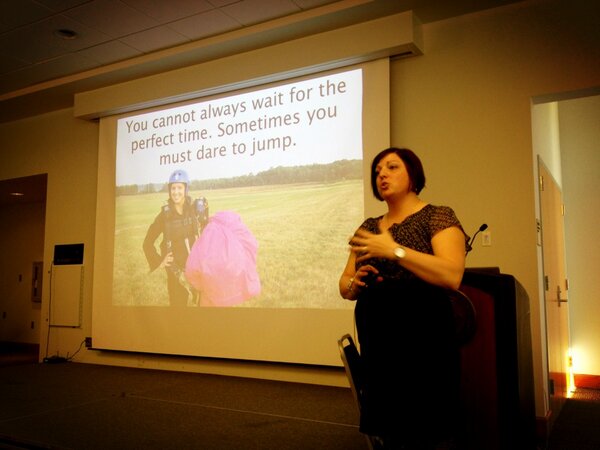
Dare to Jump

Photo c/o @DaltonInstitute {Thanks @vanessaballer!}

As the final keynote of the institute, I gave my “triple threat” perspective as a student, instructor, and professional in higher education. My goal was to share ideas and practices to develop a richer learning experiences; specifically ones that I have valued as an active scholar. So, doing my best to follow the amazing #dalton13 featured speakers – I shared my own narrative, critiques, and insights on how emerging technology can support and challenge student development. I gave some tangible examples and ideas of how to move beyond the gadget, application, or “next big tech thing” by considering ways educators can be actively pushing their learners. I talked about everything from exploration to collaboration, specifically by empowering students to be part of the solution to our institutional challenges.

My #Dalton13 Keynote – Notes & Then Some! (thanks for the photos & tweets #dalton13 backchannel!)

I appreciated the conversations (although some were far too brief!) around identity and student values that  I had with a number of #Dalton13 attendees, especially the FSU HESA graduate students. Although a number of ideas were shared at the institute, I am still left thinking and reflecting about these key questions:

  • How are student values demonstrated in a digital environment?
  • Can educators have an impact on the character development of learners?
  • Is student development really impacted by technology? How so?
  • Does there need to be a shift in how we support our student population on campus?
  • How can our graduate programs do a better job of challenging and supporting scholar-practitioners with “self-promotion” questions?
  • Will higher education cultural norms and institutional practices be changed, or will we be left behind?
Higher Education, Reflections, StudentAffairs

A Kinder Campus to Collaborate

Be KindThere are a  number of students, staff, and faculty in my life who I have gotten to know along my academic and professional journey – as colleagues and as friends. I have been fortunate enough to experience college/university life as a student, professional, and instructor  at various types of institutions and in more than one country.  Each new experience has afforded me to work with insightful colleagues, learn about effective practices, understand a variety of student populations, and consider innovative ways to  support students, staff, and faculty.

In a recent Inside Higher Ed article I shared my thoughts on why our divisions in higher education need to think beyond their own areas. Some of the challenges ahead in higher education will require our departments/divisions to step our of their silos to collaborate and reach shared goals for our institutions. It does require some risk; however I think there are larger rewards for reaching out and conversing with others. In considering some of the opportunities and challenges in higher education – such as financial, legislative, staffing, and more – perhaps it is just the right time to sit down to chat and connect to others on campus. Institutional units will need to put their heads together to think creatively and collectively about some of these issues – if they are not doing so already. 

Over the last few weeks, I have been thinking about what a “kinder campus” means in higher education. I am currently participating in a Collaborative Learning Community (CLC) at UNT that brings students, staff, and faculty together to work towards a shared solution to a problem/challenge at our institution [more to be shared on this later]. Since we have diverse representation on this CLC, as the co-chair with another faculty member we have been considering the following needs to keep our group moving forward:

  • introductions are important – find out what everyone “does” on campus
  • use common language and define terms
  • establish purpose and goals for the CLC
  • share and distribute information/facts that are not known
  • establish a meeting time/day of the week
  • create agendas to guide, not limit the conversation/sharing
  • record meeting minutes for those who might be absent
  • online space for resource sharing 
  • flexibility and understanding for attendance is a must
  • define roles to guide actionable items & project initiatives
  • bringing food/treats is never a bad thing

Although cross-departmental meetings can be challenging, as it requires stepping outside our own domains and sharing across disciplinary boundaries, I have had some of the most productive conversations and ideas to emerge from these gatherings.


Are you part of a collaborative working group at your higher ed institution? What tips do you have to “be kind” and connect with colleagues outside your division/department?

Reflections, Social Media, StudentAffairs

#Dalton13 – Google + Interview & Keynote Teaser

Thanks so much to the Dalton Institute (@DaltonInsitute) coordinators, Jessica Dean (@j_deanSAys) & Emily Fox (@EmilyFox526), for hosting my Google + Interview on Tuesday (1/9). I appreciate the great questions from the both of them, and the #Dalton13 backchannel. Everyone really made me reflect and ponder my own technology and student development path – so thanks!


In watching the video recording (which I rarely do), it helped me think more about my talk and how to best shape the focus. Here’s a sneak peak at my #dalton13 keynote title and abstract, for those of you who will be attending the session on February 2nd:

Here is my 2013 Dalton Institute Character Clearinghouse Interview and a preview to my keynote next week:

Title: 

Student Development 2.0: Optimizing Social Media to Connect Your Campus

Abstract: Today’s college student operates in a world that is informal, networked, and filled with technology. Digital interactions are influencing both our students’ characters and values, with increasing access to information and continual contentedness  With the emergence of social web resources, student development professionals and faculty have the ability to engage in experiential and applied learning objectives for their campus environments. Social media creates a space where “everybody and anybody can share anything anywhere anytime” (Joosten, 2012, p.6). Educational paradigms are shifting to include new modes of online and collaborative learning and student-centered, active learning to challenge our students to connect curriculum with real life issues (Johnson, Adams & Cummins, 2012). As new generations of students create and share content on campus, college educators need to realize the potential social media has to construct a culture of participatory, open learning. Emerging technology platforms and devices are beginning to disrupt higher education as we know it. To co-evolve and positively impact our learners’ success, it is critical that we consider the influence and impact social media has on our student populations. This keynote plenary will share ideas and suggested practices to develop a richer learning experience to help students thrive in the changing digital frontier.

References

Johnson, L., Adams, S. & Cummins, M. (2012). The NMC Horizon Report: 2012 Higher Education Edition. Austin, TX: The New Media Consortium.

Joosten, T. (2012) Social media for educators. San Francisco: Jossey Bass.

#phdchat, Learning Technologies

CFP: Emerging Technologies for Online Learning Conference #et4online

The 6th Annual International Symposium for Emerging Technologies for Online Learning (#et4online) from April 9-11, 2013 (Planet Hollywood Resort – Las Vegas, Nevada) wants YOU to submit a conference proposal. Proposals are DUE by 11 pm CDT on December 10, 2012

The Emerging Technologies for Online Learning International Symposium, a joint Symposium of Sloan Consortium and MERLOT, is designed to bring together individuals interested in the review and evaluation of emerging technologies’ impact on online teaching and learning.

The 2013 Emerging Technologies Symposium chairs know technology for learning is shifting quickly:

“New discoveries in technology happen rapidly and far too frequently. It is difficult to keep up with every new release or innovation.  Advances in technology often become the vehicle for new ways to learn or enhance learner opportunities in our classrooms. As educators we progress forward, gaze back, and aim to bring the best of old and new to create an optimal environment to our students. However daunting this mission is, we tackle the problems and learn best from those who are already building the bridges and taking on the tasks we want to try. The field is advanced by those who share, scrutinize, and study. We invite you to contribute to the progress by presenting and attending this year’s symposium and encouraging your colleagues to join our efforts.” 

The #et4online steering committee is interested in interactive sessions that engage and inform participants for the following areas:

  • Higher Education and K-12 Faculty
  • Future professors and graduate students
  • Educational technology leaders
  • Students
  • Instructional designers
  • Instructional technologists
  • Academic administrators

Sessions can be targeted to all attendees and or specified (novice, intermediate, or expert) levels of proficiency. The committee would like to see a wide range of involvement from various presenters/facilitators – this includes proposed sessions from graduate students TOO!

The #et4online symposium will accept presentations that offer attendees “real solutions,” pioneering practices, and future trends, specifically submissions which emphasize evidence-based practice and the impact of topic tracks on teaching practices and student learning outcomes using a range of research methodologies (e.g. case study, longitudinal comparisons, within group comparisons, quasi-experimental, etc.) and rigorous approaches to the analysis of supporting data, qualitative or quantitative. Here are the #et4online symposium tracks and research areas:

Here is the presenter FAQs and Webinar Recording from 11/29  to help you with your proposal submission: 5 Tips on How to Submit a Successful Conference Proposal

There will be a wide range of emerging technologies for online learning trends, talks, sharing, and more! What happens at #et4online in Vegas will NOT stay in Vegas. And that’s a good thing! Follow @et4online for more updates as well!

Social Media, StudentAffairs

Guiding #SocialMedia in Our Institutions [SURVEY]

Many of you might know I am interested in researching, working, teaching and socializing with social media in higher education — so it is only fitting that I want to assess HOW social media is being used within organizations. Dr. Tanya Joosten (@tjoosten) and I are collaborating to research this topic further; however WE NEED YOUR INPUT.  Please share your insights/experiences for Guidance for Social Media at your Institution [SURVEY] before Sunday, October 28, 2012 12 am PST

COMPLETE THE SURVEY HERE => Guiding social media in our institutions

Study Focus:

To better understanding what our institutions need to consider in guiding social media use, specifically around the questions which address student support, teaching, training and development, research, policy, infrastructure, and more. Please consider contributing to this study to help advance social media use and development at our institutions – AND both Tanya and I would greatly appreciate YOUR input. Thanks!

Study Description:  The purpose of this research study is to examine institutional support for the implementation for social media. Approximately 200 subjects will participate in this study.  If you agree to participate, you will be asked to complete a survey that will take approximately 30 minutes to complete.  The questions will ask you for your opinion on institutional support for the use of social media.

Risks / Benefits:  Risks to participants are considered minimal.  There will be no costs for participating, nor will you benefit from participating other than to further research. 

Confidentiality:  Your responses are completely confidential and no individual participant will ever be identified with his/her answers.  Data from this study will be saved on a password-protected computer for one year.  Only Primary Investigators and UWM Learning Technology Center staff will have access to the information.

Voluntary Participation:  Your participation in this study is voluntary.  You may choose to not answer any of the questions or withdraw from this study at any time without penalty.  Your decision will not change any present or future relationship with the University of Wisconsin Milwaukee.

Who do I contact for questions about the study:  For more information about the study or study procedures, contact Tanya Joosten at tjoosten@uwm.edu.

A few tips and more information about the survey:

  • Please answer any of the questions for which you have an answer.
  • If there are questions you cannot answer,  please skip those questions.
  • Due to the broad and general nature of the survey, we understand that there may only be a limited number of questions each respondent can answer.
  • This survey structure has a number of open-ended questions that require a response, URL link, or ideas about social media at your institution.
  • When possible, please forward the survey to others in your institution AND outside your institution that may be able to answer these questions.