
#AcWri, #phdchat, Professional Development

A @PhD2Published Post: A Book Review is #AcWri Too

This blog post is cross-posted at http://www.phd2published.com/. Thanks for the invite to write, @dratarrant.

For graduate students and junior faculty, book reviews can be a way to dip your toes in the publishing realm of academic journals. Although peer-reviewed articles are the pinnacle for publishing and tenure, I do not think academic book reviews should be scoffed at. A book review is a great way to engage, comment, and contribute on a colleague’s work in the field. More importantly, a refereed journal publication review can be a fun piece to hone your writing, develop your analytic reading skills, and provide interesting insights for your fellow researchers to read.

Image c/o EricLanke

The process of writing a book review encourages academic researchers to engage in the literature. Often, the practices of summarizing chapters and restating ideas provides the book reviewer how to read a book to understand the author’s key points. A great book review will weave the text into the current academic subject.

Here are some general guidelines for book reviews I have seen in academic journals and suggested practices from those who are writing #acwri book reviews:

  • Read – Check out book reviews in journals that you might be interested in publishing in 1st. See what books are being selected for review & check out the format/style.
  • Good Publications to Review – Find a book that highlights issues or resources relevant to the field and/or subject of the academic journal you are submitting to
  • Describe & evaluate– focus on the book’s purpose, contents, format,  and authority
  • Not Just a Summary – Positions and opinions should be supported with a logical argument and review the pertinent literature. Highlight strengths and weaknesses of the publication, and why this book is interesting and/or useful.
  • Be constructive with your criticism. Remember to be kind and respectful to the author(s). A great deal of effort on the author, editorial board, blind review, etc. has been put into this text. Choose to be constructive with your criticism.
  • Provide your thoughts on the book – use quotes sparingly. Readers will be interested in what YOU have to say.
  • Share key ideas. What is the main idea of the work? What does this publication contribute to the field?
  • Review Your Review – try to read from the vantage point of your audience. Is there too much/enough summary? Does your argument or key thoughts about the text make sense?

Typically academic journals will accept book reviews for publications that have been released within the year that highlights issues or resources relevant to that journal topic, genre, or field. If you are lucky, some journals might even purchase the book for you to review. It would be important to select a text that would offer solutions or directions to the field, and it would be helpful to verify with the editor if the publication would be appropriate to review.  Sometimes, journals will give preference in the review process to book review essays that comment on two or more related books

In thinking about the book review requirements for the Learning and Performance Quarterly journal, I took a gander at a number of scholarly sources that published book reviews. Here are some of the common technical requirements* for academic book reviews:

  • Reviews of publications within the recent year, i.e. 2011 or later would be acceptable now
  • Include the title, author(s), year, publisher, publisher location, ISBN, cost, book format, and page numbers of the book(s) under review.
  • Keep it simple. Typically book reviews are between 600 to 2000 words (unless you are reviewing a period or series of books).
  • An abstract of 150 words or less might be required to accompany the book review.
  • Draft a short biography and/or contact information to be included at the end of your book review.
  • *Follow ANY and ALL other book review requirements for your specific journal of choice.

Happy #acwri reading & reviewing!
#phdchat, Learning Technologies, LPQ

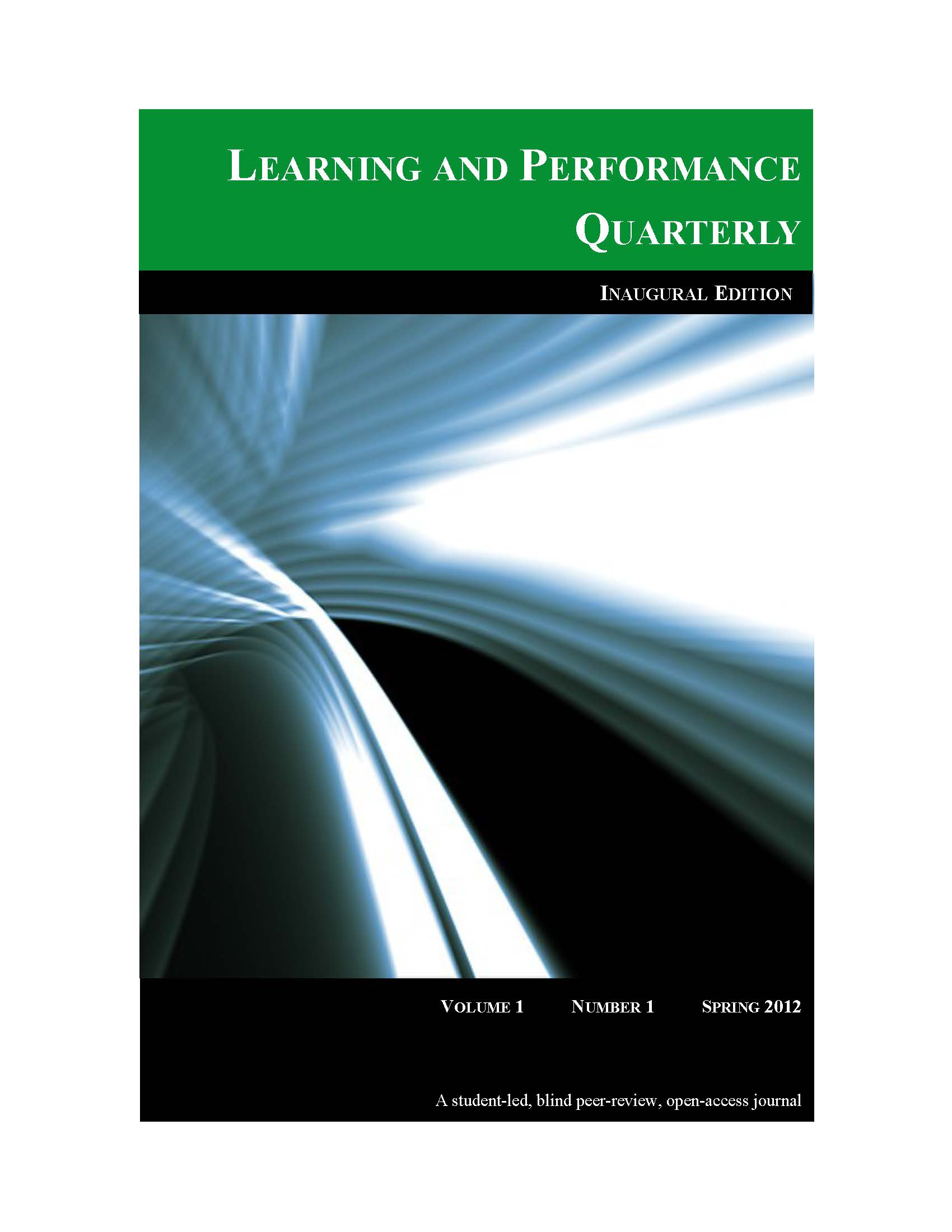
Announcement: Learning and Performance Quarterly First Issue Published & Call For Submissions for Issue No. 2

THE LEARNING AND PERFORMANCE QUARTERLY (LPQ), 1(1) FIRST ISSUE IS NOW PUBLISHED!

Thank you to the number of authors, reviewers and editors who helped contribute to the first open, access online Learning and Performance Quarterly journal. Please read and share with colleagues and researchers who might be interested:

Learning and Performance Quarterly, 1(1)

CALL FOR PAPERS: LPQ, 1(2)

The Learning and Performance Quarterly (LPQ) is currently accepting submissions for the second issue. Deadline for submissions is Friday, June 15, 2012 at 11:59 pm CSTSubmission of manuscripts can be made online through the LP Quarterly website via the Open Journal System.

TYPES OF MANUSCRIPTS ACCEPTED

Research Papers :

Papers that are concerned with the various approaches to learning and performance impact. These papers should discuss the literature related to the approach employed and include a measure of the learning and performance impact of the approach employed.

Case Studies:

Case studies that highlight a particular learning, training, performance or instructional setting in which learning and performance resources were used to address a particular challenge. They present a discussion of the challenge from current literature, what was done to solve or explore it, and the results of the project. They often offer suggestions for others interested in addressing similar challenges.

Concept/Theory Papers:

Papers that present new concepts or contribute to existing theory for learning and performance. This should offer a discussion of the literature related to the concept/theory along with a discussion of the major issues for future research needed to validate the concept/theory.

Book Reviews:

Book reviews of publications 2011 or later will be accepted to highlight a issues and resources relevant for learning and performance and offer a suggested solution or direction. The position is supported with both a logical argument and a review of the pertinent literature. Preference will be given in the review process to book review essays that comment on two or more related books.  Book review essays should not exceed 3,800 words and should include city, state, publisher, and year of the book’s publication.  An abstract of 150 words or less and keywords are required for book review essays.  Reviews of single books should not exceed 1,900 words.  At the beginning of the text please include title, author, publisher, city, date, and page numbers of the book(s) under review.

The deadline for submissions is Friday, June 15, 2012 at 11:59 pm CST. For detailed submission guidelines and instructions on how to make a submission please visit Author Guidelines.

CALL FOR LPQ REVIEWERS

Interested in reviewing articles for the LPQ Journal? The LPQ journal is looking for reviewers to conduct peer reviews and evaluations of submissions.

Please identify your reviewing interests, substantive areas of expertise, and preferred research methods when completing the LPQ journal registration online.

We look forward to receiving your submissions. Please pass this post onto other colleagues and researchers who might be interested in publishing, reviewing or editing for the Learning and Performance Quarterly journal.

Thanks!

Laura Pasquini & Jeff Allen, Founding Editors

Learning and Performance Quarterly

Like us on Facebook

Follow us on Twitter @LPQuarterly

Email: LPquarterly@gmail.com

Higher Education, Open Education

Open Access For All #oa12unt

Yesterday, I attended the 3rd Annual Open Access Symposium at UNT (#oa12unt). It was a full day of talking about open data, sharing research and collaborative efforts and examples in #highered. The open access process is not as simple as you think. It was interesting to hear from researchers, academics, librarians, industry partners, and data managers about what it means to be “open” and accessible for others. Here are a few open notes I took and a Storify I curated from the day.

I think the concluding remarks (and other notes) made by Brian Schottlaender (@ucsdBECS) helped to summarize the key points that were  both said and were not said during the day, including the following topics:

  • Data Preservation
  • Data Aggregation
  • Attribution
  • Citation
  • Publication
  • Data Ecology
  • Peer Review
  • Discovery & Delivery
  • Data Governance
  • Exhortations to Librarians

These final thoughts left me questioning about how higher education will engage in open access and consider what academic tenure/promotion will look like in the future. The open movement is present in my learning network, among the Social and Open Educators like @courosa and academic contributors who want to End Knowledge Cartels in publication such as @academicdave, There are many open and transparent academics/educators contributing to the open movement – but there needs to be more. And more importantly, academic institutions need to recognize and accept open scholarship.

I know the #oa12unt symposium lit the fire for me to finish the layout and publish the first issue of the Learning and Performance Quarterly. This student-lead, open access  journal is an open access publication that I am proud to edit and coordinate with a phenomenal group of reviewers and a great editorial team. The inaugural issue was JUST published online today, and is available for your reading and sharing pleasure HERE.

What have you done openly lately in #highered? Please share.