StudentAffairs

A.M.A. (For Real) on the @SAreddit Series

Not sure completely why, but I was asked to join the new @SAReddit Ask Me Anything (AMA) Reddit Series…so I thought, why not?

reddit_logo_Startup_620x350

As a frequent reader of Reddit threads, I figured it might be just the time to play in the “r” sandbox. There are a few lively and talkative communities sharing links, comments, and ideas in this space. If you have never used Reddit, have I got the “HOW TO” guide (or two) for you.

As for AMA, these Q & A discussions are often set up for celebrities, politicians, deans,  and the like.  Since I don’t fall into any of these categories, I will just assume this Q & A will take on my “ASK AN ADVISOR” role to discuss my varied experiences with academic advising, career counseling, doctoral/dissertation life, learning technologies, higher ed, organization/community research, and so on. Want to know more about my rogue experiences in student affairs? Interested in getting connected to the field of advising? Considering a PhD for yourself? Want to know how to balance school, work, and play in higher ed? I might have a few answers for you on the AMA Laura Pasquini thread on Monday, June 9, 2014. Post a QUESTION here:
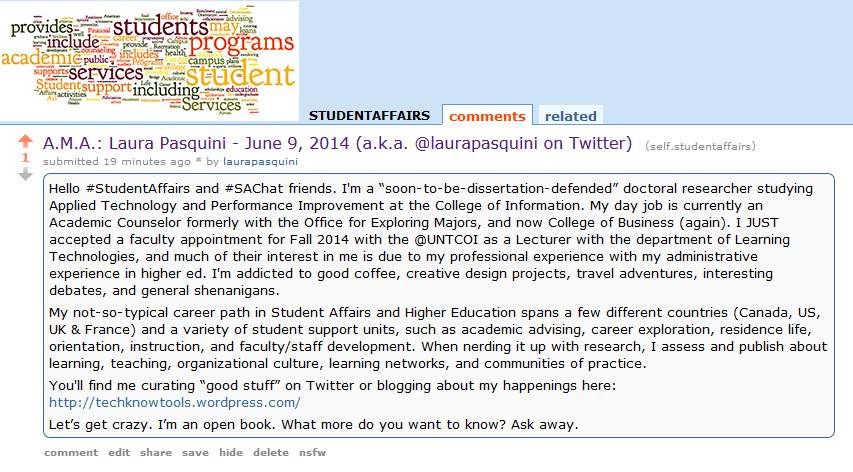
AMA
Click here to ask questions, comment, or add snark:

http://redd.it/27hehe

Want to know more? Follow the conversation on the studentaffairs Reddit. Subscribe to  /r/studentaffairs to ask questions, share resources, or just talk and socialize with other SA professionals! Please grow the community by sharing with your friends & colleagues.

Here’s the AMA studentaffairs Series line up for future dates with more to come from the moderators Nate, @JennaMagnuski, and Dan:

June 9 – Laura Pasquini, Academic Advisor, NACADA board member, and EdTech Champion

June 16 – Kasandrea Sereno, college success counselor and academic advisor, with past work in admissions, orientation, housing, greek life, and first year experience

June 23 –

June 30 – Jenna & Nate Magnuski, Live-in student affairs parents

July 7 – Stacy Oliver, Associate Director of ResLife at Lake Forest College & GLACUHO president

July 14 – Tom Krieglstein, Mastermind of Swiftkick & Founder of various digital communities (including #sachat)

July 21 –

July 28 – Leah Westcott, Editor-in-Chief of Cronk News

August 4 –

August 11 – John Wesley Lowery, scholar in student conduct/higher education law & history of higher education, chair of IUP’s SAHE program

Who do you want to participate in an AMA? Let @SAreddit and @JennaMagnuski know! Or post a comment below. 🙂
Dissertation, Social Media

Policing Social Media in Higher Ed: Implementing Policies on Campus

During the course of my dissertation research, a few events connected to the scope of my study, and directly to the social media documents I was gathering.  I ended up building a database of 250 post-secondary education (PSE) institutional guidelines and policies to completely understand HOW the PSE sector is ACTUALLY  “guiding” social media. More importantly my research uncovers the organizational identity and cultural values of social media among 10 different countries. {More to be shared post dissertation defense June 12, 2014.}

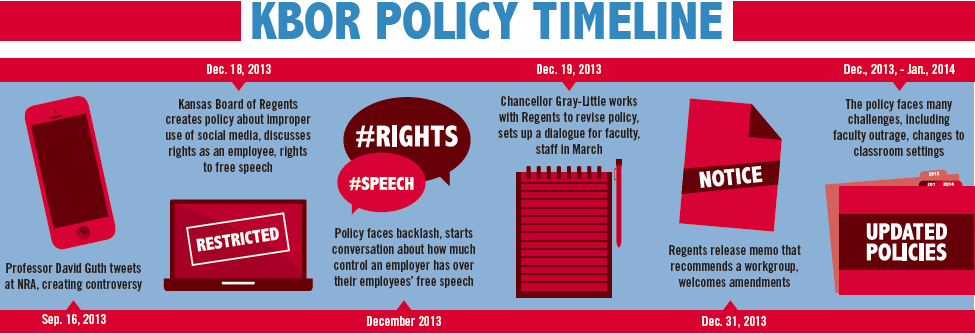
If you are interested in either research around policies and/or social media impact to organizations, specifically post-secondary education, then you most likely heard about the Kansas Board of Regents approval to amend their policy manual back in December 2013 to outline “improper use of social media by University of Kansas faculty.” If not, I have an article and infographic of the timeline of events for you:

KBOR Policies

Image and article credits from The Daily University Kansan ().

Concerns about social media use have been a continual debate and topic for higher education for at least a decade. There have been challenges to using social media accounts for “official” use, faculty blogging, HR employee regulations, or just a general “need” for increased policy implementation among a number of colleges and universities.  The PSE sector is not alone. The K-12 sector and other industries also are keen to social media polices around use and sharing for their stakeholders.

All THAT being said, I have a few questions for you:

  • HOW does (or will) a social media policy influence and impact your institutional culture?
  • Does (or will) your social media policy support your student services or research at your organization?
  • What goals and outcomes do you (or will you) achieve by implementing a social media policy on campus?
  • Does your (or will your) policy consider helpful guidelines, suggested practices, and/or training and development?
  • How does (or will) your social media policy be implemented with regards to teaching, service, and research scholarship?

Or is your PSE concerned with communication control and organizational management?  I would hope your institution of higher learning does not limit user interaction, community engagement, or general opportunities to share opinions.

From my dissertation findings, I hope to continue on this thread of research to identify ACTUAL use, related to the social media guideline and policy documents I have studied, to further understand how participation and interactions on these social media channels influence organizational identity and culture on campus. Is your campus listed in my PSE institution sample? Are YOU interested is getting involved in this type of research? Let me know.

Training & Development

Social Media to Support Your Organization

Last week I was invited to participate in the Southlake Chamber of Commerce’s UNT Professional Develop Fridays. I wrapped up the series by discussing how to effectively plan and organize social media resources for to build a community for businesses and organizations in the city.

This workshop focussed on strategies and practical applications of how social media platforms can be utilized to enhance organizations, with regards to:

  • Effective communication and marketing methods
  • Customer engagement and community development
  • Development of a communication strategy to support organizational goals
  • Implementation of social media tools to enhance goods & services

We discussed how their organizations in Southlake could “get social” (Twitter notes from the session: #SocialSouthlake) by connecting business strategies to broader communication plans and community management ideas.

Discussion points from this workshop included:

  • Be an active participant in social media platforms – explore before you plan
  • Set goals that are realistic with social media – pick 1-3 platforms to start with and use them well.
  • Map out a strategic plan for social media implementation (see worksheet) connected with your business plan.
  • Research your community and partners in the industry – get to know your audience and others participating in your potential community
  • Consider methods that build and growth your community offline and online
  • Designate a community manager, or a few to lead your development and planning
  • Identify champions from your community, i.e. individuals who are active participants from within the community, who will support your social media implementation and growth
  • Plan content directly connected to your purpose and mission
  • Effective methods to measure and track progress related to goals


Additional resources from this session can be found here: http://bit.ly/SocialSouthlake

Thanks for the invite @Southlake_CC … be sure to keep it social. 🙂

#phdchat, Reflections

So You’re Thinking About a PhD…

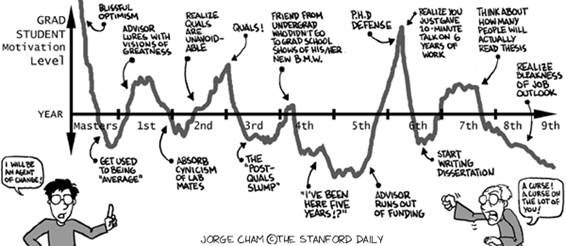
In talking to my exploring major students on campus and other professionals in the field — I often share about my Ph.D. experience and talk about what it means to be a doctoral researcher.  Often I am asked about my Ph.D. program, my line of research, and how “I like it.” I often say I’m too close to it to really give advice, but I’m happy to talk about my experience and answer questions as I can or refer to others.

phd
Last fall at the #nacada13 conference in Salt Lake City, UT, I was part of a doctoral researcher panel on this topic: 
How To Hack Your Ph.D.: Being a Doctoral Student & Academic Advisor and a few #HackPhD Notes on Storify

It was a full house. Not surprised. There has been a growing interest among colleagues interested in pursuing a Ph.D. I am often asked about my Ph.D. research, progress, and if others should get into the same program or even start a Ph.D. To be honest, I am not sure I have the answers to these questions. I am too near the subject right now…

I’ve read a great number of books on the topic of graduate work, Ph.D. survival, writing, publishing, research, and more – but really, it was for my own inquiry and nerdy interest.  Like any good academic/career counselor, I usually ask those interested in a Ph.D. about their own motivations and rationale for the interest in doctoral research.

So you’re thinking about a Ph.D.? I have 10 questions AND prompts for you! I am not sure it will help — but I thought I might as well put these “you wanna pursue a Ph.D.” questions out there others who are considering the Ph.D. track. Take these questions with you as you ponder your Ph.D. goals, research potential graduate programs, apply to potential programs, and, even, start your first semester of your doctorate program:

  • What career goals do you have? List both your short-term and long-term goals in a statement. Write them out, read, and reflect.
  • How does your current work experience (resume/CV) relate to your career goals and interest in a Ph.D. program? Reflect on your relevant experience.
  • How your master’s degree or other educational credentials relate to and support your career goals? Describe your academic experience and background.
  • If you were going to seek out letters of recommendation for your Ph.D. program, who would write your letters of recommendation? Why? What might they say about you? List at least three individuals who would be your academic reference, and consider what they might say about your application to a scholarly program.
  • Do you have any scholarly or peer-reviewed writing samples? If so, please consider how they might be submitted and reviewed by a potential Ph.D. program. If not, what articles or journals interest you in your area. Research!
  • What is your research interest? Often you will have to complete a “Statement of Research Interest” so explain the areas or topics you want to study. If applicable, also consider for research:
      • Any specific theories or models of interest?
      • What seminal work in the field have you read?
      • What will you use to guide your research focus? Authors? Disciplines?
      • What is your preferred research methodology?
      • What is your research methods “worldview”?
  • What will you contribute to the doctoral research and your Ph.D. program? Explain the unique knowledge and skills you will bring into a doctoral program as a potential student
  • What will you contribute to the doctoral research and your Ph.D. program? Explain the unique knowledge and skills you will bring into a doctoral program as a potential student.
  • Where do you want to study? This question is for both geographic location and specific discipline home (e.g. education, sociology, economics, etc.).
  • How will your basic needs be met? Financial, emotional, and social support. It is important to think about your budget, personal relationships, professional objectives, and more when plotting for doctoral work. This will be a few years of your life — so be sure this how you want to spend it. Have this discussion with family, partners, and friends in advance. Be informed about scholarships and funding costs.
  • When is the right time? I doubt this ever has a great answer – but you need to determine this for you after answering the above questions. Decide if the Ph.D. route is right for you, and then if the timing is right or can be right. You can always make it work if you want it. [p.s. Did I say you should WANT to do a Ph.D.? That’s the only way to finish.]
Bonus Question: Who will mentor you through your Ph.D. progress? Faculty advisors at your campus will be great, but who else will you consider as part of your doctoral experience. Peers? Colleagues? Researchers in the field? Scholars, you admire/read?Doctoral candidates and early career researchers? Build your Ph.D. learning network NOW.
#phdchat, Dissertation

Dissertation Boot Camp, Part II

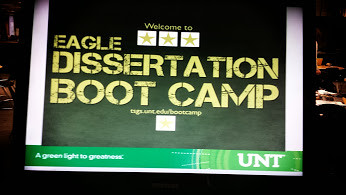
Last week I attended my second Eagle Dissertation Boot Camp. This was a three-day #ShutUpAndWrite session created for UNT graduate students to help us focus our time on our thesis/dissertation projects. My first Eagle Boot Camp was successful as I crafted a great chunk of my dissertation proposal and successfully defended said document in February.

#UNT Dissertation Boot Camp

My data analysis is complete, so my primary objective for this boot camp was to write up and explain the findings (Chapter 4). So, I am happy to report this chapter is almost complete with 28 new pages (which includes some large data graphs). I also spent the time reviewing edits and updates made to Chapter 1, 2 & 3 (my proposal). As many of my doctoral researching friends know — it’s not the page number — you write until you’re finished explaining your research.

I signed up for another boot camp because I enjoy the dedicated space, time, and peer support of these writing groups. Although my morning writing in solitary has been going well, I did appreciate a solid three days of concentration on my dissertation without disruption (texts, emails, etc). During the boot camp I also scheduled a few meetings with my major professor (Dr. Allen) and had a productive meeting with my new my co-chair (Dr. Evangelopoulos) and Dr. A. to review the scope of what I am reporting on for my dissertation. We had a great talk day #1 to review my data analysis, timeline for writing, and inclusions for my dissertation. I am thankful for the time and feedback each advisor has given me over the past few months.

Just like training for a marathon, it is critical to map out a realistic and effective training schedule. In this case, my training  = writing, reviewing, and editing. In planning for August graduation, I have to hit a few upcoming dates set by our graduate school, so my final dissertation defense date is on the near horizon.

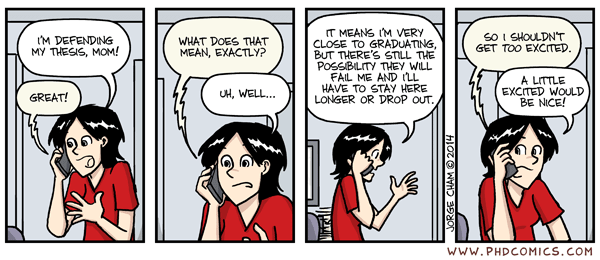
DEFENSEphd040914s

Photo c/o @PhDComics “Defending My Thesis

Dissertation Timeline

Date Task
Toulouse Graduate School Dissertation Boot camp:

Chapter 4: Data analysis review; Drafting updated analysis and findings from data productions

4/20/14-4/28/14 Chapter 5: Drafting concluding chapter discussions, social media guidelines & policy development, further research, etc.
4/28/14-5/5/14 Consult with Faculty advisors and dissertation committee to get feedback on first draft (as needed)


5/6/14 Final dissertation paper and PowerPoint ready – Mock defense with Dr. A & Dr. E
5/6/14-5/12/14 Review comments & feedback from Co-Major Professors; make edits or additions based on feedback

Consult with dissertation committee members as needed

5/12/14-5/20/14 Send to external editor: final edit and polish
5/20/14-5/27/14 Review edits and comments from editor on dissertation paper; adjust as needed
Clean up and prep final defense PPT
5/28/14 Send FINAL DISSERTATION to committee; officially schedule defense date for June 12, 2014
5/28/14-6/11/14 Edit presentation slide deck, meet with faculty advisors; meet with committee members to review/allow for questions
6/12/14 Dissertation Defense
6/27/14 All paperwork due to Toulouse Graduate School & FINAL COPY of dissertation sent to the Grad School Reader

It’s go time. Back to my “training” — write on, my PhD friends. Write on!