Reflections, Social Media, StudentAffairs

#Dalton13 – Google + Interview & Keynote Teaser

Thanks so much to the Dalton Institute (@DaltonInsitute) coordinators, Jessica Dean (@j_deanSAys) & Emily Fox (@EmilyFox526), for hosting my Google + Interview on Tuesday (1/9). I appreciate the great questions from the both of them, and the #Dalton13 backchannel. Everyone really made me reflect and ponder my own technology and student development path – so thanks!


In watching the video recording (which I rarely do), it helped me think more about my talk and how to best shape the focus. Here’s a sneak peak at my #dalton13 keynote title and abstract, for those of you who will be attending the session on February 2nd:

Here is my 2013 Dalton Institute Character Clearinghouse Interview and a preview to my keynote next week:

Title: 

Student Development 2.0: Optimizing Social Media to Connect Your Campus

Abstract: Today’s college student operates in a world that is informal, networked, and filled with technology. Digital interactions are influencing both our students’ characters and values, with increasing access to information and continual contentedness  With the emergence of social web resources, student development professionals and faculty have the ability to engage in experiential and applied learning objectives for their campus environments. Social media creates a space where “everybody and anybody can share anything anywhere anytime” (Joosten, 2012, p.6). Educational paradigms are shifting to include new modes of online and collaborative learning and student-centered, active learning to challenge our students to connect curriculum with real life issues (Johnson, Adams & Cummins, 2012). As new generations of students create and share content on campus, college educators need to realize the potential social media has to construct a culture of participatory, open learning. Emerging technology platforms and devices are beginning to disrupt higher education as we know it. To co-evolve and positively impact our learners’ success, it is critical that we consider the influence and impact social media has on our student populations. This keynote plenary will share ideas and suggested practices to develop a richer learning experience to help students thrive in the changing digital frontier.

References

Johnson, L., Adams, S. & Cummins, M. (2012). The NMC Horizon Report: 2012 Higher Education Edition. Austin, TX: The New Media Consortium.

Joosten, T. (2012) Social media for educators. San Francisco: Jossey Bass.

Higher Education, Social Media, StudentAffairs

How Social Is YOUR Student Handbook, Higher Ed?

Today I contributed to a webinar about student handbooks in higher education for Paperclip Communications. In thinking about my own student experience and searching for other suggested practices, the key question I asked was…Where can I find YOUR student handbook?” Can you answer that question?

Often times college and university policies, procedures, responsibilities, and codes of conduct are buried on the institutional website, masked in “legalize,” and typically struggle to be shared with the target population – the students. I shared a few suggested practices for usability, access, web design, and using social (media) sharing for student codes of conduct. If you missed out, don’t worry – there’s an open & shared Google Doc for that:  http://bit.ly/studenthandbooks

 
I think our institutions need to consider compliance, codes of conduct, and informed legal practices – but more importantly, they need to put these student rights and responsibilities into action. Making our student handbooks social and engaging helps to educate our students, communicate to others at our institution (faculty, staff, etc), and it sets the tone for developing community standards on campus. I recommended involving students in the process of the student handbook development and getting their insight into sharing this information to understand what their needs are, where thy find information, and questions/challenges they have about your student handbook.

Here’s just one example of how UNT Housing & 720 is being proactive with the UNT student handbook information:


How do YOU share information, policy, and guidelines at your institution? Do you have a Facebook Page? Blog? Twitter Account? Please share HOW you share about student rights & responsibilities.

Social Media, StudentAffairs

Guiding #SocialMedia in Our Institutions [SURVEY]

Many of you might know I am interested in researching, working, teaching and socializing with social media in higher education — so it is only fitting that I want to assess HOW social media is being used within organizations. Dr. Tanya Joosten (@tjoosten) and I are collaborating to research this topic further; however WE NEED YOUR INPUT.  Please share your insights/experiences for Guidance for Social Media at your Institution [SURVEY] before Sunday, October 28, 2012 12 am PST

COMPLETE THE SURVEY HERE => Guiding social media in our institutions

Study Focus:

To better understanding what our institutions need to consider in guiding social media use, specifically around the questions which address student support, teaching, training and development, research, policy, infrastructure, and more. Please consider contributing to this study to help advance social media use and development at our institutions – AND both Tanya and I would greatly appreciate YOUR input. Thanks!

Study Description:  The purpose of this research study is to examine institutional support for the implementation for social media. Approximately 200 subjects will participate in this study.  If you agree to participate, you will be asked to complete a survey that will take approximately 30 minutes to complete.  The questions will ask you for your opinion on institutional support for the use of social media.

Risks / Benefits:  Risks to participants are considered minimal.  There will be no costs for participating, nor will you benefit from participating other than to further research. 

Confidentiality:  Your responses are completely confidential and no individual participant will ever be identified with his/her answers.  Data from this study will be saved on a password-protected computer for one year.  Only Primary Investigators and UWM Learning Technology Center staff will have access to the information.

Voluntary Participation:  Your participation in this study is voluntary.  You may choose to not answer any of the questions or withdraw from this study at any time without penalty.  Your decision will not change any present or future relationship with the University of Wisconsin Milwaukee.

Who do I contact for questions about the study:  For more information about the study or study procedures, contact Tanya Joosten at tjoosten@uwm.edu.

A few tips and more information about the survey:

  • Please answer any of the questions for which you have an answer.
  • If there are questions you cannot answer,  please skip those questions.
  • Due to the broad and general nature of the survey, we understand that there may only be a limited number of questions each respondent can answer.
  • This survey structure has a number of open-ended questions that require a response, URL link, or ideas about social media at your institution.
  • When possible, please forward the survey to others in your institution AND outside your institution that may be able to answer these questions.
BreakDrink, CTCX, Social Media, StudentAffairs

#CTCX No. 71: Tech News, Reddit & Updates

On Monday (10/22/12), the @BreakDrink Campus Tech Connection (#CTCX) discussed the latest technology gadget announcements, privacy on the Interwebz and challenges with Reddit, and diving into social media guidance in an upcoming assessment. Here is the video podcast:

And here are the show notes via Storify for your reading and linkage pleasure.

For those of you interested in giving your #SocialMedia Guidance in Education — please take some time to provide myself and Dr. Tanya Joosten (a.k.a. @tjoosten) feedback and information about “Guiding social media at YOUR institution” in a current survey: https://milwaukee.qualtrics.com/SE/?SID=SV_9HmS8C37kqKWyOh This SURVEY will take about 30 minutes to complete, and will close by Sunday, October 28, 2012 at midnight PST. Thanks!

This blog post is cross-posted at BreakDrink.com

#AcWri, #phdchat, Book Review, LPQ, Social Media

Book Review: Social Media for Educators #summerreading

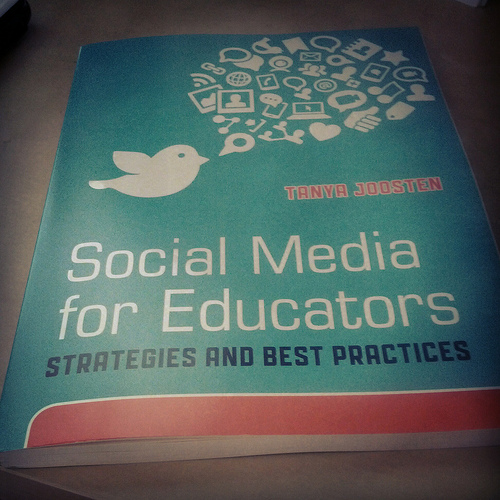
After reading, Social Media for Educators by Tanya Joosten (a.k.a. @tjoosten), I decided to complete an #AcWri book review in the Learning and Performance Quarterly 1(2). Since this journal is online and open access, I thought I would blog a few key ideas and highlights from this #summerreading book. Book Review: Social Media for Educators [PDF]

Abstract: Social Media for Educators is an excellent book that interweaves theory, applications, and current pedagogical experiences for learning environments. For those in the learning and performance industry, this book provides insights and ideas to help guide social media use for both educators and learners. Joosten provides current examples, benefits, and considerations throughout each chapter. Whether educators are beginning to design their learning curriculum or learners are considering social media for organizational development, this book presents helpful insights and experiences that will potentially influence and shape effective engagement and learning with social media.

Keywords: Social Media, Education, Strategies, Practices Although I have previously blogged about strategies for developing social media guidelines — I thought I’d share a few other suggestions for social media engagement from the book. Here are a few ideas, but really I would just recommend reading the book if you’re interested in social media for learning, training or development.

Part One: Background I appreciate how Tanya Joosten lays out the history and evolution of what we now know as social media. Social media is defined by a number of educators and summarized as “A virtual place where people share; everybody and anybody can share anything anywhere anytime” (Joosten, 2012, p. 6). Social media encompasses Web 2.0 tools, social networking sites, and user-generated content where individuals engage and contribute to these digital spaces. This section introduces readers to how social media is being used to build a network, establish support systems, and grow relationships among peers. There are a number of examples where professionals can “get their feet wet” for using social media for professional/personal use. Finally, this section wraps up with implementation considerations and identifying the following pedagogical needs (Joosten, 2012, p. 30):

  1. Increasing communication and contact
  2. Engaging students through rich, current media
  3. Gathering and providing feedback
  4. Creating cooperative and collaborative learning opportunities
  5. Providing experiential learning opportunities

Part Two: Social Media: What to Do With It? I enjoyed how this section of the book presented practical case studies and useful ideas for social media communication and instructional design. The examples and “how to” guides for using social media are very helpful when considering how to enhance the learning environment. Many of these examples are excellent models for various types of learning experiences (in class, online, blended, etc.) and training opportunities (professional associations, affiliations, etc.). As an instructor/student, I agree with Joosten’s thoughts on how social media helps facilitate peer instruction and greater interactions. I also agree that social media features and characteristics often provide a richer learning experience (Joosten, 2012, p. 54), including:

  1. Provides a virtual space for storing, archiving, and retrieving
  2. Facilitates rich and current information
  3. Increases the ability to aggregate resources to share
  4. Offers immediate access to information through mobile apps or through RSS feeds

Part Three: Other Considerations in Implementation The last section of this book deals issues that often accompany social media in education, including policy, administrative and IT support, cost, user-generated media, support for educators, training needs, effective evaluation practices, and challenges for implementation and use. The last few chapters guides educators on how to go forth and create their own social media instructional plan at their home institution. Dr. Joosten provides evaluation instruments, suggestions for establishing learning outcomes, and assessment ideas for using social media in education.

References

Joosten, T. (2012). Social media for educators. San Francisco, CA: Wiley/Jossey-Bass.

Pasquini, L. A. (2012). Book review: Social media for educators. Learning and Performance Quarterly, 1(2); 83-84.