AcAdv, nacada, NACADA Tech, Social Media

The Global #AdvTech Discussion at #nacadaINTL … And Then Some #acadv

At the beginning of June, I was fortunate to participate in the first International NACADA Conference in the Netherlands. The conversations (#nacadaINTL – archived tweets!) and sharing of ideas on how to advise and support students is universal. A number of countries and institutions were represented, and surprising enough, many of us face similar institutional challenges for effective student development.

I was happy to return to Maastricht, where I studied as a student, to present social media research, moderate a technology in advising panel, and facilitate a workshop on communication strategies for advising students.

Q: What do @ 4 am when you cant sleep? A: Go on a Maastricht walkabout to see what you remember from grad school circa 2004.

I shared recent collaborative research on guiding social media from @tjoosten & @lindseyharness, and how our institutions rarely think about learning when it comes to policy. It was good to discuss challenges and ideas on how other campuses manage social media practices, and my faculty advisor will be happy to learn that I gave me some direction for my dissertation work. 🙂

Poster Session: Guiding #socialmedia at Our Institutions on by @tjoosten @lindseyharness & moi at #nacadaINTL #acadv #highered

In thinking about actual engagement, I discussed communication plans and ideas for reaching and teaching our students. I do not think that social media is the only solution; however this workshop discussed comprehensive communication planning.

Much of what we fail to do is think holistically about this at our institutions, and I am certain that advising units can lead the way and be a strong example on campus.

This workshop discussed ideas, examples, and practical strategies – here is the digital handout and the presentation:

Finally, I would like to thank the #AdvTech Panel (left to right), Richard Sober (from Teesside University,UK), Joel Shelton (from Zayed University, UAE), Nicolai Manie (University of Maastricht,  NL), Catherine Mann (University of Melbourne-AUS), George Steele (The Ohio University, USA), and Jennifer Joslin (University of Oregon, USA) for joining in the vast conversation about technology in advising. Interested in meeting the the panel? There’s an open, Google doc for that HERE.

Untitled

Although the assigned panel topic was technology in learning, much of the discussion dealt with managing institutional objectives, supporting learning outcomes, considering effective communication strategies, and workflow solutions to make advising practices shared and developmental. The first question posed to the group  was to set the tone and give the participants an understanding of how varied and fluid “technology” is for our advising experiences.

Question:

Answers:

Immersive, necessary, potentially useful, collaborative, student-centered, electric, difficult, powerful, accessibility & connected. {What is YOUR word?}

Much of the panel discussion and general conversations at the conference around technology really involved our shared experiences for our student needs. It was not really the WHAT or HOW, but rather the reasons WHY technology is utilized at each of our institutions.

Different practices and trends for technology in advising have emerged; however an agreement on costs, advising models, student demand, and resource issues were common topics. More advising units around the globe seem to be moving towards holistic needs that require system-wide, institutional technologies to track student success, encourage mobile learning, and identify administrative solutions to make advising workflow easier. Are all institutions doing this? No. Not many at all.

I look forward to continued discussions beyond #nacadaINTL as we dig into what lies ahead for advising and technology on a global scale, specifically:

  • How can we best determine technology needs and use for advising practice?
  • What technology in advising resources will be used or should be used if they were available?
  • How is your institution attempting to respond to these questions and challenges in higher education?

Let’s keep the conversation going #advtech …
Collaboration, Reflections, Social Media

Why Understanding Differences and Coming Together Matter

To say that this past week has been eventful, would be putting it mildly. If you were under a rock or disconnected from any media, then let me do a brief re-cap of a few events that occurred:

During the week’s happenings, many were tuned into the news and social media streams. An even larger percentage of people expressed their thoughts, feelings, and concerns in various social media outlets. As events unfolded in different geographic locations, it was amazing to see people come together to show support for one another. The power of the community and lending a hand has been seen widely in these shared spaces. For example, the #RunForBoston initiative and the Americans for Mariage Equality equal signs could not be missed. Social media affords individuals to get involved, speak up, and share their thoughts.  Both our mobile and connected technologies have the power to make our world smaller and unite a community.

Unfortunately, there is a double-edged sword for this social sharing. With the increase in open, public dialogue comes harsh comments and demonstrations of disrespect. I learned that few often considered other perspectives as social/media streams shared a number of incorrect and inappropriate assumptions, outbursts, accusations, and opinions. It saddened me a bit, and I often stepped away from the screen.

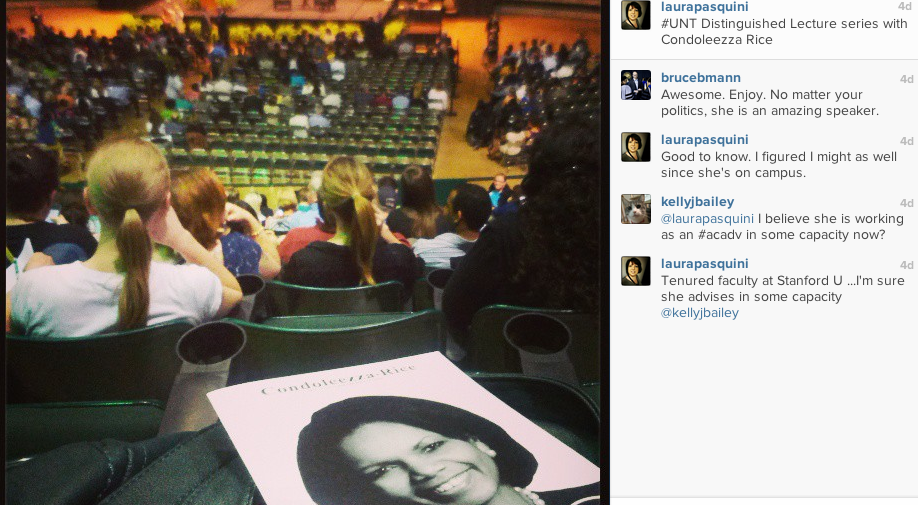
On Tuesday (4/16), I attended the Condoleezza Rice Distinguished Lecture hosted at UNT. My friend @brucebmann said it best when responding to this photo “No matter your politics, she is an amazing speaker.”

Screen Shot 2013-04-20 at 2.46.31 PMThis comment, and listening to the talk, made me think about my own perspectives and bias. How often do we challenge ourselves to think in a new way? How can listening to another perspective better inform our decisions? How is it possible to bring groups in conflict together?  I think it is possible, and I know that I am not alone.

Although “victory” has been seen this week, I don’t think that these events are really over. I challenge more of you to think about your influence and impact in social [media or not] spaces. What you say, tweet, blog, post, etc. influence the dialogue and community. It is easy to get [digital] high fives from friends and followers; however have you considered extending your reach to those you might not agree with? When is the last time you chatted with someone about the issues from this week who thinks differently than you do? Step away from the screen, and get to it.

EdTech, Higher Education, Social Media, StudentAffairs

#SXSWedu Panel: Social Media in Higher Ed – Where Are We Going? #smHE

Are you attending the SXSW Edu (#SXSWedu) conference in Austin this week? Why not drop into our panel just after the opening of #SXSWedu? Join our session on Monday, March 4th from 1:30-2:30 pm in the Austin Convention Center Room #15. Here is the skinny on our panel:

Panel: Social Media in Higher Ed – Where Are We Going?

Social Media Propoganda

Image c/o Justonescarf

100% of Colleges and Universities are now adopting “social media” tools to engage students. While strategies and tactics vary per institution there has been little analysis into the effectiveness of these networks both from the student and institutional perspective. Social Media Managers have been hired, consultants have been giving “best practices” on how to use “free tools” but is all this network chasing really getting us anywhere? In this panel we’ll showcase examples of good and bad social media implementation, and use these as a framework to discuss what a meaningful social media strategy and guidance looks like.

Intended Audience: Higher Education; Student Affairs; Academic Affairs; Faculty; Ed Tech Start Ups

Join the dialogue with Tanya (@tjoosten), Brandon (@bcroke), Brad (@bradpopilolek), and myself (@laurapasquini) as we chat about these three central questions proposed by our panel:


1. What does a failed social media strategy look like?
How do we know social media failed OR was successful? Do we need social media strategy, guidance, or policy on our campus?

2. What does a successful social media strategy look like? What are three pillars every social media initiative should have? What works really well with using social media? What initiatives have you seen?

3. What role should institutions play in engaging students with social media? How should institutions engage  social media? Why should we use social media? How can the different players on campus (faculty, administrators, students, developers, industry, & start ups) work together and collaborate for purposeful social media use?

If you have a question and you want to chime in during the session (near or far), I’ll be tracking the conversation with the hashtag #smHE to collect your questions, thoughts, and contributions before and during our panel session. What questions do you have about social media in higher education? Let me know.

UPDATED: Slide Deck & #smHE Tweets Collected. Enjoy. 

#SXSWed Panel: Social Media in Higher Ed – Where Are We Going?#smHE (with images, tweets) · laurapasquini · Storify or http://bit.ly/Z422Pw

Higher Education, Social Media

Guiding Social Media at Our Institutions [ARTICLE]

Remember last fall when Tanya Joosten (@tjoosten), Lindsey Harness (@LindseyHarness) and I asked for your input on how your institution guides social media? No? Too long ago to remember? 🙂 Well regardless, we appreciated those who could respond as it helped us gather information on what we are (or are not) doing to direct social media use in higher education.

The results from the research are in, and published! Here is the recently published, peer-reviewed article for the Society for College and University Planning (SCUP).

Access the article in PDF form here.

This article expands on Chapter 6 from Social Media for Educators to understand how higher education is guiding social media use. Through our open-ended questions, we learned more about how institutions are supporting and guiding social media. Often we see social media used a broadcast medium and there has also been a shift to designate new roles or responsibilities to support its use on campus.

Thanks to the SCUP Change-Disruption Mojo for featuring some of the findings as this week’s topic, specifically to Alexandria Stankovich (@thinkstank) for sharing both sides of the issue:

  • Concerns: monitoring online behavior, identity thief, privacy, FERPA/FIPPA, maintaining university image, control, ownership, required trainings

  • Benefits: interaction and engagement beyond the formal learning environment

Want to learn more about the research and/or article findings?

Key takeaways:

  • Social media is often used as a “broadcast channel”
  • We should engage and develop a culture through the use of social media tools
  • Institutions need fluid access to information regardless of the technology
  • Simplicity principle to build capacity for the social web
  • We need to develop models of effective practice for LEARNING!
  • Trust the faculty you hire – they have some great ideas
  • Recognize that learners are MORE than sponges
  • Match technology with task & building digital literacy opportunities
  • Is social media in your strategic plan? Is social media or technologies part of your learning outcomes on campus? THIS is where your efforts need to be
  • Institutional encouragement is needed for collaboration ON YOUR CAMPUS to identify how to best guide social media models & effective practices
“The pedagogical benefit of social media use beyond its application as a motivational technique continues to be unaddressed by many universities.”

This study was just the tip of the iceberg. There is definitely more research on learning, social media use, and higher education to be done. Time to get at it! Back to the dissertation proposal grind…

Reference:

Joosten, T., Pasquini, L. A., & Harness, L. (2013). Guiding social media at our institutions. Society for College and University Planners – Integrated Planning for Higher Education, 41(2), 1-11.

Higher Education, Social Media, StudentAffairs

Reflecting on Values & Identity from #Dalton13

Over the past few days at the 2013 Dalton Institute, I have been encouraged to think about the cross-section of how our cultural norms, use of technology, and institutional practices intersect to support students. Educational reform for higher education is not new; however it was refreshing to have a group of graduate students, faculty, scholars, and practitioners to be part of a thoughtful collective to think deeper about these challenges.

Although the institute’s focus was self-promotion, social media, and student development, it was great to hear a number of conversations emerge about the disruptive forces and potential opportunities to embrace change in Student Affairs. The philosophical narratives and analysis of technology’s impact on identity was enriched by listening to personal perspectives and such varied experiences.

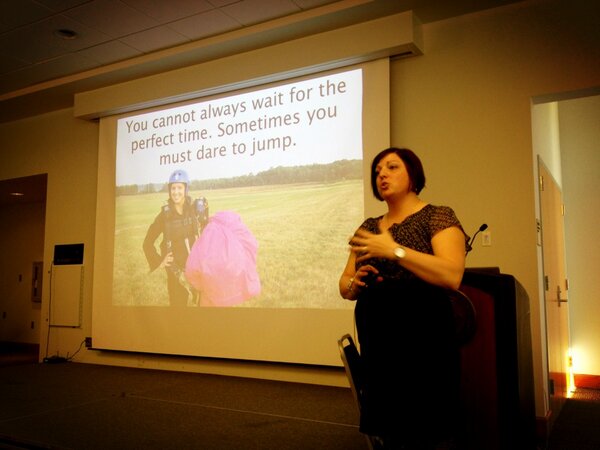
Dare to Jump

Photo c/o @DaltonInstitute {Thanks @vanessaballer!}

As the final keynote of the institute, I gave my “triple threat” perspective as a student, instructor, and professional in higher education. My goal was to share ideas and practices to develop a richer learning experiences; specifically ones that I have valued as an active scholar. So, doing my best to follow the amazing #dalton13 featured speakers – I shared my own narrative, critiques, and insights on how emerging technology can support and challenge student development. I gave some tangible examples and ideas of how to move beyond the gadget, application, or “next big tech thing” by considering ways educators can be actively pushing their learners. I talked about everything from exploration to collaboration, specifically by empowering students to be part of the solution to our institutional challenges.

My #Dalton13 Keynote – Notes & Then Some! (thanks for the photos & tweets #dalton13 backchannel!)

I appreciated the conversations (although some were far too brief!) around identity and student values that  I had with a number of #Dalton13 attendees, especially the FSU HESA graduate students. Although a number of ideas were shared at the institute, I am still left thinking and reflecting about these key questions:

  • How are student values demonstrated in a digital environment?
  • Can educators have an impact on the character development of learners?
  • Is student development really impacted by technology? How so?
  • Does there need to be a shift in how we support our student population on campus?
  • How can our graduate programs do a better job of challenging and supporting scholar-practitioners with “self-promotion” questions?
  • Will higher education cultural norms and institutional practices be changed, or will we be left behind?