#TBT Blog, Reflections

#TBT Blog Post: My Life According to Matthew Good

So, I have been blogging “officially” blogging since May 18, 2006. I have been writing on this blog since 2008; however I know that I have been publicly sharing web logs on other platforms for a while. That being said, I recently discovered a piece or two, that caught my eye – so I thought – why not re-blog to reflect what I have said.

Time flies when you write, reflect, and share in a few social spaces. Blogging for me has been a space to document happenings, archive ideas, and share memories. Instead of a Throwback Thursday (#TBT) photo – I thought I would try out a new feature – #TBT Blog. I am considering where I have posted various posts (written, video, photo, etc.), and how they have developed who I am in these spaces today. My goal is not just to re-share older content, but rather to process my own development as a blogger, writer, and then some. Welcome to my #TBT blog journey – join me every Thursday on here… until I get bored.

——

#TBT Blog Post #1:

Music has been a significant influence in my life. Whether I am playing new music, going to a concern, or part of an impromptu jam/signing session – I am a fan. Not only am I am a fan of how music can bring people together, I am also partial to the collaborative spirit for how music is made. Most importantly, some of my writing and blogging influences have come from the artists I have followed over the years — one of these artists is Matt Good:

“Somebody gave you a choice
And all you do is abuse it
If God he gave you a voice
Then use it”

~From Lullaby for a New World Order

24 July 2009 from a Facebook blog post:

Using only song names from ONE ARTIST, cleverly answer these questions. Pass it on to 10 people. You can’t use the band I used. Try not to repeat a song title. It’s a lot harder than you think! Repost as “my life according to (band name)”

Pick your Artist:
Matthew Good

Are you a male or female?:
Song for the Girl

Describe yourself:
Generation X-Wing

How do you feel:
Haven’t Slept In YearsI’m a Window
Describe where you currently live:
North American for Life

If you could go anywhere, where would you go:
Bright End of Nowhere

Your favorite form of transportation:
Metal Airplanes

What’s the weather like:
Blue Skies Over Bad Lands

Favorite time of day:
Running for Home

If your life was a TV show, what would it be called:
Life Beyond the Minimum Safe Distance

What is life to you:
A Long Way Down

Describe your most recent relationship:
True Love Will Find You in the End

Your fear:
Middle Class Gangsters

What is the best advice you have to give:
The Future Is X-Rated

Thought for the Day:
My Out Of Style Is Coming Back

How I would like to die:
Everything Is Automatic

My soul’s present condition:
Near Fantastica

Most Faithful Companion:
Lullaby for the New World Order

My motto:
Oh Be Joyful


Note: I would selected tracks from  Radiohead if my friend, @hungrypo, did not snag them first.

Feel free to share your artist & responses in the comments below. Rock on.

PLN, Reflections

Semester Reflections & What I’ve Learned [Fall 2014]

Wow. My first semester as a Lecturer and teaching ALL online classes is DONE! First and foremost – I am glad to have all my grades posted. {For real! After 2,400 hours of video watching, I can say I learned a lot from my #LTEC4121 class – and I had a talented group of students this term.}

FinishedGrading

Along with other projects (e.g. research, writing, editing, OLC Certificate, presenting, conference, and consulting), I am glad to see the semester and 2014 come to an end – or at least a pause over the holiday break. This academic term has been fun and challenging for me as I move all my instructional experiences to the online environment. My own teaching philosophy centers on technology-enhanced pedagogies that foster student–centered learning environments. Over this semester, I put a great deal of thought to how I design learning experiences and support my students online in a more meaningful and authentic manner. This term, I constantly made edits and improvements to the online courses I was teaching to help foster real-world experiences and provide opportunities for engagement. I really wanted my students to take what they are learning in the online classroom and apply these concepts to their own workforce learning and performance. With whatever technological platform and, more importantly the planned pedagogy, my primary role in these classes were to facilitate learning by motivating, instigating and supporting my students as they work through their modules and projects.

From this semester, I shared some of my personal reflections for lecturing with the GSTEP program last month:

To be honest – there are more than just 10 lessons I’ve learned. Not everything has been great this semester. There has been a great deal of stress and frustration in lecturing with someone else’s course materials, and considering how to best support the learners’ needs. I have been constantly improving functions of not only the course delivery, but also the content in the modules to consider how to get students to reach the course learning outcomes. Although it has been a busy semester, I have appreciated the hands-on lessons I have learned and applied to my online instruction and support for my students. Learning about learning, and evaluation of the curriculum supports our students. Stay tuned for deeper reflections in an upcoming blog post after I go through my course evaluations, LTEC feedback forms, and review of my course design from Fall 2014 for the next semester.

For time management and scheduling,  I learned a great deal about the need to develop my own personal workflow. Although I have been “working remotely” and I have a great deal of online work experience, my new role has got me thinking about what it means to be productive when working from home. Work-life balance is key. With a number of involvement and projects, I have had to think about how these are managed and prioritized. I believe my scheduling and task-management has improved over the term (when I am not traveling for business/personal obligations #LessonLearned), and I feel as though I have mastered my grading and instructional flow with online teaching. Thanks to some additional motivational tools for time and fitness, I have improved my time-on-task ability for work projects and increased my running/walking mileage (thanks Todoist.com, Asana, #FitBit & RunKeeper).

Most importantly,  I have learned the value of being an active participant in my networks. My mom was concerned about my social contact with others now that I teach online. I laughed – and told her that I still have just as much (or maybe more) contact with others. Although I am not an 8-5 worker on campus, I have made a point to stay connected to UNT and get involved in various things (e.g. UNT Faculty Writing group, GSTEP support,  Alternative Service Break advisor, and LT department meetings/projects). In my online work, there are a number of virtual teaming projects and collaborations that keep me quite engaged and social (e.g. #ACPAdigital task force, NACADA meetings, OLC conference planning, and other community interactions). Finally, I have sought out new opportunities to grow and learn professionally to focus on research scholarship, instructional design, and strategic organizational planning (e.g. RA position with @veletsianos, CLEAR instructional course design work, and external consulting/training initiatives).

Thanks to a number of you who have been there for me this academic term. Your ear, your advice, and your support have been greatly appreciated during my transition period. Thank you!

networkedscholar, Reflections

Vulnerability Comes With Scholars Who Care #scholar14

I feel fortunate to be in a “caring” online  spaces, when it comes to my research and writing development.

turtle-dont-be-afraid-to-be-vulnerableOver the course of the last few years I have met a number of doctoral researchers, early career scholars, and seasoned academics who actively participate and encourage open dialogues online (within Twitter hashtags, blogging communities, podcasts, and more). I know this is not always the case. In the world of academic contribution and competition, there are a number of hurdles along the tenure track and moving forward in post-secondary education leadership positions. By sharing what you do, in the network, you expose your own process, development and self. This includes the good, the bad, and the ugly of the experience:

“Sharing a story about yourself makes you vulnerable. Since stories are about transformation, telling a personal story requires you reveal a flaw, error, or a roadblock that was a difficult to overcome. Professionals are nervous to reveal their struggles at their place of work for fear it will open them up to judgment or criticism” (Duarte, 2014).

Last week, the Networked Scholar course (#scholar14) was fortunate to have Bonnie Stewart (a.k.a. @bonstewart) share her thoughts on the delicate nature of being exposed and real in academic spheres.  If you want to get caught up, watch the video recording, her SlideShare presentation, or review the Twitter notes. It was a pleasure to hear this talk, knowing Bonnie professionally and personally (she may have gone to high school with my cousin – PEI is small), but also because Bonnie brings her scholarship to the network and actively engages in this dialogue beyond the academic sphere:

Although I am not alone, it is through these real and authentic examples in higher education (both faculty and staff), that I am inspired to continue to tell my tale, share, and grow in this networked experience. Not everything will be great, but discussing the process, challenges, joys, and then some has help my own journey. That being said, it is important to be cognizant of the issues within the “networked” space of academia:

This talk left me thinking more about my purpose and intentionality with the “tools” and mediums I use. I share real photos, videos, blogs, tweets, and more about  my authentic self, which include my successes and struggles. This has left me thinking about questions I have in my “networked academic future”:

  • What does this mean for my representation of academic self?
  • How do I challenge assumptions of working in these online spaces?
  • What about potential issues that might happening being as open and honest with research?
  • How can I continue to share my story in an honest way that will contribute to my peers, institutional culture, and discipline?
  • How will I support graduate students and early career researchers who will continue to participate in these online spaces, moving forward?

I think about the challenges academics face (e.g. trolls, research thieves, tenure track requirements, discipline silos, and institutional cultures); however I am inspired to still be in these spaces with researchers, like Bonnie, who have modeled, interacted, supported, and engaged in real interactions related to their research threads. I want to support my peers and the next generation of networked scholars – so the best way I know how to do is to be there.

References:

Duarte, N. (2014, October 29). Are you brace enough to be vulnerable? Retrieved from https://medium.com/@nancyduarte/are-you-brave-enough-to-be-vulnerable-5a09bd99c4c4

Stewart, B. (2014, November 3). Networks of care & vulnerability. SlideShare. [Lecture slides]. Retrieved from http://www.slideshare.net/bonstewart/networks-of-care-vulnerability

AcAdv, PhD, Reflections

PhD Balance & Support: Life as a Doctoral Researcher and Higher Ed Professional

As part of my “Thanks-For-Supporting-My-PhD-Completion” and ways to motivate other doctoral researchers, Melissa and I decided to write an article for NACADA’s Academic Advising Today. This piece shared insights from our #hackPhD Panel at #nacada13 and our own hindsight of what it takes to successfully finish the degree.

PhD Survivor

We are not alone in thinking that being both a full-time professional in higher education AND full-time PhD student is a CHALLENGE:

The tensions among academic and personal roles can have a great impact on an advisor’s doctoral education. The theory of doctoral student persistence (Tinto, 1997) in particular can provide a look at how conflicting roles might impede a doctoral student’s academic progress. Tinto’s theory (1997) assumes that the primary communities for students relative to their graduate education are their peers and the faculty in their programs. Social integration within graduate education is almost synonymous with academic integration in the department. These social communities assist students with both intellectual and skill-building capacities needed to succeed in their doctoral programs, as well as networking within the greater professional community. Membership in other communities, e.g. those encompassing personal roles, can have a negative impact on graduate persistence by providing conflicting demands for time. If students are not able to manage their competing roles, they may find that they must give up on some of them.  (Read the full article here.)

I am thankful to the #AcAdv Chat community and fellow PhD friends (#sadoc & #phdchat) for the support. A number of my colleagues from these groups ALSO hold a faculty or staff position on campus, while grinding through their doctoral coursework and/or dissertation. I salute all of you who have made it, and a number of you who are still working towards the end. {You can do it! #GoScholarGo!}

At times this challenge is not easy – AT ALL. What it often comes down to is, support at the local level. At my campus, I was fortunate to have dedicated faculty advisors, solid graduate program support, an understanding/empathetic boss, a supportive and collaborative office team, and brilliant Dean to scaffold my PhD progress. Although my support network online is brilliant,  I think that it is imperative for the Staff/Faculty Supervisor of the PhD employee to consider how they can impact degree completion. Here are a few suggestions on how to get started:

  1. Ask How To Support: Sounds easy enough, but often it does not come up in 1:1 meetings. Consider asking how their degree will fit into their overall career goals, and what sort of strategies and resources would be most appropriate to reaching this objective.
  2. Identify Funding Resources: Inform students about tuition breaks, employee scholarships, and travel funding that might be optional during their doctoral study. Sure – your grad student might be savvy enough on this topic; however it does not hurt to inform them about budget allowances or potential funding sources.
  3. Encourage Professional Development: Continue to nourish and cultivate professionals who want to hack their doctoral degree, AND contribute to their own personal growth. Professional and informal affiliations often helps their progress towards degree completion.
  4. Consider Scheduling & Being Flexible (with Time): Allow for a varied staff schedule, time in office, or even opportunities to telecommute on projects. This might even include moving a lunch or break around to meet with dissertation committee members, writing groups, or graduate student seminars. Often your graduate student is very good at both self- and time management, so trust them to be effective in and out of the office.
  5. Express Value for Scholarship: Help your employee identify service, teaching and research scholarship on your campus and with your professional affiliations. Think about their research as an extension of your unit’s or institution’s vision and mission, and capitalize on their talent and skills in this area. Scholar-practitioner contributions can impact strategic goals, and compliment what you do day-to-day.

If you currently supervise a doctoral researcher who is a full-time staff member, how do you support your employee? OR vice-versa. What do you need as full-time employee AND PhD student to get you to your dissertation defense? Please share in the comments below.

References:

Johnson, M. A., & Pasquini, L. A. (2014, September). Negotiating the multiple roles of being and advisor and doctoral student. Academic Advising Today, 37(3).

Tinto, V. (1997). Toward a theory of doctoral persistence. In P. G. Altbach (Series Ed.) & M. Nerad, R. June, & D. S. Miller (Vol. Eds.), Contemporary higher education: Graduate education in the United States (pp. 322-338). New York, NY: Garland Publishing, Inc.

Academia, Reflections

Top Ten List for Being a Better Faculty Member

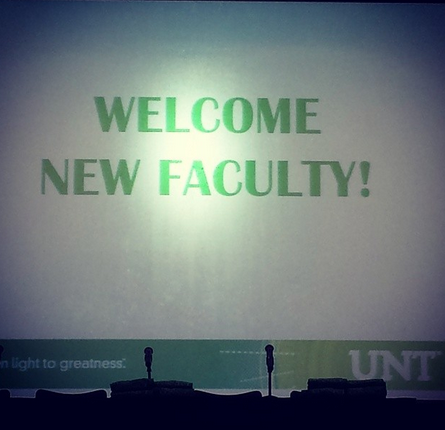
Just when I thought I was done with orientation sessions at UNT… I attended my OWN “new faculty” orientation.

welcome new faculty

{UPDATE: For those who are not aware, I finished my PhD this summer, graduated, and accepted a 9-month faculty appointment with the UNT College of Information as a Lecturer for the Department of Learning Technologies. Yay!}

During the day, information about the campus, expectations and advice was shared by a number of administrative leaders from the campus.

ten

One talk, from Dr. Warren Burggren, the Top 10 List for Being a Better Faculty Member, provided some sound advice, so I thought I would share this with you. I think it applies to new faculty, returning faculty, and others starting a new job in higher education.

10. Get to know the lay of the land. Beyond your office or workspace, get to know other locations on campus. Walk around and explore your college/university. Find out where buildings and resources are located.

9. Meet and greet in your department. Get to know fellow faculty members. Introduce yourself. Starting a new position is a great time to network and meet others in your department, on your campus, and in your discipline.

8. Know the rules… or ask about them. There are a lot of rules at every institution. Be sure to be informed, or know where to go for help or who to ask questions. Don’t be overwhelmed – just be smart.

7. Talk frequently to your chair. They are an ally and confident. Your chair will be there to support and guide your development within the department and your discipline. Set regular meetings/check-ins with your chair as their schedule allows.

6. Most of your frame of reference is still as a graduate student. Make the full transition to full time faculty. Please don’t feel like you need to socialize with your students – rather get social with your peer group. Get involved in faculty networking and social groups. Inappropriate interactions with students is something administration has to deal with, and they would prefer not to manage this.

5. Get a life. Even though you are working hard during your first faculty appointment, don’t forget to play hard as well. Take care of yourself. Find time to do things for you. #TreatYoSelf

4. Stay OR get organized. Don’t over commit. Manage your time effectively. Learn the ability to say no, and feel free to borrow the following phrase when asked to do something: “I would love to do ____ however; I don’t think I am being the best faculty member I can be.”

3. Teach and teach well. Focus on excellence in the classroom. Include solid bookends in your semester, i.e. the first and last lecture. Find something to talk to your students about during both classes. Make it experiential. Engage the students in the first lecture and final lecture. Be dynamic and encourage learners to want more.

2. Take pride in your university and community. Be part of the activities around the campus and city. There are a number of ways to be involved in the community and engage in school spirit. #GoMeanGreen.

1. Keep a sense of humor. The university is a complex hierarchical organization. You will want to take all things in stride. Be sure to laugh, and let things role off you.

Others offer advice for entering into academia here, herehere, here, and HERE. What advice would you give a to a new faculty member? Please share.