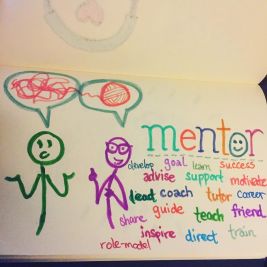
 One of my research projects I am currently working focuses on professional mentoring, specifically mentoring experiences for professional learning and development offered by professional organizations/associations. Over the past couple of years, I have been fortunate to speak with a number of higher education professionals who have been part of a formal mentoring program, either as a mentor or a learner (a.k. a. mentee, protege, or leader). It has been great to learn about their how mentoring has met their professional development needs, helped to meet career goals, and navigated both personal/professional situations faced in the workplace. As I finish a few more interviews, I hope to wrap up data collection/analysis to share findings/implications of mentoring experiences later this year — I promise. Part of this research design includes understanding how professional learning organizations/associations structure and administer mentoring programs for its membership. In speaking with mentoring participants and coordinators from a variety of mentoring programs that serve higher education professionals (Thank you: NACADA ELP, ACPAgrow, OACUHO, and NASPA Candid Conversations 365), I hope to offer insights and practical implications based on these mentoring experiences.
In my literature review, I stumbled upon, Mentoring Programs That Work by Jenn Labin, which was recently published by the Association for Talent Development. Based on my own thread of scholarship, I wanted to review and learn what suggestions this author had to provide based on her experiences in mentoring programs in a variety of industries. Although each mentoring program will have its own objectives and unique needs for participants, one constant component across all programs is the need to form connections to support an effective mentoring relationship. Mentoring relationships will be the cornerstone for skill development, personalized learning, and knowledge acquisition within any professional domain. Unlike typical educational training programs or professional development/learning, mentoring programs are more uniquely tailored for talent development needs. That being said, I am not sure we put the time or effort into preparing mentors and learners who enter this type of learning and development program. I agree with Labin’s sentiments: “Mentoring programs are important.” Mentoring is an individual, learner-driven experience where proteges work with mentors to create a learner-focused solution. Mentors can support learners to acquire a specific knowledge domain, scaffold professional work situations, and develop tacit skills required to advance in their career field. Labin (2017) believes most mentoring programs fail if their goals are not aligned to talent/professional needs, inability to scale and sustain initiatives, and/or as a result of little stakeholders involvement or championship. I am sharing this brief overview of this book, as I think it has practical solutions for managers or program coordinators who want to develop (or improve) a successful mentoring program, while also supporting the mentoring experience and empowering mentors with tools they will need for this type of professional learning.
This book presents practical ideas and examples to outline the AXLES Framework for developing mentoring programs. The AXLES approach is similar to the ADDIE model for designing learning solutions, which will be familiar to my instructional designers or training industry colleagues. Labin introduces the components of AXLES in the introduction chapter of her book (2017, p. xv-xvi):
- A = Align to Purpose: define the intention/goals of the program; identify critical questions for program success, and establish strategic partners within the organization to support the mentoring program
- X = Design the Experience: identify the mentoring program structure, schedule, participant matching, and expectations; what are the deliverables, outcomes, and lifecycle of the program you want to design?
- L = Launch Your Program: this is the implementation of the mentoring program (initially or annually); Will you have an orientation meeting, agenda, or focused platform/communication method to get the program going?
- E = Evaluate Effectiveness: What will be the types of measures or metrics for the mentoring program?; identify program success from both narratives of participants and potential data collection with milestones and participant input
- S = Support Participants: design and develop resources, webinars, videos, or other performance support aids to scaffold mentor-learner interactions; these could be a participant playbook, monthly meeting agendas, or even conversation guides/resources for discussions to encourage connections for these mentoring relationships
Mentoring is defined in a number of different ways, and the approach for a mentoring experience will be individual and unique depending on your organization/institutions needs. Chapter 2 helps to identify both the direction and talent development gaps you would like to address within your own mentoring program. This foundational chapter requires readers to identify the purpose, success measures, and the focus of the program by examining both the learners’ (protege) benefits and mentors’ benefits for involvement. A mentoring program could be developed to meet technical needs or to transfer institutional knowledge, or it might be created for talent development/growth of professionals within your organization. Identifying the objectives, purpose statement, and the “role of mentoring” will be a critical phase for those constructing this type of training design.
Chapter 3 offers suggestions for mentoring program designs. For the practical organization of a mentoring program, you are encouraged to outline questions for planning the program structure, identify the program schedule, consider how to conduct participant matching, and describe how learners and mentors will participate in the program. The considerations for “cultural alignment” were addressed early in this chapter, as this type of professional development might be executed differently based on the organizations need and its learning culture. A mentoring program structure type could include traditional or 1:1 mentoring, reverse mentoring, mentor-led (group mentoring), peer-led (mentoring circles), or a hybrid of any of these formats. Additionally, this section of the books helps readers to consider the schedule length, entry, and programmatic features, such as the matching process for mentoring and potential technology solutions for support. The last stages of design decisions required for planning mentoring programs involve the learner and mentor engagement, specifically participants entry and exit into the program and outlining operating directions, guidelines, and expectations to create successful mentoring experiences.
Chapter 4 and 5 offer insights and practical suggestions for launching and evaluating a mentoring program, respectively. I appreciated the potential suggestions for professional learning opportunities, such as communication preferences, setting goals and development plans, skill-building workshops, and other resources that could be curated for a mentoring program (e.g. icebreakers, readings, teambuilding activities, conversation topics, etc.). For evaluation purposes, Labin (2017) mapped the Kirkpatrick Four Levels of Evaluation for review of a sample mentoring program and offered strategies for how qualitative and quantitative data might offer measurement insights during a program review. Potential metrics for success could be conducted by observation of performance improvement/changes, case-based examination of the mentoring relationship, individual development plans/goals met, reflections or narratives shared in milestone reports, and engagement of mentors and leaders within the organization.
Regardless of the industry or occupation, I think mentoring program administrators/coordinators will find Labin’s book both informative and practical for designing a comprehensive mentoring program that supports productive mentoring experiences. There are a number of suggestions for defining effective mentoring behaviors, onboarding participants, engaging in regular skill building and/or learning activities, and considerations for how to engage participants throughout a mentoring program experience. Administrators of mentoring programs will gain a number of valuable ideas for communication planning, participant recruitment, mentor-learner pair matching, supporting mentors in their role, potential ways to report and offer metrics for program measurement, learning material development/maintenance, dealing with issues, and supporting participants throughout the mentoring program cycle. I appreciate how each chapter offers applied examples of mentoring perspectives from learners or various industry leaders, and the end of each chapter offers key insights, exercises, and questions for individual reflection and potential team discussions. Additionally, there are a number of support resources and example materials in the appendices of this book to help guide mentoring program development.
Reference:
Labin, J. (2017). Mentoring programs that work. Alexandria, VA: Association for Talent Development Press.
*Full disclosure: The book, Mentoring Programs That Work, was sent to me by @ATD Press to read and review. As this is a valuable contribution for mentoring program development to support professional learning and development, I am more than pleased to offer this review on my blog. Thank you!”

 his month, I have found myself sharing more and more about how we can think about social, digital tools to tell our stories in higher ed. There are many ways to share our experiences and highlight the amazing things students, staff, and faculty are working on at and beyond our institutions. I have found podcast hosting/producing to be a very rewarding experience to support my own learning and development. There is no shortage of knowledge I have not learned from podcast guests, the research of topics, and the notes for each episode I have hosted – thanks @BreakDrink & #InVinoFab podcast!
 There are SO many ways to produce a podcast these days. This open document is a space to SHARE and LEARN about HOW higher education professionals create, make, produce, and host their own podcasts:
 Take a LISTEN to podcasts for and created by higher education professionals who want to share resources, ideas, and aspects about their own work:
 The time for higher ed professionals, practitioners, graduate students, researchers, instructors, administrators, and more to gain a share of the podcast ear. Higher ed hosts and producers, it’s time to raise our mics and let our tales be told through podcasts. Go ahead and launch the podcast you have always dreamed of creating now! I hope to listen to your pod story soon, @LauraPasquini



 techKNOWtools
You must be logged in to post a comment.