PhD, Reflections

#sxswEDU: Thoughts, Reflections & Then Some…

Time sure flies when you’re conferencing, volunteering and travelling… so my thoughts on South By South West Edu (#sxswEDU), are delayed by exactly 2 weeks. My bad.

Due to my love of Austin and enjoyment of SXSW, I thought SXSW Edu would be a great conference to engage with other educators and expand professionally. There were a number of things I liked – such as being on public transit, new perspectives on learning, and connecting with tweeps (Shout out to: @tjoosten, @gsiemens, @veletsianos@audreywatters & more #iamEDU friends!). I also appreciated the lively banter our Social Media in Higher Ed (#smHE) panel had on the topic, and the great follow up conversations with other instructors, practitioners, and researchers. 

Essentially, I got what I wanted out of the #sxswEDu conference – connect, social, interact and learn. I sort of expected something else from this conference, specifically with regards to the education (K-12 and Higher Ed) involvement. I was a bit disappointed to see that the Panel Picker selected more sessions with industry, rather than any educators. It was odd. I was not alone in noticing the tensions were felt between the industry and educationWhy were the instructors, teachers, principals, faculty, higher education professionals, and educational administrators not sitting in these #sxswEDU seats?

Let's get ready to MOOC-off! Where art thou @gsiemens?

Although the education presence was not the “sage on the stage” approach, I am glad I was present to listen to what industry and technology leaders think the “future of learning” will be. I know that many of these sessions were challenged and talked about outside the formal #sxswEDU program, and I was curious as to how other educators interpreted the conference message(s). 

One thing that was very noticeable = the repetitive rhetoric being shared from room to room. To mix it up I, jokingly, initiated the  #SXSWedu Terms to Know, Use, Love & Hate Google doc to note the key words, terms or phrases I heard at the conference. Some might say I was being jaded (*cough* Siemens *cough*), but really I was just having fun with the common language of the conference. After curating this list, I decided to create a game (…which had multiple players, I might add): 

#sxswEDU BINGO Card #3

Note: Another suggestion was to draft a blog post with the complete list of terms. I decided to respectfully decline said challenge; however I will stay alert to the language and context of these words. It’s not a bad idea to keep your ears open and listen every once in a while… Thanks for reminding me of that #sxswEDU.

PhD, Professional Development, Reflections, SocioTech

Finding a Research “Home” with #SocioTech at #iConf13

As a College of Information student, the learning technology department compliments a number of research areas emphasized within our iSchool and at the 2013 iConference. Andrew Miller (@findandrew), Leila Mills, Mark Evans and I proudly represented UNT as one of the 12 finalists for the Social Media Expo hosted by FUSE Labs of Microsoft Research at the iConference this year. After conducting our ethnographic study on the Denton Local Food System (LFS), we submitted a research paper, video, poster, and created an online space for the LFS community to share information, house knowledge and connect to local happenings within the community at FeedDenton.org.
#iConf13 Social Media Expo Finalists
  Social Media Expo poster @ 2013 iConference (#iConf13) with @findandrew

What I enjoyed most about attending the conference was the refreshing opportunities to engage about research methodology and conceptual frameworks that apply to my scholarly interests. It felt like I was coming “home” when talking shop with various academics and graduate students during the conference. The best part might have been the pre-conference session:  Sociotechnical Systems Research workshop (#CNFWSP2). This is where I was able to connect to other #sociotech researchers, and learn more about areas of inquiry coming out of the iSchools and various disciplines.

The pre-conference was a full day of fun that housed various speakers, discussions, and sharing of directions in sociotechnical research, including

  • critical study and comparative study
  • considerations for multi-scale ethnographic research
  • artifacts that change communication in organizations
  • impacts of human and non-human delegation
  • shifts from visible to invisible networks (part of ANT)
  • organization as a constant communication
  • sustainable information practices
  • action-based research for informatics improvement
  • participation, community resilience, plurality, design

Later in the day, Steve Sawyer, conducted a master class to present various sociotechnical systems (STS) perspectives, which drew upon theories from Actor-Network to social construction. Everything is relational as new forms of social organization is occurring with new technical arrangements all around us. We talked about #sociotech in practice, specifically how to situate the phenomena (conceptual & empirical framing) and conceptualize sociotechnical systems (identify characteristics of the social, technical and interactions) by looking at this STS conceptual space mapping from Steve.

Untitled
This post is just the tip of the iceberg, as I have a number of notes, ideas, references, and research peers to turn to thanks to this workshop. I was not surprised to run into some of the #sociotech usual suspects in #iConf13 sessions such local communities, learning environments, or ethnographic studies of online communities. I appreciated the comments and dialogues brought to both the paper and notes sessions (I preferred the workshop space in the notes session better), and I am motivated to dig back into my own research and dissertation grind.

Want to read more about the 2013 iConference proceedings or connect to a few sociotechs? Here you go:


Reference:

Miller, A. J., Pasquini, L. A., Mills, L. A., & Evans, M. (2013). Towards a methodology of virtually augmenting a knowledge sharing community of practice: A case study of the local food system of Denton, Texas. iConference 2013 Proceedings (pp. 1095-1101). doi:10.9776/13527

#phdchat, PhD, Professional Development

Have Conferences, Will Travel

Apparently when it rains, it pours – for conference proposal acceptances, that is. Since this semester is light on course work, heavy on dissertation proposal research, and I have a amazingly supportive supervisor/department, I will be fortunate enough to be able to attend a few conferences this term.

Laura Pasquini Where is Shee

Here is the rundown for my tentative CONFERENCE travel schedule:

Dalton Institute 2013 http://studentvalues.fsu.edu/2013-Dalton-Institute
Florida State University, Tallahassee, FL  January 30-February 2nd   Follow: #dalton13 Invited Keynote: Student Development 2.0: Optimizing Social Media to Connect Your Campus

AHRD Conference http://www.ahrd.org/ 
Washington, DC   Feb 13-17, 2013
Abstract paper: “A Review of Theoretical Frameworks Explaining Formal Mentoring Relationships”; Thanks to my co-author Mariya Gavrilova-Aguilar who will be presenting

iConference 2013  http://www.iconference.ischools.org/iConference13/2013index/
@iSchools & UNT Host, Fort Worth, TX   February 12-15, 2013  Follow:#iconf13   Our #UNT Social Media Expo team (Andrew Miller, Leila Mills, Mark Evans & I) qualified for the grant from Microsoft Research FUSE Labs on our paper: “Towards a Methodology of Virtually Augmenting a Knowledge Sharing Community of Practice: A Case Study of the Local Food System of Denton, Texas”

South by Southwest (SXSW) Education Conference & Festival http://sxswedu.com/
Panel Discussion: Social Media in Higher Ed – where are we going? with @Bcroke, @tjoosten, & @bradpopiolek
Austin, TX  March 4-7, 2013  Follow: #sxswEDU


Emerging Technologies for Online Learning – Sloan C http://sloanconsortium.org/conference/2013/et4online/welcome
Las Vegas, NV   April 9-11, 2013   Follow: #et4online                               @et4online Conference Planning committee; graduate student instigator


Futures of Academic Publishing: UNT’s 4th Symposium on Open Access https://openaccess.unt.edu/symposium/2013

May 30-31, 2013   Dallas, TX


NACADA 2013 International Conference http://www.nacada.ksu.edu/Events-Programs/Events/International-Conference.aspx
Maastricht, Netherlands   June 5-7, 2013
Workshop: Communication 2.0 Plans: Effectively Engaging Students Online
*Possible poster and panel session involving the #AdvTech survey and Social Media in Higher Education research.*


10th Annual Sloan Consortium – Blended Learning Conference & Workshop http://sloanconsortium.org/conference/2013/blended/welcome 

Milwaukee, WI    July 8-9, 2013


Invited Workshop: Supporting Blended Learner’s Need to Develop Social and Connected Skills Through Digital Pedagogy

Let me know if you will be attending, presenting, or frequenting any of the above conferences. I expect to meet up with the usual [professional/scholarly] suspects I collaborate with, and I look forward to new colleague connections and learning during this conference season.

#phdchat, PhD

I’m Qualified… to Work on My Dissertation Proposal

Today I received the “official” paperwork letting me know that I am qualified to move onto the dissertation/thesis phase of my PhD. At the end of the Fall 2012 semester I defended my ATPI Portfolio, as part of my comprehensive or qualifying exams, and became a PhD Candidate.

This semester (much to my faculty advisor‘s surprise) I am not enrolled in any courses at UNT. The goal for this term is to concentrate on completing my dissertation proposal for a successful defense by the end of April 2013, if not before to be eligible for scholarship and/or other opportunities. Other than a few publications/projects, conference travel, and editing for the Learning and Performance Quarterly, you will probably see my nose deep in research methodology as I fine tune my literature review. Stay tuned…

ATPI, PhD

My ATPI Portfolio & Presentation: Look Ma’, Now I’m A PhD Candidate!

After an early morning presentation and Q & A about my ATPI Doctoral Portfolio – I am now a doctoral candidate in the ATPI Program (here’s the NEW PhD Portfolio Requirements). I am now able to start my dissertation hours in the Spring 2013 semester. Yay!
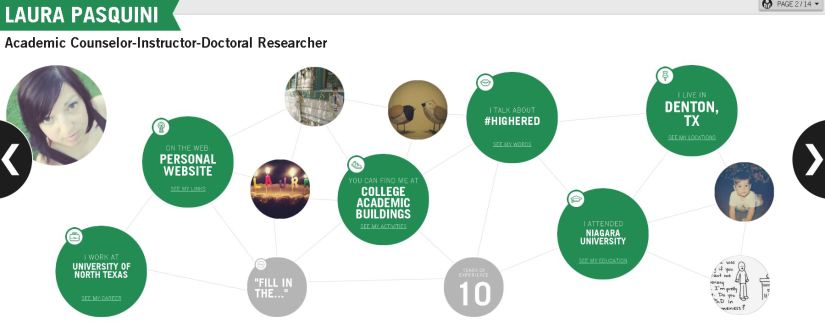
Vizify S

Professional Overview

The Applied Technology and Performance Improvement (ATPI) doctoral program has supported my growth as a scholar, professional, and consultant. Throughout my interdisciplinary course work in Applied Training and Development, Management, and Educational Psychology and Research, I have been able to develop and enhance my critical thinking, improve upon my research analysis and research perspective over the last three years of my doctoral program. Beyond the degree course work, the ATPI faculty and the Department of Learning Technologies has supported my efforts towards presenting, publishing scholarly works, improving my instructional skills, and augmenting my service scholarship. My ATPI doctoral portfolio will demonstrate my scholarly development and illustrate my contributions to the learning, computing, and performance field.

During my last three years as a doctoral student, I have sought and participated in a number of research opportunities and academic experiences to support my development as a scholar. Through my involvement in collaborative graduate writing groups, professional associations, and academic partnerships with faculty, I have improved upon my scholarly research, honed my writing craft, and advanced my editorial skills. My publications include the topics of formal and informal learning, personal learning networks, learning and performance innovation, and technology needs assessment and implementation to be utilized for education. Beyond research and publications, I have been invited to consult, train, and speak to a number of public and private learning organizations nationally and internationally about my research interests, learning pedagogy, and instructional design.

As the founding student editor for the Learning and Performance Quarterly (LPQ), an open access, peer-reviewed journal within the Department of Learning Technologies, I have gained a vast amount of insight in reviewing manuscripts, working with a diverse editorial board, supporting online distribution, and partnering with a number of contributing authors and academics. Both reviewing and editing for the LPQ and other academic journals, has improved my research and how I critically analyze academic publications. Being the editor has also not only challenged me to consider style and format, but has compelled me to assess other research methodologies.

As a connected and open learner, I have attempted to apply knowledge from the classroom and knowledge from scholars in the field of learning and performance. My ten years’ of experience in the field of Student and Academic Affairs in education has come from employment in the United Kingdom, France, Canada, and the United States. My professional experiences in education include teaching (higher education and K-12) , academic advising, tutoring services, supplemental instruction, career advising, campus activities, first year experience curriculum, orientation programs and housing and residence life. With my education, I haveattempted to integrate my student and academic affairs experiences with my scholarly objectives. In doing so, I have shared my eclectic learning and PhD journey via a variety of social spaces. You can often find me blogging, tweeting, taking photos, or sharing my research developments and professional experiences online. Being an open and digital scholar has presented me with a number of opportunities you will see presented in my ATPI portfolio.

Currently, I am an academic counselor and instructor with the Office for Exploring Majors where I help undergraduate students explore their major and career goals. In this position, I have had the opportunity to work collaboratively with various departments on the UNT campus to integrate assessment with program design, create innovative learning initiatives, and provide training and development for our staff and faculty. As a member of the Global Community for Higher Education (NACADA) and connecting with learning technology associations, such as EDUCAUSE and the Sloan Consortium, I have had the opportunity to enhance my mix my service scholarship disciplines to consider new models for learning and performance. As an active member and leader within my professional affiliations, my service has valuable developmental experiences, including mentoring relationships, planning conferences, consulting contracts, and supporting research for the organizations.

My professional goal is to secure a tenure-track faculty position at a research university while consulting for training and development on the side. I have had a number of excellent experiences in higher education in the area of advising, teaching, and service and I believe that I will be a talented candidate for any institution seeking a dedicated research scholar. There are a number of complimentary research opportunities in the field of learning technology, and I would expect to remain involved in research, consulting, and learning in higher education as it evolves in the future.

My research interests lies in the understanding of informal, online learning networks for professional developments and how these digital communities of practice influence and impact professional and trade associations, such as American Society for Training & Development (ASTD) and the International Society for Technology in Education (ISTE). I am interested specifically in analyzing how social media and online applications affect the formal processes and the structure of training and development.