CPLP, HRD, Learning and Performance, Training & Development, Workplace

Getting Certified in Learning & Performance with the CPLP

For my time “between gigs” (and within contracts), I’ve decided to get certified for my work in Learning and Performance. The Association for Talent Development (ATD) provides the ATD Competency Model to outline what professionals in the industry of talent development needs to know and the relevant skills for industry.

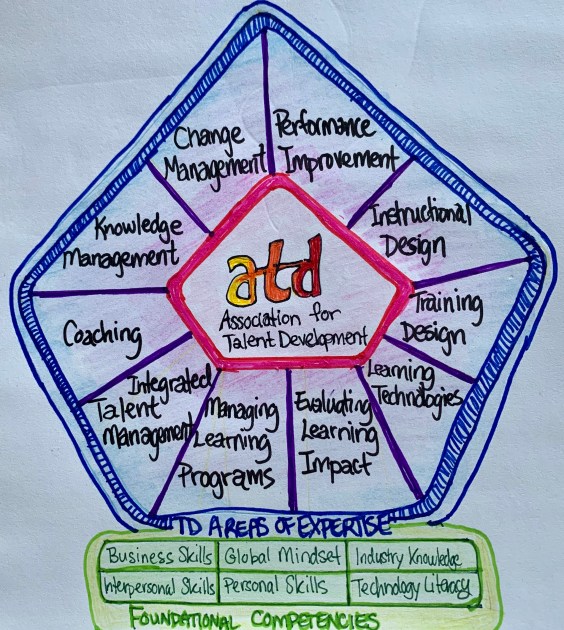
In choosing to certify my knowledge and skills, it will require me to review and prepare for the Certified Professional in Learning and Performance (CPLP) exams. ATD certifies this and the Associate Professional in Talent Development (APTD). The CPLP is a globally recognized certification for those in the learning and performance, focused on the 10 areas of expertise (AOE):

  1. Training Delivery
  2. Instructional Design
  3. Learning Technologies
  4. Evaluating Learning Impact
  5. Managing Learning Programs
  6. Integrated Talent Management
  7. Coaching
  8. Knowledge Management
  9. Change Management
  10. Performance Improvement

These AOE’s have been part of my doctoral studies and what I’ve been teaching and researching this past decade. Since ATD confirmed my eligibility and I have a bit of time on my hands, I figured it would be an optimal time to review and prepare for the two CPLP exams that test Knowledge and Skills Application. Here are a few examples of the many (150) knowledge questions, to study for the Knowledge test:

  • Which theory of learning focuses on matching individual needs to appropriate instructional experiences and is particularly useful for helping employees adapt to changes in their work lives?
  • What are the five principles of andragogy?
  • What is an informal philosophy of teaching that focuses on what the instructor does rather than what the participants learn and usually refers to the teaching of children?
  • What is the difference between teaching and facilitating learning?

If you are interested (and maybe considering the CPLP), I will use my blog to post open “study notes” to let you know what I am reviewing. If you are interested, eligible, and have the time/resources to prepare — join me and we’ll form a digital study group. Here are 10 tips for taking the CPLP, from an ATD certified member. My goal is to work towards either the January/February 2020 exams for the CPLP Knowledge Exam and February/April 2020 for the CPLP Skills Application Exam. If you have completed the CPLP exams in the last couple of years — let me know! There has been a few updates to the I would love to gain you perspective and advice as I prepare.

mentor, mentoring, PhD, Research

Cultivating Mentoring: Peer Mentorship Matters for Doctoral Scholars

Mentoring of doctoral scholars vary between disciplines and domains of practice. Mentorship is generally seen as both a relationship and process between a minimum of two individuals seeking to share and build knowledge, expertise, and support (Williams & Kim, 2011). Mentoring occurs within informal and formal settings in terminal degree programs. Often (but not always) doctoral scholars are mentored by a faculty advisor or supervisor; however, even more are seeking mentorship from professionals, practitioners, and peers within their industry or workplace. In thinking back to your own graduate school or doctoral learning experience, who did you seek out or stubble upon for as a mentor? Where did you find professional support for your research and career plans? Who was part of your mentoring community for the work you do?

Over the past few years, I have been working with scholars and practitioners to understand how formal and informal mentoring experiences develop occupational pathways for academic writers, researchers, and higher education professionals. Traditionally, mentoring is viewed as a face-to-face, long-term relationship with interactions between an experienced colleague and a novice professional or learner to support professional, academic, or personal development of the protégé (Donaldson, Ensher, & Grant-Vallone, 2000). With emergent technologies and digital access to colleagues, this no longer needs to be the only model or experience for establishing mentoring relationships. Graduate students and early career scholars/practitioners are beginning to form peer networks to learn and thrive as they set out on their own professional paths. We can now find mentoring opportunities within our networks, communities, and areas of interest in online settings.

With the opportunity to connect to scholars and practitioners beyond geographic boundaries, time zones, and physical locations, it is possible to establish a mentoring relationship with one or many professionals/academics from afar. Also, the typical dyad of the mentoring experience is shifting as structures are evolving to support specific career goals and personal life changes. There is an increase in peer-to-peer, group, and networked mentoring opportunities. In a recent study, we wanted to know more about these digital mentoring experiences of doctoral scholars so we asked the following research questions:

  1. What type of mentoring opportunities are you involved with formally or informally to reach your personal and professional goals?
  2. What expectations and motivations did you bring to this mentoring relationship?
  3. What sort of resources, support, and kinship occurs within peer mentoring experiences in digital environments?

In exploring mentoring opportunities in-person and within digital environments, we learned most early career scholars sought out a mentor to help them with the follow areas of professional development and growth:

  • Navigating the norms, expectations, and experiences working in academia
  • Gaining career advice and guidance for planning their professional path
  • Improving or developing a particular applied skill related to scholarship (e.g. academic writing, research methods, instruction, etc.)
  • Learning from others on team-based projects, labs, or group assignments that had a shared vision, goal(s), and outcome(s)
  • Offering and receiving feedback, personal support, and professional advice from and among their peers
  • Identifying ways to communicate, virtually team, and work collaboratively from a distance

There are so many possibilities for early career scholarship mentoring, and part of this is just the beginning. I have no doubt that you might even have your own reflections or maybe research to share OR you are thinking about ways to support your graduate students. If you want to find out more about this research, I will be posting these findings and implications from this study here over the next couple of months: https://techknowtools.com/mentoring/

References:

Donaldson, S. I., Ensher, E. A., & Grant-Vallone, E. J. (2000). Longitudinal examination of mentoring relationships on organizational commitment and citizenship behavior. Journal of Career Development, 26(4), 233-249.

Williams, S. L., & Kim, J. (2011). E-mentoring in online course projects: Description of an e-mentoring scheme. International Journal of Evidence Based Coaching & Mentoring, 9(2).


Thanks to Janet Salmons for asking me to share my reflections on these findings at #SAGEMethodSpace (https://www.methodspace.com/) you can find a version of this blog post cross-posted HERE.

Professional Development

Designing Multimodal Approaches for Learning

There are so many different ways to understand a concept or learn something new. We share knowledge and communicate information in so many ways. That being said, it doesn’t often translate into how we experience “formal” learning in action in education or industry talent development. When I say multiple modes or multimodal approaches for learning, you may jump to say “learning styles have been debunked.”  This is true. There is not much evidence for said things. That being said, what is not part of the conversation is the option to offer multiple ways to meet our learners needs, preferences, or a diversity of choice for how they will learn a skills, concept, or theory.

“Pole Dynamics” by Mario Paiano is licensed under CC BY-NC-ND 4.0

Sadly, learning delivery, regardless of the industry or sector, rarely offers much choice/variety for learning or training.  Instruction or facilitation is commonly a lecture, presentation format with Q&A, a webinar, maybe a workshop with some activity, or some other typical face-to-face experience. Not surprisingly, there seems to be even fewer instructional approaches when the pedagogy becomes digital (i.e. online, blended, hybrid learning environments). If the goal is to reach our diverse learners, their individual needs, and perhaps their preferences — then sadly, we learning professionals could do better for how to design, deliver, and format learning experiences.

I started thinking about this as I prepped for an online workshop I’ll be facilitating next week on this topic: Designing Multimodal Approaches. As I was editing the modules and developing this introduction, I decided to intentionally model this with my own design. I wanted to engage, construct their own knowledge, and offer a personal way to learn from the start.

Here’s the what mulitmodal artifacts/learning objects I created to represent and communicate the theory of modes of meaning (Kalantzis, Cope, Chan, & Dalley-Trim, 2016) in multiple contexts:

Audio & Oral Meanings

Communication with music, ambient sounds, noises, alerts, hearing & listening and as a form of live or recorded speech, presentation, etc.

MULTIMODAL CREATE: Soundcloud audio recording and screencast with Camtasia of a slide deck with voice over plus ambient music. Audio grabbed simultaneously with Audio Hijack software while recording the screencast.

Writing & Reading Meanings

Textual: writing, notes, reading, reflections, journals, etc.
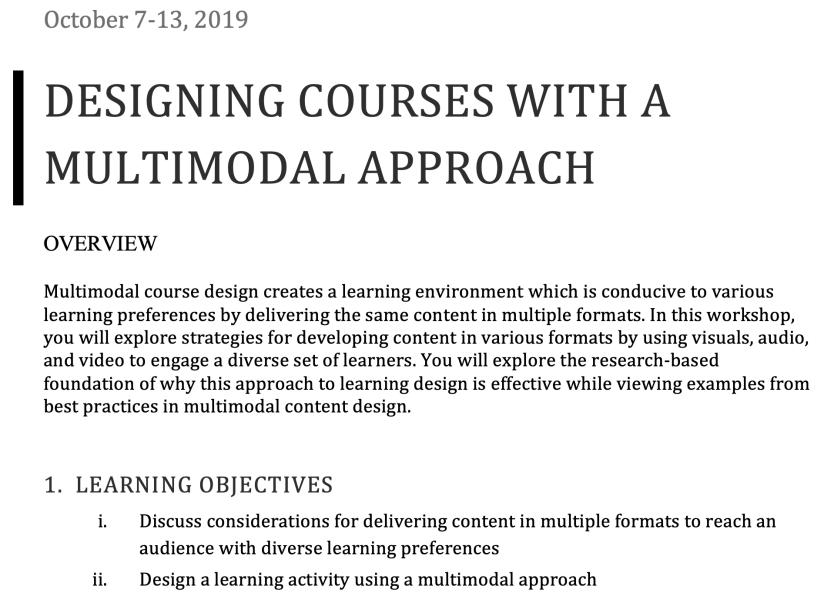
MULTIMODAL CREATE: Text presented in the slide deck + written instructions on the screen PLUS a full transcript as PDF file available for download from Dropbox,  and text format by sending my audio recording to otter.ai — then editing this transcript with links, e.g. https://otter.ai/s/HCmFi2ZcTRKdQgXgH7TeiQ Beyond these text versions, I also added this transcript to the Closed Captions on the YouTube video and edited it for timing accuracy.

Visual Meanings

Making still and video images. Similar to the “audio & oral” meanings, there are so many learning tools I have been tinkering with to make this visual for learning and to explain my process for research, design, etc.

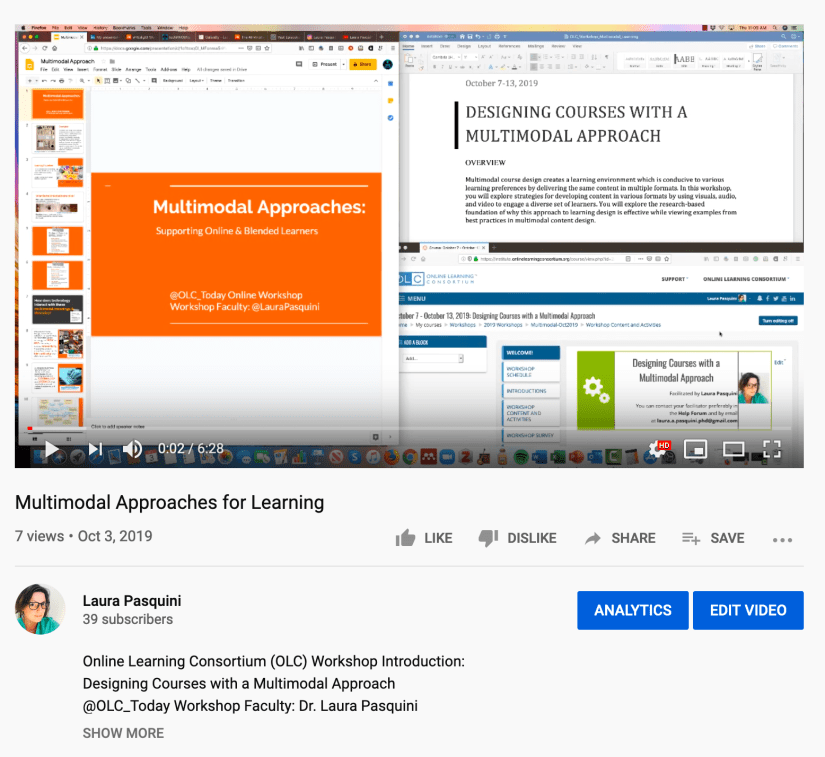
MULTIMODAL CREATE: I decided to source some CC-BY photos, layout my slides and tabs on my screen, and develop a video with these still images and screen directions moving my mouse around the course, to different tabs, etc. to review the course resources.
Spatial, Tactile, & Gestural Meanings

Positioning oneself in relation to others; Making experiences of things that can be felt; and Communicating through movements of the body, facial expressions, eye-movement, demeanor, style, etc.

MULTIMODAL CREATE: This one can be a bit more challenging in a digital environment; however, I decided to “bring in” my learners by building a rapport, sharing a bit about how I approach multimodal learning in my work, and offer them my personal interests and ideas by scrolling through my Instagram page images, sharing about the podcasts I produce/host, and telling them about the #femedtech network I’m curating this week. Although my learners will not see my physical gestures on this video/screencast, they are able to get a feel for who I am, how I relate to their learning objectives of the workshop, and what experiences I hope we can share as we work on multimodal approaches together.

The things that are not said about designing a multimodal approach for learning, that should be noted:

  1. It takes some creative planning to identify how you can offer learning content in multiple modes and formats, specifically to reach your learning outcomes/goals in a course.
  2. Multimodal levels the playing field — it allows for Universal Design for Learning, accessibility, portability, and choice for how learners can participate.
  3. Multimodal approaches for learning REQUIRES TIME to do it well — so start small. Try re-designing or creating at ONE learning activity, object, or aspect of a course you are instructing.

Do you have advice and suggestions for multimodal approaches for learning design?

Let me know! Over the next week, I have no doubt you will see me tweeting about this workshop using the hashtag #multimodalLX. I strongly encourage and welcome YOUR suggestions, resources, and advice for how to design digital learning experiences in a variety of modes and format.

Reference:

Kalantzis, M., Cope, B., Chan, E., & Dalley-Trim, L. (2016). Literacies, 2nd Ed. Melbourne, Australia: Cambridge University Press
#FemEdTech

Holding A Mic Up for #FemEdTechVOICES on #InternationalPodcastDay

Happy #InternationalPodcastDay, y’all! If you were not aware, TODAY, September 30th celebrates all those pods we listen to around the world. It’s true! https://internationalpodcastday.com/

“The celebration is a great opportunity to connect with fellow podcasters, podcast listeners, podcast enthusiasts, and leaders in the podcasting industry. Help spread the word by telling your friends, sharing the celebration on your podcasts and social media feeds, and using #InternationalPodcastDay. There are several ways to get involved and plenty to benefit from by taking part in International Podcast Day.”

To start the pod conversation with you this year, I want to amplify the voices of women in educational technology. As the designated “curator” for the @FemEdTech network, I’ve been sharing presentations, talks, podcast hosts, and episodes featuring interviews/conversation from members of the ##FemEdTech community using the hashtag #FemEdTechVOICES

Thanks to those of you who have shared the podcasts, episodes, and more using the #femedtech hashtag or tweeting/DM -ing the @femedtech Twitter account. I appreciate your suggestions and curating these does take a small digital/global village online. 🙂

To properly curate and share all the recommendations, I present an open Google sheet I hope YOU will contribute to this week… and beyond! Expect to find this repository on the femedtech.net website soon.

Or just click on this link:

http://bit.ly/femedtechvoices

to find three tabs organized to share the #FemEdTechVOICES — the talks, presentations, podcasts, episodes, etc. we need to hear. Here are the tabs and more about this spreadsheet’s organization:

  1. Recommended Podcasts for the #FemEdTech Network: This tab of the spreadsheet is to curate the podcasts the #femedtech network would want to subscribe and listen to. Please include the podcast name, URL link where we can subscribe or find it online, and the brief description of this suggested podcasts. Typically we are interested in podcasts created for and/or hosted by women involved in teaching, learning, ed tech, academia, or general issues impacting feminism. {If you need to understand what the #femedtech network is about: femedtech.net/about-femedtech/}
  2. Suggested Podcast Episodes & Interviews: This tab of the spreadsheet is to share a specific episode we should listen to. This might be an interesting interview with a member of the #femedtech network, or perhaps a conversation topic relevant to this community.  Please be sure to include the Podcast/Show Name, Episode Number/Title and URL link to the SPECIFIC episode audio and maybe even the show notes, description, etc., if available.
  3. Amplifying Your Talks, Presentation, & Panels: This tab of the spreadsheet is to include a link to either your or other #femedtech presentations. This might be a conference session, workshop, webinar, keynote, or panel you contributed to related to this network. Please include the speakers names/Twitter handles, Conference or Event Name, Title of the Talk, and link to where this presentation can be viewed (e.g. YouTube, Google Slides recording, webinar archive, etc.) You can promote an upcoming session or future talk, but ideally — we’d love to hear and watch the recorded archive if there is video or audio available.
#FemEdTech, Learning Community, Networked Community

Curating & Amplifying the Voices of #FemEdTech

For the next couple of weeks (September 23 through October 4), I’m the designated “curator” for the @FemEdTech Twitter handle and hashtag: #FemEdTech If you are not aware, this is an organic network of feminists working educational technology who collaboratively and collectively support conversations on Twitter. Learn more at http://femedtech.net/ #MakingTwitterFeministAgain

This voluntary network of peers aggregate and share conversations, resources, posts, ideas,  etc. for and by the #FemEdTech community online. I signed up to curate earlier this year, as y’all know my love for online, rogue networks that lift others up and share knowledge. The purpose of #FemEdTech is to tweet, retweet, and amplify those in the community so… for the next couple of weeks, I will be curating all of the #FemEdTechVOICES !!

My plan is to connect others to the VOICES in the community. These might be the conversations, interviews, presentations, panels, discussions, podcasts, and more — that are shared online and in our professional circles. I want to SHARE and TWEET upcoming and past presentations, podcasts, talks, and panels where you are sharing your work, expressing ideas, curiously learning, and showcasing the things you love in education technology (and maybe life). As the Fall 2019 Conference season is now in full swing — this means that many of you will be presenting sessions, moderating panels, giving talks/keynotes, and more. Why not tell this lovely network all about it in advance to #HumbleBrag about your work AND if it’s being digitally archived/recorded — why not share with this network. This might be your presentation slides, a video/audio recording, a webcast or webinar, or a future session others should check out with the conference hashtag. If you have a presentation, why share about it with the #FemEdTech hashtag?

Also, how could I not share your ACTUAL voice(s) you might have recorded for an audio presentation, recorded panel, or even a podcast you have been a part of — either as a host or guest?  Is there a podcast you might recommend the #FemEdTech network should check out as well? Tell me about it.  With #InternationalPodcastDay just around the corner (September 30th), I want to curate a list of podcast episodes, series, and shows the #FemEdTech network will want to listen to and learn from — so be sure to tell me what’s caught your ear?

Want to amplify a presentation, podcast, OR voice for the #FemEdTech network? Here’s how:

  1. Post a TWEET with your “VOICE” (presentation, podcast, etc.) that includes the #FemEdTech and/or #FemEdTechVOICES hashtag so I can RETWEET it.

  2. COMMENT on this blog post to tell me WHO and WHAT voices need amplifying in the #FemEdTech network, and I would be happy to brag, boast, and share.

  3. Send me a direct message (DM) on Twitter to @femedtech or @laurapasquini, if you’re a bit shy about highlighting your own work/voice/presentations/podcast — I can do it for you!

  4. EMAIL me by sending me a message through my “Let’s Connect!” page on this website.