Learning and Performance, Professional Development, Training & Development

Twitter to Enhance Learning & Performance

Twitter provides the opportunity to have micro-conversations in 140 characters or less. This social media platform has been repurposed by a number of educators for workplace learning. Twitter is not the only form of professional development available and you do not have to tweet to learn.  That being said, an increasing number of educators have repurposed and remixed Twitter for work learning and performance. You would be surprised what 140 characters can do to create community and interaction online. A number of grassroots initiatives have developed for educators to consider Twitter as part of their professional development plans for informal learning, scholarly development, and shared practices. For me, the last seven years spent on Twitter has been invaluable. This platform continues to provide an open, informal learning space to collaborate and banter with a community of educators. Thanks for that, Larry.

Twitter Bird in the Lattice

Flickr photo c/o Brian Kopp

Twitter is really the “water-cooler” for educators to share news, post reports/trends, read the news, review research, ask questions, gather information, and curate knowledge. Educators are increasingly expressing ideas and links to relevant websites, videos, articles, images, etc. related the workforce.  This commentary and resources were shared for my own learners and other training participants who want to “get started” with workplace learning and performance – so I welcome your shared suggestions for helpful Twitter resources and tips in the comments below.

The Twitter Basics:

Hashtags & Backchannels

GotHashtag

Hashtag: A symbol used in Twitter messages, the # symbol, used to identify keywords or topics in a Tweet. The hashtag was an organic creation by Twitter users as a way to categorize Twitter messages and link keywords posted on Twitter. Besides a current event or pop culture reference, Twitter has been an essential part of the conference tool kit to support sharing on the backchannel. You no longer have to be in-person to engage in the workshops, presented talks, or round table discussions via the live experience. There’s now a full stream of activity created around single hashtags for professional development and workplace learning events.

Here are just a few Hashtags to SEARCH and Follow:  

  • #AcWri (academic writing)
  • #highered
  • #digped
  • #edtech and #onlinelearning
  • #phdchat and #gradchat and #SAdoc
  • #Open and #OER and #openaccess
  • #acadv (academic advising)
  • #StudentAffairs and #sachat
  • And MORE!
  • P.D. hashtags related to your field and conferences, e.g. 2015 Education and Ed Tech Conferences [Psssst… you can add to it if  I’m missing any!]

What Is a Twitter Chat and How to Make the Most of ItTwitter chats are threaded discussions using a hashtag to dialogue about a specific subject.Twitter chats are linked conversations via a single hashtag that participants can search, follow, and include in their own Tweet as they respond during the Twitter chat time. Twitter chats are similar to online chats, forums, or discussion boards; however, they are often synchronous and active during a designated date and time. The hashtag for many chats continues past the “live” event on Twitter for others who want to share and engage. Some Twitter chats guide the discussion or have open topics central theme, while others Twitter chats are moderated in a structured question-response format. E.g. Edu Chat Calendar http://bit.ly/educhatcalendar and the Twitter Directory from IHE. 

Other Twitter Tips & Resources:

Professional Development, SAchat, Training

Twitter for Professional Development… Make it Part of Your PD Plan. #SAchallenge

In the field of learning and performance, there are a number of ways to train and develop employees. A number of professional organizations and educational institutions are interested in supporting online learning communities to enhance learning and development for “the workforce of tomorrow.” This often results in going to where the communities are already active online, i.e. social media. A number of social spaces, including blogs, videos, microblogs, and photo sharing websites, have been repurposed for training and development by the community. One of the largest areas for professional development has been on Twitter with users aggregating around a hashtag to form a community. In higher education, a number of Twitter-based communities of practice are emerging as the “combination of improved facility and user flexibility has created an environment in which networks and communities, albeit of a restricted kind, can flourish (Lewis & Rush, 2013).

sachallenge

It is no wonder why we see The #SAChat January Twitter Challenge #SAchallenge appear with the start of the new year. Although I’ve been loosely off the social grid for the holidays, I tuned back in to find January #SAChallenge prompts posted to get connected and involved on Twitter:

During the month of January, we will be tweeting out various challenges and ideas of ways you can engage on Twitter – starting with basic how-tos and moving towards looking at different ways to engage through the medium. Each weekday will bring at least one “challenge” – something you can do to either learn more about using Twitter or to refresh yourself and make you think about using it differently, especially within the #SAChat community. We’ll be posting the challenges here if you miss one and want to catch up.

I applaud the @The_ SA_Blog community managers for facilitating the #sachallenge.  To best support learning and development, The SA Collective L-Team are actively supporting their online subscribers and cultivating the #SAchat hashtag, by utilizing these key community management skills:

  • Listen. It might be a great space to broadcast and disseminate content – but that’s not how you hold a conversation. What do people what to talk about, not just receive? What is the online community engaged in? What are the conversations about online? Take a minute to read and learn from others online.
  • Participate. You need to be a community member, too. Try to join conversations as a peer contributor, not a facilitator. Contribute useful ideas, articles, research, and more. Your online community will want you to be actively sharing online like others in their learning community.
  • Include. Let others help find and create content, guide conversation, start new discussions. It’s a change for many of us in the field who what to “lead” the professional development experience but will pay off in a more vibrant, sustainable community. Encourage members of the community to be the active voice.

I think Twitter is a key component of my own learning and development, and I often encourage others (i.e. students, professionals, faculty, etc) to set up their own Twitter handle [HOW TO: Set Up a Twitter Account], and/or follow along with the community hashtag. I am also more than happy to connect and chat with those of you who reach out to me on Twitter (a.k.a. @laurapasquini), or by any other means if you want to to talk about Twitter or professional development. Although the #SAchat hashtag focusses on the Student Affairs arena there are a number of other higher education and discipline-based Twitter communities to follow.   

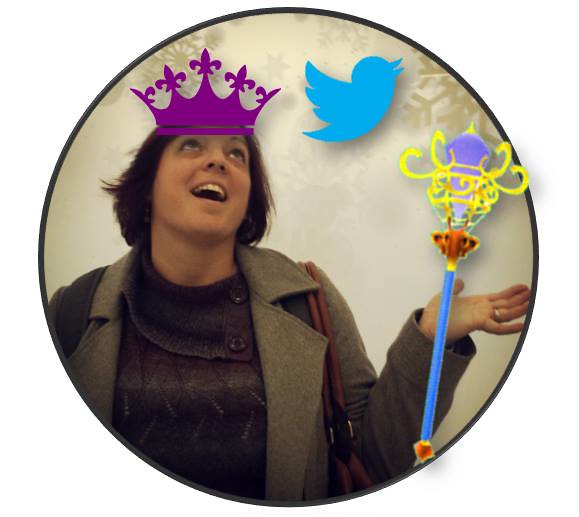
Dubbed the Twitter Queen by @hglez9

Photo mashup credit goes out to @hglez9

That being said, I also caution using Twitter as the only means for learning and development. As an avid Twitter user, who has learned a great deal from tweeting over the past few years, I have a healthy skepticism that Twitter is the “best” platform for delivering professional development. Apparently, I am not alone. Audrey Watters recently asked this question in her blog post “Is Twitter the Best Option for Online Professional Development?” and identified both its benefits and challenges. Twitter has created opportunities for conversation, research, collaboration, and support; however I have also witnessed spam bots, self-promoting followers, bullying, disciplinary implications in academia, and other not-so-nice things.  I was reminded by Audrey that “there is a fragility to our ability to connect and share online. Some of that fragility comes when we opt to rely on for-profit companies to run the infrastructure. We do not own the conversations on Twitter. We have limited control over our data and the content we create and share there.” That is not to say you should not participate and engage – but don’t let Twitter be the ONLY only means for your PD.

In my opinion, I think Twitter can augment, not replace, learning and development. Let Twitter be one part of your professional development plan for 2015, and then ask yourself what do you want to learn? Think about what goals you are setting for yourself first, and then consider the spaces you want to engage in this year. Always put your PD goals ahead of the platform, and then go searching for where you want to engage this year. You might also consider searching out training and development opportunities at your institution, at your professional associations, with trade/professional journals, by reading new literature & books, through research projects, signing up for a course/seminar/webinar, by conducting an informational interview, by reaching out to others in your network, and always by discussing your goals with mentors and peers from the field. Perhaps you might even take the time to reflect on these training experiences when you return to/start some “bloggery” (Thanks for the term, Bryan) to process your learning and development. Good luck with your PD goals for 2015! Let me know if or how I can help.

References:

Lewis, B., & Rush, D.  (2013). Experience of developing Twitter-based communities of practice in higher education. Research in Learning Technology, 21. Retrieved from http://www.researchinlearningtechnology.net/index.php/rlt/article/view/18598 doi: http://dx.doi.org/10.3402/rlt.v21i0.18598.

Watters, A. (2014, December 17). Is Twitter the best option for online professional development? Hack Education. Retrieved from http://hackeducation.com/2014/12/17/twitter-professional-development/.

networkedscholar, Reflections

Vulnerability Comes With Scholars Who Care #scholar14

I feel fortunate to be in a “caring” online  spaces, when it comes to my research and writing development.

turtle-dont-be-afraid-to-be-vulnerableOver the course of the last few years I have met a number of doctoral researchers, early career scholars, and seasoned academics who actively participate and encourage open dialogues online (within Twitter hashtags, blogging communities, podcasts, and more). I know this is not always the case. In the world of academic contribution and competition, there are a number of hurdles along the tenure track and moving forward in post-secondary education leadership positions. By sharing what you do, in the network, you expose your own process, development and self. This includes the good, the bad, and the ugly of the experience:

“Sharing a story about yourself makes you vulnerable. Since stories are about transformation, telling a personal story requires you reveal a flaw, error, or a roadblock that was a difficult to overcome. Professionals are nervous to reveal their struggles at their place of work for fear it will open them up to judgment or criticism” (Duarte, 2014).

Last week, the Networked Scholar course (#scholar14) was fortunate to have Bonnie Stewart (a.k.a. @bonstewart) share her thoughts on the delicate nature of being exposed and real in academic spheres.  If you want to get caught up, watch the video recording, her SlideShare presentation, or review the Twitter notes. It was a pleasure to hear this talk, knowing Bonnie professionally and personally (she may have gone to high school with my cousin – PEI is small), but also because Bonnie brings her scholarship to the network and actively engages in this dialogue beyond the academic sphere:

Although I am not alone, it is through these real and authentic examples in higher education (both faculty and staff), that I am inspired to continue to tell my tale, share, and grow in this networked experience. Not everything will be great, but discussing the process, challenges, joys, and then some has help my own journey. That being said, it is important to be cognizant of the issues within the “networked” space of academia:

This talk left me thinking more about my purpose and intentionality with the “tools” and mediums I use. I share real photos, videos, blogs, tweets, and more about  my authentic self, which include my successes and struggles. This has left me thinking about questions I have in my “networked academic future”:

  • What does this mean for my representation of academic self?
  • How do I challenge assumptions of working in these online spaces?
  • What about potential issues that might happening being as open and honest with research?
  • How can I continue to share my story in an honest way that will contribute to my peers, institutional culture, and discipline?
  • How will I support graduate students and early career researchers who will continue to participate in these online spaces, moving forward?

I think about the challenges academics face (e.g. trolls, research thieves, tenure track requirements, discipline silos, and institutional cultures); however I am inspired to still be in these spaces with researchers, like Bonnie, who have modeled, interacted, supported, and engaged in real interactions related to their research threads. I want to support my peers and the next generation of networked scholars – so the best way I know how to do is to be there.

References:

Duarte, N. (2014, October 29). Are you brace enough to be vulnerable? Retrieved from https://medium.com/@nancyduarte/are-you-brave-enough-to-be-vulnerable-5a09bd99c4c4

Stewart, B. (2014, November 3). Networks of care & vulnerability. SlideShare. [Lecture slides]. Retrieved from http://www.slideshare.net/bonstewart/networks-of-care-vulnerability

networkedscholar

Once A Networked Scholar… Always One? #scholar14


Social media is my thing (so I’ve heard). Really, the THING about social media is the SOCIAL. Throughout my personal, professional and academic career, I have touted the value of my personal learning network on Twitter. I give credit to this 140-character medium as it daily contributes to my literature review, data collection, and connected engage in my discipline.

I am not alone in the love of Twitter and scholarship. Other academics have identified value in Twitters’s role for scientific publication and power of dissemination when shared among the network of scholars. In contrast, there is a dark side to being in this particular space (“they” say). I shared this article earlier in the stream today, “To tweet or not to tweet: academic freedom and social media” – if you have not read it,  you should. This article is one of MANY that calls into question the use and impact of social media networks in academia. As an early career researcher, I am interested in learning more about the impacts to the field and the influence digital scholarship has for teaching, learning, service and research scholarship. {More on this research and work… to come.}

csfzzj3z-1412558503


I have a number of questions that need answers on the networked/digital scholar topic:

  • How will social networks shape tenure and promotion?
  • What issues do academics face, when being active in social media spaces?
  • What challenges will emerge with the use of transmedia for research and learning in post-secondary education?
  • Will digital scholarship impact and shift how tenure and promotion?
  • What other influences should be considered for impact factors and scholarly contributions?
  • How does the digital influence our own doctoral programs & preparation?
  • How digital influence truly effect impact factors for research? Should it?
  • What information do we know about “the networked scholar”?

These are just a few of my questions. I have more. I signed up for George’s (@veletsianos) Networked Scholar (#scholar14) MOOC to continue this dialogue and bat around a few ideas with other interested scholars. I am looking forward to continuing my meanderings on my blog and, of course, on the Twitters => #scholar14 Won’t you join in the discussion and banter as well? http://networkedscholars.net/

#AcWri

#iamAcAdv – The #AcAdv Chat Community Topic for the NEXT @AcAdvChat

#iamAcAdv Join us for Tuesday’s (4/15) #AcAdv Chat from 12-1 pm CT on Twitter as the academic advising community discusses, shares,  and challenges ideas put forth in a recent article and blog post. Follow the moderator (MOD) @AcAdvChat  and conversation on Twitter with the #AcAdv & #iamAcAdv hashtags From my own experience, Jeff Selingo’s thoughts that faculty in higher education are not advising , are completely off the mark and inaccurate:

“While advising takes time away from research and teaching, not all professors favor relinquishing their role to professionals. Many see themselves as essential fonts of information about majors, courses and graduate school. But there are also fewer full-time faculty members around to do mentoring.”

In response to the inaccurate quotes from this article, Dr. Charlie Nutt, Executive Director of NACADA, responded in an Inside Higher Ed blog post follow up and on the NACADA Blog he says:

“believe[s] very strongly in faculty involvement the academic advising experiences of students. That role must be carefully defined and implemented. My statement as quoted in the article appears to be negative toward faculty advisors or faculty advising and that was not my message.  My message was that institutions must look carefully at their missions, their students, and their structure to determine the best advising processes.”

From my own experiences, I know the Academic Advising Community is strong, and might have a thing or two to say about the commentary above. I look forward to hearing from NACADA members and my @AcAdvChat colleagues, which INCLUDE  instructors, faculty, professionals, personal tutors, and more who comprise a diverse academic advising community. Follow  and contribute to the current conversation using the #iamAcAdv hashtag. Let me know “who advises best” …or better yet answer the how and what helps us support our students BETTER. How are you advising in the community? What does academic advising mean to you on your campus? 

Who is part of the Academic Advising Community & what we’re about => #iamAcAdv  UPDATE 4/15/14: The #AcAdv Chat group Discusses what it means to be part of the #iamAcAdv community [Transcripts]  Thoughts from @jselingo – the author from the NYT article post chat on Twitter, with tweet backs from myself and Marsha Miller: