Dissertation, Social Media

Policing Social Media in Higher Ed: Implementing Policies on Campus

During the course of my dissertation research, a few events connected to the scope of my study, and directly to the social media documents I was gathering.  I ended up building a database of 250 post-secondary education (PSE) institutional guidelines and policies to completely understand HOW the PSE sector is ACTUALLY  “guiding” social media. More importantly my research uncovers the organizational identity and cultural values of social media among 10 different countries. {More to be shared post dissertation defense June 12, 2014.}

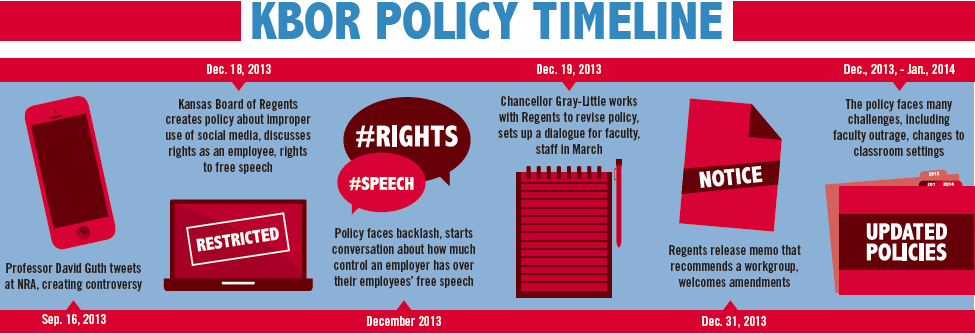
If you are interested in either research around policies and/or social media impact to organizations, specifically post-secondary education, then you most likely heard about the Kansas Board of Regents approval to amend their policy manual back in December 2013 to outline “improper use of social media by University of Kansas faculty.” If not, I have an article and infographic of the timeline of events for you:
KBOR Policies

Image and article credits from The Daily University Kansan ().

Concerns about social media use have been a continual debate and topic for higher education for at least a decade. There have been challenges to using social media accounts for “official” use, faculty blogging, HR employee regulations, or just a general “need” for increased policy implementation among a number of colleges and universities.  The PSE sector is not alone. The K-12 sector and other industries also are keen to social media polices around use and sharing for their stakeholders.

All THAT being said, I have a few questions for you:

  • HOW does (or will) a social media policy influence and impact your institutional culture?
  • Does (or will) your social media policy support your student services or research at your organization?
  • What goals and outcomes do you (or will you) achieve by implementing a social media policy on campus?
  • Does your (or will your) policy consider helpful guidelines, suggested practices, and/or training and development?
  • How does (or will) your social media policy be implemented with regards to teaching, service, and research scholarship?

Or is your PSE concerned with communication control and organizational management?  I would hope your institution of higher learning does not limit user interaction, community engagement, or general opportunities to share opinions.

From my dissertation findings, I hope to continue on this thread of research to identify ACTUAL use, related to the social media guideline and policy documents I have studied, to further understand how participation and interactions on these social media channels influence organizational identity and culture on campus. Is your campus listed in my PSE institution sample? Are YOU interested is getting involved in this type of research? Let me know.

Training & Development

Social Media to Support Your Organization

Last week I was invited to participate in the Southlake Chamber of Commerce’s UNT Professional Develop Fridays. I wrapped up the series by discussing how to effectively plan and organize social media resources for to build a community for businesses and organizations in the city.

This workshop focussed on strategies and practical applications of how social media platforms can be utilized to enhance organizations, with regards to:

  • Effective communication and marketing methods
  • Customer engagement and community development
  • Development of a communication strategy to support organizational goals
  • Implementation of social media tools to enhance goods & services

We discussed how their organizations in Southlake could “get social” (Twitter notes from the session: #SocialSouthlake) by connecting business strategies to broader communication plans and community management ideas.

Discussion points from this workshop included:

  • Be an active participant in social media platforms – explore before you plan
  • Set goals that are realistic with social media – pick 1-3 platforms to start with and use them well.
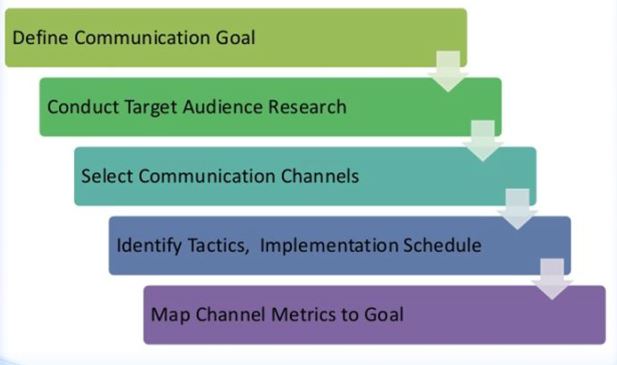
  • Map out a strategic plan for social media implementation (see worksheet) connected with your business plan.
  • Research your community and partners in the industry – get to know your audience and others participating in your potential community
  • Consider methods that build and growth your community offline and online
  • Designate a community manager, or a few to lead your development and planning
  • Identify champions from your community, i.e. individuals who are active participants from within the community, who will support your social media implementation and growth
  • Plan content directly connected to your purpose and mission
  • Effective methods to measure and track progress related to goals


Additional resources from this session can be found here: http://bit.ly/SocialSouthlake

Thanks for the invite @Southlake_CC … be sure to keep it social. 🙂

Social Media

Digital Clean Up: Social Media Audit & How Not to Be Hacked

As a digital ethnographer and networked researcher, I tend to play in different social (media) spaces. I typically try out new websites and platforms that I hear about from other scholars, practitioners, and researchers. Most of you know I can be found in a few key social media spaces (I’m looking at you Twitter, WordPress, SlideShare & Flickr); however I do use a number of other social platforms to collect, archive, research, collaborate, and write.

2013.04.04_Cleanup_DataImage from responsys.com

Over the past week, I started conducting my own social media audit for what I use and how it’s being used. Part of this is process is to keep track of files and resources, and also think about what I’m sharing and using online. In being purposeful with social media and my web tools, I wanted to see what I am using or not using. Recently I have been cleaning up a few of my digital spaces, to take inventory and assess how I’m using these spaces personally and professionally.

For example, I updated a title on a LinkedIn employment role by adding “Graduate Student” to my Research Affiliate position for the Center for Knowledge Solutions (which I have been contributing for the last couple of years), and I received a number of “congratulations” for the “new” job:

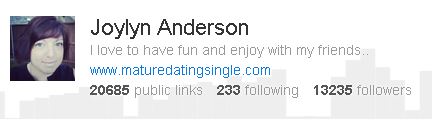
Screen Shot 2013-12-15 at 11.47.33 AMThen I discovered my name had changed on my Delicious account. I use this account to archive my tweets & tags for what I share on Twitter, so I was surprised to find my new found love for “fun and enjoy with my friends” while advertising mature dating single websites:

Delicious HackThis was quickly fixed within hours thanks to the Delicious Team, and I’m back to my normal nerdy self on this social bookmarking website:

Screen Shot 2013-12-13 at 9.03.00 PM

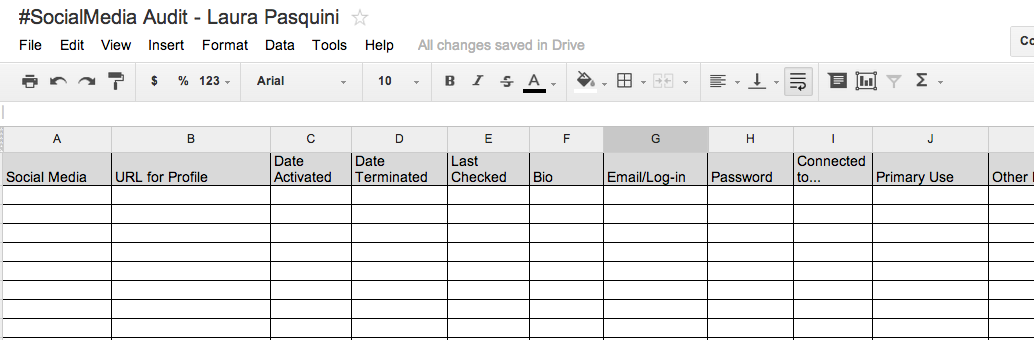
This incident reminded me it was time to review my social media spaces to see what I use and what I need to lose. It is easy to take advantage websites like JustDelete.me to kill off your pages; however I wanted to take stock of what I am using and document how I am using it. To assess my digital footprint and identity, I started my own social media audit spreadsheet o’ fun with the following columns:

  • URL for the profile
  • recordupdate passwords
  • review account settings (privacy)
  • date activated
  • date terminated (if deleted or archived)
  • verify information is correct
  • update bio, picture, etc.
  • review platform access & connections
  • assess unused or less accessed social media spaces to delete
  • identify how these social media platforms are being utilized

Screen Shot 2013-12-15 at 12.50.53 PM

Have you conducted your own social media audit lately? If so, how have you review and cleaned up your online accounts on your various social media platforms? How do you keep track of what social media spaces you use? Please share any tips & tricks. Thanks!

Dissertation, PhD, Social Media

Your Higher Ed Website + Search: “Social Media Guidelines” or “Social Media Policy” = A Database for My Dissertation Research

Yes. I know that this may be my  LONGEST blog post title ever. I created it for one reason. It is the equation which will help me move my research forward for my dissertation.

featuredimages_socialmedia

You may recall a previous request for this from an earlier blog post: Gathering #SocialMedia Guidelines from #HigherEd. So, basically what I’m saying is…

I NEED YOUR HELP! => Submit Your Social Media Guidance Please!

My dissertation research methodology (good ol’ Chapter 3) will involve text mining analysis for reviewing all these many social media guidelines (policies, strategies, beliefs, regulations, etc. included) I am gathering right now. The caveat for this type of research is –  I need to build a large enough database of documents to examine and evaluate. BONUS: After collecting all of these documents, I will share this Social Media Guidance database AND my research findings for you here: http://socialmediaguidance.wordpress.com/

As of today (4:30 pm CT), I have collected approximately 176 Social Media Guidance documents from 13 different countries. Hoo-ray!

Check to see if your institution is listed below, and if it is not – please SEARCH YOUR COLLEGE OR UNIVERSITY WEBSITE to see if you might just happen to have social media guidelines, a policy, a directory, and/or anything that might be related to social media. Thank you!

Social Media

Do You Have Social Media Goals?

After participating in today’s Social Media Metrics in Government Using GSA Guidelines webinar hosted by Hootsuite, I began to think more about the WHY and HOW social media guidelines and policies develop. This session discussed how the government developed their guidelines around their GSA social media goals which were connected to their strategic communication plan and web presence.

Obviously this webinar had a focus on measurement and assessment for social media use using both free and paid tools, like Hootsuite; however it offered some sound advice to organizations that are just developing social media guidance or for those who are re-thinking their social media policy. Instead of starting with a policy, strategy, or guideline list of what to do or not do, it would be more helpful for institutions to think through the WHY of social media. This process provides organizations focus, sets out objectives, and creates a rationale for social media use and how these goals might be measured and assessed. For example, the GSA wanted to use social media and social data goals, included:

  • Be more effective in how they distribute critical information to citizens & communities
  • Engage citizens to help shape to public programs
  • Better inform strategies leading to greater efficiency
  • Increase use of innovative tools and services to further development

It is important to consider your institutional goals when organizing your social media guidance, here a few suggestions given from the webinar – but I am sure your organization has many others.

Internal Considerations:

  • Collaboration
  • Knowledge sharing
  • Cost saving & cost avoidance strategy
  • To be transparent
  • Talent acquisition

External Considerations:

  • Citizen engagement – Active use and participation (2-ways)
  • Promote services and resources
  • Provide customer service – feedback
  • Provide real-time resources – expand upon current communication channels

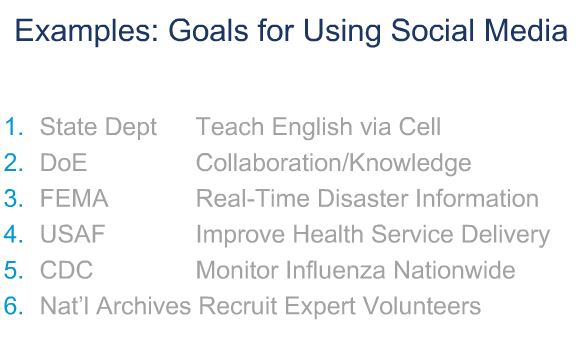
Here are a couple of examples shared from the GSA for their use of social media goals:

Example of Goals for Using Social Media in Government

Another reason to consider developing social media goals before establishing your guidelines is to consider how you will evaluate social media use for your organization. Social media management of your resources is critical. To help assess social media engagement and use it will be helpful to align your goals to evaluation as part of your strategic communication plan. Social media analytics and metrics through different 3rd party tools and social dashboards; however what will be relevant for your organization to track and use for assessment purposes. You want to connect your goals to your key performance indicators (KPI) and desired evidence-based outcomes.

Planning for Measurement

One example was the use of hashtags from the Twitter for Public  Health case study to outline a clear system for planning social media management. This public health group utilized a hashtag, #SM4PH, to build hype around the start of a regular, organized Twitter chat and to launch a hashtag for community development. Their goal was to measure the impact of the hashtag use, conversation, and community involvement before, during, and after this first chat to assess the long tail of this campaign.

Does your organization or institution have social media goals? How do these goals support your social media spaces? How do you assess and measure your social media goals? Let me know.

Reference:

Macey, B. (2013, November 14). Social media metrics in government: Using GSA Guidelines – Webinar. HootSource. Retrieved from http://blog.hootsuite.com/social-metrics-gsa-guidelines/

UPDATE 11-19-13: If interested, this webinar is available for viewing on demand.