edusocmedia, Social Media

How is social media being researched to support student development/success in higher education beyond the “classroom”?

I recently curated a  reading list of literature/research on social media and technology use, specifically outside the higher ed “classroom” for a colleague at Niagara University, Dr. John Sauter. For his Sociology of Higher Education course, John wanted to share readings that demonstrate how social media and technology are being utilized outside formalized learning, and provide more information beyond the Social Media Resources [from the WNY Advising group] the practical guides/strategies. A recent prompt from my #edusocmedia friend Ove, made me think that this short list should be shared and hopefully expanded upon – enter this blog post.

Screen Shot 2015-02-22 at 12.02.04 PMImage c/o mkhmarketing on Flickr

In searching online, you will find that there are no shortage of “how to” and “social media strategy” publications – which often bridge the marketing, communications, education, business, and student affair disciplines. A growing number of  bloggers also share suggestions for social media use, community development, and campus engagement; however  my focus was to find recent RESEARCH in post-secondary education that examined how social media and emerging technologies are impacting student life, support, and success outside the “classroom” (face-to-face, online & blended learning) environments.

To consider social media perceptions and use outside of formal learning environments, it is important to gain insight from recent studies around learning in higher education with technologies, including:

Junco, R., Heiberger, G., & Loken, E. (2011). The effect of Twitter on college student engagement and grades. Journal of computer assisted learning, 27(2), 119-132.

Junco, R. (2012). Too much face and not enough books: The relationship between multiple indices of Facebook use and academic performance.Computers in Human Behavior, 28(1), 187-198.

Junco, R., Elavsky, C. M., & Heiberger, G. (2013). PuttingTwitter to the test: Assessing outcomes for student collaboration, engagement and successBritish Journal of Educational Technology, 44(2), 273-287.

Junco, R. (2015). Student class standing, Facebook use, and academic performance. Journal of Applied Developmental Psychology, 36, 18-29.

Muñoz, C. L., & Towner, T. (2011). Back to the “wall”: How to use Facebook in the college classroom. First Monday, 16(12).

Roblyer, M. D., McDaniel, M., Webb, M., Herman, J., & Witty, J. V. (2010). Findings on Facebook in higher education: A comparison of college faculty and student uses and perceptions of social networking sites. Internet and Higher Education, 13(3), 134-140.

Rodriguez, J. E. (2011). Social media use in higher education: Key areas to consider for educators. MERLOT Journal of Online Learning and Teaching, 7(4).

Silius, K., Kailanto, M., & Tervakari, A-M. (2011). Evaluating the quality of social media in an educational context. International Journal of Emerging Technologies in Learning, 6(3), 21-27.

Wakefield, J. S., Warren, S. J., Alsobrook, M., & Knight, K. A. (2013). What do they really think? Higher education students’ perceptions of using Facebook and Twitter in formal higher education learning. International Journal of Social Media and Interactive Learning Environments1(4), 330-354.

**Shout out to Josie Ahlquist for also sharing a wealth of resources on her Reference List page related to this topic as well and more related to student development theory and youth culture in media!**

My focus for this class reading list, was to find recent (2011 forward) peer-reviewed publications that share implications and findings from research on how social media impacts support/success in higher ed beyond the instructional context. Yes. Student affairs, academic advisors, and the like, in student support areas of higher ed, ARE educators – however social media/technology use for learning without the weight of the grade “carrot” does impact and influence adoption/use. In looking around, I found a number of recent literature reviews and compilations that look at social media in higher education – here are a select few I thought I would share:

Davis III, C. H., Deil-Amen, R., Rios-Aguilar, C., & Gonzalez Canche, M. S. (2012). Social Media in Higher Education: A literature review and research directions.

Hew, K. F., & Cheung, W. S. (2013). Use of Web 2.0 technologies in K-12 and higher education: The search for evidence-based practice. Educational Research Review, 9, 47-64.

Lewis, B., & Rush, D. (2013). Experience of developing Twitter-based communities of practice in higher education. Research in Learning Technology21.

Rios-Aguilar, C., Canché, G., Sacramento, M., Deil-Amen, R., & Davis III, C. H. (2012). The role of social media in community colleges.

Tarantino, K., McDonough, J., & Hua, M. (2013). Effects of student engagement with social media on student learning: A review of literature. The Journal of Technology in Student Affairs.

Tess, P. A. (2013). The role of social media in higher education classes (real and virtual)–A literature reviewComputers in Human Behavior29(5), A60-A68.

For my own interest, I decided to conduct a preliminary literature search to determine “How is social media being researched to support student development/success in higher education beyond the “classroom”?  This is NOT a comprehensive list, but more of a primer to initiate a more comprehensive search for recent (2011 forward) scholarly publications involving research on this topic:

Al-Harrasi, A. S., & Al-Badi, A. H. (2014). The Impact Of Social Networking: A Study Of The Influence Of Smartphones On College Students. Contemporary Issues in Education Research (CIER), 7(2), 129-136.

Birnbaum, M. G. (2013). The fronts students use: Facebook and the standardization of self-presentations. Journal of College Student Development54(2), 155-171.

Chen, B., & Bryer, T. (2012). Investigating instructional strategies for using social media in formal and informal learning. The International Review of Research in Open and Distributed Learning, 13(1), 87-104.

Cheung, C. M., Chiu, P. Y., & Lee, M. K. (2011). Online social networks: Why do students use Facebook? Computers in Human Behavior, 27(4), 1337-1343.

DeAndrea, D. C., Ellison, N. B., LaRose, R., Steinfield, C., & Fiore, A. (2011). Serious social media: On the use of social media for improving students’ adjustment. Internet and Higher Education, 15, 15-23.

Fuller, M., & Pittarese, T. (2012, June). Effectively communicating with university students using social media: a study of social media usage patterns. In 45th Annual Conference June 10-14, 2012 (p. 46).

Graham, M. (2014). Social Media as a tool for increased student participation and engagement outside the classroom in higher education. Journal of Perspectives in Applied Academic Practice, 2(3).

Jacobsen, W. C., & Forste, R. (2011). The wired generation: Academic and social outcomes of electronic media use among university studentsCyberpsychology, Behavior, and Social Networking, 14(5), 275-280.

Lin, M. F. G., Hoffman, E. S., & Borengasser, C. (2013). Is social media too social for class? A case study of Twitter use. TechTrends, 57(2), 39-45.

Lou, L. L., Yan, Z., Nickerson, A., & McMorris, R. (2012). An examination of the reciprocal relationship of loneliness and Facebook use among first-year college students. Journal of Educational Computing Research, 46(1), 105-117.

Joosten, T., Pasquini, L. A., & Harness, L. (2013). Guiding social media in our institutions. Planning for Higher Education – Society for College and University Planners. 41(2), 1-11.

Mastrodicasa, J., & Metellus, P. (2013). The impact of social media on college students. Journal of College & Character, 14(1), 21-29.

O’Brien, O., & Glowatz, M. (2013). Utilising a social networking site as an academic tool in an academic environment: student development from information-sharing to collaboration and innovation (ICI). AISHE-J: The All Ireland Journal of Teaching and Learning in Higher Education, 5(3).

Pettijohn, T. F., LaPiene, K. E., & Horting, A. L. (2012). Relationships between Facebook intensity, friendship contingent self-esteem, and personality in US college students. Cyberpsychology, 6(1), 1-7.

Ternes, J. A. (2013). Using social media to engage students in campus life. (Doctoral dissertation, Kansas State University).

Sponcil, M., & Gitimu, P. (2013). Use of social media by college students: relationship to communication and self-concept.  Journal of Technology Research, 4, 1-13.

Wang, Z., Tcherneve, J. M., & Solloway, T.  (2012).  A dynamic longitudinal examination of social media use, needs, and gratifications among college students.  Computers in Human Beheavior, 28(5), 1829-1839.

If you have published any articles and/or have contributions for research in this area – please add to the list! Post any publication references in the comments or reach out to me to discuss further.  I suspect this quest will continue, and it will also need a few collaborators to be successful. Are you interested in digging into the research to learn more about HOW we are SUPPORTING students in higher education using social media beyond formalized learning structures?  Let’s talk – so we can move forward in understanding the research lay of the land.
EdTech, Higher Education, Online Learning

Research Wanted: Distance Education & Technology in US Higher Ed #DETAsummit

Last week, I was invited to join a group of educators, researchers, practitioners, leaders, and more before #eli2015 to discuss the state of online and blended learning at the DETA Summit (#DETAsummit), hosted by the National Research Center for Distance Education and Technological Advancements (DETA). With the primary role of the DETA Research Center “to promote student access and success through evidence-based online learning practices and learning technologies,” the morning’s agenda was full and the purpose of the DETA Summit meeting was to:

  • Gather key partners and research experts to generate of ideas
  • Brainstorm crucial issues in conducting research and developing coherency in the field of distance education
  • Discuss ideas relating to competency-based education, accessibility, and distance education support

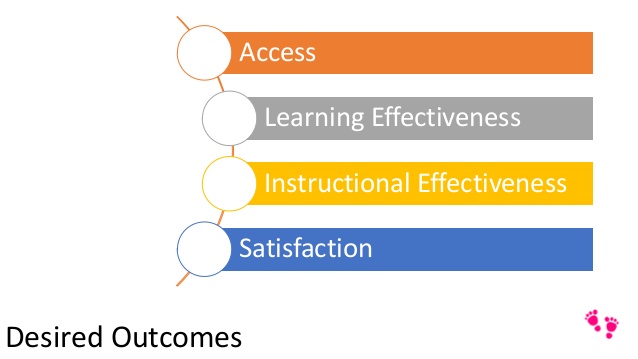
The DETA Research center has desired outcomes that focus on access, satisfaction and learning/instructional effectiveness – read more about these from the grant HERE:

Desired Outcomes

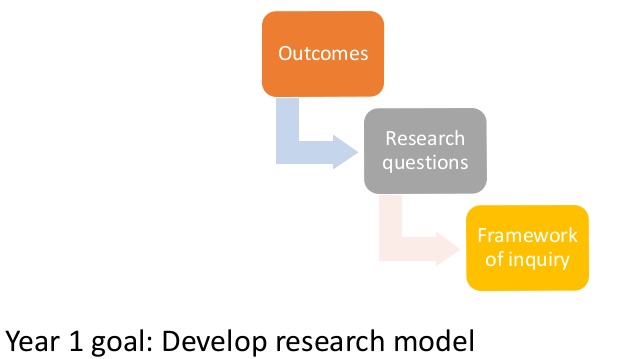
At the #DETAsummit a wide variety of folks gathered with interest to discuss what research should look like for technology and distance education. Looking around the room, it was like a tweet up of all online learning  levels of support, instruction, development, planning, and research from around the US.  The focus of the meeting was to work on the DETA Yea 1 goal: Develop a research model.

Research Model

In facilitating one of the many round tables discussions, our group swapped ideas about potential research questions that should be asked, common definitions under the distance education umbrella, standard variables to measure, known frameworks for inquiry, and shared models being used for online/blended learning assessment. Although we were only given about 3 hours in total, I think the entire room was buzzing with ideas and wanted to continue talking. The conversations were driven to list our top choices on large post-its and vote on top our top choices after seeing what other groups discussed [See post-it voting from my Flickr album]. For the short amount of time, I think the #DETAsummit  was a very productive, and we managed to gain some broader insight into what a research model could look like. With a mixed participant list, there were insights and questions  from varying perspectives and it was rather REFRESHING.

Based on the small group discussions and voting process, the research questions selected are:

  • What are the definitions of success from student’s perspective? | 33 | Wicked Hop
  • What patterns of behavior lead to increased student learning for different populations? | 26 | Safehouse
  • What are the different design components (content, interactivity, assessments) that impact student learning? | 29 | Rochambo
  • How can we define and measure student success beyond traditional outcomes (learning and competency)? | 25 | Benelux

If you are interested in distance education research (e.g. online learning, blended learning, hybrid pedagogy, etc.) I would suggest digging into the conversation and resources from the #DETAsummit. The DETA group is very open and transparent with their development process, as you can find our discussion notes shared in Collaborative Google Docs, listen/view the G+ Hangout Recording, and check out the Presentation Slides that give an overview of the day.

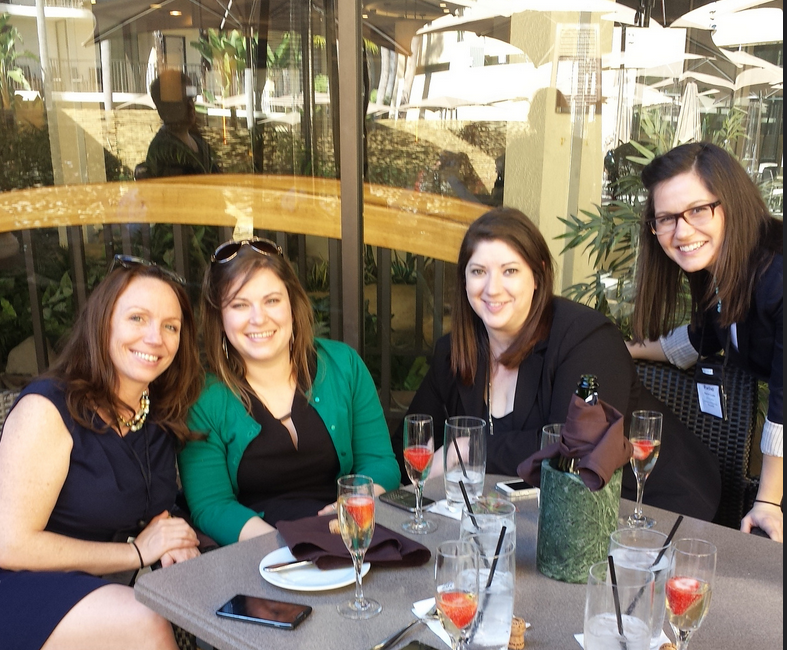
Congratulations to the DETA Team (who I now call the #DETAdivas) on a successful start to the work you have ahead. I look forward to following along with your progress on the grant, learning how your group utilize these research questions, and, hopefully, contributing to a better way to measure/assess online and blended learning.

DETAdivas

Want to stay connected to the research?

EdTech, Higher Education, Online Learning

Online Education in the US [2014 Report]

As I am on my way to the EDUCAUSE Learning Initiative (ELI & #eli2015), specifically to attend the National Research Center for Distance Education and Technological Advancement (DETA) Summit, I figured it was critical to review the 2014 Grade Level: Tracking Online Education in the United States just released from the Babson Survey Research Group (BSRG):

“The study’s findings point to a competitive marketplace, in which traditional institutions are gaining ground on the for-profits in online and distance education,” said study co-author Jeff Seaman, co-director of the Babson Survey Research Group. “While the rapid pace of online learning growth has moderated, it still accounts for nearly three-quarters of all US higher education’s enrollment increases last year.”

It is clear that online learning is on the rise in America – yet there is a vast difference between how administration and faculty view it. A majority of post-secondary education leaders (70.8%)  indicated that online learning is “critical to their long-term strategy;” however these leaders may struggle with online adoption as only 28% of their faculty find “value” and view online education as “legitimate.” A number of findings in this report show opposing views for online education. For example, these two factions of higher differ  by their awareness of open education resources (OER).

OER_FutureHE

There is much more of this narrative to tease out; and I would like to go through this report further (on the plane) and learn what others in the field have to say. For now I will leave you with some of the ‘quick facts’ shared, and encourage you to download and read through the FULL REPORT if you are in the online learning sphere:

Key report findings include:

  • The number of higher education students taking at least one distance education course in 2014 is up 3.7 % from the previous year.
  • The year-to-year 3.7% increase in the number of distance education students is the lowest recorded over the 13 years of this report series.
  • Public and private nonprofit institutions recorded distance enrollment growth, but these were offset by a decrease among for-profit institutions.
  • The percent of academic leaders rating the learning outcomes in online education as the same or superior to those in face-to-face remained unchanged at 74.1%.
  • The proportion of chief academic leaders reporting online learning is critical to their long-term strategy reached a new high of 70.8%.
  • Only 28.0% of academic leaders say that their faculty accept the “value and legitimacy of online education.”
  • The adoption of MOOCs (Massive Open Online Course) is reaching a plateau, only 8.0% of higher education institutions currently offer one, another 5.6% report MOOCs are in the planning stages.
  • The proportion of academic leaders who believe that MOOCs represent a sustainable method for offering online courses dropped to 16.3%.

Update:

A couple areas to note, and for further discussion this week at #eli2015 and the #DETAsummit (Follow @UWMDETA):

Pgs. 43-44: Discuss the under count and over count of distance education, i.e. for “fully online” enrollments – this seems to be hazy, as it might be as learning design for enrollment varies by student population type and course design delivery.

Pg. 44 – “The definition of ‘distance education is causing confusion”

There was an interesting segment in this report that struggled with the term “distance education.” This report takes into account distance education, when looking at “fully online” higher education programs. This part of the report reminded me about the Twitter debate of online learning, online education, distance education, and then some when trying to name an update to an edited book. What terminology is best? How can we describe/define education that is delivered from a distance/online/on the web/virtually? Please advise.

networkedscholar, Reflections

Vulnerability Comes With Scholars Who Care #scholar14

I feel fortunate to be in a “caring” online  spaces, when it comes to my research and writing development.

turtle-dont-be-afraid-to-be-vulnerableOver the course of the last few years I have met a number of doctoral researchers, early career scholars, and seasoned academics who actively participate and encourage open dialogues online (within Twitter hashtags, blogging communities, podcasts, and more). I know this is not always the case. In the world of academic contribution and competition, there are a number of hurdles along the tenure track and moving forward in post-secondary education leadership positions. By sharing what you do, in the network, you expose your own process, development and self. This includes the good, the bad, and the ugly of the experience:

“Sharing a story about yourself makes you vulnerable. Since stories are about transformation, telling a personal story requires you reveal a flaw, error, or a roadblock that was a difficult to overcome. Professionals are nervous to reveal their struggles at their place of work for fear it will open them up to judgment or criticism” (Duarte, 2014).

Last week, the Networked Scholar course (#scholar14) was fortunate to have Bonnie Stewart (a.k.a. @bonstewart) share her thoughts on the delicate nature of being exposed and real in academic spheres.  If you want to get caught up, watch the video recording, her SlideShare presentation, or review the Twitter notes. It was a pleasure to hear this talk, knowing Bonnie professionally and personally (she may have gone to high school with my cousin – PEI is small), but also because Bonnie brings her scholarship to the network and actively engages in this dialogue beyond the academic sphere:

Although I am not alone, it is through these real and authentic examples in higher education (both faculty and staff), that I am inspired to continue to tell my tale, share, and grow in this networked experience. Not everything will be great, but discussing the process, challenges, joys, and then some has help my own journey. That being said, it is important to be cognizant of the issues within the “networked” space of academia:

This talk left me thinking more about my purpose and intentionality with the “tools” and mediums I use. I share real photos, videos, blogs, tweets, and more about  my authentic self, which include my successes and struggles. This has left me thinking about questions I have in my “networked academic future”:

  • What does this mean for my representation of academic self?
  • How do I challenge assumptions of working in these online spaces?
  • What about potential issues that might happening being as open and honest with research?
  • How can I continue to share my story in an honest way that will contribute to my peers, institutional culture, and discipline?
  • How will I support graduate students and early career researchers who will continue to participate in these online spaces, moving forward?

I think about the challenges academics face (e.g. trolls, research thieves, tenure track requirements, discipline silos, and institutional cultures); however I am inspired to still be in these spaces with researchers, like Bonnie, who have modeled, interacted, supported, and engaged in real interactions related to their research threads. I want to support my peers and the next generation of networked scholars – so the best way I know how to do is to be there.

References:

Duarte, N. (2014, October 29). Are you brace enough to be vulnerable? Retrieved from https://medium.com/@nancyduarte/are-you-brave-enough-to-be-vulnerable-5a09bd99c4c4

Stewart, B. (2014, November 3). Networks of care & vulnerability. SlideShare. [Lecture slides]. Retrieved from http://www.slideshare.net/bonstewart/networks-of-care-vulnerability

Academia, networkedscholar, Open Education, OpenAccess

Being #Open Comes with a Number of Assumptions, Challenges and Tensions #scholar14

Being an open educator is critical. From my personal experience, I have engaged and interacted with research, teaching, and service scholarship based on the examples I have seen around me.  A large number of collaborative research and learning opportunities could not have been possible without using open and social platforms. To be a truly effective educator and researcher, I believe it is critical to share our research-to-practice work. It is through transparency and openness, scholars are able to contribute to their discipline, connect to other related fields, and, most importantly, contribute to public knowledge.

open
Photo c/o Flickr member OpenSource.com 

As I think about digital scholarship and “openness” as an early career researcher, there are a number of questions unanswered and need to be discussed further as academia is challenged by the digital (Pasquini, Wakefield, & Roman, 2014, p. 13) :

  • What type of research exchange will scholars participate in during the 21st century?
  • Is scholarship just about publication and citation index?
  • Should research require a social aspect to connect and exchange discourse and/or debate?
  • What social media and altmetrics are best suited for interaction and engagement within each discipline?
  • How do individual research impact factors influence academia career development?
  • What suggestions do seasoned researchers have for the digital scholar generation?

Challenges and tensions should be considered when openly giving back to the resource pool of learning and research. A number of researchers have expressed their concern for being open and sharing methods, research findings, and other aspects of the “process” of learning and research. To balance these concerns, also comes the tensions of network influence, identity, and impact that continue to pour over from #scholar14 Week 1 conversations:

“Uncovering differences in network structure according to discipline and position points to a relationship with academic career trajectory and identity. This finding contradicts the perception that the online environment acts as a democratising space, suggesting instead a preservation of ‘off-line’ hierarchy” (Jordan, 2014).

Within this past week, I was fortunate to hear how a few members of my personal learning network grapple and manage these dueling tensions in academia – here are a few notes, tweets, and ideas gathered from these talks:

  1. Martin Weller‘s #UTAlink talk  Battle for the Open
  2. Royce Kimmons (@roycekimmonsAssumptions, Challenges & Tensions #scholar14 Chat
  3. Dave Cormier‘s #aln14 Keynote on Rhizomatic Learning – The Community is the Curriculum

“Tearing down the traditional walls” is becoming more common in online, social academic communities. This breaking down of the traditional norms in academia, is designed to remove barriers placed between the faculty member and their learners. To be part of this sharing community, you need to really embody core values of openness, equity, access, and sharing. The challenge often emerges when your own philosophy of being “open” is not inline with your post-secondary education institution. I strongly believe that open needs to be a key  attribute for PSE institutions to take the lead on, specifically in terms of policy or manifesto that includes (e.g. Open Access @ UNT), OER resources, open scholarship, open data resources (e.g. UNT Data Spot),  and more.

How does the culture of your academic community, discipline, or institution influence you? Are there considerations and tensions challenging you “to be or not be” in these open spaces? Please share. My ears and eyes are open. Always.

References:

Jordan, K. (2014). Academics and their online networks: Exploring the role of academic social networking sites. First Monday, 19 (11 – 3). Retrieved from http://firstmonday.org/ojs/index.php/fm/article/view/4937/4159 doi: http://dx.doi.org/10.5210/fm.v19i11.

Pasquini, L. A., Wakefield, J. S. , & Roman, T. (2014). Impact factor: Early career research & digital scholarship. TechTrends, 58(6), 12-13. DOI 10.1007/s11528-014-0797-7