#AcWri

#AcWriSummer for #AcWri Accountability Summer 2016

I’ve heard the mantra “publish or perish” in academia from a number of scholars, but what we don’t talk about is the true comradery of academic research and writing. I have been fortunate to be part of a few collaborative research and writing groups and pairs (Shout out to: The Center for Knowledge Solutions, my work with Dr. Nick, The Digital Learning & Social Media Research Group, #edusocmedia research team, the Mentoring Research Team, and the UNT Faculty Writing Group). I am proud to say that research and writing need not be a solo process.  This I know to be true.

In reading the @ProfHacker blog post, Academic Through Accountability, I was prompted to think about my own summer research and writing projects ahead. One quote stood out the most: “Finding the motivation to persevere through lengthy tasks with no end or reward in sight is a major part of being an academic.” The analogy of running and training alongside others for the long haul struck a chord with me. As a marathon runner, and one dedicated to long-term “training” for other sports — I am ready to part of another team to account for my writing habit and keep my #acwri practice productive this summer. And… I learned I am not alone.

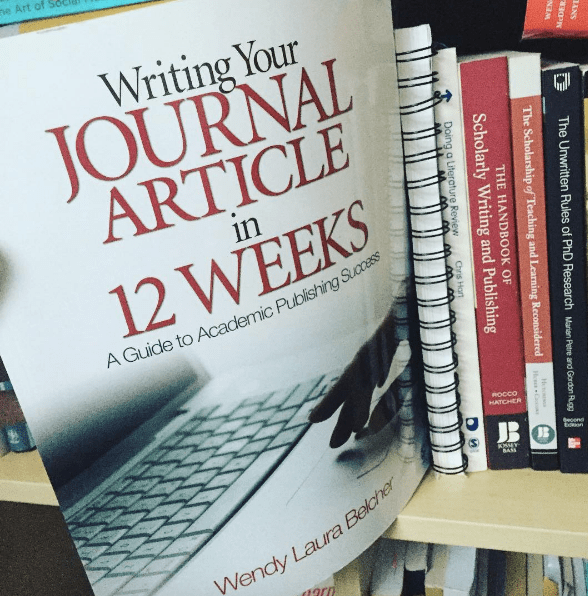
Over the next couple of months, Patrice (a.k.a. @ProfPatrice) and I have committed to being #acwri writing partners-in-crime. In doing so we are going to work through the Writing Your Journal Article in 12 Weeks, by Wendy Laura Belcher, in maybe 10 weeks this summer. Thanks to the UNT Writing Faculty Group for this resource, the time I have this summer to work through this book over the summer, and to Patrice for joining me in this #acwri journey process. 12 weeks If you want to join us on this #AcWriSummer journey (there’s a few of us using this hashtag on Twitter),  you can get your own book or read my weekly blog posts, and join our #acwri summer productivity group. There are only two rules:
  1. You have to COMMIT to the #acwri process EVERY WEEK. This means following the chapter curriculum (I’ll try to post the chapter themes on a Monday/Tuesday of each week), check in during our weekly meetings, and following through with goals and objectives set each week for your writing process.
  2. Be sure to #SaveTheDate and JOIN US each Friday (in June and July) from 9-10 am CT via the GoToMeeting link to “check in” to discuss your #AcWri progress:

#AcWri Summer Accountability Group 2016

Join the meeting from your computer, tablet or smartphone: https://global.gotomeeting.com/join/648338213

You can also dial in using your phone: United States +1 (408) 650-3123; Access Code: 648-338-213

Week 1: Designing Your Plan for Writing

  • Understanding your feelings about writing
  • Keys to positive writing experiences
  • Designing a plan for submitting your article in twelve weeks (or less)
  • Selecting a paper or projects for revision/writing
  • Choosing Your Writing Site
  • Organizing your writing Schedule
  • Anticipating and overturning writing obstacles

It’s time to clean off that #AcWri white board of mine and put a few goals up… more to be updated soon! See y’all on Friday (6/10) at 9 am CT if you want to join the fun. Blogging, Instagramming, or tweeting about your academic writing progress? Feel free to use #AcWriSummer to share your updates. Write on!

Reference:

Belcher, W. L. (2009). Writing your journal article in 12 weeks: A guide to academic publishing success. Thousand Oaks, CA: Sage Publications Inc.

mentor, mentoring

Thank Your Mentor Day!

Happy THANK YOUR MENTOR Day! January, with January 17, 2016 being International Mentoring Day, was proclaimed National Mentoring Month by President Obama. This mentoring campaign is targeted at supporting youth and mentoring IRL (#MentoringIRL).

miyagi_mentorAlthough my youth is behind me, I can definitely say a number of people helped to get me where I am today. A mentor can listen, teach, guide, and coach. Can you think about the mentor(s) in your life? Where would you be today had it not been for their support?

Here are a few simple ways the National Mentor Campaign suggests to THANK your mentor:

  1. Contact your mentor directly to express your appreciation;
  2. Express your gratitude on social media; (#MentorIRL)
  3. Pass on what you received by becoming a mentor to a young person in your community;
  4. Make a financial contribution to a local mentoring program in your mentor’s honor; and,
  5. Write a tribute to your mentor for posting on the Who Mentored You? website.

You can download a Thank you card from the Campaign Marketing Materials page.

As a thank you to all the mentors who have supported me and the mentees I have learned from, it would be only fitting to introduce this research study on this topic; however now I am interested learning how mentoring supports professionals and the field they work in:

Exploring Mentoring Programs in Professional Learning Organizations

Have you been part of a mentoring experience? Tell us about it. I am grateful for the informal and formal mentoring experiences, and I would not be interested in this study if it weren’t for the formal mentoring programs I have been a part of (shout out to ACPAgrow & NACADA ELP).  If you have any formal or informal mentoring experiences, please take a few minutes to share by filling out this survey:

http://bit.ly/ExploringMentoring

More about the research study: https://techknowtools.wordpress.com/mentoring/

#AcWri, #AcWriMo

Developing Writing Habits with #AcWriMo

Woah. It’s December 9th … where did the time go? It feels just like yesterday that I logged in to post my November #AcWriMo goals.

writing blockHere’s me reporting back after the month (Note: this month was extended as I took a bit of a hiatus over American Thanksgiving & #Friendsgiving) on my #AcWriMo GOAL(S):

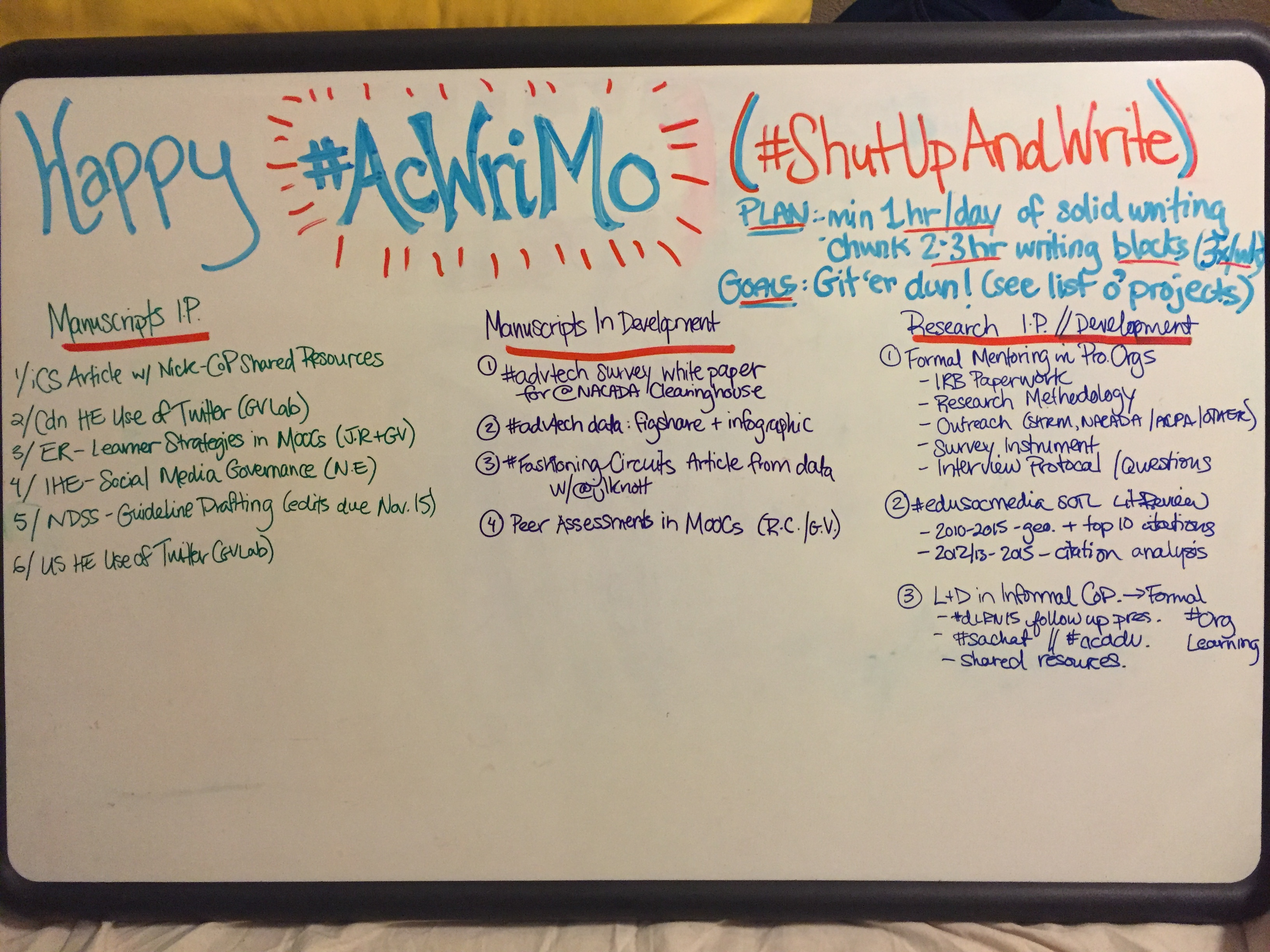
1. Finish manuscripts in progress for journal submissions:
(a) ICS-Shared resources in CoP
(b) ER – Remedies for learners in MOOCs
(c) Cdn institutions use of Twitter
(d) IHE – social media governance
2. Edit and submit final version of NDSS chapter
3. Complete a draft of the full article for #edusocmedia SOTL systematic lit review publication.
4.  Draft of #advtech data & article on NACADA Clearinghouse/figshare.
5. Research methods & IRB for formal mentoring research project.
6. Outline article for peer review in MOOCs
7. #FashioningCircuits – data for another manuscript outside book chapter

Not bad, eh? Who knew that I just need to hone into #AcWriMo Rule No. 3:

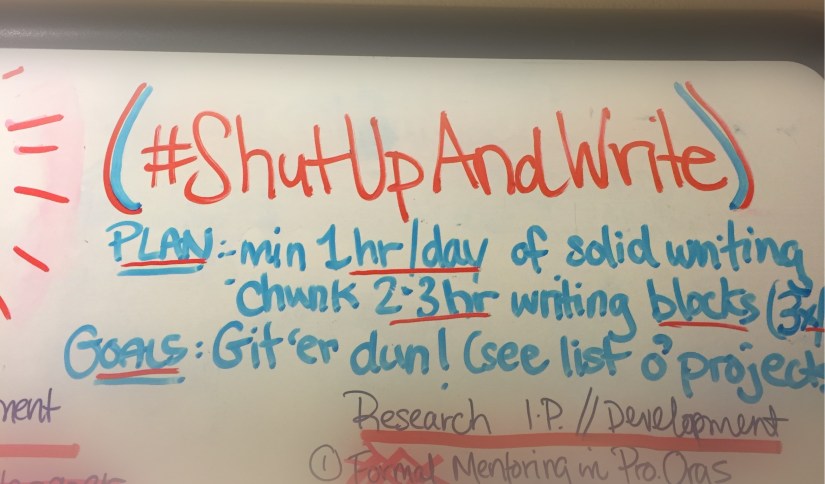
Draft a writing strategy. Plan how to accomplish your goals. Organize your schedule for your uninterrupted #ShutUpAndWrite time. PLAN TO WRITE IN ADVANCE!

It’s SO true. If you don’t plan to write, you won’t actually write. Here was my overall strategy and plan for the month:

23641853985_c1f2571412_oTo make sure it happened, here are the strategic ways I ensured enough time to write:

  • Write EVERY day. This is hard. You are not always motivated to #AcWri every day — but it really helps you build a writing habit (21 days, right?). I am sure there are other items you can work on to fill the writing time, e.g. editing a manuscript, literature review search, organizing analysis, setting up project task lists, or organizing writing/research materials for your co-authors.
  • Determine the best time of day to write for you! For me, it was first thing in the morning between the hours of 6-10 am. These chunks of the day were for my “quiet writing” time. It could be late at night, or just after lunch. You decide.
  • Don’t check _______ before you start writing. For me the blank included e-mail, text messages, mobile, calendar invites, Twitter, RSS feeds, Facebook streams or news. I went right to the #acwri project that was up for that morning.
  • Block #ShutUpAndWrite time on your calendar (personal and work). Make it for 1 to 3 hours. Make appointments with yourself to write and KEEP THEM. I do this to reserve time on my calendar. This is a meeting for your writing productivity. (I do this with running & yoga as well — also very important appointments I keep).
  • Be an #AcWri Project Manager. Break your writing projects into smaller tasks. This will allow you to check off pieces of your writing, and motivate you as you make progress through your #acwri and research “to do” lists. (Bonus: Need a visual? Put it on a whiteboard in your office or remind yourself on your browser tabs – thanks Momentumdash!]
  • Log Your Time. This can be in your calendar notes, in a journal, or even an excel document — just to note the time in and out of writing. This helps to track when you were most productive, and what you worked on over the past week or month. If you need peer pressure, you could continue to log it here: #AcWriMo PUBLIC Accountability spreadsheet
  • Take A Day (or Two) Off. If you were VERY productive earlier in the week, it’s okay to break from the #acwri habit. Don’t burn yourself out from the writing flow. Or maybe come back to it later in the day if you’re not feeling it. #TreatYoSelf

The good news is I am still making progress on the #acwri goals not crossed off the list from November (and then some). Now that I’m armed with my #acwri plan, I will keep this writing pattern going strong for the winter break. With  ALL THE GRADING complete, nothing can stop me now. [Well perhaps a beach holiday might for a while, but I’m just adhering to #AcWriMo Rule No. 5]. Write on!

#AcWri, #AcWriMo

Learn to Write Badly #AcWriMo

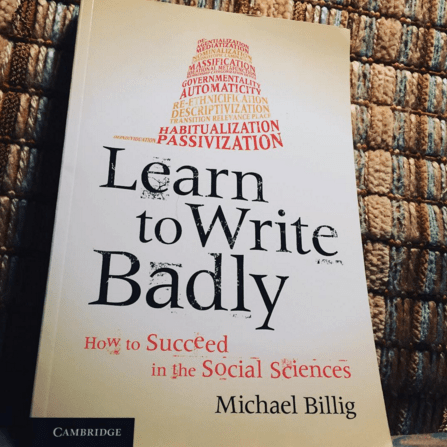
In my writing process of jumping into #AcWriMo for November, I also decided to add reading to my writing goals. I have a number of books on academic writing I’ve acquired, so why not read more about said things to gain motivation, inspiration, and ideas for my writing process. As I’m personally extending my November #AcWriMo through this weekend (because American Thanksgiving interrupted my workflow, and perhaps some other fun things), I thought I would share some words of wisdom from Michael Billig’s book, Learn to Write Badly.

LTWBbook

I may have ordered this book based on the Times Higher Education review or comments from @ThomsonPat‘s blog post — either way it was not fully read until this month. I spent some time away from the screen to visit my parents in Florida and also to get ideas about my own writing practice. This was one of the books I packed and picked up again. A few comments stood out from these posts, which I agreed and wanted to read more about:

  • Academe is part of a wider world in which the use of highly technical, specialised language is endemic and possibly even necessary.” ~Times Higher Education
  • “…in writing in particular ways – doing pretty conventional social science in fact – we actually do poor research. When we turn actions into lofty abstractions, he suggests, we actually gloss over important ambiguities and difficulties and make it hard for readers to understand what has really happened, how or why.” ~ @ThomsonPat

As I agreed on both of these points, I thought — this read is for me. I will be honest. This books is not for all. There’s some historical context to academia that interested me; however there is also a delve into the discipline diatribe nature of certain social science arenas. This is not the fun “how to” light read you might be looking for; however it’s one academics comments and thoughts on how we research, write, and contribute to the cannon. If you’re into that, then you’ll enjoy this book.

A section of the book that stood out to me was in Chapter 2, where Billig discusses “Mass producing research” and the efforts academe puts into this process in higher education:

“Superficially all seems to be well in the academic world, for, along with the increasing student numbers, research is booming as never before and, as we shall see, never have academics been publishing so much. This is an age where research, across all disciplines, is being mass produced. Of course, with more academics working in higher education, one might predict an increase in research and academic publications. However, the books in research is far too big to be accounted for simply by the increase in the number of academics. The job of many academics has changed so that they are now expected to publish as well as teach” (Billig, 2013, p. 19).

[As well as service: mentoring, advising, career development, coaching, program development, course design, and then some.]

Just because there is more research or a “massification” in academic publications — it does not mean it is good. If you have had the chance to do a systematic literature review and citation analysis lately in your field or specific research area — you will soon discover a bunch of okay research gets published. Multiple times. Sometimes the same research, almost written the SAME WAY… just with different titles [I kid you not, and will dig into this topic in a later blog post].

This book had some serious slagging for how social scientists write and perpetuate a particular writing style, paired with a number of interesting historical and discipline specific references. For all academic writers, I think Billing’s (2013, pp. 212-215) recommendations offered in the final chapter provides helpful suggestions for our academic writing practice:

  1. We should try to use simple language and avoid technical terms as much as possible. We should not assume that technical terms are clearer and more precise than the ordinary ones…” – Keep it simple. Could you explain your research to anyone outside your field? Then do it in your manuscripts.
  2. “Try to reduce the number of passive sentences in your writing.” Say what you mean in present terms. Own it. The active voice should be the default voice as your sentences will contain more information and connect with your readers. Build this habit in your writing.
  3. “We should try to write clausally rather than nominally… I would like to see a greater proportion of them [technical terms] as other parts of speech besides nouns.” i.e. we need to express ourselves in clauses with active verbs. Be less passive in how we write (see #2).
  4. “Treat all these recommendations as either guidelines or aspirations, but not as a rigid rules.” You need to know the rules to break the rules of writing. I may have this rule for most things in life. Understanding more of the rules to guide how you draft your publications.
  5. “As social scientists, we should aim to populate our tests – to write about people rather than things.” The goal for this suggestion is to describe and write about what people think, do, feel, etc. How do your research findings actually impact the world around you? What does this mean for your discipline, field, or society?

Reference

Billing, M. (2013). Learn to write badly: How to succeed in the social sciences. Cambridge, UK: Cambridge University Press.

#AcWri, #AcWriMo

Accountability for Writing with #AcWriMo

Academic Writing Month (#AcWriMo) is a month-long academic write-a-thon that happens every November. Are you in it, to win it? I am!

acwrimo-unsw

Thanks to @CharlotteFrost for setting up the 1st #AcWriMo in 2011 (she’s also the founder and director of @PhD2Published) to coordinate a collaborative peer effort around accountability for academic writing.  After the first #AcWriMo ended, many embraced the #AcWri hashtag to continue a the discussion & discourse around academic writing (Follow: @AcWri). The PhD2Published blog shares ideas and inspiration for #AcWriMo – to follow these tips via the blog, follow the Twitter account, or “like” the Facebook page.

I’ve done #acwrimo in the past during my dissertating phase, so I know it works. This is a great peer community to help keep writing in check and supports my #acwri progress. This year I’ve set my #AcWriMo goals for November to wrap up a few writing and research projects. My priority is the green list, as these are active manuscripts in progress and need to be submitted before the month’s end. Then I’ll move right to publications in development, and future research ideas to tease out. Ask me how it goes this month – PLEASE!

22742710956_3dd118705a_oGood news. As of day 3, I am already finished with green list #1 – first draft of this manuscript is being edited and sent to the editors before the week is done. I have also made some progress on the Research I.P. for the IRB application and Research design on mentoring thanks to a meeting with collaborators this evening.

It might be day 3, but it’s NOT TOO LATE TO JOIN IN the #AcWriMo 2015 challenge => here are the 6 basic rules from the @PhD2Published blog:

  1. Set your writing goal(s) & plan. This can be in words, hours, or end products. You decide. (Check out the PhDometer app or 750 Words site to help you measure!)
  2. Make it public. Make it known. SIGN UP and let your goals & plan be known on the AcWriMo 2015 Sign-Up Form and then return to edit daily your progress. Peer pressure can do wonders! Check out WHO is participating from around the world on the #AcWriMo Map.
  3. Draft a writing strategy. Plan how to accomplish your goals. Organize your schedule for your uninterrupted #ShutUpAndWrite time. PLAN TO WRITE IN ADVANCE!
  4. Share your writing progress. Post it publicly. Twiter, blog, Facebook, Instagram — share with the hashtag #AcWriMo how things are going AND track your daily progress on the community #AcWriMo PUBLIC Accountability spreadsheet.
  5. Keep the #AcWriMo -tivation going. Don’t slack off. Write like it matters. Push yourself to reach your goals — chunk out projects, writing sections, and manuscripts to GIT ‘R DUN!  December will be here sooner than you think…
  6. Declare your results. Update the spreadsheet or whatever space you are keeping track of your writing progress — then let the #AcWriMo community know about your writing results at the end of the month. It helps to share and be accountable in the open — it is also a chance to get support, cheers, and feedback along the way.

So what are you waiting for? It’s time to get your academic writing ON! See you out there, #AcWriMo!