Learning Technologies

Happy Digital Learning Day! #DLDay – Top 10 Learning Web Tools of 2012

Happy Digital Learning Day (#DLDay)!
digital-learning2 (1)

To celebrate digital learning day today, I thought it would be a good idea to share my belated Top 10 Learning Web Tools list from 2012. As I have read other lists (here and here), I have been meaning to share useful tools that have helped me learn this last year. You may have heard me say “it’s not the tool” but rather how you use the tool – so I thought I would share my top tools that I have put to use for my own productivity and learning.

  1. Twitter – This is my active stream of information that allows me to track on conversations either via search, hashtags or through my Twitter lists. I value Twitter to find information, learn about news/trends, collect articles, read blog posts, and, most importantly, engage with peers on a daily basis. My evolving personal learning network (PLN) is definitely at the top of my learning list.
  2. Google Docs/Drive I have found Google Drive EXTREMELY useful in 2012, as I am often seen with my Chromebook in tow. Daily I can be found using Google Drive, as I typically take notes during a lecture/meeting, brainstorm storm agenda items, crowdsource ideas, collect information (via a Google forms), or store resources i.e. PDFs, presentations, and database files.
  3. Dropbox – Not all of my collaborators of research, work and writing use Google Docs, so I tend use Dropbox as my “go to” cloud storage and sharing with MS Word. I often move in between spaces and devices (mobile, PC, Chromebook, & Mac) both on campus and at home, so Dropbox is easy enough to save and return to any working projects or assignments. As a frequent flyer for with an edu account, I have accrued 23.22 GB of space through referrals, use, and a Dropbox quest. My Dropbox allows for easy work flow, specifically for storing conference presentations, collecting articles for a literature review, archiving tweets through IFTTT, downloading my mobile photos, holding my lesson plans, and editing manuscripts with co-authors.
  4. Google Search – When in doubt…Let Me Google That For You. I would say that Google is typically used as my initial search for information, news, and quick finds probably because I am often working in Google Drive (see #2) and using Google Chrome (see #7). I have learned benefits of refining my power searching skills, and also not having this as my only outlet for knowledge acquisition.
  5. Google Scholar Although I increasingly use the UNT Libraries – Find Online Articles Search more often these days, I can say that Google Scholar has been a helpful tool for finding data, collecting statistics, locating peer-reviewed journal articles, collecting my literature review materials, and retrieving other scholarly resources.
  6. Google + Hangouts The reason I value Google Plus is for the Hangouts. Both for a meeting space or “On Air” live recording, this forum has proven well for meetings, conference calls, presentations, demonstrations, peer-review process, and general catch up with colleagues. I do still use Skype; I have a greater preference for using a video conference space that has live notes, free group (up to 10) calls, connection to my Google Drive, and, of course, the ability to infuse ridiculous Google Effects when meetings run on too long. Side note: I  am curious to see what happens with the Google Plus Communities. I have recently been invited to a few, and I can see some potential with this feature in Google Plus.
  7. Google Chrome As a mobile learner and avid Chromebook-er, I would say that Google Chrome is a user-friendly web browser for productivity and workflow. I appreciate the streamline interface, search ability, extensions  and applications from the Chrome Web Store {which compliments my Android phone apps as well}. Also, it is quite compatible with Google Drive, Google + Hangouts, and easily transferable from my office to home computing life.
  8. WordPress I may have been exhausted from reflecting during my Masters’ program; however I think that having my own space and place for reflection has helped me in 2012. For a fellow researcher, I candidly explained why I blog and more about my blogging history; however I used my blog more this year to document my doctoral progress and process my own educational experiences. Thanks for being an easy space to draft, publish, and share these thoughts, WordPress.
  9. Delicious Although I use Scoopit, Storify, and Paper.li a great deal, I can say that Delicious is still my top curation tool. Since 2007, I have been collecting and organizing resource into my delicious account. When I share a URL on Twitter it automatically archive the link to my delicious account via packrati.us. This is great to return back to my tags and stacks to find notes, information, statistics, or articles that I can use for presentations and publications. Also I appreciate others in my Delicious network who stayed loyal to this tool (even after a few changes) and socially bookmark useful resources.
  10. Flickr This social photo sharing site has provided me with a lot of inspiration and ideas. Whether I have used creative common-licensed images for presentations and blog posts, or just as a tool to document my own PhD adventures, I appreciate being a member of the Flickr community. I often capture a photo of a presentation slide, make a note from class, or document an image on the go to house them on Flickr for future reference and referral.

For 2013, I plan on taking Jane Hart’s (@C4LPT10 Tools Challenge to find out how to use new tools to help for my own professional learning, research, and development as an educator/trainer. For those of you who want to join in the fun, check out the Top 100 Tools for Learning 2012 for inspiration to explore. Happy learning!
Higher Education, Social Media, StudentAffairs

Reflecting on Values & Identity from #Dalton13

Over the past few days at the 2013 Dalton Institute, I have been encouraged to think about the cross-section of how our cultural norms, use of technology, and institutional practices intersect to support students. Educational reform for higher education is not new; however it was refreshing to have a group of graduate students, faculty, scholars, and practitioners to be part of a thoughtful collective to think deeper about these challenges.

Although the institute’s focus was self-promotion, social media, and student development, it was great to hear a number of conversations emerge about the disruptive forces and potential opportunities to embrace change in Student Affairs. The philosophical narratives and analysis of technology’s impact on identity was enriched by listening to personal perspectives and such varied experiences.

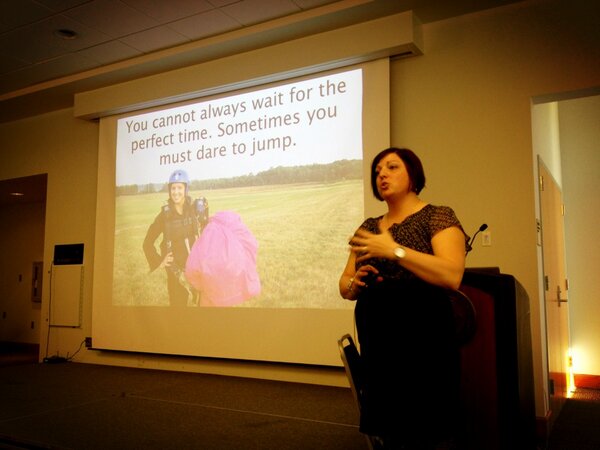
Dare to Jump

Photo c/o @DaltonInstitute {Thanks @vanessaballer!}

As the final keynote of the institute, I gave my “triple threat” perspective as a student, instructor, and professional in higher education. My goal was to share ideas and practices to develop a richer learning experiences; specifically ones that I have valued as an active scholar. So, doing my best to follow the amazing #dalton13 featured speakers – I shared my own narrative, critiques, and insights on how emerging technology can support and challenge student development. I gave some tangible examples and ideas of how to move beyond the gadget, application, or “next big tech thing” by considering ways educators can be actively pushing their learners. I talked about everything from exploration to collaboration, specifically by empowering students to be part of the solution to our institutional challenges.

My #Dalton13 Keynote – Notes & Then Some! (thanks for the photos & tweets #dalton13 backchannel!)

I appreciated the conversations (although some were far too brief!) around identity and student values that  I had with a number of #Dalton13 attendees, especially the FSU HESA graduate students. Although a number of ideas were shared at the institute, I am still left thinking and reflecting about these key questions:

  • How are student values demonstrated in a digital environment?
  • Can educators have an impact on the character development of learners?
  • Is student development really impacted by technology? How so?
  • Does there need to be a shift in how we support our student population on campus?
  • How can our graduate programs do a better job of challenging and supporting scholar-practitioners with “self-promotion” questions?
  • Will higher education cultural norms and institutional practices be changed, or will we be left behind?
Higher Education, Reflections, StudentAffairs

A Kinder Campus to Collaborate

Be KindThere are a  number of students, staff, and faculty in my life who I have gotten to know along my academic and professional journey – as colleagues and as friends. I have been fortunate enough to experience college/university life as a student, professional, and instructor  at various types of institutions and in more than one country.  Each new experience has afforded me to work with insightful colleagues, learn about effective practices, understand a variety of student populations, and consider innovative ways to  support students, staff, and faculty.

In a recent Inside Higher Ed article I shared my thoughts on why our divisions in higher education need to think beyond their own areas. Some of the challenges ahead in higher education will require our departments/divisions to step our of their silos to collaborate and reach shared goals for our institutions. It does require some risk; however I think there are larger rewards for reaching out and conversing with others. In considering some of the opportunities and challenges in higher education – such as financial, legislative, staffing, and more – perhaps it is just the right time to sit down to chat and connect to others on campus. Institutional units will need to put their heads together to think creatively and collectively about some of these issues – if they are not doing so already. 

Over the last few weeks, I have been thinking about what a “kinder campus” means in higher education. I am currently participating in a Collaborative Learning Community (CLC) at UNT that brings students, staff, and faculty together to work towards a shared solution to a problem/challenge at our institution [more to be shared on this later]. Since we have diverse representation on this CLC, as the co-chair with another faculty member we have been considering the following needs to keep our group moving forward:

  • introductions are important – find out what everyone “does” on campus
  • use common language and define terms
  • establish purpose and goals for the CLC
  • share and distribute information/facts that are not known
  • establish a meeting time/day of the week
  • create agendas to guide, not limit the conversation/sharing
  • record meeting minutes for those who might be absent
  • online space for resource sharing 
  • flexibility and understanding for attendance is a must
  • define roles to guide actionable items & project initiatives
  • bringing food/treats is never a bad thing

Although cross-departmental meetings can be challenging, as it requires stepping outside our own domains and sharing across disciplinary boundaries, I have had some of the most productive conversations and ideas to emerge from these gatherings.


Are you part of a collaborative working group at your higher ed institution? What tips do you have to “be kind” and connect with colleagues outside your division/department?

Reflections

TechKNOW Tools Blog Year in Review – Top Posts for 2012

Although I am off the grid for the holidays, I thought I would thank those of you who share, read, RT, and comment on my TechKNOW Tools blog. I started this particular blog for a learning workshop and seminar back in 2009, but then switched to blog about what I am learning, reading, presenting, and more. I try to share ideas for educators, trainers, and others around the topics of learning, technology, and design. I rarely post a “top viewed” blog post, but I thought I might as well share the favored posts from 2012 as I ponder about blog topics for 2013.

Title Views
I Tumblr For You… To Reflect. 4,184
The Productive & Disruptive Innovation of EDU 1,236
Organizational Learning Constructs 1,219
A @PhD2Published Post: A Book Review is #AcWri Too 962
Online Learning: More Than Just a MOOC 829
LMS/LCMS Review 822
My Prolegomenon to Technology 775
Facebook for Learning Communities: Groups vs. Pages 750
Going Mobile for Academic Advising: Tablets, iPads & Protocols on Campus 550
What’s Your Research Methods Worldview? 527
Social Media Strategies in Student Affairs 527
Backwards Design with TED-Ed 436

I appreciate the community of bloggers who I read and learn from – you inspire and challenge me to think and consider how and when I share. Thanks for reading and engaging with me. All the best in 2013!

Happy-2013-560x420

#phdchat, ATPI, PhD, Professional Development, Reflections

ATPI Doctoral Portfolio Reflection

This weekend will involve the usual researching, writing, and editing of projects – however I have one more item to polish up before it’s time to be thankful in the U.S. – my doctoral portfolio.

For the Applied Technology & Performance Improvement Doctorate (ATPI) program, the doctoral portfolio is a new requirement for us young, budding scholars. Rather than sit in a room for two 8-hour days or respond to a set of questions over a period of time, ATPI doctoral students will need to complete our departments Ph.D. portfolio to officially become a Doctoral Candidate and move forward with dissertation work. Some students in our program are still opting to take the comprehensive exam route while they still can, only because the requirements include research, teaching, and service scholarship experience that is akin with academics who might be seeking tenure/promotion. I think that this portfolio makes sense, professionally it helps to document my PhD Journey and encourages students to gain scholarship experience before being launched into a dissertation or even the academic job search.

Here are the ATPI Doctoral Portfolio Requirements [DRAFT] that I have been using to guide my portfolio development. {I say draft as this document is subject to change since our department will have myself and another student defend in December for the 1st time.}

I promise to share my ATPI doctoral portfolio, after I review it and put the finishes touches on it. I learned a great deal from our “dry-run” on Friday, and I was reminded about some of the key things to highlight in my 15-minute presentation. I am also pleased to say that I will be sharing my digital PhD journey (blogging, tweeting, and then some) with my doctoral committee for my portfolio defense. My faculty advisor and another committee member thought it would be valuable to discuss my philosophy and experience as an open educator/scholar/researcher.

In thinking about how to “show case” some of this, I am looking through my blog for musings and what I have been up to over the last 3 years of my doctoral course work. So far my TechKNOW Tools Wordle reflects this:

TechKNOW Tools Blog Wordle

I also know that my digital footprint can be found in my Google Docs (or now Drive), YouTube channel, Dropbox, shared on my SlideShare account, posted on my Flickr account in photos, and even among my 23, 926 tweets (good thing I auto-send these into Delicious with hashtags for easy searching). Time to mine my own digital data, review what I’ve created, and compile my professional development and scholarship.

Grad Students & PhD Friends: How do you track your progress? Professional development? Teaching, service, and research scholarship? Please share!