Learning Technologies, Professional Development

The Technology Test Kitchen & #et4online CFP Deadline

The Technology Test Kitchen (TTK) was developed at the Online Learning Consortium‘s #blend14 event, and recently enhanced at #aln14.

What the heck is the TTK?

  1. A makerspace for sharing innovative tools and new media
  2. An open collaborative environment for hands-on exploration
  3. An engaging way to connect with your colleagues over emerging technology

how it works

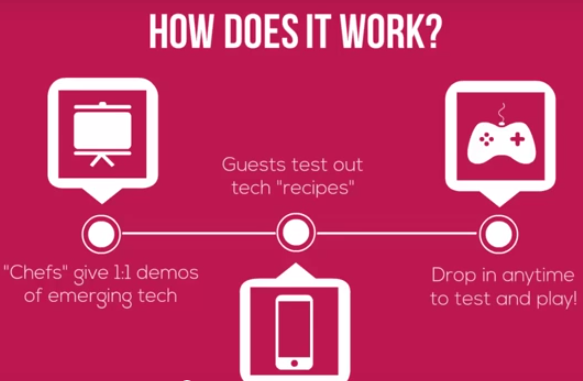
The TTK ideas was created to bring faculty, instructional designers, researchers, and conferences participants together to get a hands-on experience with a variety of learning technologies. In the Test Kitchen, there are a number of “chefs” (volunteers who love applying media to learning) who are typically available to talk about design, discuss a “recipe” (a quick how-to guide for a platform, e.g. PDF Recipe Book from #blend14 is posted HERE), utilize apps, brainstorm curriculum strategies, introduce new media (hardware & software), and provide 1:1, hands-on sharing with learning technologies.

To learn more, check out this AMAZING video created by Angela Gunder (a.k.a. @adesinamedia):

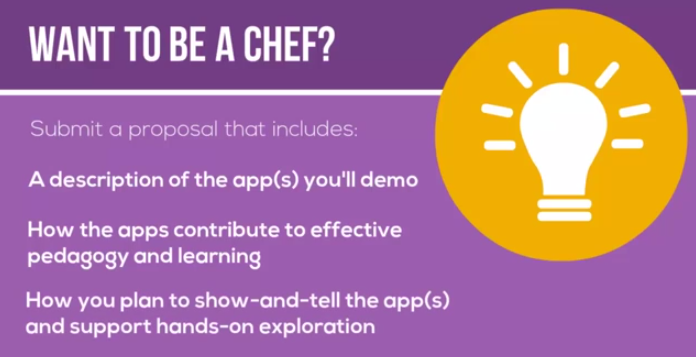
For the 2015 #et4online conference, the TTK will be looking for chefs, like YOU, to actively work in the kitchen and demonstrate how to apply media to pedagogical practice.

CFP for Chefs

Interested in applying? Check out the Call for Proposals today for the TTK or any other program track. We would LOVE to review your proposal. The CFP closes on December 1, 2014.

dalmooc

Do You Want to Learn About Learning Analytics? #dalmooc

Last week, I attended the UTA LINK Lab talk presented by Dragan Gasevic (@dgasevic) on learning analytics and research. This discussion shared all the digital traces and learning that can be collected and measured in our various learning environments, and questions how we are best doing some of these analytics within our institutions. Although we have a number of statistics, data, and information on our learners – how can we offer actionable insight, summative feedback, and information about learner progress. Our post-secondary institutions seem to want to only deal with the “R” word = Retention. Often institutions are looking to identify students at risk, provide information about learning success, and understand how to enhance learning – but how can we effectively use data when often times our metrics only focus on single outcomes?

data-analytics-608x211

Photo c/o the #dalmooc edX Course Site

Instead, it is the process and context that our education institutions need to identify when looking at learning analytics, that is, the need to understand and optimize learning (Butler & Winne, 1995). Whether we apply the community of inquiry framework,  cognitive presence, which includes triggering events, exploration, integration and resolution (Garrison, Anderson & Archer, 2001), or the COPES (Conditions, Operations, Products, Evaluation, & Standards) model (Winnie, 1997) –  it is the meaningful data points for learning analytics that really need to be identified within our educational institutions.  As @dgasevic said, “Learning analytics is about LEARNING!” Often we assume the data collected from our courses and our systems will provide us with the answers; however if not identified in a purposeful way – why bother? What we really need to consider is, what does it mean to study and support the learning experience and not just the end results?

Here are a few areas of learning analytics and data evaluation need to be considered (just to name a few):

  • learner agency and self-regulation
  • interaction effect – external and internal conditions
  • formal and informal learning communities
  • instructional intervention methods
  • multimodal learning
  • emerging technology impact, i.e. mobile, wearable tech, etc.

Here are  questions our institutions need to consider when they want examine learning analytics:

  • What data we are collecting? And why?
  • How does the learner information we know contribute to the PROCESS of learning?
  • Who should be part of this learning analytic research for learning?
  • How can we best present and interact with the data? Can this be more immediate?
  • How can we encourage and support multidisciplinary teams to study learning analytics at our institutions?
  • Are we being being driven by questions of need, access, and availability for the learning data collection?
  • What ethical and privacy considerations should be considered when collecting data around learning?

Interested in learning more about learning analytics and data in education? Check out the paper in press by Gasevic, Dawson, and Siemens http://bit.ly/techtrends15  or better yet – join the 9-week Data Analytics & Learning MOOC that UTA & edX is hosting on this very topic starting Monday, October 20th: http://linkresearchlab.org/dalmooc/ or follow along with the conversation on Twitter #dalmooc.

References

Butler, D. L., & Winne, P. H. (1995). Feedback and self-regulated learning: A theoretical synthesis. Review of educational research, 65(3), 245-281.

Garrison, D. R., Anderson, T., & Archer, W. (2001). Critical thinking, cognitive presence, and computer conferencing in distance education. American Journal of Distance Education, 15(1), 7-23.

Gasevic, Dawson, Siemens (inpress). Let’s not forget: Learning analytics are about learning. TechTrends. http://bit.ly/techtrends15

Winne, P. H. (1997). Experimenting to bootstrap self-regulated learning. Journal of educational Psychology, 89(3), 397.
Social Media

The State of Social Media @ #edu14

State of #SocialMedia in Higher Ed (2)

Looks like EDUCAUSE 2014 (#edu14) is just around the corner.

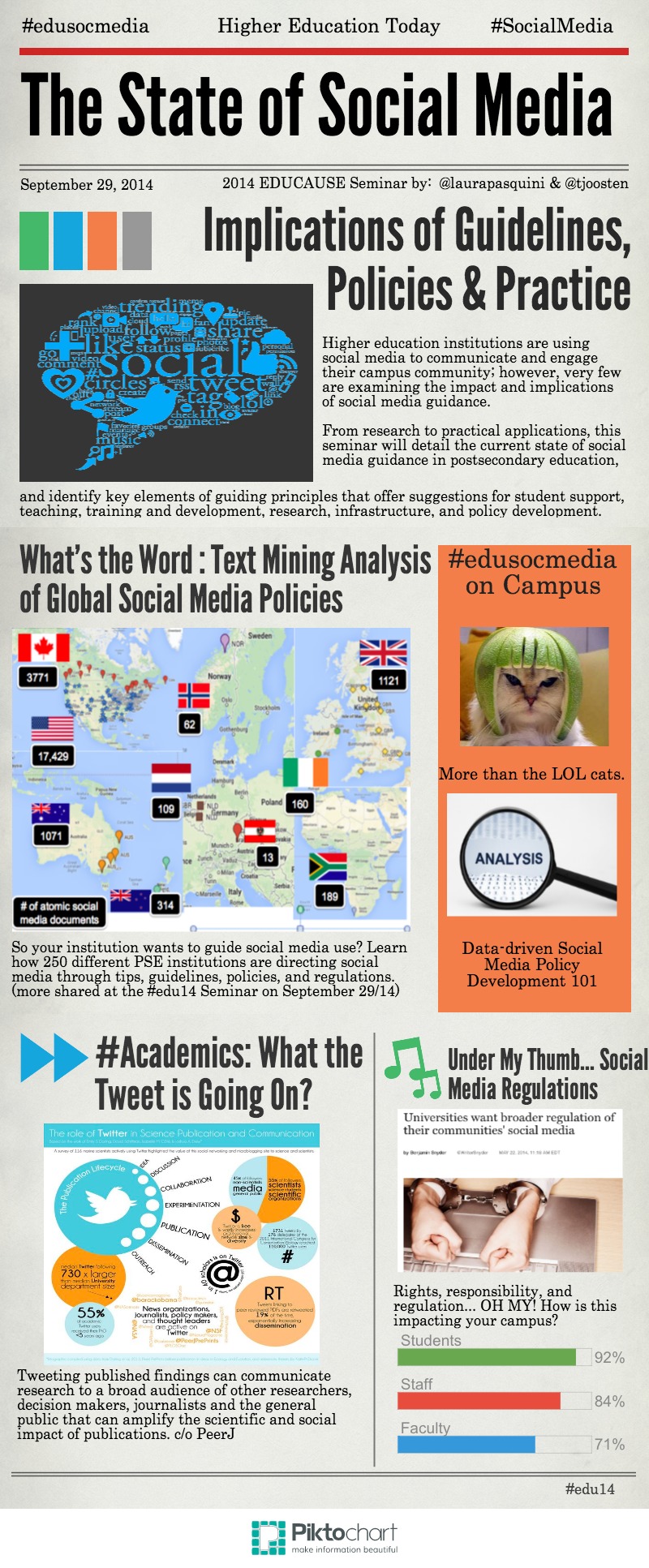
I am heading out to Orlando on Sunday and will be sharing my dissertations research at the #edu14 Virtual Seminar with Tanya Joosten (@tjoosten) on Monday, September 29, 2014. Interested in learning more about it? Sign up (HERE) for the online, half-day seminar to help with your social media planning:

Seminar 2A – The State of Social Media Guidance: Implications of Guidelines, Policies, and Practice in Higher Education (separate registration required)

Higher education institutions are using social media to communicate and engage their campus community; however, very few are examining the impact and implications of social media guidance. From research to practical applications, this seminar will detail the current state of social media guidance in postsecondary education and identify key elements of guiding principles that offer suggestions for student support, teaching, training and development, research, infrastructure, and more.

OUTCOMES
Participants will be able to:

  1. Articulate current higher education social media guidelines and policy document trends, categories, themes, and patterns emerging from research
  2. Identify practical components for effective social media guidelines for campuses
  3. Create meaningful guidelines and policies to positively impact teaching, learning, research, and development at your institution

Since I am only at #edu14 for a short stint,  I plan on making the most of my time. Here is my quick hit list of sessions that are in line with my research agenda:

If I was staying longer at #edu14, I would most likely attend these sessions:

Will you be at EDUCAUSE 2014? What is your focus and objective for attending this year? More importantly, will we be able to have a bit of a chat around these issues. I hope so. See you @ #edu14!

AcAdv, PhD, Reflections

PhD Balance & Support: Life as a Doctoral Researcher and Higher Ed Professional

As part of my “Thanks-For-Supporting-My-PhD-Completion” and ways to motivate other doctoral researchers, Melissa and I decided to write an article for NACADA’s Academic Advising Today. This piece shared insights from our #hackPhD Panel at #nacada13 and our own hindsight of what it takes to successfully finish the degree.

PhD Survivor

We are not alone in thinking that being both a full-time professional in higher education AND full-time PhD student is a CHALLENGE:

The tensions among academic and personal roles can have a great impact on an advisor’s doctoral education. The theory of doctoral student persistence (Tinto, 1997) in particular can provide a look at how conflicting roles might impede a doctoral student’s academic progress. Tinto’s theory (1997) assumes that the primary communities for students relative to their graduate education are their peers and the faculty in their programs. Social integration within graduate education is almost synonymous with academic integration in the department. These social communities assist students with both intellectual and skill-building capacities needed to succeed in their doctoral programs, as well as networking within the greater professional community. Membership in other communities, e.g. those encompassing personal roles, can have a negative impact on graduate persistence by providing conflicting demands for time. If students are not able to manage their competing roles, they may find that they must give up on some of them.  (Read the full article here.)

I am thankful to the #AcAdv Chat community and fellow PhD friends (#sadoc & #phdchat) for the support. A number of my colleagues from these groups ALSO hold a faculty or staff position on campus, while grinding through their doctoral coursework and/or dissertation. I salute all of you who have made it, and a number of you who are still working towards the end. {You can do it! #GoScholarGo!}

At times this challenge is not easy – AT ALL. What it often comes down to is, support at the local level. At my campus, I was fortunate to have dedicated faculty advisors, solid graduate program support, an understanding/empathetic boss, a supportive and collaborative office team, and brilliant Dean to scaffold my PhD progress. Although my support network online is brilliant,  I think that it is imperative for the Staff/Faculty Supervisor of the PhD employee to consider how they can impact degree completion. Here are a few suggestions on how to get started:

  1. Ask How To Support: Sounds easy enough, but often it does not come up in 1:1 meetings. Consider asking how their degree will fit into their overall career goals, and what sort of strategies and resources would be most appropriate to reaching this objective.
  2. Identify Funding Resources: Inform students about tuition breaks, employee scholarships, and travel funding that might be optional during their doctoral study. Sure – your grad student might be savvy enough on this topic; however it does not hurt to inform them about budget allowances or potential funding sources.
  3. Encourage Professional Development: Continue to nourish and cultivate professionals who want to hack their doctoral degree, AND contribute to their own personal growth. Professional and informal affiliations often helps their progress towards degree completion.
  4. Consider Scheduling & Being Flexible (with Time): Allow for a varied staff schedule, time in office, or even opportunities to telecommute on projects. This might even include moving a lunch or break around to meet with dissertation committee members, writing groups, or graduate student seminars. Often your graduate student is very good at both self- and time management, so trust them to be effective in and out of the office.
  5. Express Value for Scholarship: Help your employee identify service, teaching and research scholarship on your campus and with your professional affiliations. Think about their research as an extension of your unit’s or institution’s vision and mission, and capitalize on their talent and skills in this area. Scholar-practitioner contributions can impact strategic goals, and compliment what you do day-to-day.

If you currently supervise a doctoral researcher who is a full-time staff member, how do you support your employee? OR vice-versa. What do you need as full-time employee AND PhD student to get you to your dissertation defense? Please share in the comments below.

References:

Johnson, M. A., & Pasquini, L. A. (2014, September). Negotiating the multiple roles of being and advisor and doctoral student. Academic Advising Today, 37(3).

Tinto, V. (1997). Toward a theory of doctoral persistence. In P. G. Altbach (Series Ed.) & M. Nerad, R. June, & D. S. Miller (Vol. Eds.), Contemporary higher education: Graduate education in the United States (pp. 322-338). New York, NY: Garland Publishing, Inc.

ACPAdigital, StudentAffairs

Introducing the @ACPA Digital Task Force: Project Planning

This year I am fortunate to be collaborating with an invested group of scholar-practitioners on the ACPA Digital Task Force to  examine how technology impacts and influences post-secondary education student development. The various teams involved will focus on how the digital realm influences our campus communities, with regards to  crisis management, communication channels, programming initiatives, learner competencies, practitioner implications, curriculum development, and research contributions.

493567123 [Converted].eps

This year our specific team, comprise of Paul, Jason, Erik & myself, will be working on “Informed and Responsible Engagement with Social Technology.” Here is a snapshot of what our key focus area is about from the blog:

Our work is focused on educating students about their use of social and digital technologies.  To that end, our group will focus on how to effectively educate students on:

  1.     The new rules of social technology engagement.
  2.     Acting authentically, ethically and with civility in one’s online and offline life.
  3.     The opportunities and impact of social technology participation.

Although students are our main priority, we also recognize that educators need to be informed and skilled to engage students on this topic.  Therefore, our group will also focus on educating educators on these topics and how they can translate this knowledge into learning opportunities for their students.

We are interested in getting feedback, soliciting author contributions, writing educational resources, and more as the year progresses. If you are currently working on resources for informed and responsible use of social technology for campus, specifically for your learners – let us know! Do you have experience in collaborative writing, curriculum development, instructional design, and/or creating train-the-training facilitation guides? We want to hear from you!

To learn more about The ACPA Digital Task Force:

http://digitaltaskforce.myacpa.org/