Higher Education, Learning Technologies, Professional Development

Using Google Apps in Higher Ed #ACPA15

Join me today (3/7) at 9 AM for my  #ACPA15 Genius Labs session on Google Apps for Education (1st Floor West Side of Tampa CC) where I’ll share how I use a few applications to make my workflow more productive and how I’ve used a few of these applications for my educational curriculum and developmental programs on campus. Blog-Post-Image-Google-Apps-Admin-Best-Practices-1024x372 About: Many universities/colleges are turning to Google Apps for Education as a solution, and it isn’t just for email. This 20-minute session will introduce applications provided by Google Apps, and will illustrate easy-to-implement practices for everyday problems. Google Apps to Explore & Use

Examples for Google Docs & Forms

Google Video – YouTube & Hangouts On Air

3 Google Apps to Check Out More Often

  • Google Scholar What it is: Academic search engine for publications of scholarly research Why It’s useful: Search of scholarly literature across many disciplines and sources, including theses, books, abstracts and articles. Pro tip: Identify articles available from your institutional library on campus. Also able to search & preview millions of books from libraries and publishers worldwide in Google Books.
  • YouTube Trends Dashboard What it is: A handy tool to figure out what’s trending on YouTube. Why it’s useful: What are your students watching on campus? What is being shared most often near you? With the Trends Dashboard, you can tap into the zeitgeist quickly and easily. Pro tip: Compare the “Most Shared” (across Facebook and Twitter) with “Most Viewed” to get a sense of what content gets viewed often but shared infrequently. To see what was trending in the past, check out
  • Google Trends. Use the optional forecast checkbox to anticipate whether interest in a particular topic is expected to rise over time. Google Keep What it is: Lets you easily jot down whatever’s on your mind via a beautiful, simple interface. Why it’s useful: Share any one individual note with a collaborator, create to-do lists, drop an image into notes as needed, and organize notes using eight color options. Pro tip: Don’t want to forget to do something? No problem: You can easily turn any note into a date or location-activated reminder.

Resources

How do you use Google Apps for education? Please feel free to share links and resources here: http://bit.ly/acpa15google

Higher Education, Reflections, Teaching

Rethinking Office Hours

Office hours were designed to offer a space and place for learners to meet with their faculty. The practice of holding a “office hours” at every higher education campus, and even within a single department, varies drastically. Some institutions/departments set guidelines, whereas others see this as a service expectation that will automatically be assumed by the faculty member.

silly questions

Image c/o Flame @ KZK

The basic idea of faculty office hours was to carve out time to be available for your students. This set time each was is designated for the instructor to be in a physical, set space to offer support and assistance for courses, research, etc. In reality we know that only “a small number of students take advantage of office hours, [and] typically those who show up are not those who most need to be there (Weimer, 2015a). With increased use of technological communications, our students prefer to send a quick electronic message [email, learning management system (LMS) message, discussion board, text, tweet, etc.], to ask a question, seek advice, or get help.  So how do we “meet and reach” our students who are often juggling more than just school and cannot make the typical “office hour” on campus?  How do we make getting support more convenient for both the instructor and the student?

As an online instructor, I have experimented with a few approaches  the last couple of semesters. Although I work with online, adult learners – I think these strategies could also be useful for other faculty who instruct face-to-face (F2F) or blended learning environments.

A Few Ideas to Rethink Office Hours:

  1. Offer a standard “Office Hour” time slot at least 1-2x per week. This might be the day before assignments are due, or perhaps an evening hour after the typical 9-5 work day. You can indicate availability in your own office, by Skype/phone, IM, or via a web conferencing platform. You decide!
  2. Identify YOUR preferred mode of contact/communication. Let them know HOW and WHEN you will be checking and responding to their messages. Be sure to consider your own communication workflow – then share these expectations for your learners about your preferred protocol for related course communications.  Here are the best ways (in order) for students to contact me:
    • EMAIL: This is BY FAR the recommended method. My students know they will get a response from me within 24-48 hours by e-mail, and they are to include their course name, section, and ID in messages. This also allows me to track and keep a record of our conversations in a student file I save in Outlook.
    • Skype/Google Chat: A few of them have also utilized Skype/Google Chat for a quick instant message (IM) if I am Available (“green”) online.
    • Bb Learn Messaging/Email: I have decided to close the LMS messages on Bb Learn this term, to organize all incoming inquiries from students into my institutional email account.
    • Google Voice: I use a number set up here as my primary office number. Students have used it to leave web voicemails and/or text messages every now and then.
    • Twitter: I have also welcomed the odd Tweet here and there – but often these get tossed into another space for more than 140-characters. More so this is used to share news, information & articles via the course hashtags e.g. #LTEC4440, #LTEC4121, #LTEC4070 and #LTEC3010
  3. Require 1:1 meetings early in the semester (Weimer, 2015b). If possible, have a 1:1 meeting planning in your course schedule to discuss a final project/assignment. You can use this time to check in and allow your students to ask question. This introduces students to your “space” and often encourages them to follow up. Pro Tip: This takes time and organization for your own schedule. Only consider 1:1’s if you can manage it (30 students or less recommended), and if there is a specific purpose within your course design and learning objectives.
  4. Offer class meetings for group advising and support. Provide semi-regular meetings for your students. Ask your learners when a good class meeting time is via Doodle poll to help establish most available times during the semester to host these meetings. My courses often met in the evenings between 6-8 pm and online in a web conference platform (e.g. GoToMeeting, Zoom, etc.) room. These meetings were designed to offer information, updates, and a bite-sized instructional piece for my learners. In previous F2F courses, I had offered this sort of “meet up” after a campus event, in a seminar room, or even an off-campus coffee shop. For my graduate students in smaller classes, we would even conduct peer-review sessions in Google+ hangouts. Include an agenda for the meeting with the topics that will be covered and open discussion. Always solicit questions from your students in advance & leave time for Q & A at the end.
    • Pro Tip: Take questions you received from emails and include them into the class meeting advising sessions. Often learners might be afraid to ask during an open Q & A time, so “plant the question seed.” Students learn from other learner’s questions.
    • My incentives to attend our online (non-required) course meetings = advice on projects/assignments, helpful “how to” or demonstrations, and guest speakers (A BIG thanks goes out to Jess, Josie & Paul this term!).
    • Offer a recording and class notes for those who cannot attend, but want the supplemental information and resources.
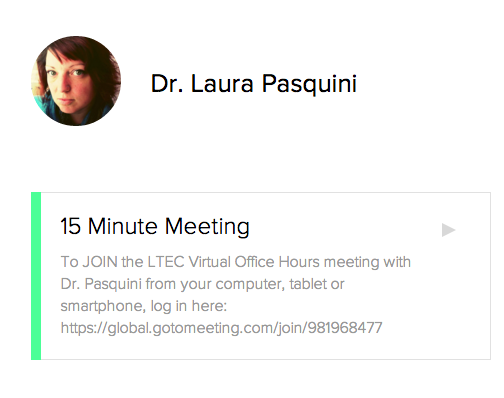
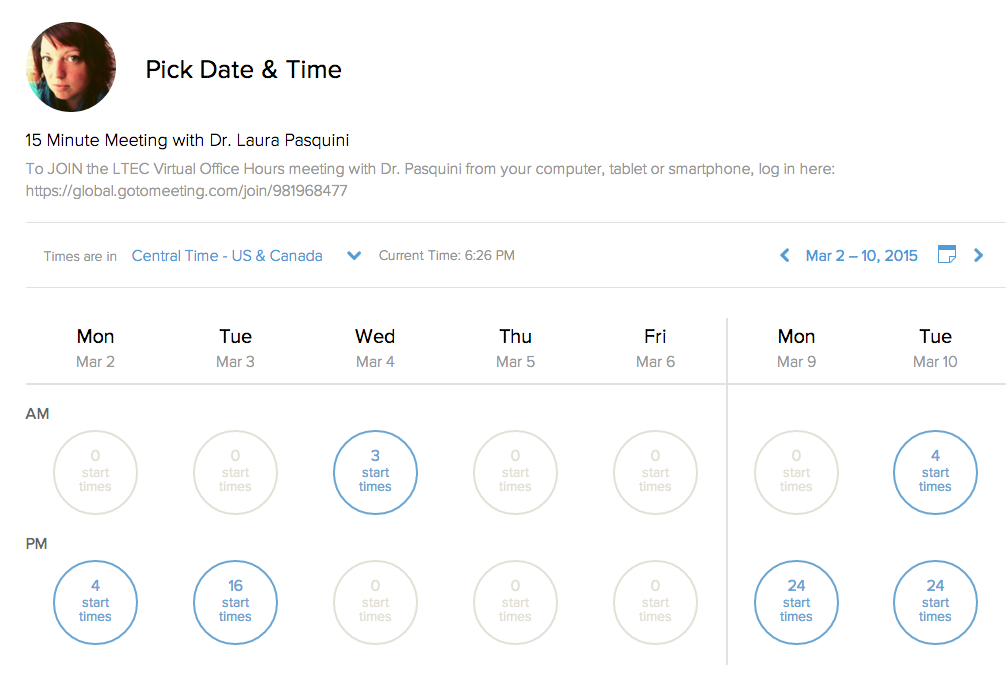
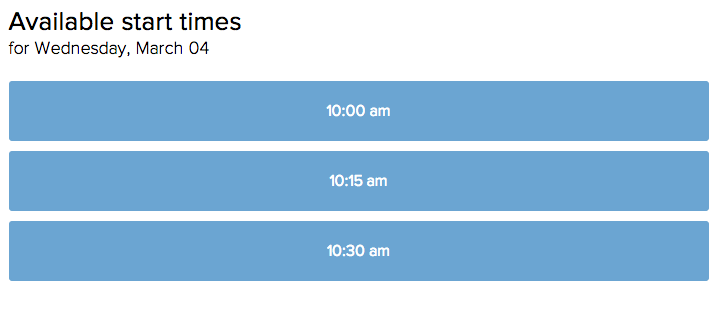
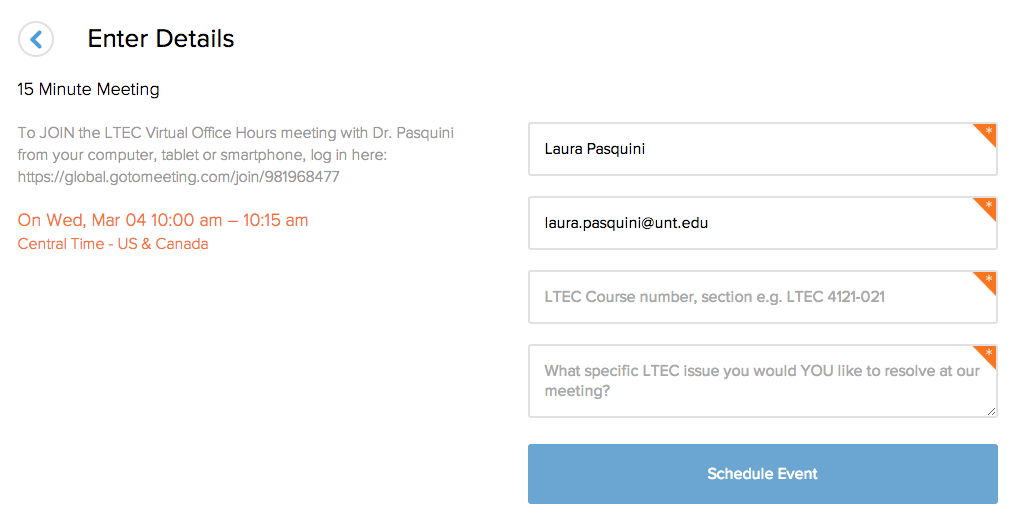
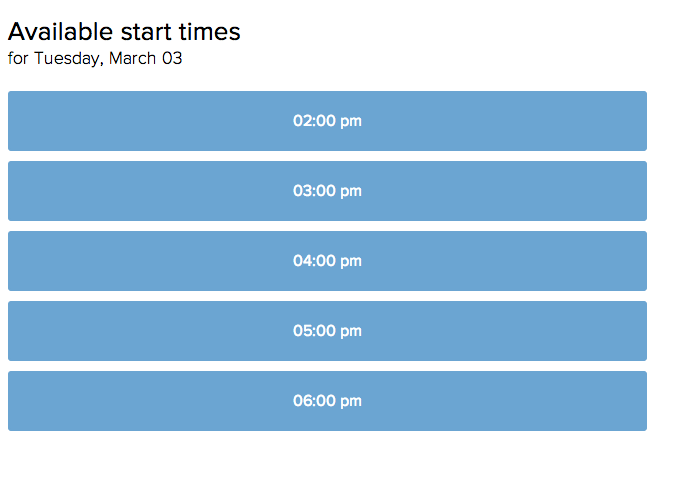
  5. Try offering “on demand” office hours. I use helpful scheduling websites with my Google Calendar to set up student meetings. Both youcanbook.me and calendly offer easy ways for learners to schedule 15-, 30- or 60-minute meetings, depending on my own personal work/travel schedule. Example of the calendly appointment scheduler below:

Step ONE

Screen Shot 2015-02-28 at 6.26.18 PM


Step TWOsched


Step THREE

book
 Step FOUR

Screen Shot 2015-02-28 at 6.51.51 PM

  • ProTip: Be sure have your students identify the purpose of the meeting. E.g. I ask, “What specific issue you would YOU like to resolve at our meeting?
  • Dedicated meeting location: Since I lecture online, I decided to keep all my office hour meetings in a set GoToMeeting space that is standard for all my courses. This is included on the course syllabus, class announcements, and, most importantly, it is an accessible location – students can use their web or phone:

LTEC Virtual Office Hours with Dr. Pasquini” Please join my meeting from your computer, tablet or smartphone. https://global.gotomeeting.com/join/981968477

  • You can also dial in using your phone.United States (Long distance): +1 (213) 289-0012
    Access Code: 981-968-477 

I am still evaluating my own office hour approaches for my distance learners, so please feel free to share your strategies with me. How do you support your learners? What ways have you encouraged your students to connect with you for office hours? Do you have suggestions that I might want to consider for online office hours? Post your suggestions below!

References

Weimer, M. (2015a, February 17). Office hours alternative resonates with students. Faculty Focus. Retrieved from http://www.facultyfocus.com/articles/teaching-and-learning/office-hours-alternative-resonates-students/

Weimer, M. (2015b, February 18). Office hours redux. Faculty Focus. Retrieved from http://www.facultyfocus.com/articles/teaching-professor-blog/office-hours-redux/ 

edusocmedia, Social Media

How is social media being researched to support student development/success in higher education beyond the “classroom”?

I recently curated a  reading list of literature/research on social media and technology use, specifically outside the higher ed “classroom” for a colleague at Niagara University, Dr. John Sauter. For his Sociology of Higher Education course, John wanted to share readings that demonstrate how social media and technology are being utilized outside formalized learning, and provide more information beyond the Social Media Resources [from the WNY Advising group] the practical guides/strategies. A recent prompt from my #edusocmedia friend Ove, made me think that this short list should be shared and hopefully expanded upon – enter this blog post.

Screen Shot 2015-02-22 at 12.02.04 PMImage c/o mkhmarketing on Flickr

In searching online, you will find that there are no shortage of “how to” and “social media strategy” publications – which often bridge the marketing, communications, education, business, and student affair disciplines. A growing number of  bloggers also share suggestions for social media use, community development, and campus engagement; however  my focus was to find recent RESEARCH in post-secondary education that examined how social media and emerging technologies are impacting student life, support, and success outside the “classroom” (face-to-face, online & blended learning) environments.

To consider social media perceptions and use outside of formal learning environments, it is important to gain insight from recent studies around learning in higher education with technologies, including:

Junco, R., Heiberger, G., & Loken, E. (2011). The effect of Twitter on college student engagement and grades. Journal of computer assisted learning, 27(2), 119-132.

Junco, R. (2012). Too much face and not enough books: The relationship between multiple indices of Facebook use and academic performance.Computers in Human Behavior, 28(1), 187-198.

Junco, R., Elavsky, C. M., & Heiberger, G. (2013). PuttingTwitter to the test: Assessing outcomes for student collaboration, engagement and successBritish Journal of Educational Technology, 44(2), 273-287.

Junco, R. (2015). Student class standing, Facebook use, and academic performance. Journal of Applied Developmental Psychology, 36, 18-29.

Muñoz, C. L., & Towner, T. (2011). Back to the “wall”: How to use Facebook in the college classroom. First Monday, 16(12).

Roblyer, M. D., McDaniel, M., Webb, M., Herman, J., & Witty, J. V. (2010). Findings on Facebook in higher education: A comparison of college faculty and student uses and perceptions of social networking sites. Internet and Higher Education, 13(3), 134-140.

Rodriguez, J. E. (2011). Social media use in higher education: Key areas to consider for educators. MERLOT Journal of Online Learning and Teaching, 7(4).

Silius, K., Kailanto, M., & Tervakari, A-M. (2011). Evaluating the quality of social media in an educational context. International Journal of Emerging Technologies in Learning, 6(3), 21-27.

Wakefield, J. S., Warren, S. J., Alsobrook, M., & Knight, K. A. (2013). What do they really think? Higher education students’ perceptions of using Facebook and Twitter in formal higher education learning. International Journal of Social Media and Interactive Learning Environments1(4), 330-354.

**Shout out to Josie Ahlquist for also sharing a wealth of resources on her Reference List page related to this topic as well and more related to student development theory and youth culture in media!**

My focus for this class reading list, was to find recent (2011 forward) peer-reviewed publications that share implications and findings from research on how social media impacts support/success in higher ed beyond the instructional context. Yes. Student affairs, academic advisors, and the like, in student support areas of higher ed, ARE educators – however social media/technology use for learning without the weight of the grade “carrot” does impact and influence adoption/use. In looking around, I found a number of recent literature reviews and compilations that look at social media in higher education – here are a select few I thought I would share:

Davis III, C. H., Deil-Amen, R., Rios-Aguilar, C., & Gonzalez Canche, M. S. (2012). Social Media in Higher Education: A literature review and research directions.

Hew, K. F., & Cheung, W. S. (2013). Use of Web 2.0 technologies in K-12 and higher education: The search for evidence-based practice. Educational Research Review, 9, 47-64.

Lewis, B., & Rush, D. (2013). Experience of developing Twitter-based communities of practice in higher education. Research in Learning Technology21.

Rios-Aguilar, C., Canché, G., Sacramento, M., Deil-Amen, R., & Davis III, C. H. (2012). The role of social media in community colleges.

Tarantino, K., McDonough, J., & Hua, M. (2013). Effects of student engagement with social media on student learning: A review of literature. The Journal of Technology in Student Affairs.

Tess, P. A. (2013). The role of social media in higher education classes (real and virtual)–A literature reviewComputers in Human Behavior29(5), A60-A68.

For my own interest, I decided to conduct a preliminary literature search to determine “How is social media being researched to support student development/success in higher education beyond the “classroom”?  This is NOT a comprehensive list, but more of a primer to initiate a more comprehensive search for recent (2011 forward) scholarly publications involving research on this topic:

Al-Harrasi, A. S., & Al-Badi, A. H. (2014). The Impact Of Social Networking: A Study Of The Influence Of Smartphones On College Students. Contemporary Issues in Education Research (CIER), 7(2), 129-136.

Birnbaum, M. G. (2013). The fronts students use: Facebook and the standardization of self-presentations. Journal of College Student Development54(2), 155-171.

Chen, B., & Bryer, T. (2012). Investigating instructional strategies for using social media in formal and informal learning. The International Review of Research in Open and Distributed Learning, 13(1), 87-104.

Cheung, C. M., Chiu, P. Y., & Lee, M. K. (2011). Online social networks: Why do students use Facebook? Computers in Human Behavior, 27(4), 1337-1343.

DeAndrea, D. C., Ellison, N. B., LaRose, R., Steinfield, C., & Fiore, A. (2011). Serious social media: On the use of social media for improving students’ adjustment. Internet and Higher Education, 15, 15-23.

Fuller, M., & Pittarese, T. (2012, June). Effectively communicating with university students using social media: a study of social media usage patterns. In 45th Annual Conference June 10-14, 2012 (p. 46).

Graham, M. (2014). Social Media as a tool for increased student participation and engagement outside the classroom in higher education. Journal of Perspectives in Applied Academic Practice, 2(3).

Jacobsen, W. C., & Forste, R. (2011). The wired generation: Academic and social outcomes of electronic media use among university studentsCyberpsychology, Behavior, and Social Networking, 14(5), 275-280.

Lin, M. F. G., Hoffman, E. S., & Borengasser, C. (2013). Is social media too social for class? A case study of Twitter use. TechTrends, 57(2), 39-45.

Lou, L. L., Yan, Z., Nickerson, A., & McMorris, R. (2012). An examination of the reciprocal relationship of loneliness and Facebook use among first-year college students. Journal of Educational Computing Research, 46(1), 105-117.

Joosten, T., Pasquini, L. A., & Harness, L. (2013). Guiding social media in our institutions. Planning for Higher Education – Society for College and University Planners. 41(2), 1-11.

Mastrodicasa, J., & Metellus, P. (2013). The impact of social media on college students. Journal of College & Character, 14(1), 21-29.

O’Brien, O., & Glowatz, M. (2013). Utilising a social networking site as an academic tool in an academic environment: student development from information-sharing to collaboration and innovation (ICI). AISHE-J: The All Ireland Journal of Teaching and Learning in Higher Education, 5(3).

Pettijohn, T. F., LaPiene, K. E., & Horting, A. L. (2012). Relationships between Facebook intensity, friendship contingent self-esteem, and personality in US college students. Cyberpsychology, 6(1), 1-7.

Ternes, J. A. (2013). Using social media to engage students in campus life. (Doctoral dissertation, Kansas State University).

Sponcil, M., & Gitimu, P. (2013). Use of social media by college students: relationship to communication and self-concept.  Journal of Technology Research, 4, 1-13.

Wang, Z., Tcherneve, J. M., & Solloway, T.  (2012).  A dynamic longitudinal examination of social media use, needs, and gratifications among college students.  Computers in Human Beheavior, 28(5), 1829-1839.

If you have published any articles and/or have contributions for research in this area – please add to the list! Post any publication references in the comments or reach out to me to discuss further.  I suspect this quest will continue, and it will also need a few collaborators to be successful. Are you interested in digging into the research to learn more about HOW we are SUPPORTING students in higher education using social media beyond formalized learning structures?  Let’s talk – so we can move forward in understanding the research lay of the land.
EdTech, Higher Education, Online Learning

Online Education in the US [2014 Report]

As I am on my way to the EDUCAUSE Learning Initiative (ELI & #eli2015), specifically to attend the National Research Center for Distance Education and Technological Advancement (DETA) Summit, I figured it was critical to review the 2014 Grade Level: Tracking Online Education in the United States just released from the Babson Survey Research Group (BSRG):

“The study’s findings point to a competitive marketplace, in which traditional institutions are gaining ground on the for-profits in online and distance education,” said study co-author Jeff Seaman, co-director of the Babson Survey Research Group. “While the rapid pace of online learning growth has moderated, it still accounts for nearly three-quarters of all US higher education’s enrollment increases last year.”

It is clear that online learning is on the rise in America – yet there is a vast difference between how administration and faculty view it. A majority of post-secondary education leaders (70.8%)  indicated that online learning is “critical to their long-term strategy;” however these leaders may struggle with online adoption as only 28% of their faculty find “value” and view online education as “legitimate.” A number of findings in this report show opposing views for online education. For example, these two factions of higher differ  by their awareness of open education resources (OER).

OER_FutureHE

There is much more of this narrative to tease out; and I would like to go through this report further (on the plane) and learn what others in the field have to say. For now I will leave you with some of the ‘quick facts’ shared, and encourage you to download and read through the FULL REPORT if you are in the online learning sphere:

Key report findings include:

  • The number of higher education students taking at least one distance education course in 2014 is up 3.7 % from the previous year.
  • The year-to-year 3.7% increase in the number of distance education students is the lowest recorded over the 13 years of this report series.
  • Public and private nonprofit institutions recorded distance enrollment growth, but these were offset by a decrease among for-profit institutions.
  • The percent of academic leaders rating the learning outcomes in online education as the same or superior to those in face-to-face remained unchanged at 74.1%.
  • The proportion of chief academic leaders reporting online learning is critical to their long-term strategy reached a new high of 70.8%.
  • Only 28.0% of academic leaders say that their faculty accept the “value and legitimacy of online education.”
  • The adoption of MOOCs (Massive Open Online Course) is reaching a plateau, only 8.0% of higher education institutions currently offer one, another 5.6% report MOOCs are in the planning stages.
  • The proportion of academic leaders who believe that MOOCs represent a sustainable method for offering online courses dropped to 16.3%.

Update:

A couple areas to note, and for further discussion this week at #eli2015 and the #DETAsummit (Follow @UWMDETA):

Pgs. 43-44: Discuss the under count and over count of distance education, i.e. for “fully online” enrollments – this seems to be hazy, as it might be as learning design for enrollment varies by student population type and course design delivery.

Pg. 44 – “The definition of ‘distance education is causing confusion”

There was an interesting segment in this report that struggled with the term “distance education.” This report takes into account distance education, when looking at “fully online” higher education programs. This part of the report reminded me about the Twitter debate of online learning, online education, distance education, and then some when trying to name an update to an edited book. What terminology is best? How can we describe/define education that is delivered from a distance/online/on the web/virtually? Please advise.

Professional Development, SAchat, Training

Twitter for Professional Development… Make it Part of Your PD Plan. #SAchallenge

In the field of learning and performance, there are a number of ways to train and develop employees. A number of professional organizations and educational institutions are interested in supporting online learning communities to enhance learning and development for “the workforce of tomorrow.” This often results in going to where the communities are already active online, i.e. social media. A number of social spaces, including blogs, videos, microblogs, and photo sharing websites, have been repurposed for training and development by the community. One of the largest areas for professional development has been on Twitter with users aggregating around a hashtag to form a community. In higher education, a number of Twitter-based communities of practice are emerging as the “combination of improved facility and user flexibility has created an environment in which networks and communities, albeit of a restricted kind, can flourish (Lewis & Rush, 2013).

sachallenge

It is no wonder why we see The #SAChat January Twitter Challenge #SAchallenge appear with the start of the new year. Although I’ve been loosely off the social grid for the holidays, I tuned back in to find January #SAChallenge prompts posted to get connected and involved on Twitter:

During the month of January, we will be tweeting out various challenges and ideas of ways you can engage on Twitter – starting with basic how-tos and moving towards looking at different ways to engage through the medium. Each weekday will bring at least one “challenge” – something you can do to either learn more about using Twitter or to refresh yourself and make you think about using it differently, especially within the #SAChat community. We’ll be posting the challenges here if you miss one and want to catch up.

I applaud the @The_ SA_Blog community managers for facilitating the #sachallenge.  To best support learning and development, The SA Collective L-Team are actively supporting their online subscribers and cultivating the #SAchat hashtag, by utilizing these key community management skills:

  • Listen. It might be a great space to broadcast and disseminate content – but that’s not how you hold a conversation. What do people what to talk about, not just receive? What is the online community engaged in? What are the conversations about online? Take a minute to read and learn from others online.
  • Participate. You need to be a community member, too. Try to join conversations as a peer contributor, not a facilitator. Contribute useful ideas, articles, research, and more. Your online community will want you to be actively sharing online like others in their learning community.
  • Include. Let others help find and create content, guide conversation, start new discussions. It’s a change for many of us in the field who what to “lead” the professional development experience but will pay off in a more vibrant, sustainable community. Encourage members of the community to be the active voice.

I think Twitter is a key component of my own learning and development, and I often encourage others (i.e. students, professionals, faculty, etc) to set up their own Twitter handle [HOW TO: Set Up a Twitter Account], and/or follow along with the community hashtag. I am also more than happy to connect and chat with those of you who reach out to me on Twitter (a.k.a. @laurapasquini), or by any other means if you want to to talk about Twitter or professional development. Although the #SAchat hashtag focusses on the Student Affairs arena there are a number of other higher education and discipline-based Twitter communities to follow.   

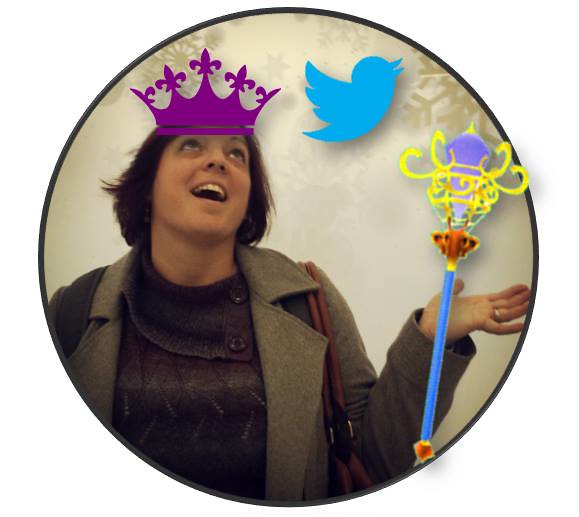
Dubbed the Twitter Queen by @hglez9

Photo mashup credit goes out to @hglez9

That being said, I also caution using Twitter as the only means for learning and development. As an avid Twitter user, who has learned a great deal from tweeting over the past few years, I have a healthy skepticism that Twitter is the “best” platform for delivering professional development. Apparently, I am not alone. Audrey Watters recently asked this question in her blog post “Is Twitter the Best Option for Online Professional Development?” and identified both its benefits and challenges. Twitter has created opportunities for conversation, research, collaboration, and support; however I have also witnessed spam bots, self-promoting followers, bullying, disciplinary implications in academia, and other not-so-nice things.  I was reminded by Audrey that “there is a fragility to our ability to connect and share online. Some of that fragility comes when we opt to rely on for-profit companies to run the infrastructure. We do not own the conversations on Twitter. We have limited control over our data and the content we create and share there.” That is not to say you should not participate and engage – but don’t let Twitter be the ONLY only means for your PD.

In my opinion, I think Twitter can augment, not replace, learning and development. Let Twitter be one part of your professional development plan for 2015, and then ask yourself what do you want to learn? Think about what goals you are setting for yourself first, and then consider the spaces you want to engage in this year. Always put your PD goals ahead of the platform, and then go searching for where you want to engage this year. You might also consider searching out training and development opportunities at your institution, at your professional associations, with trade/professional journals, by reading new literature & books, through research projects, signing up for a course/seminar/webinar, by conducting an informational interview, by reaching out to others in your network, and always by discussing your goals with mentors and peers from the field. Perhaps you might even take the time to reflect on these training experiences when you return to/start some “bloggery” (Thanks for the term, Bryan) to process your learning and development. Good luck with your PD goals for 2015! Let me know if or how I can help.

References:

Lewis, B., & Rush, D.  (2013). Experience of developing Twitter-based communities of practice in higher education. Research in Learning Technology, 21. Retrieved from http://www.researchinlearningtechnology.net/index.php/rlt/article/view/18598 doi: http://dx.doi.org/10.3402/rlt.v21i0.18598.

Watters, A. (2014, December 17). Is Twitter the best option for online professional development? Hack Education. Retrieved from http://hackeducation.com/2014/12/17/twitter-professional-development/.