#TBT Blog

#TBT Blog Post #3: Resoluting. #oneword2015

In honor of the new year, I thought I would see how I resolved to do better in the past. I still agree with my earlier sentiments, as I will stick with reasonable goals and good behaviors for 2015 (like I have been working on in 2014). I typically have a few projects on the list, and over arching objectives for each year (and semester… and month). That being said – I have been more of a fan of the #OneWord idea to motivate and encourage the year ahead.

Last year my #oneword2014 was simplify. The purpose was not to have goals, but rather consider my process and space of where I worked and lived. I think I reached this objective, and I have trimmed down my life clutter. This year,  my #OneWord2015 is NOW to remind me to always be present. It is important to remember the past and, of course, plan for the future; however  it is often a challenge (for me, at least) to be present and in the moment — so I will use the word NOW to remind me.

By taking on the word now, I hope to be more thoughtful, and on-task with projects, research, writing, and teaching. I think it is critical to direct my attention to those who I am collaborating with for work, and family/friends in my life. The word now will serves as a mean to act intentionally and be present with those around me more. I also see the word “now” as a way to be. It is important to focus on what is directly in front of you, and to not always look down the road. There is much to be said to be content with what is happening and going on in my life. As a planner and with possible change (life, career, location, etc.), I know this will be a good challenge for me for 2015. Maybe I should have reverted back to my 2007 resolutions… wish me luck!

——

#TBT Blog Post #3:

Resoluting. [Blog post from 7th January 2007]

I am not one for resolutions. They never last. Goals are better. However this year I was inspired by Jeff’s Cheapest New Years Resolution post on his blog… or rather I wanted to create/post a few simple (yet clever) resolutions. Here’s what I came up with:

1. Catch up on missed “Lost” episodes (season 3).
2. Initiate more high fives.
3. Listen to one new song a day.

So far, so good. I watched the re-cap episode of “Lost” last night. I high-fived co-workers while watching Team Canada crush Russia to win the gold medal last Friday at the office. And I have enjoyed numerous new tunes on Pandora.com (thanks Jeff) to help with my listening pleasure.

Small and attainable objectives. It’s where it’s at, folks.
#AcWri, #AcWriMo, Dissertation

#AcWriMo Discipline: Dissertation Boot Camp Here I Come!

In honour of my #AcWriMo November Goal #1, I decided to apply to the UNT Eagle Dissertation Boot Camp that is happening this week (November 21-23). To date, my word count for the month is 19, 344; however I need to dedicate more of these words to my dissertation drafting.

BootCampGraphic

Image from UDaily post from University of Delaware.

After approval from my faculty advisor and support from my supervisor, I applied to this 3-day boot camp to SHUT UP AND WRITE.  I just received my official acceptance to the program from Dr. Joseph Oppong, the Associate Dean for Research and Professional Development in the Toulouse Graduate School:

 Dear Student,

Congratulations, you have been accepted to attend the Eagle Dissertation Boot Camp! It will be held in the Willis Library Forum (first floor area). The boot camp is designed to provide you 3 days of interruption-free, stress-free, no-excuses-just-do-it writing time for your dissertation. To help you prepare so that you optimize your output here are some packing tips.

Be sure to clear your calendar for the whole of the boot camp. You need to commit to attend the entire workshop. You will not be excused to teach or attend class. Arrange transportation and childcare so that you are free to attend each day.

This is your notice that you are enrolled in Boot Camp. If you cannot attend this session let me know immediately. If you cancel within 3 days of the event you will be considered a “no show” unless you situation truly is serious. If you “no show” you will not be allowed to participate in the next session and your advisor will be notified. We have limited funds, space, and resources and you must commit to coming or give your seat to someone else.

Please bring a laptop, a mug (coffee/tea available) and/or water bottle. If you don’t have a laptop, you can check one out from the Library, but, bring a flash drive to save your work. MP3 players and headphones are recommended if they help you concentrate, or if you find nearby conversations distracting. Work tables, lunch, and snacks are provided.

No lateness, please. It’s distracting for the other campers…

Here is the line up this week’s dissertation boot camp – so don’t expect a whole lot of tweets, email responses, social network posts,  or interaction from me as my Interwebs use will be limited from Thursday (11/21) morning onward:

Boot Camp Schedule

Day 1 Day 2 Day 3
8:00-9:30 a.m. Formatting Workshop
9:30-10:00 a.m. Roll Call, Welcome, Introductions, Breakfast
10:00-11:30 a.m. Writing
11:30-12:00 p.m. Wellness Activity
12:00-1:30 p.m. Writing
1:30-2:00 p.m. Lunch
2:00-3:30 p.m. Writing
3:30-6:00 p.m. Optional Writing Time or Optional Individual Consulting
9:00-10:30 a.m. Writing
10:30-11:00 p.m. Wellness Activity
11:00-12:30 p.m. Writing
12:30-1:00 p.m. Lunch with Advisors
1:00-2:30 p.m. Writing
2:30-3:00 p.m. Self-Assessment and Discussion
3:00-6:00 p.m. Optional Writing Time or Optional Individual Consulting
9:00-10:30 a.m. Writing
10:30-11:00 a.m. Wellness Activity
11:00-12:30 p.m. Writing
12:30-1:30 p.m. Lunch
1:30-3:00 p.m. Writing
3:00-6:00 p.m. Optional Writing Time or Optional Individual Consulting

Each day includes:

  • several blocks of writing time
  • scheduled, limited time for web-browsing
  • tip sheets
  • wellness breaks
  • a lunch conversation with fellow campers (box lunches provided)
  • space to continue writing in the afternoon (if interested)

The reason I applied, is to have specific time carved out and a dedicated space to move forward on my #AcWriMo goal #1. A number of things get in the way of my dissertation writing, including other writing projects, presentations, work items, and life. Also, as a student who wears “many hats” on campus and outside my job, I can sometimes find it challenging to pick up where I have left off, and my motivation to just write is fragmented with other responsibilities. I think this dedicated writing schedule will push me further along with my dissertation goals.

I will report back in after “camp” is over. Write on, my friends. Write on.

Social Media

Do You Have Social Media Goals?

After participating in today’s Social Media Metrics in Government Using GSA Guidelines webinar hosted by Hootsuite, I began to think more about the WHY and HOW social media guidelines and policies develop. This session discussed how the government developed their guidelines around their GSA social media goals which were connected to their strategic communication plan and web presence.

Obviously this webinar had a focus on measurement and assessment for social media use using both free and paid tools, like Hootsuite; however it offered some sound advice to organizations that are just developing social media guidance or for those who are re-thinking their social media policy. Instead of starting with a policy, strategy, or guideline list of what to do or not do, it would be more helpful for institutions to think through the WHY of social media. This process provides organizations focus, sets out objectives, and creates a rationale for social media use and how these goals might be measured and assessed. For example, the GSA wanted to use social media and social data goals, included:

  • Be more effective in how they distribute critical information to citizens & communities
  • Engage citizens to help shape to public programs
  • Better inform strategies leading to greater efficiency
  • Increase use of innovative tools and services to further development

It is important to consider your institutional goals when organizing your social media guidance, here a few suggestions given from the webinar – but I am sure your organization has many others.

Internal Considerations:

  • Collaboration
  • Knowledge sharing
  • Cost saving & cost avoidance strategy
  • To be transparent
  • Talent acquisition

External Considerations:

  • Citizen engagement – Active use and participation (2-ways)
  • Promote services and resources
  • Provide customer service – feedback
  • Provide real-time resources – expand upon current communication channels

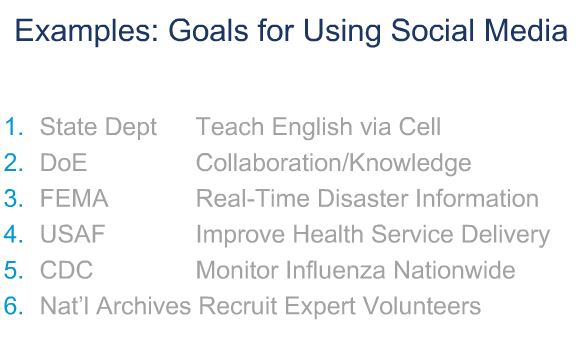
Here are a couple of examples shared from the GSA for their use of social media goals:

Example of Goals for Using Social Media in Government

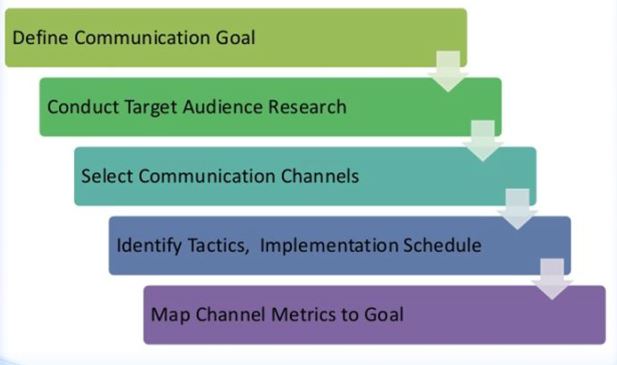
Another reason to consider developing social media goals before establishing your guidelines is to consider how you will evaluate social media use for your organization. Social media management of your resources is critical. To help assess social media engagement and use it will be helpful to align your goals to evaluation as part of your strategic communication plan. Social media analytics and metrics through different 3rd party tools and social dashboards; however what will be relevant for your organization to track and use for assessment purposes. You want to connect your goals to your key performance indicators (KPI) and desired evidence-based outcomes.

Planning for Measurement

One example was the use of hashtags from the Twitter for Public  Health case study to outline a clear system for planning social media management. This public health group utilized a hashtag, #SM4PH, to build hype around the start of a regular, organized Twitter chat and to launch a hashtag for community development. Their goal was to measure the impact of the hashtag use, conversation, and community involvement before, during, and after this first chat to assess the long tail of this campaign.

Does your organization or institution have social media goals? How do these goals support your social media spaces? How do you assess and measure your social media goals? Let me know.

Reference:

Macey, B. (2013, November 14). Social media metrics in government: Using GSA Guidelines – Webinar. HootSource. Retrieved from http://blog.hootsuite.com/social-metrics-gsa-guidelines/

UPDATE 11-19-13: If interested, this webinar is available for viewing on demand.

Professional Development, Reflections

#oneword2013 = ACTION

It’s that time of year… time to consider the #oneword2013. I think I embodied my #oneword2012, fantabulous, so I thought I might as well give #oneword2013 a go. 2013 has a great deal in store for me – there are a number of projects, deadlines, objectives, and initiatives I want to accomplish this year. My one word will move beyond TO DO lists, goals, New Years’ resolutions, or even wishes [sorry Daruma doll!].

Our goal is set for 2013 @FiachraM.Here's to our scholarly work & having our Daruma doll to remind us of our focus.
My #oneword2013 is ACTION! This word will remind me to be active and engaged in what I am doing. A little less conversation, a little more action. This means you should be seeing more verbs in my blog posts, such as researching, writing, moving, publishing, dancing, exploring, adventuring, trying, doing, completing, graduating, and challenging.

I have also decided to use the word ACTION to push me beyond my comfort zone. It’s time to visit new places, to try new things, and to enhance my learning and professional development. Whether it’s a road trip to a new location or learning a new sport (that involves a few bumps & bruises) – then why not? It’s a year for ACTION. Just do it!
Let's ride
What’s YOUR #oneword2013? Add yourself to the list.

#AcWri

#AcWriMo & Accountability to Write

Continuing with my blog “catch up” from the Fall 2012 semester theme…

I thought I’d share my #AcWriMo statistics for the month of November. In conjunction with #NaNoWriMo and #DigiWriMo, there are an avid group of academic scholars and early career researchers who “checked in” virtually to post their #AcWri goals and daily progress in a shared Google document.

So I decided to join in for #acwrimo in November to tackle a few writing projects and goals I had to hit by the end of 2012. This digital check in helped me track what I was doing. My goal was at least 750 words per day, as I found the 750words tool useful and a reasonable daily goal. In the end, my total number of words for the month of November 2012 = 60, 088 words!

I’m not sure if anyone really paid attention to what I was updating in the shared Google Excel doc, but  using 750words.com and tracking my own word count in a public space did remind me that I was not alone in my #acwri and publishing goals. This #AcWriMo word count sharing helped me keep tabs on my progress, and I was able to focus my attention to small milestones I have had for the bigger writing tasks, i.e. grant research, conference paper proposals, manuscript submissions edits, etc.

If you’re impressed with my stats and you want to increase your word count these days, then perhaps  a digital #acwrimo accountability is for you! A growing number of scholars continue to share #acwri goals and word count writing objectives each month here: Academic Writing Accountability 2013 spreadsheet.  Forget New Years resolutions for #acwri intentions, and focus on some S.M.A.R.T. goals for your scholarly writing this year.