Academia, Reflections

Top Ten List for Being a Better Faculty Member

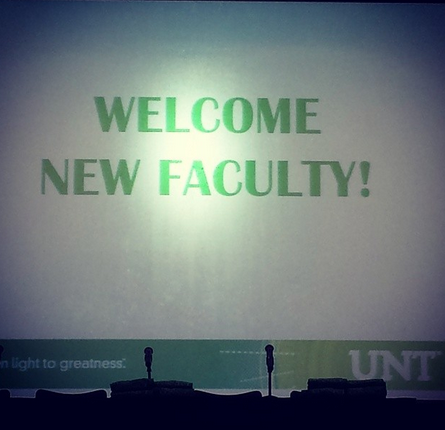
Just when I thought I was done with orientation sessions at UNT… I attended my OWN “new faculty” orientation.
welcome new faculty

{UPDATE: For those who are not aware, I finished my PhD this summer, graduated, and accepted a 9-month faculty appointment with the UNT College of Information as a Lecturer for the Department of Learning Technologies. Yay!}

During the day, information about the campus, expectations and advice was shared by a number of administrative leaders from the campus.
ten

One talk, from Dr. Warren Burggren, the Top 10 List for Being a Better Faculty Member, provided some sound advice, so I thought I would share this with you. I think it applies to new faculty, returning faculty, and others starting a new job in higher education.

10. Get to know the lay of the land. Beyond your office or workspace, get to know other locations on campus. Walk around and explore your college/university. Find out where buildings and resources are located.

9. Meet and greet in your department. Get to know fellow faculty members. Introduce yourself. Starting a new position is a great time to network and meet others in your department, on your campus, and in your discipline.

8. Know the rules… or ask about them. There are a lot of rules at every institution. Be sure to be informed, or know where to go for help or who to ask questions. Don’t be overwhelmed – just be smart.

7. Talk frequently to your chair. They are an ally and confident. Your chair will be there to support and guide your development within the department and your discipline. Set regular meetings/check-ins with your chair as their schedule allows.

6. Most of your frame of reference is still as a graduate student. Make the full transition to full time faculty. Please don’t feel like you need to socialize with your students – rather get social with your peer group. Get involved in faculty networking and social groups. Inappropriate interactions with students is something administration has to deal with, and they would prefer not to manage this.

5. Get a life. Even though you are working hard during your first faculty appointment, don’t forget to play hard as well. Take care of yourself. Find time to do things for you. #TreatYoSelf

4. Stay OR get organized. Don’t over commit. Manage your time effectively. Learn the ability to say no, and feel free to borrow the following phrase when asked to do something: “I would love to do ____ however; I don’t think I am being the best faculty member I can be.”

3. Teach and teach well. Focus on excellence in the classroom. Include solid bookends in your semester, i.e. the first and last lecture. Find something to talk to your students about during both classes. Make it experiential. Engage the students in the first lecture and final lecture. Be dynamic and encourage learners to want more.

2. Take pride in your university and community. Be part of the activities around the campus and city. There are a number of ways to be involved in the community and engage in school spirit. #GoMeanGreen.

1. Keep a sense of humor. The university is a complex hierarchical organization. You will want to take all things in stride. Be sure to laugh, and let things role off you.

Others offer advice for entering into academia here, herehere, here, and HERE. What advice would you give a to a new faculty member? Please share.
Impact Factor, Job Search

What’s Your Research Impact? #ImpactFactor

For those of you who track on me in social spaces, you know that I just completed my tenure as an academic advisor and counselor as of TODAY! This does not mean I will drop off from the advising world entirely, as I serving my term on the NACADA Council, I am a fan of the #AcAdv Chat community, and I involuntarily advise a number of students, colleagues, friends, and family, about academic and career matters on a regular basis. 🙂

syllabus Job Update: I’m Off the Market

I accepted a full-time faculty position with the UNT College of Information, as a Lecturer for the Department of Learning Technologies. YAY! My teaching responsibilities start in mid-August, so I will be sure to share more about this down the road. I will say that my work in both student affairs and academic advising helped contribute to my hire. {Remind me to post about the job search, interview, etc. process later.} All that I have learned about student development and support will DEFINITELY be applied to the online classes I’m instructing this Fall. Thanks #AcAdv & #SAchat!


So what am I doing  this summer?

Taking a hiatus from 8-5 office life on campus, to work on a few projects. One of these projects is an EPIC road trip adventure and… RESEARCH! I am contributing to a grant with @drjeffallen to compile a comprehensive literature review, platform information, metric indexes, social spaces, and general research on scholarly impact in the digital age. So far, I have been collaborating with a few researchers to assess and review individual research impact, specifically with regards to open and online scholarship, citation indexing, and alt-metrics.

impactstory

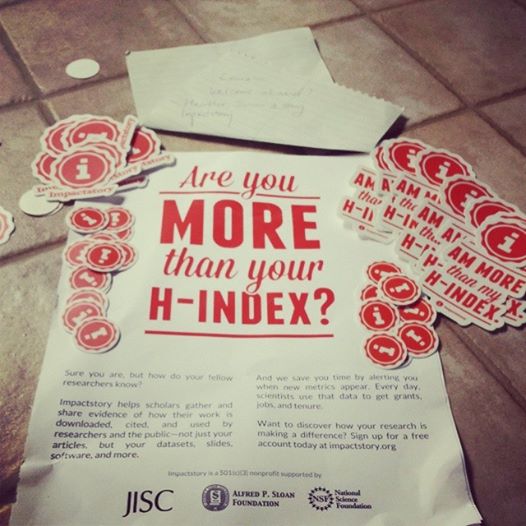
Personally, I have been interested in learning more about this topic as an early career researcher who is a fan of digital scholarship and identity. I was recently added to the Impactstory advisor posse, so now I have some swag to give to fellow research collaborators, who share a similar research impact philosophy. See – I’m still an advisor!

Are you interested in research impact? Do you want to talk about how digital scholarship can influence research, writing, and publication? Let me know. Let’s chat! Follow along this blog, as I am sure to share some ideas, findings, and insights, and I will be tweeting using  #ImpactFactor as my hashtag of choice.

#phdchat, Book Review, Higher Education, PhD

I’m “On the [Job] Market”: The Application Process

As academic job postings and other employment opportunities are becoming available, I decided it was time to prepare my own application materials and announce that I’m ON THE JOB MARKET. It should be no surprise to many as I am ABD (not a title), and I have been diligently working on my dissertation— so there is really no better time for a job search.

Well I was going to save this for holiday reading...but it looks like I'm On The Market NOW #phdchat I’ll be honest. I’m quite accustomed to the thrill of the job hunt (I am in my 3rd position of employment, since I have moved to Texas 5 years ago); however the academic job search has upped the ante. My future career planning involves a potential re-location (either in the US or abroad) and new career beginnings (either as a junior faculty member, research or other), which means this job search and application process is being treated like a job itself.

To prepare for my job search and career planning…

I have been talking to many researchers in the field, administrators in higher education, companies who seek my support, current faculty (off and on campus), mentors, and peers over the past year [Thank you for these discussions and talks – you know who you are]. More than not, many are quite open to offer advice, share professional experiences, edit my application materials, provide a reference, or send potential job postings my way (hint, hint). In my spare time, I have been reading Barnes’ (2007) “On the Market: Strategies for a Successful Academic Job Search,” specifically,  Chapter 4: The Application Process. This section of the book includes great questions to ask and think about before the application process, and examples of deciphering what academic job postings mean to decide what I want. Here are some current, pre-application questions I am currently pondering:

  • What type of position am I most interested in?
  • What sort of institution or organization do I want to work for?
  • Where do I want to live?
  • Do I want to apply for administrative or faculty track positions?
  • Who will write my reference letters?
  • Will my academic search focus on research or teaching institutions?
  • What is my best academic “fit” for department?
  • Do I want to look beyond higher education & academia?
  • Who will I connect to discussion the application process?
  • What is my timeline and schedule for applications?
  • How will I best organize a joint career search with my partner in crime?

Fortunately, most of my academic application requirements are “works in progress” from my doctoral program and portfolio requirements (Thanks #untLT department!) these past few years. My current objectives are to edit and prepare materials I have for my academic job search and application, including:

  1. Cover Letter
  2. Curriculum Vita
  3. Letters of Recommendation
  4. Writing Samples and Other Supporting Documents
  5. Teaching Portfolio (Dossier)
  6. Social Media Spaces & Places
  7. Application Schedule – to track applications & submissions

This chapter also includes helpful templates for CV’s and cover letter formats. I plan on re-tooling and modifying my current application materials based on position type and job description, so a review of these examples were helpful. Here are a few suggestions for cover letter writing items to include – 17 elements for the academic cover letter:

17 elements of the academic cover letter. #phdchat

Do you have academic job search advice? Tips on the application process? Considerations for the academic research and faculty positions? Potential openings I might be interested at your institution? Let me know. Academic job search advice is welcome.


Reference:

Barnes, S. L. (2007). On the market: Strategies for a successful academic job search. Lynne Rienner Publishers.

Higher Education, Social Media

10 High(er Ed) Fliers on Twitter

Check out 10 frequent fliers that are active on Twitter in Higher Ed c/o the Chronicle article from late last week. (Sorry for the delay.)

Most of these micro-bloggers study new media & the impact of Twitter on higher education.  Follow on, friends.

@PRSAjobcenter

@jayrosen_nyu

@hrheingold

@amandafrench

@academicdave

@dancohen

@paullev

@mcleod

@mwesch

@presidentgee

NACADA Tech Seminar 2009

NACADA Presentation & Resource Archive

New Trends in Technology for NACADA

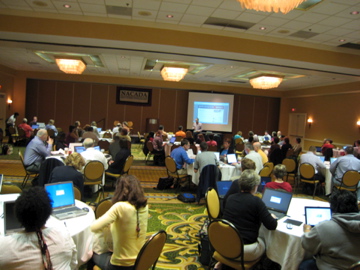
Today was a pretty exciting for NACADA as they host their 1st NACADA Technology Seminar with 118 participants in Clearwater Beach, FL. The sessions were filled with lots online tools & resources. It was great to follow up these sessions with discussions at lunch & in Learning Communities on how to use these mediums for advising. I enjoyed the sharing, questions, & thoughts about the future face of advising & technology. There is definitely room and space for this discussion to continue tomorrow – and onwards!

Be sure to stay connected to the many resources & presentations that are being shared at NACADA Tech, to help you work on you plans & development for technology:

  1. NACADA Presentation Archive (this will be updated as they are posted)
  2. The NACADA Tech Hub
  3. Faculty Wiki & Pages: Karen, George, Eric & Laura

Happy sleeps to all! We shall continue this tomorrow…and beyond.