Higher Education, Professional Development, Reflections

Digesting #dLRN15: Making Sense of Higher Ed

In the midst of the death of higher ed headlines,the  disruption of HE,  and all the higher ed is broken rhetoric tossed out, a few of us took a pause last week to discuss how to deal with the issues and challenges facing the post-secondary education sector at #dLRN15. I felt fortunate to be able to connect with a number of colleagues to talk behind the buzzwords, and dig into a the real issues challenges our colleges and universities face. It’s time and there is a need to take time for making change in higher education (thanks for the prompt post, @KateMfD). I am not sure that “change” was made, but I am proud to be part of the discussion and momentum that will move some of it forward.

pre-con QaMany thanks to the conference organizers for bringing a few smart kids around the table to discuss the following issues:

  • Ethics of collaboration
  • Individualized learning
  • Systemic impacts
  • Innovation and work
  • Sociocultural implications

The panels, sessions, and keynotes left me with more questions than answers – and that is a good thing. Beyond the formal program, the sidebar chats over coffee/snacks/pints were not to be dismissed As Mike Caufield said, I will need to process discussions had at #dLRN15 for weeks. There were some deep discussions into complex issues that could not be dealt with in just two days.

In our pre-conference meeting, each group picked a question/issue based on the themes the conference was focused on (see above). One the groups developed a question that resonated with me the most:

keyquestionWe always want to push forward with big change and innovative ideas in higher ed, but really do we sometimes forget to recognize the incremental changes occurring within our institutions? How do we acknowledge the slow movements and progress we make in HE or that it is an on-going process of change? There are many micro-movements occurring within our learning spaces to help us evolve. I know there are a number of amazing things happening within our colleges and universities — sometimes it’s these slow contributions that make the difference and we often fail to recognize this gradual progress. Slow and steady does win the race.
FinalPanel

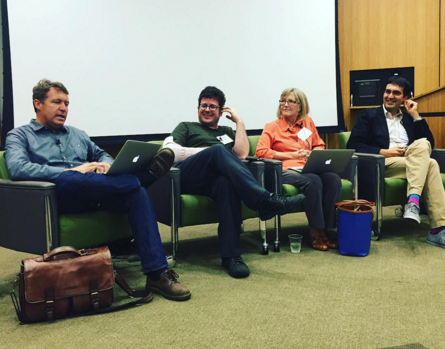
Ethics of Collaboration & Closing Remarks: Random Dude, Mike, Barbara & George

Fast-forward to the end of the conference, after a number of thoughtful conversations, this final panel reminded all of us of the call to action => to provide evidence for higher ed to shift. George Siemens asked us to utilize research to fuel the fight around the issues raised. Beyond collaboration, what are we really going to do with what we’ve talked about now? It’s great to hear that we are not alone in our discussions however we need empirical evidence to support the change ahead in higher education. I appreciated how this panel spoke about getting beyond the dichotomies and encouraged us to think about research in collaboration with our students and work. We really need to listen to our students and amplify their story/voice in the research we do. It’s easier to move and change when there is already momentum for systemic change, and perhaps #dLRN15 titled the scale for a few. There are a number of challenges and questions from #dLRN15 to consider with our research in higher education, including:

  • What were the foundational assumptions and purpose we thought about at the #dlrn15 ?
  • How do the threads of the conference fit together in a framework to support advancing higher ed? 
  • What does it mean to have a US-centrist focus in higher education? How does it impact HE on a global scale? Does it?
  • Was there enough systems-level research or research on systems change at #dLRN15?
  • Is there a need for systematic-change at all levels to advert change in higher ed?
  • How can higher ed research impact practitioner-based work?
  • Is research is the lever for change for us? And does empirical evidence have the potential to change the higher ed system?
  • How can we create a true design jam process — where research is reviewed and reflected?
  • Why should we trust the researchers?
  • We are able to get learners to the institution, but just not to get them through
  • economics of higher education — and the future of higher ed
  • Do we have enough divergent thoughts or ideas shared? Is this an echo chamber or do we need to invite others into the room/discussion for HE? 

This conversation (thankfully) is not over. Here’s a snapshot of my #dLRN15 Reading List with reflections and then some. Let’s keep this conversation and momentum going.
networkedscholar, Research

Being A Networked Scholar

Using social media and being a networked scholar allows provides you with an online, research presence and connects you to academics inside and outside your field. The power of open, social networks, allows academic to connect to research and researchers across disciplines. Consider all the ways you can collaborate and share in social media. A growing number of scholars have adopted and joined these online scholarly communities to meet other like-minded scholars, solicit for research support, share project progress, and disseminate findings beyond a conference publication or journal article. A core value of open, online networked scholarship is it is “a place where scholars can congregate to share their work, ideas and experiences” (Veletsianos, 2013, p. 648).  There are a number of researcher identification and citation tools connected to social media sites and scholarly metrics. Teaching and research information are being distributed and shared across platforms and communities.

elearn14-digital-scholarship-21-638

“It is a critical time to rethink how research is produced, distributed, and acknowledged.”

(Pasquini, Wakefield, Reed & Allen, 2014, p. 1567).

As I investigate workplace learning and performance, it has been helpful to blog and bounce ideas off on others on Twitter. I have used Mendeley to work on literature reviews, Google+ hangouts for research team meetings, Google documents for collaborative writing/research, searched Academia.edu or ResearchGate to access publications, and posted academic results to SlideShare. These are just a few ways I like to “show my work” and work in the open as a scholar. Being social and online allows me to reflect on my academic teaching and research scholarship experiences, and it has connected me to a great number of academics who I learn and research among.

If you or another academic colleague are thinking about how social media and networks can impact your teaching, research, and service scholarship, then here are a few insights George & I shared via Royal Roads University post on networked scholarship.

Network with colleagues

Higher education faculty and academics are adopting social media in growing numbers. A 2011 survey, for example, found that 45 % of higher education respondents use Facebook for professional, non-classroom purposes. Joining social media networks allows scholars to connect with colleagues, offer resources and discuss issues of professional interest.

Solicit feedback and reflect on your research and teaching

Academics increasingly share their work online, often engaging in activities that impact practice. Academic-focused social networking sites, such as Academia.edu and Mendeley, and general interest sites such as Twitter and SlideShare provide scholars with places to distribute, discuss and expand on their research and teaching.

Reach multiple audiences

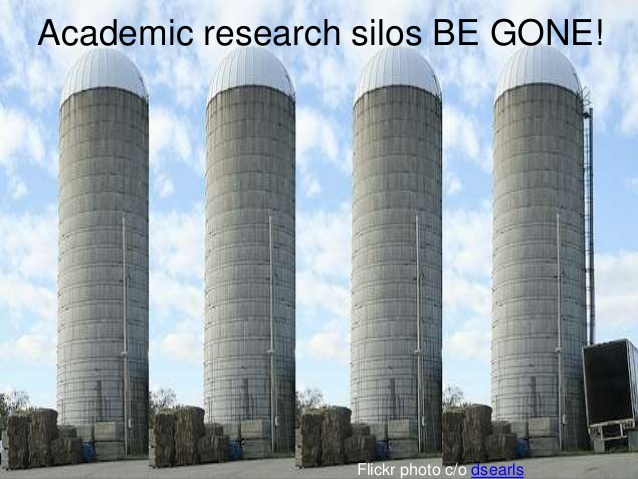
In sharing in open social networks, scholars enter into an interdisciplinary territory and often break down barriers between academic disciplines. Not only are the traditional walls of the academy thinner online, but academic work could reach broader audiences, such as practitioners and journalists.

Cultivate your identity as a scholar

Social media and online networks allow scholars to manage their online identity, track their citations, identify their spheres of influence and connect with colleagues. These tools support different ways in which knowledge can be produced, shared, negotiated and acknowledged. Learn more about a few of these tools here and here.

Become more open

Using social media and online social networks means being a tad more open, and that’s good for all of us. Openness is the practice of sharing resources and materials (e.g., syllabi, lectures, research papers) in a way that allows others to retain, reuse, revise, remix and redistribute them. Social media and online social networks often support an ethos of openness, enabling academics to share their work more frequently. A more open approach to scholarship allows knowledge and education to flow more freely and to be used more widely.

What advice do you give early career researchers and academics who are just getting started with social media?

I am not naive to say that being a networked, social scholars does not have any issues. What challenges do you see in being part of the “open” and involved in networked scholarship? Let me know. A follow-up blog post on this particular question and issue to come…

References:

Pasquini, L., Wakefield, J., Reed, A. & Allen, J. (2014). Digital Scholarship and Impact Factors: Methods and Tools to Connect Your Research. In Proceedings of World Conference on E-Learning in Corporate, Government, Healthcare, and Higher Education 2014 (pp. 1564-1569). Chesapeake, VA: Association for the Advancement of Computing in Education (AACE). Retrieved June 1, 2015 from http://www.editlib.org/p/148918.

Veletsianos, G. (2013). Open Practices and Identity: Evidence from Researchers and Educators’ Social Media Participation. British Journal of Educational Technology, 44(3), 639-651.

A version of this blog post is cross-posted on the Royal Roads University website.

Academia, networkedscholar, Open Education, OpenAccess

Being #Open Comes with a Number of Assumptions, Challenges and Tensions #scholar14

Being an open educator is critical. From my personal experience, I have engaged and interacted with research, teaching, and service scholarship based on the examples I have seen around me.  A large number of collaborative research and learning opportunities could not have been possible without using open and social platforms. To be a truly effective educator and researcher, I believe it is critical to share our research-to-practice work. It is through transparency and openness, scholars are able to contribute to their discipline, connect to other related fields, and, most importantly, contribute to public knowledge.

open
Photo c/o Flickr member OpenSource.com 

As I think about digital scholarship and “openness” as an early career researcher, there are a number of questions unanswered and need to be discussed further as academia is challenged by the digital (Pasquini, Wakefield, & Roman, 2014, p. 13) :

  • What type of research exchange will scholars participate in during the 21st century?
  • Is scholarship just about publication and citation index?
  • Should research require a social aspect to connect and exchange discourse and/or debate?
  • What social media and altmetrics are best suited for interaction and engagement within each discipline?
  • How do individual research impact factors influence academia career development?
  • What suggestions do seasoned researchers have for the digital scholar generation?

Challenges and tensions should be considered when openly giving back to the resource pool of learning and research. A number of researchers have expressed their concern for being open and sharing methods, research findings, and other aspects of the “process” of learning and research. To balance these concerns, also comes the tensions of network influence, identity, and impact that continue to pour over from #scholar14 Week 1 conversations:

“Uncovering differences in network structure according to discipline and position points to a relationship with academic career trajectory and identity. This finding contradicts the perception that the online environment acts as a democratising space, suggesting instead a preservation of ‘off-line’ hierarchy” (Jordan, 2014).

Within this past week, I was fortunate to hear how a few members of my personal learning network grapple and manage these dueling tensions in academia – here are a few notes, tweets, and ideas gathered from these talks:

  1. Martin Weller‘s #UTAlink talk  Battle for the Open
  2. Royce Kimmons (@roycekimmonsAssumptions, Challenges & Tensions #scholar14 Chat
  3. Dave Cormier‘s #aln14 Keynote on Rhizomatic Learning – The Community is the Curriculum

“Tearing down the traditional walls” is becoming more common in online, social academic communities. This breaking down of the traditional norms in academia, is designed to remove barriers placed between the faculty member and their learners. To be part of this sharing community, you need to really embody core values of openness, equity, access, and sharing. The challenge often emerges when your own philosophy of being “open” is not inline with your post-secondary education institution. I strongly believe that open needs to be a key  attribute for PSE institutions to take the lead on, specifically in terms of policy or manifesto that includes (e.g. Open Access @ UNT), OER resources, open scholarship, open data resources (e.g. UNT Data Spot),  and more.

How does the culture of your academic community, discipline, or institution influence you? Are there considerations and tensions challenging you “to be or not be” in these open spaces? Please share. My ears and eyes are open. Always.

References:

Jordan, K. (2014). Academics and their online networks: Exploring the role of academic social networking sites. First Monday, 19 (11 – 3). Retrieved from http://firstmonday.org/ojs/index.php/fm/article/view/4937/4159 doi: http://dx.doi.org/10.5210/fm.v19i11.

Pasquini, L. A., Wakefield, J. S. , & Roman, T. (2014). Impact factor: Early career research & digital scholarship. TechTrends, 58(6), 12-13. DOI 10.1007/s11528-014-0797-7

Academia, Reflections

Top Ten List for Being a Better Faculty Member

Just when I thought I was done with orientation sessions at UNT… I attended my OWN “new faculty” orientation.

welcome new faculty

{UPDATE: For those who are not aware, I finished my PhD this summer, graduated, and accepted a 9-month faculty appointment with the UNT College of Information as a Lecturer for the Department of Learning Technologies. Yay!}

During the day, information about the campus, expectations and advice was shared by a number of administrative leaders from the campus.

ten

One talk, from Dr. Warren Burggren, the Top 10 List for Being a Better Faculty Member, provided some sound advice, so I thought I would share this with you. I think it applies to new faculty, returning faculty, and others starting a new job in higher education.

10. Get to know the lay of the land. Beyond your office or workspace, get to know other locations on campus. Walk around and explore your college/university. Find out where buildings and resources are located.

9. Meet and greet in your department. Get to know fellow faculty members. Introduce yourself. Starting a new position is a great time to network and meet others in your department, on your campus, and in your discipline.

8. Know the rules… or ask about them. There are a lot of rules at every institution. Be sure to be informed, or know where to go for help or who to ask questions. Don’t be overwhelmed – just be smart.

7. Talk frequently to your chair. They are an ally and confident. Your chair will be there to support and guide your development within the department and your discipline. Set regular meetings/check-ins with your chair as their schedule allows.

6. Most of your frame of reference is still as a graduate student. Make the full transition to full time faculty. Please don’t feel like you need to socialize with your students – rather get social with your peer group. Get involved in faculty networking and social groups. Inappropriate interactions with students is something administration has to deal with, and they would prefer not to manage this.

5. Get a life. Even though you are working hard during your first faculty appointment, don’t forget to play hard as well. Take care of yourself. Find time to do things for you. #TreatYoSelf

4. Stay OR get organized. Don’t over commit. Manage your time effectively. Learn the ability to say no, and feel free to borrow the following phrase when asked to do something: “I would love to do ____ however; I don’t think I am being the best faculty member I can be.”

3. Teach and teach well. Focus on excellence in the classroom. Include solid bookends in your semester, i.e. the first and last lecture. Find something to talk to your students about during both classes. Make it experiential. Engage the students in the first lecture and final lecture. Be dynamic and encourage learners to want more.

2. Take pride in your university and community. Be part of the activities around the campus and city. There are a number of ways to be involved in the community and engage in school spirit. #GoMeanGreen.

1. Keep a sense of humor. The university is a complex hierarchical organization. You will want to take all things in stride. Be sure to laugh, and let things role off you.

Others offer advice for entering into academia here, herehere, here, and HERE. What advice would you give a to a new faculty member? Please share.

#phdchat, Job Search, PhD

The Vitae: Brewing Academic Experience for Your CV

A key part of the academic application is the vita. Since I mentioned I’m on the job market, a number of peers have asked me, what does my curriculum vitae (CV) look like? My response – it depends. It depends on the type of position – academic or nonacademic – and the institution. For the most part, I have a standard CV that I tailor for my applications and will update as I review my  academic job search spreadsheet o’ fun this week.

Screen Shot 2013-11-26 at 10.56.41 PM

Besides the cover letter, the vitae is probably the most important document for your academic job search. The vitae provides a detailed, yet distinct, review of your academic experiences and background that is chronological, skill-based, and in a combination of formats.

Viva Vita Java

The CV is a presentation of you on paper (for the most part) that highlights your expertise and development as a scholar. Although the organization resembles a resume, a vitae does not have length restrictions and it focuses on your academic experiences (you may want to include non-academic information if it strengthens your CV, and this information is relevant and specific for your discipline):

A typical CV includes:

  • Your Information (e-mail, address, mobile, website, etc.)
  • Education (undergraduate and graduate school)
  • Dissertation information & faculty advisor (title, expected graduation, if ABD)
  • Areas of research (or teaching) interest
  • Publications – peer-reviewed and relevant non academic publications
  • Grants, honors & awards
  • Teaching scholarship – link to teaching portfolio if applicable
  • Related work experience & positions (academic & non-academic; paid & unpaid)
  • Names of references (phone and email)

Format, style, and visual presentation of the CV is really up to you; however I recommend reviewing vitae examples, and getting other faculty or scholars in your discipline to review it. A few helpful tips on the curriculum vitae from Barnes (2007) includes:

  1. List your publications on the first page – show how you are already contributing to the literature in your discipline.
  2. Separate academic from nonacademic publications – distinguish between peer-reviewed articles, book reviews, & nonacademic publications.
  3. Separate publications from presentations – differentiate writing from teaching.
  4. Provide lists in chronological order – most recent first and move backward in time for easy reading & review.
  5. Include works in progress – identify if it is in review, accepted, and dates.
  6. Avoid filler – be confident and concise in your details.
  7. Include honors and grants immediately following publications – introduce most recent achievements & that you are able to acquire funding sources.
  8. Include related and nontraditional employment – consider the position and what experiences are relevant for your applications, perhaps you should industry, university administrative role(s) on your CV.
  9. Include postdoctoral experiences in the “education” section of the vita.
  10. Include service-related experiences – leadership role in a department, committee work or organized a conference helps to make you look like a more rounded candidate.

Format and style for your CV is a personal choice. You may wish to organize your CV differently for research-focused vs. teaching institutions vs. nonacademic roles vs. positions. There are a number vitae examples to review herehere, here, and here. I would also recommend looking at faculty profile pages for vita examples at the departments/institution you are applying to, and be sure to review CVs from scholars whose work you follow in your field. More often than not, CVs examples are posted online (pros & cons of this) and shared – as it also shares academic scholarship and experiences.

Ask your faculty advisor, current faculty, and respected researchers for advice. Many would be happy to support your academic search, and gladly review your CV — plus a few may want to have a copy of this document if they will serve as your reference. Get support with editing and fine tuning your vitae. Another set of eyes, and feedback from an outside perspective will help you improve your CV.  Good luck with your applications — I’m off to edit and update my own.

Reference:

Barnes, S. L. (2007). On the market: Strategies for a successful academic job search. Lynne Rienner Publishers.