EC&I831, Learning Technologies, Virtual Communities

Gaming in Education

It’s all fun & games… until someone actually learns something.

Educational gaming has become a “hot topic” as accessibility to computers and increased electronic gaming resources have entered the hands of learners. Educators are interested bringing innovative and appealing teaching resources to the evolving learning sphere. Many game designers see the potential for building learning games to capitalize on the video and simulation game market for the classroom. Although I can see potential in gaming for education, I am wary of the disconnect between these two players. Some instructors buy into mass produced “edutainment” games as their response to “adding technology in the classroom.” It would be more effective to connect learners with problem-based, collaborative games that challenge students to critically think and apply the curriculum.

Educators, like Sylvia Martinez, are providing examples for learning professionals who are interested in game-based curriculums. Sylvia is the President of Generation YES (Youth & Educators Succeeding) and she has been engaged in design and implementation of games for education for quite some time.  She is a strong believer that play to supports effective learning and that games can support curriculum needs in the classroom.

Sylvia gives a great introduction to gaming in education in her Kicking It Up A Notch: Games in Education presentation and wiki resources from the K-12 Online Conference 2009.

VideoGamingClub

Picture from the Committee for Melbourne

During last week session in #eci831, Sylvia provided some good and bad examples of how gaming practices have been incorporated in the classroom. It is critical that learners are given the time and purpose for gaming, and support is facilitated through effective reflection and follow up provided by the instructor.

James Paul Gee itemizes “game-like” attributes in his publication Good Video Games and Good Learning:

  • identity

  • interaction

  • production

  • risk-taking

  • customization

  • agency

  • well-ordered problems

  • challenge and consolidation

  • situated meanings

  • pleasantly frustrating

  • just in time and on demand

  • system thinking

  • explore, think laterally, rethink goals

  • smart tools and distributed knowledge

  • cross-functional teams

  • If properly introduced, gaming and project design opportunities compliment & enhance curriculum. Instructors interested utilizing project-based or game-based learning should consider time needs, classroom management, student readiness to collaborate and desired learning outcomes. A few key objectives for gaming implementation is the adaption, correlation, connection assessment and reflection for classroom learning. Sylvia recommends educators look for games that:

  • are programmable & adaptable
  • supports the big ideas for learning
  • offers students multiple ways to “win”
  • plays slow, not twitch play
  • increases ability
  • provides opportunities to collaborate
  • encourages problem-solving & logic strategies
  • suits the curriculum that is taught
  • includes thinking and planning
  • Game on!

    Learning Community, Networked Practice, PLE, PLN

    Personal Learning Environments (PLEs) & Personal Learning Networks (PLNs)

    Personal Learning Environments (PLEs) & Personal Learning Networks (PLNs) are a forced to be reckoned with as technology becomes more accessible and user-friendly.

    pler

    On October 13-16, 2009, the online symposium on learning-centric technology shared ideas on how PLEs & PLNs are impacting the educational technology field. Here’s a bit more from the symposium organizer’s George Siemens & Stephen Downes:

    The interest in Personal Learning Environments has grown with the emergence of Web2.0 technologies. Learning technologists can see how PLEs can help learners to organize their own personal learning, rather than that formal education institutions control the technologies that are being used and the way in which they are being used. Speakers will include developers and researchers of PLEs. All events will be hosted in Elluminate and recorded for archives. A discussion forum will be hosted in Moodle for asynchronous interactions.

    Although I was working during the scheduled speakers, I managed to read posted materials and listen to the one of the recorded sessions . There are a wealth of great experiences & ideas archived online, and I hope to listen/learn more  in the upcoming weeks. Many of these speakers are leaders and pioneers in the PLE & PLN learning field.

    For those of you interested and engaged in contributing your own educational experience with personal learning environments/networks, might I suggest you also check out the Call For Chapters for an upcoming eBook by Athabasca University and the National Research Council of Canada.

    EC&I831, Learning Technologies, Photo Sharing, Social Media

    What’s In A Story?

    Everyone loves a good story. Think of your favourite story. What is it? Why do you like it? Tell me more.

    rm

    Image c/o Scholastic.ca

    When asked this question in #eci831 last week, the first story teller I connected to as a child was  Robert Munsch. I fell in love with almost all his books, especially The Paper Bag Princess, Love You Forever & I Have To Go.  These books are great read aloud and audio books, since most stories were created as an oral tradition in during Robert Munsch’s daycare working days. I was fortunate to meet Munsch during my 2nd year of undergrad when he visited my Children’s Literature class at the University of Guelph. Although the audience was older than his usual reading groups, Robert was still able to keep these “kids” on the edge of their seat.

    Alan Levine shared some interesting & useful resources for using new media for Digital Storytelling. In both his presentation (you may need to download Cooliris to view in Firefox or Safari) and 50 Way Wiki there are numerous tools to explore for effective online storytelling.

    Here are a few examples of digital stories we shared & discussed:

    How do you share your story online? Check out a few tools to support your digital story telling:
    CCK09, Learning Community

    Networks Influence Learning

    It’s know what you know, it’s who you know. Dave Cormier believes that “knowledge is something that can be negotiated and validated in a community of knowledge.” This means that the future of education may be more connected and less constructed. This idea both challenge and invigorates educators alike.

    A couple weeks ago, Dave & Stephen discussed/bantered about a few key concepts about Connective Knowledge for CCK09 Week 4:

    • Knowledge is the psychological result of perception, learning and reasoning.
    • Connective learning is a process of creating new knowledge patterns.
    • Networks influence how knowledge is shared.

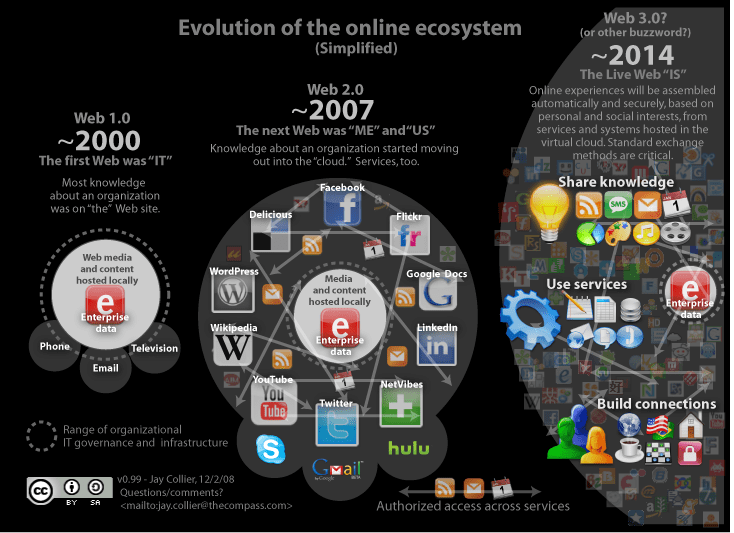
    The Online Ecosystem (Redux) by Jay Collier provides a good example of how online connections have become more integrated over the last few years in higher education:

    online-evolution

    In thinking about how networks influence learning and how integrative online environments impact knowledge-sharing, Dave presents two camps for education practice for online learning:

    1) The Guild Model: designed with rules & regulations, peer learners, and methods to validate success; no restrictions & not a fully connected model

    2) The Wild West Model: learning & knowing by being connected to a group of people who do the same types of things that you do, i.e. through Twitter, blogs, etc; knowledge exists in random locations; natural kind of learning

    Both models of learning have value for the online education, however one method structures networks from the instructor, whereas the other connections are organically grown by the learner. There are many examples of learning technologies and numerous tools to support online initiatives, however it is important to establish methods to make connections and best practices in developing skills for effective learning. As online connections and environments evolve, this debate for how to best construct online learning continues.

    blogs, EC&I831, Learning Community

    Blogging for Learning & Learning to Blog

    I sat back to ponder why I blog, and why I take the time to read other blogs. Here are a few reasons I thought of off, the top of my head:

    • reflection
    • to share knowledge and resources
    • news & information acquisition
    • a research starting point
    • connection to peers in my field of study/work
    • a sounding board for ideas/questions/thoughts
    • to be part of a community

    In thinking about education and reviewing the above list, I can see why blogging is an effective means for contextualizing and mentoring learners. Sue Waters mentors educators on effective blogging and web 2.0 resources on EduBlogs. She delved into the topic of blogging for learning and connection during last week’s #eci831 weekly session on Elluminate.  The concept of blogging in the classroom, leads to a transparent educational process for students. Learners are able to share ideas and be empowered in their digital learning community. Blogging can deeper understanding of knowledge and course content, while challenging students to participate in an open, expressive forum.

    blogging

    Image from the Algebra Learning Networking website 

    It was interesting to learn how other students in the class viewed blogging for learning. Some are unsure about how to include blogs, while others want to ensure engagement and purpose in their learning environments. Here’s the #eci831 class brainstorm for our Thoughts, Challenges or Concerns about blogging:

      • how do educators best define learning outcomes to give purpose?
      • spam
      • how to get students to buy in
      • how to engage students; keep them interested and on task
      • most important aspect in my class
      • assigned topics or more creative original ideas
      • what to write
      • learning in a public forum – putting yourself out there
      • loosing the meaning for the learning objective
      • long term use
      • safety of students and liability
      • privacy concerns for parents
      • how to move teachers towards these ideas
      • non-standard views of students
      • open or closed environments for students?
      • teachers blogging as PD, nervous about putting their ideas out there
      • do all students feel confident in their posts
      • what to have the students blog about
      • how to move teachers away from seeing blogging as a tech ‘add

    Final thoughts from Sue, was actually in the question form:

    What are 3 questions (and why) you would like answered on educational blogging or building personal learning networks?

    So here are my 3:

    1. What are some of the key privacy concerns for educational blogging? And how educators best address these issues? Resources for either Canada or US would be greatly appreciated.
    2. Are there any examples of peer mentor blogging initiatives in education, that you know of, in K-12 or Higher Education learning environments? It would be interesting to learn more about how modelling and mentoring can help learners engage in blogging.
    3. How has your blogging practice altered (or has it?) now that microblogging (Twitter, etc) has been introduced into the blogasphere? Do you engage much in microblogging? How do you see value in it for learning?