Collaboration, Open Education, PLE

It’s Time for the Educational Remix…

It’s time to catch up with some fantastic scholastic chats in #eci831… and there are a few weeks to share. During #eci831 Week 10Brian LambScott Leslie discussed their experience in remixing education. In reviewing some inspiring media savants, examples, and ideas for open, remixed educational resources.In a true network environment – the application logic is relied onto the machines and built into the network itself. The open education movement introduced large quantities of formal education resources into the pool of content that can be mashed up and remixed for learners. Networks have evolved to the point where learners are no longer bound by space or time, which allows learners to direct and choose their personal learning environment objectives. There is now a “mashup of learning” medium to best support content knowledge and skill acquisition for learners. The process of remixing education is simply extending the existing concept. Mashing OERs as an Instructor (or DJ) includes this sample DJ workflow applied to education:
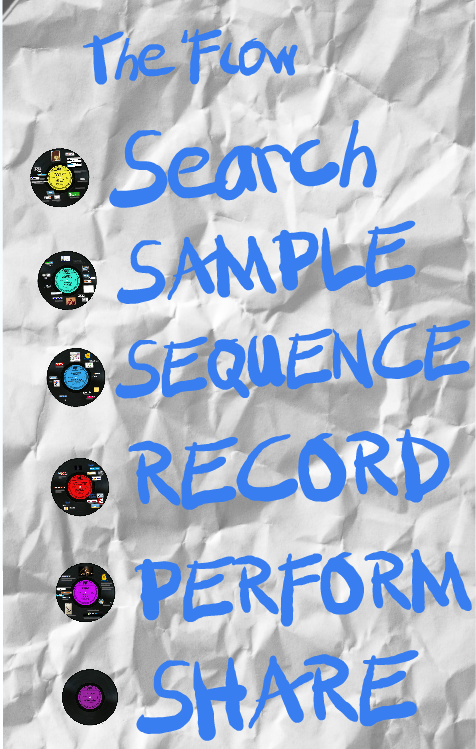
Image from Mashing OER Wiki

More resources that inspire openness & remixing:

CCK09, Learning Community, Learning Technologies

Visitor or Resident?

“Transparency is related to openness. Openness is most often related to content. Transparency, in contrast, involves making our learning explicit through forums, blogs, presentations, podcasts, and videos.” ~ George Siemens, Week 8: Openness and Transparency

Participation in #CCK09, the entire course thrives on learners and educators who are open and transparent in the learning process. David White joined the #CCK09 class to discuss his ideas on how Visitor and Resident learners impact the online educational environment [session recording].

Visitors & Residents: Original Blog Post & Presentation

v

Image c/o original V TV series

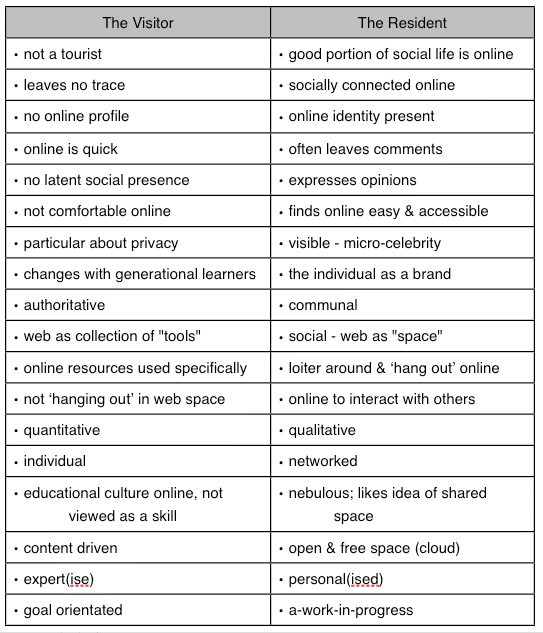
Much of this conversation was initiated with the JISC funded Isthmus project which was designed to bridge the gap between institutions and online learning, specifically how learners are utilizing technology. Instead of using the terms ‘digital native’ and ‘digital immigrant’ (coined by Marc Prensky in Digital Natives, Digital Immigrants 2001 publication), White sees learners as being a Visitor or Resident in their motivation for online education. Here is a quick Visitor vs. Resident comparison chart I created based on his presentation:

Visitor vs. Resident

In thinking about my own experience, as an online learner, I seem to fall in the ‘Resident’ category. I am very transparent and open online, and I am comfortable sharing my learning experiences and social experiences digitally. Although I am a resident, I can recognize a few visitor experiences from time to time, i.e. learning new tools, online resources and expanding my personal learning environment perimeters.

In thinking of the Visitor vs. Resident comparison, it is critical to think of it as a continuum rather that distinct categories. Students should not be labelled definitely into these categories since it is fluid. Each learner may have boundaries and limitations, however possess a willingness to be an open, online learner. As an educator, it is critical to create a learning environment online that provides structure and purpose online, while allowing learners to expand their creativity and knowledge as they see fit.

Conference, Professional Development

Tech Trends from Educause 09

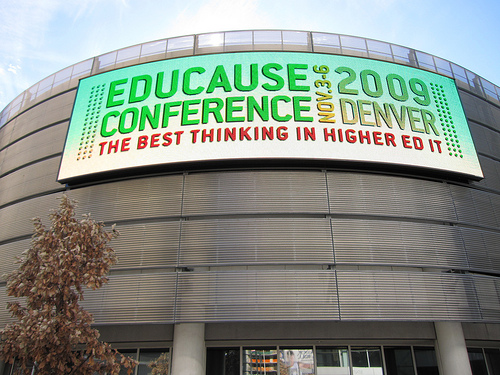
The Chronicle’s Wired Campus released a short video clip about the buzz from the  Educause Conference 09 in Denver, CO. A few attendees were asked about what they thought the top technological trends in higher education & also their concerns at the conference:

4072038913_5f54d15628

Picture c/o educausestaff on Flickr.

Trends:

  • Web 2.0
  • Virtualization
  • Cloud Computing
  • Social Networking
  • Mobile Learning
  • ePortfolios

Concerns:

  • Open Access
  • Transformational Course Management Systems
  • Security Concerns
  • Finances
  • Learners’ Needs
  • Keeping track of connections made at the conference

Whether you’re at the Educause 09 conference or following from afar, you can stay connected to the diolage on Twitter (hashtag #EDUCAUSE09), Flickr, & via the streaming of select conference content online.

CCK09, EC&I831, Learning Community, Open Education

Is Your Education Open?

The term “open education” means different things to different people. There are many interpretations as to what open education and content means for learning. Often the financial costs, learning environments, accreditation and the role of the faculty are a few key issues that arise when discussed amongst educators.

I thought it was suitable to explore this topic, since I am currently enrolled in 2 open education courses, EC & I 831 & CCK 09 as a non-credit student. My goal in joining these open content courses was to collaborate with other learners, share resources, & establish on-going connections beyond the scope of the course, i.e. stay connected to people in the #edtech field for information-sharing and learning support. My participation in #eci831 & #cck09 has greatly enhanced my knowledge and research for my doctorate work at UNT, and I value the introductions to various topics, presenters, and peers.

Last week, Jon Mott joined #eci831 to discuss his experiences in open education. Here are the slides:

A few key take-away points, resources & quotes include:

  • Great Talk: David Wiley’s recent keynote on Open Education
  • openness allows for connection, personalizing and creation: allowance to share resources, ideas & knowledge
  • ability to move from passive consumption to sharing & collaborating amongst our connections
  • Creative Commons is a valuable entity that allows content to be shared & accessed
  • “Literacy is moving from being knowledgeable to knowledge-able.” ~Jon Mott
  • MIT Open CourseWare project is a solid model that offers free content for approximately 2000 courses
  • Open Courseware Consortium is a great database for other open education content
  • Other examples where education is open = Education Channel of YouTube,  iTunes U, and OER Commons
  • academic institutions vary their stance on content sharing, open education, etc
  • help students and instructors to understand the difference between “open” and “closed” education
  • need to seek sustainable models for open courseware and education
  • debates and questions continue about openness in education, with regards to Learning Management Systems (LMS), credentialing, faculty role, archeticture of courses, etc.
  • open education is more of a social & cultural issue, now that the technology is becoming rapidly available and accessible for learners/educators

The final thoughts prompted questions on how open education will impact our learners & how education will change in the future. More discussion about open education will continue tomorrow evening when Alan Levine joins #cck09 to share some of his thoughts around Openness & Transparency. Join in & share your two cents.

Collaboration, Learning Technologies, PLE

Surfing the Google Wave.

Google wave is a web-based application that enhances electronic communication. Here is a (long) presentation and preview of Google Wave:

This latest initiative may provide educators additional resources for online personal learning environments. In EDUCAUSE‘s 7 Things You Should Know About Google Wave, details how this emerging technology can be utilized for teaching and learning:

  • Conversations -multiple messages for message board chats, IM, texting, etc
  • Archiving email/chat dialogues that are also non-linnear & asynchronous
  • Interactive maps
  • Informal polls
  • Translation of text for global learners
  • Photography & image sharing
  • Playback function for review of conversations, notes & presentations
  • Team-based learning for collaboration of projects
  • Accessibility & usability
  • Practical uses for academic advising [from @ericstoller]

As a recent invitee to Google Wave, I am still experimenting and sampling this new resource [with the help of The Complete Guide to Google Wave]. As more people receive invites and the beta version of Google Wave develops, educators will get involved and as they find value and potential for their profession.