#AcWri, #AcWriMo, Dissertation

#AcWriMo Discipline: Dissertation Boot Camp Here I Come!

In honour of my #AcWriMo November Goal #1, I decided to apply to the UNT Eagle Dissertation Boot Camp that is happening this week (November 21-23). To date, my word count for the month is 19, 344; however I need to dedicate more of these words to my dissertation drafting.
BootCampGraphic

Image from UDaily post from University of Delaware.

After approval from my faculty advisor and support from my supervisor, I applied to this 3-day boot camp to SHUT UP AND WRITE.  I just received my official acceptance to the program from Dr. Joseph Oppong, the Associate Dean for Research and Professional Development in the Toulouse Graduate School:

 Dear Student,

Congratulations, you have been accepted to attend the Eagle Dissertation Boot Camp! It will be held in the Willis Library Forum (first floor area). The boot camp is designed to provide you 3 days of interruption-free, stress-free, no-excuses-just-do-it writing time for your dissertation. To help you prepare so that you optimize your output here are some packing tips.

Be sure to clear your calendar for the whole of the boot camp. You need to commit to attend the entire workshop. You will not be excused to teach or attend class. Arrange transportation and childcare so that you are free to attend each day.

This is your notice that you are enrolled in Boot Camp. If you cannot attend this session let me know immediately. If you cancel within 3 days of the event you will be considered a “no show” unless you situation truly is serious. If you “no show” you will not be allowed to participate in the next session and your advisor will be notified. We have limited funds, space, and resources and you must commit to coming or give your seat to someone else.

Please bring a laptop, a mug (coffee/tea available) and/or water bottle. If you don’t have a laptop, you can check one out from the Library, but, bring a flash drive to save your work. MP3 players and headphones are recommended if they help you concentrate, or if you find nearby conversations distracting. Work tables, lunch, and snacks are provided.

No lateness, please. It’s distracting for the other campers…

Here is the line up this week’s dissertation boot camp – so don’t expect a whole lot of tweets, email responses, social network posts,  or interaction from me as my Interwebs use will be limited from Thursday (11/21) morning onward:

Boot Camp Schedule

Day 1 Day 2 Day 3
8:00-9:30 a.m. Formatting Workshop
9:30-10:00 a.m. Roll Call, Welcome, Introductions, Breakfast
10:00-11:30 a.m. Writing
11:30-12:00 p.m. Wellness Activity
12:00-1:30 p.m. Writing
1:30-2:00 p.m. Lunch
2:00-3:30 p.m. Writing
3:30-6:00 p.m. Optional Writing Time or Optional Individual Consulting
9:00-10:30 a.m. Writing
10:30-11:00 p.m. Wellness Activity
11:00-12:30 p.m. Writing
12:30-1:00 p.m. Lunch with Advisors
1:00-2:30 p.m. Writing
2:30-3:00 p.m. Self-Assessment and Discussion
3:00-6:00 p.m. Optional Writing Time or Optional Individual Consulting
9:00-10:30 a.m. Writing
10:30-11:00 a.m. Wellness Activity
11:00-12:30 p.m. Writing
12:30-1:30 p.m. Lunch
1:30-3:00 p.m. Writing
3:00-6:00 p.m. Optional Writing Time or Optional Individual Consulting

Each day includes:

  • several blocks of writing time
  • scheduled, limited time for web-browsing
  • tip sheets
  • wellness breaks
  • a lunch conversation with fellow campers (box lunches provided)
  • space to continue writing in the afternoon (if interested)

The reason I applied, is to have specific time carved out and a dedicated space to move forward on my #AcWriMo goal #1. A number of things get in the way of my dissertation writing, including other writing projects, presentations, work items, and life. Also, as a student who wears “many hats” on campus and outside my job, I can sometimes find it challenging to pick up where I have left off, and my motivation to just write is fragmented with other responsibilities. I think this dedicated writing schedule will push me further along with my dissertation goals.

I will report back in after “camp” is over. Write on, my friends. Write on.

#AcWri, #AcWriMo

#AcAWriMo Reading: The Literature Review

In SAGE’s Doing a Literature Review, Hart (1998) defines the literature review as “The selection of available documents (both published and unpublished) on the topic, which contain information, ideas, data and evidence written from a particular standpoint to fulfill certain aims or express certain views on the nature of the topic and how it is to be investigated, and the effective evaluation of these documents in relations to the research bring proposed.”

Reviewing my literature this afternoon. #phdchat

I have been collecting and organizing literature, publications, and more on the topic of social media guidance for quite some time. I have been reviewing the key questions used for a typical literature search and review of my research topic (Hart, 1998):

  • What are the key sources?
  • What are the major issues and debates around the topic?
  • What are the key theories, concepts, and ideas?
  • What are the epistemological and ontological grounds fro the discipline?
  • What are the political standpoints?
  • What are the origins of this topic?
  • What are the definitions involved with this topic?
  • How is knowledge on the topic structured and organized?
  • How have approaches to these questions increase our understanding and knowledge?

In thinking about my own doctoral research, the literature review, a.k.a. Chapter 2 and part of Chapter 3 (methodology), often demonstrates a specialization in a topic and focus. For a number of doctoral researchers, the dissertation/thesis is requires a high level of scholarship, and it is an opportunity to make an original contribution to the field. Phillips and Pugh (1994) conducted a study around doctoral research and literature reviews, in which they identified nine definitions for originality:

  1. doing empirically based work that has not been done before;
  2. using already known ideas, practices or approaches but with a new interpretation;
  3.  bringing new evidence to bear on an old issue or problem;
  4. creating a synthesis that has not been done before;
  5. applying something done in another country to one’s own country;
  6. applying a technique usually associated with on are to another;
  7. being cross-disciplinary by using different methodologies;
  8. looking at areas that people in the discipline have not looked at before;
  9. adding to knowledge in a way that has not previously been done before.

It appears I will be working on #1, #6, & #7 with my dissertation research methodology. Enough talking about it, back to my literature review additions, and more writing. Go #AcWriMo Go! [p.s. Word count to date for #AcWriMo = 16, 271 now. How are you doing?]

References:

Hart, C. (1998). Doing a literature review: Releasing the social science research imagination. Sage.

Phillips, E. M., & Pugh, D. S. (1994). How to get a Ph. D.: a handbook for students and their supervisors. Buckingham, UK: Open University Press.

Dissertation, PhD, Social Media

Your Higher Ed Website + Search: “Social Media Guidelines” or “Social Media Policy” = A Database for My Dissertation Research

Yes. I know that this may be my  LONGEST blog post title ever. I created it for one reason. It is the equation which will help me move my research forward for my dissertation.

featuredimages_socialmedia

You may recall a previous request for this from an earlier blog post: Gathering #SocialMedia Guidelines from #HigherEd. So, basically what I’m saying is…

I NEED YOUR HELP! => Submit Your Social Media Guidance Please!

My dissertation research methodology (good ol’ Chapter 3) will involve text mining analysis for reviewing all these many social media guidelines (policies, strategies, beliefs, regulations, etc. included) I am gathering right now. The caveat for this type of research is –  I need to build a large enough database of documents to examine and evaluate. BONUS: After collecting all of these documents, I will share this Social Media Guidance database AND my research findings for you here: http://socialmediaguidance.wordpress.com/

As of today (4:30 pm CT), I have collected approximately 176 Social Media Guidance documents from 13 different countries. Hoo-ray!

Check to see if your institution is listed below, and if it is not – please SEARCH YOUR COLLEGE OR UNIVERSITY WEBSITE to see if you might just happen to have social media guidelines, a policy, a directory, and/or anything that might be related to social media. Thank you!

Social Media

Do You Have Social Media Goals?

After participating in today’s Social Media Metrics in Government Using GSA Guidelines webinar hosted by Hootsuite, I began to think more about the WHY and HOW social media guidelines and policies develop. This session discussed how the government developed their guidelines around their GSA social media goals which were connected to their strategic communication plan and web presence.

Obviously this webinar had a focus on measurement and assessment for social media use using both free and paid tools, like Hootsuite; however it offered some sound advice to organizations that are just developing social media guidance or for those who are re-thinking their social media policy. Instead of starting with a policy, strategy, or guideline list of what to do or not do, it would be more helpful for institutions to think through the WHY of social media. This process provides organizations focus, sets out objectives, and creates a rationale for social media use and how these goals might be measured and assessed. For example, the GSA wanted to use social media and social data goals, included:

  • Be more effective in how they distribute critical information to citizens & communities
  • Engage citizens to help shape to public programs
  • Better inform strategies leading to greater efficiency
  • Increase use of innovative tools and services to further development

It is important to consider your institutional goals when organizing your social media guidance, here a few suggestions given from the webinar – but I am sure your organization has many others.

Internal Considerations:

  • Collaboration
  • Knowledge sharing
  • Cost saving & cost avoidance strategy
  • To be transparent
  • Talent acquisition

External Considerations:

  • Citizen engagement – Active use and participation (2-ways)
  • Promote services and resources
  • Provide customer service – feedback
  • Provide real-time resources – expand upon current communication channels

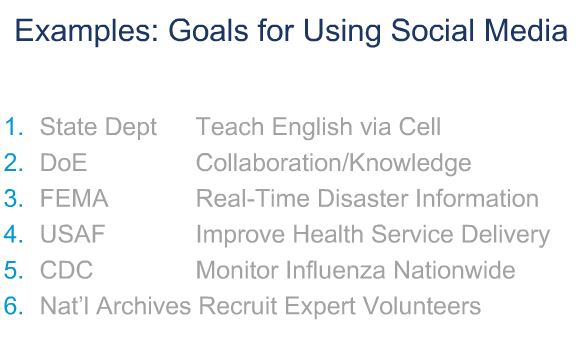
Here are a couple of examples shared from the GSA for their use of social media goals:

Example of Goals for Using Social Media in Government

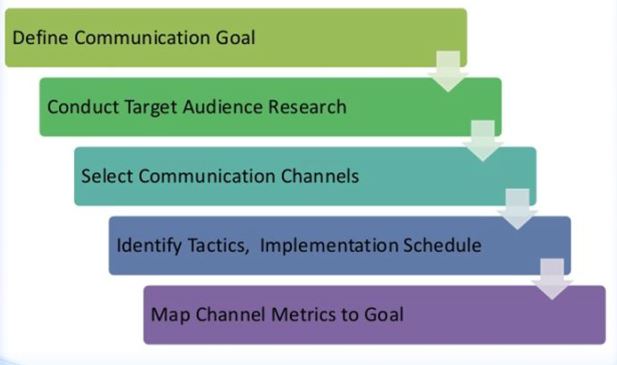
Another reason to consider developing social media goals before establishing your guidelines is to consider how you will evaluate social media use for your organization. Social media management of your resources is critical. To help assess social media engagement and use it will be helpful to align your goals to evaluation as part of your strategic communication plan. Social media analytics and metrics through different 3rd party tools and social dashboards; however what will be relevant for your organization to track and use for assessment purposes. You want to connect your goals to your key performance indicators (KPI) and desired evidence-based outcomes.

Planning for Measurement

One example was the use of hashtags from the Twitter for Public  Health case study to outline a clear system for planning social media management. This public health group utilized a hashtag, #SM4PH, to build hype around the start of a regular, organized Twitter chat and to launch a hashtag for community development. Their goal was to measure the impact of the hashtag use, conversation, and community involvement before, during, and after this first chat to assess the long tail of this campaign.

Does your organization or institution have social media goals? How do these goals support your social media spaces? How do you assess and measure your social media goals? Let me know.

Reference:

Macey, B. (2013, November 14). Social media metrics in government: Using GSA Guidelines – Webinar. HootSource. Retrieved from http://blog.hootsuite.com/social-metrics-gsa-guidelines/

UPDATE 11-19-13: If interested, this webinar is available for viewing on demand.

#phdchat, Book Review, Higher Education, PhD

I’m “On the [Job] Market”: The Application Process

As academic job postings and other employment opportunities are becoming available, I decided it was time to prepare my own application materials and announce that I’m ON THE JOB MARKET. It should be no surprise to many as I am ABD (not a title), and I have been diligently working on my dissertation— so there is really no better time for a job search.

Well I was going to save this for holiday reading...but it looks like I'm On The Market NOW #phdchat I’ll be honest. I’m quite accustomed to the thrill of the job hunt (I am in my 3rd position of employment, since I have moved to Texas 5 years ago); however the academic job search has upped the ante. My future career planning involves a potential re-location (either in the US or abroad) and new career beginnings (either as a junior faculty member, research or other), which means this job search and application process is being treated like a job itself.

To prepare for my job search and career planning…

I have been talking to many researchers in the field, administrators in higher education, companies who seek my support, current faculty (off and on campus), mentors, and peers over the past year [Thank you for these discussions and talks – you know who you are]. More than not, many are quite open to offer advice, share professional experiences, edit my application materials, provide a reference, or send potential job postings my way (hint, hint). In my spare time, I have been reading Barnes’ (2007) “On the Market: Strategies for a Successful Academic Job Search,” specifically,  Chapter 4: The Application Process. This section of the book includes great questions to ask and think about before the application process, and examples of deciphering what academic job postings mean to decide what I want. Here are some current, pre-application questions I am currently pondering:

  • What type of position am I most interested in?
  • What sort of institution or organization do I want to work for?
  • Where do I want to live?
  • Do I want to apply for administrative or faculty track positions?
  • Who will write my reference letters?
  • Will my academic search focus on research or teaching institutions?
  • What is my best academic “fit” for department?
  • Do I want to look beyond higher education & academia?
  • Who will I connect to discussion the application process?
  • What is my timeline and schedule for applications?
  • How will I best organize a joint career search with my partner in crime?

Fortunately, most of my academic application requirements are “works in progress” from my doctoral program and portfolio requirements (Thanks #untLT department!) these past few years. My current objectives are to edit and prepare materials I have for my academic job search and application, including:

  1. Cover Letter
  2. Curriculum Vita
  3. Letters of Recommendation
  4. Writing Samples and Other Supporting Documents
  5. Teaching Portfolio (Dossier)
  6. Social Media Spaces & Places
  7. Application Schedule – to track applications & submissions

This chapter also includes helpful templates for CV’s and cover letter formats. I plan on re-tooling and modifying my current application materials based on position type and job description, so a review of these examples were helpful. Here are a few suggestions for cover letter writing items to include – 17 elements for the academic cover letter:

17 elements of the academic cover letter. #phdchat

Do you have academic job search advice? Tips on the application process? Considerations for the academic research and faculty positions? Potential openings I might be interested at your institution? Let me know. Academic job search advice is welcome.


Reference:

Barnes, S. L. (2007). On the market: Strategies for a successful academic job search. Lynne Rienner Publishers.