Fashioning Circuits, Research Methods

Ethnographic Methods

In thinking about how to evaluate the curriculum and pedagogy for the #FashioningCircuits book with Dr. Kim Knight (@purplekimchi), I spent some time over the weekend reviewing  potential research methods for the project. Since I have used  ethnographic methods for a grant project Fall 2012 (studying culture and healthcare perceptions), I thought I’d revisit these as potential research methods and blog about it here.

Ethnographic Methods

Ethnographic is the description of groups, specifically these approaches appeal to those who are confident they have time to stay in a research setting (the field) for a sustained observation and informal interviewing (Cousin, 2008).
ethno

Typically ethnographic research derives from anthropology where communities or groups are studying for long periods of time (a year or so) for the “purpose of learning from their ways of doing things and viewing reality” (Agar, 1980, p. 6) where the researcher not only observes, but also interacts and talks with participants (Delamont, 2002, p.g. 8). Other data collection can be collected with communities also interact in online spaces and contexts. Ethnographers can study forums, wikis, blogs, or Twitter in the context of participant observation research to review the community and activity or historical research archive (Boellstorff et al., 2012).

A few selected strategies for research inquiry:

  1. Observation: Researchers will complete overt participant and observer review strategies which the ethnographer has negotiated access to the group to observe and participate in its activities (Cousin, 2008). Observations of this group will include notations about the environment, population, interactive order, and characteristics of the membership. In thinking about digital footprints, historical archives and other means of data collection for “observation” of this group is inclusive of blog posts, videos, tweets, and other online contexts (Boellstorff et al., 2012).

  2. Semi-Structured Interviews using the Ethnographic method (Schensul et al., 1999) provides researchers with a structured set of themes to organize the interview discussion. Unlike the structured interview, interviewers will be required to adapt, modify, and augment the prepared questions if they flow of the interview discussion suggests it (Cousin, 2008). The interviews discussions are “meaning making events” where the ethnographer utilizes “active interviewing” skills (Holstein & Gubrium, 1997). From a common list of questions, ethnographers will interview various members of the group. These interviews will be transcribed and evaluated for thematic information and content using a grounded approach.

References

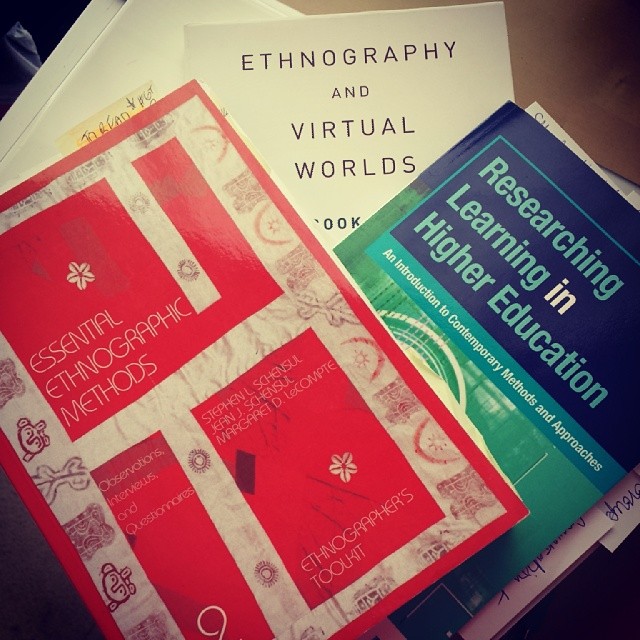
Boellstorff, T., & Marcus, G. E. (2012). Ethnography and Virtual Worlds: A Handbook of Method. Princeton University Press.

Cousin, G., Cousin, J., & Deepwell, F. (2005). Discovery through dialogue and appreciative inquiry: A participative evaluation framework for project development. D. Taylor and S. Balloch (Eds.), The politics of evaluation, 109-118.

Cousin, G. (2008). Researching learning in higher education: An introduction to contemporary methods and approaches. Routledge.

Delamont, S. (2002). Fieldwork in educational settings: Methods, pitfalls and perspectives. Routledge.

Holstein, J. A., & Gubrium, J. F. (1997). Active interviewing (pp. pp-113). Sage Publications.

Schensul, S. L., Schensul, J. J., & LeCompte, M. (1999). Essential ethnographic methods. Walnut Creek.

AcAdv, nacada

What’s On the Horizon for Academic Advising?

Last week, I shared my thoughts about what academic advising might look in the future in higher education with an advising group.

Based on Lowenstein’s (2013) “Vision, Not a Prediction” description in his Academic Advising Approaches chapter, I shared my ideas of how the field of academic advising COULD contribute to evolution of post-secondary education. Lowenstein shares a number of insights and examples about how advising as a profession can move forward, so my talk focussed on HOW (specifically with examples) where faculty and professional advisors can enhance student development in terms of:

  1. Interaction with students to  contribute and encourage learning outside their curriculum.
  2. Influence to changes and developments on their own campuses.
  3. Integration into the broader focus and purpose of academia.

Much of this session discussed how higher education institutions and administrators would be the only ones to lead advising changes, unless the advising profession asked the following questions themselves:

  • What is the role of advising or the advisor in post-secondary education?
  • What will advising look like in 5, 10, or 20 years?
  • What do YOU want the profession of advising to look like?
  • What sort of advising “profession” do YOU want to participate in?
  • How can YOU contribute to the change and develops occurring in higher ed, specifically with regards to how advising is organized?

In thinking about my own responses to the above prompts, I know that advisors can be at the forefront of institutional and organizational change. A number of advisors I interact with and know are very forward thinking, innovative problem-solvers who want to contribute to research, teaching, or service initiatives for the profession. It is this type of critical thinking and resilience of this generation of advisors, that we need to step up to debate practices, contribute ideas, and become active participants in how the role of advising at our institutions.  Does this mean increased advising training and development, enhance qualifications, or greater expectations for advisors? Perhaps. I think the advising community of practice can decide that, and should before some one else in the post-secondary sector decides to take this challenge on without consulting advisors altogether.


Reference

Lowenstein, M. (2013). Chapter 14: Envisioning the future. In J. K. Drake, P. Jordan, & M. A. Miller (Eds.), Academic advising approaches: Strategies that   teach students to make the most of college. (pp. 243-258). San Francisco,   CA: Jossey-Bass.


AcAdv

5 Ways to Support Your Professional Development with #AcAdv Chat

Do you make New Year resolutions?  Or is it just time to set some goals for the academic semester? Academic advisors often support their student and the success of others; however to do this well it is important to take time to “sharpen the tool” to learn as well.

PD with #AcAdv Chat

In the spirit of the new year and improvement, here are 5 quick and easy ways to learn, grow, and develop as an academic advisor with #AcAdv Chat:

  1. Read the #AcAdv Chat Archives: There is a wealth of great ideas, messages, websites, and resources shared on the #AcAdv Chat Blog from past @AcAdvChat sessions for you to READ in the #AcAdv Chat ARCHIVES.
  2. Lurk on #AcAdv Chat: Maybe you are new to Twitter and are just learning how to tweet. We want to help you learn more About #AcAdv Chat. If you want to explore Twitter for the professional development check out one of our weekly LIVE sessions every TUESDAY from 12-1 pm CT by following the conversation here: http://tweetchat.com/room/AcAdv
  3. Sign Up For Twitter & Follow the #AcAdv Community: Get connected with academic advisors who are on Twitter. . Follow @AcAdvChat on Twitter or “like” our #AcAdv Chat Facebook Page. Also connect to a growing group of advisors who participate in @AcAdvChat and often tweet using the #AcAdv hashtag. Here’s a list of advisors on Twitter curated by one of our #AcAdv Chat Moderators.
  4. Participate in a LIVE #AcAdv Chat: Once you have read a few archives, signed up for your own Twitter account, and witnessed the @AcAdvChat during a LIVE session on Tuesday from 12-1 pm CT –JOIN IN! It will be a moderated (MOD) discussion  in a series of Questions (Q) and responses like this:

Question posted by the MOD @AcAdvChat:

Question

Response from #AcAdv Chat Participants using the #AcAdv hashtag:

Response5. Give #AcAdv Chat Feedback: Tell us what YOU want to discuss during the weekly chats – we LOVE feedback! Or perhaps you want to get involved as an #AcAdv Chat Moderator (MOD) or have another idea for us. Let us know here: http://acadvchat.wordpress.com/feedback/

This blog post is cross-posted at The #AcAdv Chat Blog.

Note to Readers: Not interested in #AcAdv Chat? Check out one of the MANY Twitter chats to connect, learn, and grow with in YOUR field from this shared Google Doc: http://bit.ly/TwitterChatSchedule Happy tweeting & learning!

Higher Education, MOOC

The State of #OnlineLearning in the US [REPORT]

The 11th annual survey and report of online learning in U.S. higher education was recently released:

Grade Change: Tracking Online Education in the United States”*

=> DOWNLOAD A FREE COPY HERE

Background: From previous studies and reports of online learning in the US, there is a strong belief that  online education is a critical component of post-secondary education institutions’ long-term strategy. In surveying a number of higher education entities, it is apparent that the development in online learning has shown a small but steady increases over the past decade. This report also teases out how PSE institutions are providing online education – blended, hybrid, and others as they experiment with different models of online learning pedagogy.

Screen Shot 2014-01-19 at 10.08.16 AM

The respondents from more than 2,800 post-secondary education institutions in the US, attempted to answer the following overarching questions about online learning in higher ed:

  • Is Online Learning Strategic?
  • Are Learning Outcomes in Online Comparable to Face-to-Face Learning?
  • How Many Students are Learning Online?
  • How are Massive Open Online Courses (MOOCs) faring?

Key findings and highlights from the report: 

  • Around 5.5 (NOT 7.1) million higher education students are taking at least 1 online course (Read more: HERE and HERE)
  • The % of academic leaders rating the learning outcomes in online education as the same or superior to those as in face-to-face instruction, grew from 57% in 2003 to 74% in 2013
  • The 6.1 % growth rate represents over 400,000 additional students taking at least 1 online course
  • The number of students taking at least 1 online course continued to grow at a rate far in excess of overall enrollments, but the rate was the lowest in a decade
  • 90% of academic leaders believe that it is likely or very likely that a majority of all higher education students will be taking at least one online course in 5 year’s time
  • Only 5 % of higher education institutions currently offer a MOOC, another 9.3 % report MOOCs are in the planning stages
  • Less than one-quarter of academic leaders believe that MOOCs represent a sustainable method for offering online courses

For more on the study design, survey administration, analysis,  and report production, check out The BABSON Survey Research Group: http://www.onlinelearningsurvey.com/

*The survey is designed, administered and analyzed by the BABSON Survey Research Group, with data collection conducted in partnership with the College Board, and is sponsored in part by Pearson and the Sloan Consortium

Update – 1/19/14 @ 6:45 pm:

It appears the BABSON survey numbers seem to be off from the IPEDS data for students who have completed online courses – 7.1 vs. 5.5 million. Thanks for the update, Kevin. Here’s a useful article to read.

#AcWri, LPQ, LPQuarterly

Just Published: @LPQuarterly Volume 2, Issue 2

Happy 2014 to all my academic writing (#AcWri) friends! With the start of a new year, and academic semester comes a number of goals for writing and publishing. My short list of writing goals is ready … but I will share that later.

LPQ Facebook Banner

For many, you might be supporting other scholars through peer review and editing (like me!). It is my pleasure to present the Learning and Performance Quarterly (LPQ), Volume 2, Issue 2 for you and our readers as we enter our third year of publication:

“January is a common time for New Year’s resolutions centered on growth and transformation. The articles included in our January volume of The Learning and Performance Quarterly (LPQ) align with this spirit of change as they focus on the evolution of online learning, virtual communities and the effectiveness of the learning organization (Zimmerman et al., 2014, p. 1)”

On behalf of our editors and contributing authors, I invite you to review the LPQ 2(2) Table of Contents and abstracts here, and then visit our website to read the articles and items of interest.

Learning and Performance Quarterly
Vol 2, No 2 (2014)
Table of Contents

Editorial
——–
Expanding the Boundaries of Learning and Performance (1)
Tekeisha D. Zimmerman,  Laura A. Pasquini,      Jeff M. Allen

Invited Articles
——–
In Search of Ideal Relationships between Learning and Performance: Lessons
Learned from Balancing Two Identities (2-10)
Seung Won Yoon

Case Studies
——–
Internet and Society: A Hybrid Honors Course (11-27)
Mitzi E. Lewis, Mark Farris

Concept/Theory Paper
——–
Social Informatics and Virtual Communities: A Literature Review (28-36)
Andrew Jordan Miller

Research Articles
——–
Investigating the Research Trends of Learning Organization Studies between
1979 and 2011: An Approach of the Citation Network Research (37-63)
Ji Hoon Song,   Cho Hyun Park,  I-Pang Fu

Do you have goals to research, write, and publish in 2014? Our call for proposals is OPEN! Submit your manuscript to the journal TODAY!

You can review the previous article submissions in the LPQ Archives. We are seeking manuscript submissions for the following categories:

  • Research Articles – Qualitative/Quantitative
  • Concept/Theory Papers
  • Literature Reviews
  • Case Studies
  • Book or Media Reviews
  • Invited Articles
  • Editorials

If you have any questions about your potential article or would like to join our editorial team (peer-reviewing, copy editing, layout, etc.) please contact the Learning and Performance Quarterly Editors.

Happy reading,

Laura A. Pasquini, Editor (@laurapasquini)
Tekeisha D. Zimmerman, Assistant Editor (@TekeishaZ)
Dr. Jeff M. Allen, Managing Editor (@drjeffallen)
~~~~~~~~~~~~~~~~~~~~~~~~~
Learning and Performance Quarterly
University of North Texas