#AcWri, LPQ, LPQuarterly

Just Published: @LPQuarterly Volume 2, Issue 2

Happy 2014 to all my academic writing (#AcWri) friends! With the start of a new year, and academic semester comes a number of goals for writing and publishing. My short list of writing goals is ready … but I will share that later.
LPQ Facebook Banner

For many, you might be supporting other scholars through peer review and editing (like me!). It is my pleasure to present the Learning and Performance Quarterly (LPQ), Volume 2, Issue 2 for you and our readers as we enter our third year of publication:

“January is a common time for New Year’s resolutions centered on growth and transformation. The articles included in our January volume of The Learning and Performance Quarterly (LPQ) align with this spirit of change as they focus on the evolution of online learning, virtual communities and the effectiveness of the learning organization (Zimmerman et al., 2014, p. 1)”

On behalf of our editors and contributing authors, I invite you to review the LPQ 2(2) Table of Contents and abstracts here, and then visit our website to read the articles and items of interest.

Learning and Performance Quarterly
Vol 2, No 2 (2014)
Table of Contents

Editorial
——–
Expanding the Boundaries of Learning and Performance (1)
Tekeisha D. Zimmerman,  Laura A. Pasquini,      Jeff M. Allen

Invited Articles
——–
In Search of Ideal Relationships between Learning and Performance: Lessons
Learned from Balancing Two Identities (2-10)
Seung Won Yoon

Case Studies
——–
Internet and Society: A Hybrid Honors Course (11-27)
Mitzi E. Lewis, Mark Farris

Concept/Theory Paper
——–
Social Informatics and Virtual Communities: A Literature Review (28-36)
Andrew Jordan Miller

Research Articles
——–
Investigating the Research Trends of Learning Organization Studies between
1979 and 2011: An Approach of the Citation Network Research (37-63)
Ji Hoon Song,   Cho Hyun Park,  I-Pang Fu

Do you have goals to research, write, and publish in 2014? Our call for proposals is OPEN! Submit your manuscript to the journal TODAY!

You can review the previous article submissions in the LPQ Archives. We are seeking manuscript submissions for the following categories:

  • Research Articles – Qualitative/Quantitative
  • Concept/Theory Papers
  • Literature Reviews
  • Case Studies
  • Book or Media Reviews
  • Invited Articles
  • Editorials

If you have any questions about your potential article or would like to join our editorial team (peer-reviewing, copy editing, layout, etc.) please contact the Learning and Performance Quarterly Editors.

Happy reading,

Laura A. Pasquini, Editor (@laurapasquini)
Tekeisha D. Zimmerman, Assistant Editor (@TekeishaZ)
Dr. Jeff M. Allen, Managing Editor (@drjeffallen)
~~~~~~~~~~~~~~~~~~~~~~~~~
Learning and Performance Quarterly
University of North Texas
Reflections

#OneWord2014: Simplify

simplify

sim·pli·fy
ˈsimpləˌfī/
verb
verb: simplify; 3rd person present: simplifies; past tense: simplified; past participle:simplified; gerund or present participle: simplifying.
  1. make (something) simpler or easier to do or understand.
    “an overhaul of court procedure to simplify litigation”
    synonyms: make simple/simpler, make easy/easier to understand, make plainer,clarify, make more comprehensible/intelligible; More

    antonyms: complicate

That’s it. That’s all. Forget the #oneword213 = ACTION. Here’s to living the less complicated life in 2014. Sláinte!

blogs, Reflections

TechKNOW Tool 2013 – Blog Posts In Review

In the process of auditing my social media and web life, I thought I’d take a gander at what I blogged about in 2013. What the heck was I reflecting and sharing in 2013?

Screen Shot 2013-12-20 at 8.26.57 AM

Photo from  marsmettnn tallahase on Flickr

TechKNOW Tools received a number of views on older blog posts; however the key themes that were clicked on for 2013 included: academic writing, research gathering, teaching support, role transition, job search/application, conference sharing, learning design, and social media auditing.

Thanks for reading, and following along. I’ll be sure to share more in 2014. 🙂

Title


Digital Clean Up: Social Media Audit & How Not to Be Hacked
Lucky 13: Top Blog Post Views for Summer 2013
The PhD: Troubles Talk… and Moan… and So On
Using Verbs for Specific Learning Outcomes
Supporting Student Success at #UFTL13
#EDUSprint 1: Beyond MOOCs – IT as a Force of Change
Do You Have Social Media Goals?
The Dissertation Proposal. #phdchat
Your Higher Ed Website + Search: “Social Media Guidelines” or “Social Media Policy” = A Database for My Dissertation Research
Help My #ugstSTORY Class Tell Their Story
Gathering #SocialMedia Guidelines from Higher Education #SoMe #edusomedia #highered
#SXSWedu Panel: Social Media in Higher Ed – Where Are We Going? #smHE
#AdvTech at #nacada13…More Than Just a Hashtag!
#AcWriMo In Review: My Output
#AcWriMo & Accountability to Write
#AcWriMo Peer Pressure: Time, Challenge/Support & Cheerleaders
My #AcWriMo Goals for November
I’m “On the [Job] Market”: The Application Process
Passing the Torch: Leadership Transition in Our Professional Organizations
The Vitae: Brewing Academic Experience for Your CV
Social Media

Digital Clean Up: Social Media Audit & How Not to Be Hacked

As a digital ethnographer and networked researcher, I tend to play in different social (media) spaces. I typically try out new websites and platforms that I hear about from other scholars, practitioners, and researchers. Most of you know I can be found in a few key social media spaces (I’m looking at you Twitter, WordPress, SlideShare & Flickr); however I do use a number of other social platforms to collect, archive, research, collaborate, and write.

2013.04.04_Cleanup_DataImage from responsys.com

Over the past week, I started conducting my own social media audit for what I use and how it’s being used. Part of this is process is to keep track of files and resources, and also think about what I’m sharing and using online. In being purposeful with social media and my web tools, I wanted to see what I am using or not using. Recently I have been cleaning up a few of my digital spaces, to take inventory and assess how I’m using these spaces personally and professionally.

For example, I updated a title on a LinkedIn employment role by adding “Graduate Student” to my Research Affiliate position for the Center for Knowledge Solutions (which I have been contributing for the last couple of years), and I received a number of “congratulations” for the “new” job:

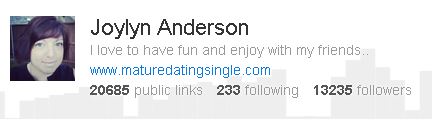
Screen Shot 2013-12-15 at 11.47.33 AMThen I discovered my name had changed on my Delicious account. I use this account to archive my tweets & tags for what I share on Twitter, so I was surprised to find my new found love for “fun and enjoy with my friends” while advertising mature dating single websites:

Delicious HackThis was quickly fixed within hours thanks to the Delicious Team, and I’m back to my normal nerdy self on this social bookmarking website:

Screen Shot 2013-12-13 at 9.03.00 PM

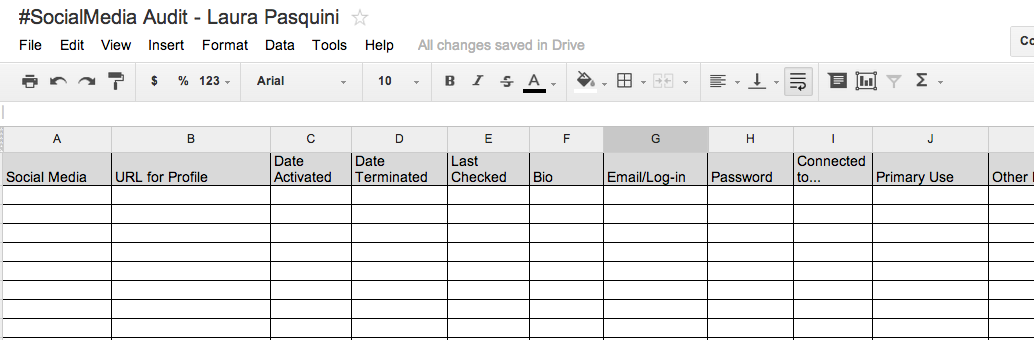
This incident reminded me it was time to review my social media spaces to see what I use and what I need to lose. It is easy to take advantage websites like JustDelete.me to kill off your pages; however I wanted to take stock of what I am using and document how I am using it. To assess my digital footprint and identity, I started my own social media audit spreadsheet o’ fun with the following columns:

  • URL for the profile
  • recordupdate passwords
  • review account settings (privacy)
  • date activated
  • date terminated (if deleted or archived)
  • verify information is correct
  • update bio, picture, etc.
  • review platform access & connections
  • assess unused or less accessed social media spaces to delete
  • identify how these social media platforms are being utilized

Screen Shot 2013-12-15 at 12.50.53 PM

Have you conducted your own social media audit lately? If so, how have you review and cleaned up your online accounts on your various social media platforms? How do you keep track of what social media spaces you use? Please share any tips & tricks. Thanks!