Reflections, Social Media, StudentAffairs

#Dalton13 – Google + Interview & Keynote Teaser

Thanks so much to the Dalton Institute (@DaltonInsitute) coordinators, Jessica Dean (@j_deanSAys) & Emily Fox (@EmilyFox526), for hosting my Google + Interview on Tuesday (1/9). I appreciate the great questions from the both of them, and the #Dalton13 backchannel. Everyone really made me reflect and ponder my own technology and student development path – so thanks!


In watching the video recording (which I rarely do), it helped me think more about my talk and how to best shape the focus. Here’s a sneak peak at my #dalton13 keynote title and abstract, for those of you who will be attending the session on February 2nd:

Here is my 2013 Dalton Institute Character Clearinghouse Interview and a preview to my keynote next week:

Title: 

Student Development 2.0: Optimizing Social Media to Connect Your Campus

Abstract: Today’s college student operates in a world that is informal, networked, and filled with technology. Digital interactions are influencing both our students’ characters and values, with increasing access to information and continual contentedness  With the emergence of social web resources, student development professionals and faculty have the ability to engage in experiential and applied learning objectives for their campus environments. Social media creates a space where “everybody and anybody can share anything anywhere anytime” (Joosten, 2012, p.6). Educational paradigms are shifting to include new modes of online and collaborative learning and student-centered, active learning to challenge our students to connect curriculum with real life issues (Johnson, Adams & Cummins, 2012). As new generations of students create and share content on campus, college educators need to realize the potential social media has to construct a culture of participatory, open learning. Emerging technology platforms and devices are beginning to disrupt higher education as we know it. To co-evolve and positively impact our learners’ success, it is critical that we consider the influence and impact social media has on our student populations. This keynote plenary will share ideas and suggested practices to develop a richer learning experience to help students thrive in the changing digital frontier.

References

Johnson, L., Adams, S. & Cummins, M. (2012). The NMC Horizon Report: 2012 Higher Education Edition. Austin, TX: The New Media Consortium.

Joosten, T. (2012) Social media for educators. San Francisco: Jossey Bass.

Reflections

TechKNOW Tools Blog Year in Review – Top Posts for 2012

Although I am off the grid for the holidays, I thought I would thank those of you who share, read, RT, and comment on my TechKNOW Tools blog. I started this particular blog for a learning workshop and seminar back in 2009, but then switched to blog about what I am learning, reading, presenting, and more. I try to share ideas for educators, trainers, and others around the topics of learning, technology, and design. I rarely post a “top viewed” blog post, but I thought I might as well share the favored posts from 2012 as I ponder about blog topics for 2013.

Title Views
I Tumblr For You… To Reflect. 4,184
The Productive & Disruptive Innovation of EDU 1,236
Organizational Learning Constructs 1,219
A @PhD2Published Post: A Book Review is #AcWri Too 962
Online Learning: More Than Just a MOOC 829
LMS/LCMS Review 822
My Prolegomenon to Technology 775
Facebook for Learning Communities: Groups vs. Pages 750
Going Mobile for Academic Advising: Tablets, iPads & Protocols on Campus 550
What’s Your Research Methods Worldview? 527
Social Media Strategies in Student Affairs 527
Backwards Design with TED-Ed 436

I appreciate the community of bloggers who I read and learn from – you inspire and challenge me to think and consider how and when I share. Thanks for reading and engaging with me. All the best in 2013!

Happy-2013-560x420

#phdchat, ATPI, PhD, Professional Development, Reflections

ATPI Doctoral Portfolio Reflection

This weekend will involve the usual researching, writing, and editing of projects – however I have one more item to polish up before it’s time to be thankful in the U.S. – my doctoral portfolio.

For the Applied Technology & Performance Improvement Doctorate (ATPI) program, the doctoral portfolio is a new requirement for us young, budding scholars. Rather than sit in a room for two 8-hour days or respond to a set of questions over a period of time, ATPI doctoral students will need to complete our departments Ph.D. portfolio to officially become a Doctoral Candidate and move forward with dissertation work. Some students in our program are still opting to take the comprehensive exam route while they still can, only because the requirements include research, teaching, and service scholarship experience that is akin with academics who might be seeking tenure/promotion. I think that this portfolio makes sense, professionally it helps to document my PhD Journey and encourages students to gain scholarship experience before being launched into a dissertation or even the academic job search.

Here are the ATPI Doctoral Portfolio Requirements [DRAFT] that I have been using to guide my portfolio development. {I say draft as this document is subject to change since our department will have myself and another student defend in December for the 1st time.}

I promise to share my ATPI doctoral portfolio, after I review it and put the finishes touches on it. I learned a great deal from our “dry-run” on Friday, and I was reminded about some of the key things to highlight in my 15-minute presentation. I am also pleased to say that I will be sharing my digital PhD journey (blogging, tweeting, and then some) with my doctoral committee for my portfolio defense. My faculty advisor and another committee member thought it would be valuable to discuss my philosophy and experience as an open educator/scholar/researcher.

In thinking about how to “show case” some of this, I am looking through my blog for musings and what I have been up to over the last 3 years of my doctoral course work. So far my TechKNOW Tools Wordle reflects this:

TechKNOW Tools Blog Wordle

I also know that my digital footprint can be found in my Google Docs (or now Drive), YouTube channel, Dropbox, shared on my SlideShare account, posted on my Flickr account in photos, and even among my 23, 926 tweets (good thing I auto-send these into Delicious with hashtags for easy searching). Time to mine my own digital data, review what I’ve created, and compile my professional development and scholarship.

Grad Students & PhD Friends: How do you track your progress? Professional development? Teaching, service, and research scholarship? Please share!

MGMT 6860, Reflections

Considering the Impact of Work Design

Work Design is the “study, creation, and modification of the composition, content, structure, and environment within which jobs and roles are enacted… concerns who is doing the work, what is done at work, and the interrelationship of the different work elements, and the interplay of job and role enactment with the broader task, social, physical, and organizational context” (Morgeson & Humphrey, 2008, p. 47).

In thinking about the world of work – how often do you consider the design or composition of your work? Jobs are typically organized in similar positions with regards to work tasks performed or a set of activities to serve the organization. In thinking about job design, Morgeson and Humphrey (2008) identify this as the “content and structure of jobs that employees perform.” Those who research job design tend to review the tasks and activities performed on a regular basis, and also consider the team design and role requirements within teams.

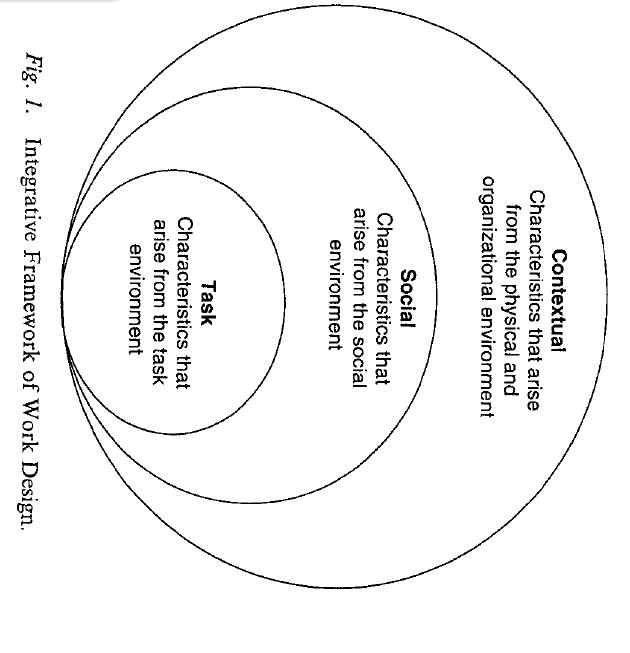
Since a number of jobs are combined and collaborative, it might be more helpful to consider an Integrative Model of Work Design. Morgeson and Humphrey’s (2008) model will identify various work and worker characteristics – specifically those work attributes that includes task, social, and contextual sources.

1) Task Characteristics: autonomy, worker control, skill variety, task identity, task significance, feedback from the job, task variety, job complexity, information processes, specialization, problem solving. Worker characteristics include job knowledge, technical skills, self-management, cognitive ability, task experience, proactive personality, and needs for achievement

2) Social Characteristics: social support, feedback form others, interdependence,, interaction outside the organization, team experience, need for affiliation, and hardy personalities

3) Contextual Characteristics: physical demands, work conditions, ergonomics, equipment use, boundary spanning (interaction within the organization but outside one’s department/team), organizational support, workspace, virtuality of work (communication), consequence of facility, physical ability, propensity to trust, organizational experience

Future research considerations for work design could include:

  •  key theoretical perspectives on fit is the needs-supplies/demands-abilities duality
  • gravitational hypothesis: workers “gravitate” towards and stay in jobs that they are both capable of performing and fit with their individual differences
  • conceptualizing individual attributes at the team level takes an additive approach – studying team vs. individual composition models
  • role vs. team composition approach: how role holder characteristics impact performance rather than putting the focus only on individuals
  • understand the impact that learning  and knowledge-based organizations should consider for work design
  • influence of the following attributes: self-regulation, social-facilitation, workload sharing, convergence, etc
  • impact for informal work redesigns – job crafting – that emerges out of work experience and organizational change
Reference: 

Morgeson, F.P. & Humphrey, S.E. (2008). Job and team design: Toward a more integrative conceptualization of work design. In J. Martocchio (Ed.). Research in Personnel and Human Resource Management (Vol. 27, pp. 39-91). United Kingdom: Emerald Group Publishing.

#phdchat, ATPI, Learning Technologies, LPQ, Reflections

LT Forum Interview – About My PhD Experience So Far…

The LT Forum is a place for students, staff and faculty in the Department of Learning Technologies at the University of North Texas to share news, announcements and updates. Here is an interview I did for them over the summer, that I forgot to cross-post here. Thanks to for inviting me to share my thoughts Jenny Wakefield.

« on: June 02, 2012, 01:24:32 PM »

We have many talented doctoral students in The Department of Learning Technologies. Our hope is to be able to interview and showcase these PhD learners here in the LT Forum as each reaches milestones through-out their journey towards their graduation. Reading about other students’ successes may boost that extra energy needed for others to push themselves forward and learning about challenges may help guide others. We also want to spotlight our students so that new learners come join our team and travel with us in the Learning Technologies – a great place to be! [Jenny Wakefield.]Our third interview is with Laura Pasquini, Doctoral Student in the APTI program:

Laura Pasquini – PhD Learner in ATPI

JW: Tell me a little bit about what made you decide to enroll in the ATPI program and pursue a PhD/EdD. (When did you enroll? How long have you been working towards your exam and course completion?)

LP: In looking for a graduate program that suited my scholar-practitioner interests in higher education, I thought that the Department of Learning Technologies at UNT was best suited for my talents and interests. After completing a course in Fall 2009. I decided to join the ATPI program in Spring 2010, as I liked the interdisciplinary approach and learning model that was built into the curriculum. As an ATPI doctoral student approaching completion, I appreciate the ability to study in the field of applied technology, human resource management, organizational change/theory, and educational research while connecting with faculty and leaders in the field. The end of 2012 marks the end of my course work and movement into being a PhD candidate. I am fortunate to be one of the first ATPI doctoral students to complete the NEW ATPI portfolio (instead of the comprehensive exam) by November, and after my last ATTD class with Dr. Nimon this Fall I will be ready to propose my doctoral dissertation and move on to being a doctoral candidate. The tentative plan is to be complete the ATPI doctoral program and graduate around May 2014.

JW: Who is your major professor?

LP: Dr. Jeff Allen is my major professor. It has been great collaborating and learning from one another. I appreciate the ability to work with and contribute to research, publications, and opportunities in the LT department. He has been a great faculty advisor who knows how to challenge and support my professional/academic needs.

JW: What has been the most challenging parts of your studies so far?

LP: Balance. I am a student, staff, and instructor at the University of North Texas. My role as an Academic Counselor/Instructor with the Office for Exploring Majors, Undergraduate Studies supports undecided students with their major/career choices and academic journey; whereas I am often found on campus, late in class, or researching/writing for another project. Besides working on courses, I have found great values in collaborating with other authors on publications, connecting in the field with other educators, and meeting corporate leaders. Besides working on courses, I have been busy with contributing to professional associations and journals with research, publications, and presentations. This year I have taken on the role as the editor for the Learning and Performance Quarterly (LPQ) which is a student-led, blind peer-review open-access online journal. We just published our first issue on May 22, 2012 and I’m looking forward to working with our reviewers and editors on the second issue over the summer.

JW: Tell us a little bit about your journey so far. What are challenges you’ve had to overcome? Have you had any pleasant surprises, aha-moments you’d like to share?

LP: I am originally from Toronto/Niagara Falls, Canada, so it took me a little while to adjust to the climate and the ways of Texas. I have been fortunate to meet some hospitable friends and colleagues who have helped my transition to the Lone Star state. So far I have really enjoyed my PhD journey. I have appreciated the projects, classes, discussions, and, most importantly, the connections with peers from UNT and in the learning technology field. I think that learning is an ongoing process, and developing as a researcher and academic is a continual experience. I have learned to celebrate the accomplishments and milestones along the way, and to be open to any feedback and new ideas I am exposed to along the way.

JW: What presentations have you attended/presented at? Tell us a little bit about one of them. Anything in particular that comes to mind? Advice for others?

LP: I have been fortunate to present research, papers, and theoretical sessions at a variety of professional associations and conferences over the last few years. Some have been collaborative and others have been a great learning experience where I have engaged with participants in meaningful discussions about shared research experiences.

LP: Over the last year I have been fortunate to be asked to share ideas and thoughts around connected learning and social practices for professionals as an invited speaker a few conferences/meetings. Last fall I was invited to talk to the University of Hawaii System Advising group at their annual workshop in Honolulu, HI about “Why Advising Networks Matter” and how holistic, community models of connected advising practices best support our learners. I just returned from Helena, MT where I was invited to be the opening keynote speaker for the Mountain MoodleMoot. During this talk I shared strategies for developing learning curriculum and ideas to support social learning with Digital Pedagogy to Engage. Both talks offered me opportunities to share my research ideas and practical experiences with social, connected learning; but more importantly it allowed me to connect with colleagues to discuss how these ideas can be applied to provide solutions for issues in education.

JW: What publications and/or creative works have you published?

LP: In collaborating with a few authors from our campus and other locations in the US, I have experience publishing book chapters, monograph chapters, and conference proceedings around topics in technology for advising, collaborative learning, and innovative practices for performance and learning. I am currently working on a few manuscripts for peer-reviewed journals. If you want to see my publications, I have current publications shared on my Mendeley account. Besides formal publications, I am often reflecting and sharing thoughts about my research on my blog or podcasting with the BreakDrink.com Student Affairs and Higher Education community on the Campus Technology Connection podcast.

JW: Have you decided on your dissertation topic and if so what was it? If so, what made you decide on this topic?

LP: I am currently culling through my literature review and narrowing my dissertation topic – which should be finalized over the break in coursework this summer. My current research thread and interests are in the areas of collaborative learning environments and personal learning networks, specifically how these networks and environments impact learning, training, and development in organizations. What interested me in these topics was personal experience connecting and learning in both formal and informal learning networks – specifically with peer-to-peer learning and mentoring in professional organizations. I hope to share some insights and values to how alternative forms of learning, training, and mentoring can impact professional development and career growth.

JW: Have you been studying full-time or also been working? How do you feel about combining PhD studies and working full-time (if you did)? What are things to potentially keep in mind?

LP: As I shared above, I have been working full-time as well as working on my doctoral studies, research, and publications. I will say that it is quite busy and challenging; however with some effective time management and organization it is not impossible to accomplish your academic goals. I am grateful to have supportive peers, colleagues, faculty, and family who continue to motivate and push me along my PhD journey. Although it is not impossible, I will say that it takes a great amount of energy, effort, and time to commit to doctoral research and academic professional development.

JW: Any recommendations you would like to share with the rest of us on the journey towards a PhD/Ed.D? 

LP: Stay the course. It seems like a long journey to the end of the PhD/Ed.D, but I think that there are some valuable experiences and rewards along the way. Embrace the challenges and opportunities that you have as a doctoral student beyond the course/program requirements. You can help shape your degree and academic experience, so be sure to make the most of it by getting involved, getting connected, and embrace new learning experiences that you stumble upon along the way.

JW: Anything else you would like to add?

LP: Thanks for asking me to share my thoughts about the Learning Technologies department and ATPI doctoral program. For those of you who want to follow along my PhD journey, I can often be found tweeting or reflecting on my blog. Get connected and share your experiences with me: http://about.me/laurapasquini