PhD, Reflections

#sxswEDU: Thoughts, Reflections & Then Some…

Time sure flies when you’re conferencing, volunteering and travelling… so my thoughts on South By South West Edu (#sxswEDU), are delayed by exactly 2 weeks. My bad.

Due to my love of Austin and enjoyment of SXSW, I thought SXSW Edu would be a great conference to engage with other educators and expand professionally. There were a number of things I liked – such as being on public transit, new perspectives on learning, and connecting with tweeps (Shout out to: @tjoosten, @gsiemens, @veletsianos@audreywatters & more #iamEDU friends!). I also appreciated the lively banter our Social Media in Higher Ed (#smHE) panel had on the topic, and the great follow up conversations with other instructors, practitioners, and researchers. 

Essentially, I got what I wanted out of the #sxswEDu conference – connect, social, interact and learn. I sort of expected something else from this conference, specifically with regards to the education (K-12 and Higher Ed) involvement. I was a bit disappointed to see that the Panel Picker selected more sessions with industry, rather than any educators. It was odd. I was not alone in noticing the tensions were felt between the industry and educationWhy were the instructors, teachers, principals, faculty, higher education professionals, and educational administrators not sitting in these #sxswEDU seats?

Let's get ready to MOOC-off! Where art thou @gsiemens?

Although the education presence was not the “sage on the stage” approach, I am glad I was present to listen to what industry and technology leaders think the “future of learning” will be. I know that many of these sessions were challenged and talked about outside the formal #sxswEDU program, and I was curious as to how other educators interpreted the conference message(s). 

One thing that was very noticeable = the repetitive rhetoric being shared from room to room. To mix it up I, jokingly, initiated the  #SXSWedu Terms to Know, Use, Love & Hate Google doc to note the key words, terms or phrases I heard at the conference. Some might say I was being jaded (*cough* Siemens *cough*), but really I was just having fun with the common language of the conference. After curating this list, I decided to create a game (…which had multiple players, I might add): 

#sxswEDU BINGO Card #3

Note: Another suggestion was to draft a blog post with the complete list of terms. I decided to respectfully decline said challenge; however I will stay alert to the language and context of these words. It’s not a bad idea to keep your ears open and listen every once in a while… Thanks for reminding me of that #sxswEDU.

Reflections, StudentAffairs

Finding our Strengths(Quest) with Alternative Spring Break #asbABQ13

MHP logo

This Spring Break, I will be accompanying 9 undergraduate students from University of North Texas (UNT) as we road trip west to work with the Mi Casa Es Su Casa – Metropolitan Homelessness Project in Albuquerque, NM (#asbABQ13). We are one of the many UNT Alternative Spring Break trips created for students who want to give back to their community and participate in a service learning project while away from academics. Our trip is a new location; however I believe that we will be primarily be working to set up new spaces for those who are without a home.

Part of our efforts before the trip has involved getting to know one another, and raise funds to support our groups trip.

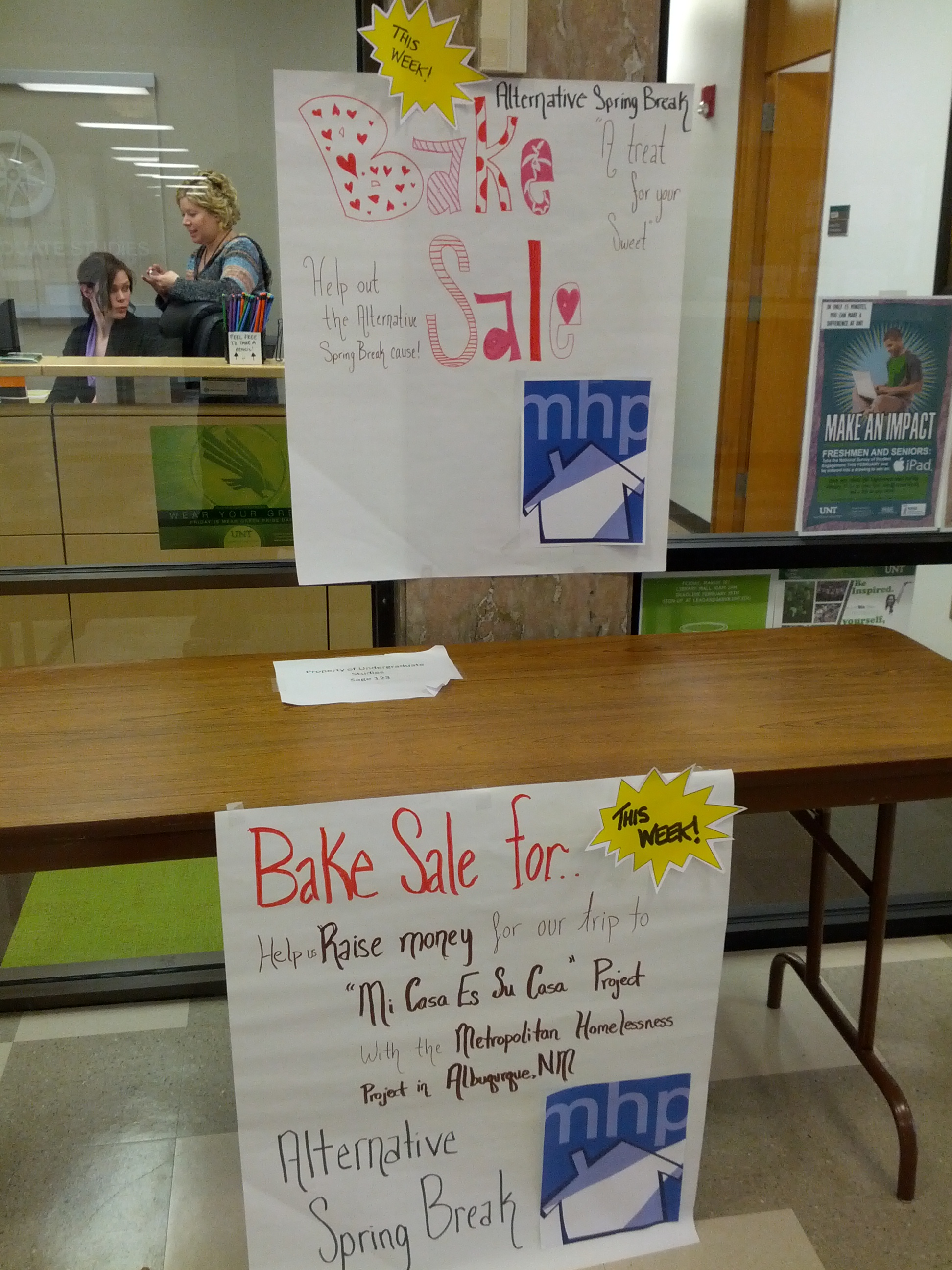
So far we had a moderately successful bake sale last week, selling “Treats for Your Sweet”… (yours truly even baked in her “spare” time)…

bake sale

And recently I encouraged the group to “LAUNCH” a Student Launcher website (formerly known as AlumniChoose), to crowd-source funds via their own social networks.

Screen Shot 2013-02-21 at 10.52.47 PM

If you would like to help fund part of the students’ travels, meals, or house-warming gifts for the new tentants, please feel free to contribute what you can to the launched #asbABQ13 funding raising site:  http://StudentLauncher.org/9cab 

Bonus: If you help fundraise, we ensure that you can follow along with our efforts and adventures. We promise to share photos and updates about our trip, and the progress we make with the Mi Casa Es Su Casa project.

Reviewing our Strengths

The last part of our trip prep has been about building our team and getting to know one another. Kudos to Irene & Becca, the #asbABQ13 site leaders, who have done a great job bringing everyone together and planning a large chunk of the trip. At our last group meeting, we debriefed about our top 5 strengths from StrengthsQuest during our last meeting. It was great to learn about what others will bring to our service project.

strengthsquest2

Here are my top 5 Strengths:

Input

“You are inquisitive. You collect things…because it interests you…to add more information to your archives…each new location offers novel artifacts and facts. So you keep acquiring and compiling and filing stuff away. It’s interesting. It keeps your mind fresh. And perhaps one day some of it will prove valuable.”

Dead on. I blame my academic background in history for my documentation, archival, recording, and research approach to things. Travel and adventures might also contribute to my desire to collect these memories and moments – I take photos, tweet, save, and then some.

Strategic

“…enables you to sort through the clutter and find the best route. It is not a skill that can be taught. It is a distinct way of thinking, a special perspective on the world at large…“What if?” Select. Strike.”

When you have a lot of things going on at the same time – you sort of have to be.

Individualization

…intrigued by the unique qualities of each person. You are impatient with generalizations or “types”…focus on the differences between individuals…a keen observer of other people’s strengths, you can draw out the best in each person…helps you build productive teams.

It’s true. I don’t like boxes, compartments, labels, or single identities. Everyone is a beautiful and unique snowflake, and I want to get to know them better. Blanket statements and group designations don’t fly with me.

Activator

“Only action can make things happen. Only action leads to performance. Once a decision is made, you cannot not act…action and thinking are not opposites…you believe that action is the best device for learning. You make a decision, you take action, you look at the result, and you learn…You must put yourself out there…you will be judged not by what you say, not by what you think, but by what you get done…”

This probably is connected to my Strategic strength. See my #oneword2013 => ACTION Need I say more. Less talk, more do. This #asbABQ13 is right up my alley.

Futuristic

“…The future fascinates you…it will always be inspirational to you…When the present proves too frustrating and the people around you too pragmatic, you conjure up your visions of the future and they energize you. They can energize others…often people look to you to describe your visions of the future…”

Am I alone on this one? I am guessing that my current research focus and scholarly work help to fuel the fire of this one. I am okay with that – who doesn’t want to have a crystal ball? Let’s take a look at my archives from my Input strength, and look to what is on the horizon. So far, I can predict a great Alternative Spring Break trip. 🙂

PhD, Professional Development, Reflections, SocioTech

Finding a Research “Home” with #SocioTech at #iConf13

As a College of Information student, the learning technology department compliments a number of research areas emphasized within our iSchool and at the 2013 iConference. Andrew Miller (@findandrew), Leila Mills, Mark Evans and I proudly represented UNT as one of the 12 finalists for the Social Media Expo hosted by FUSE Labs of Microsoft Research at the iConference this year. After conducting our ethnographic study on the Denton Local Food System (LFS), we submitted a research paper, video, poster, and created an online space for the LFS community to share information, house knowledge and connect to local happenings within the community at FeedDenton.org.
#iConf13 Social Media Expo Finalists
  Social Media Expo poster @ 2013 iConference (#iConf13) with @findandrew

What I enjoyed most about attending the conference was the refreshing opportunities to engage about research methodology and conceptual frameworks that apply to my scholarly interests. It felt like I was coming “home” when talking shop with various academics and graduate students during the conference. The best part might have been the pre-conference session:  Sociotechnical Systems Research workshop (#CNFWSP2). This is where I was able to connect to other #sociotech researchers, and learn more about areas of inquiry coming out of the iSchools and various disciplines.

The pre-conference was a full day of fun that housed various speakers, discussions, and sharing of directions in sociotechnical research, including

  • critical study and comparative study
  • considerations for multi-scale ethnographic research
  • artifacts that change communication in organizations
  • impacts of human and non-human delegation
  • shifts from visible to invisible networks (part of ANT)
  • organization as a constant communication
  • sustainable information practices
  • action-based research for informatics improvement
  • participation, community resilience, plurality, design

Later in the day, Steve Sawyer, conducted a master class to present various sociotechnical systems (STS) perspectives, which drew upon theories from Actor-Network to social construction. Everything is relational as new forms of social organization is occurring with new technical arrangements all around us. We talked about #sociotech in practice, specifically how to situate the phenomena (conceptual & empirical framing) and conceptualize sociotechnical systems (identify characteristics of the social, technical and interactions) by looking at this STS conceptual space mapping from Steve.

Untitled
This post is just the tip of the iceberg, as I have a number of notes, ideas, references, and research peers to turn to thanks to this workshop. I was not surprised to run into some of the #sociotech usual suspects in #iConf13 sessions such local communities, learning environments, or ethnographic studies of online communities. I appreciated the comments and dialogues brought to both the paper and notes sessions (I preferred the workshop space in the notes session better), and I am motivated to dig back into my own research and dissertation grind.

Want to read more about the 2013 iConference proceedings or connect to a few sociotechs? Here you go:


Reference:

Miller, A. J., Pasquini, L. A., Mills, L. A., & Evans, M. (2013). Towards a methodology of virtually augmenting a knowledge sharing community of practice: A case study of the local food system of Denton, Texas. iConference 2013 Proceedings (pp. 1095-1101). doi:10.9776/13527

Professional Development, Reflections

#oneword2013 = ACTION

It’s that time of year… time to consider the #oneword2013. I think I embodied my #oneword2012, fantabulous, so I thought I might as well give #oneword2013 a go. 2013 has a great deal in store for me – there are a number of projects, deadlines, objectives, and initiatives I want to accomplish this year. My one word will move beyond TO DO lists, goals, New Years’ resolutions, or even wishes [sorry Daruma doll!].

Our goal is set for 2013 @FiachraM.Here's to our scholarly work & having our Daruma doll to remind us of our focus.
My #oneword2013 is ACTION! This word will remind me to be active and engaged in what I am doing. A little less conversation, a little more action. This means you should be seeing more verbs in my blog posts, such as researching, writing, moving, publishing, dancing, exploring, adventuring, trying, doing, completing, graduating, and challenging.

I have also decided to use the word ACTION to push me beyond my comfort zone. It’s time to visit new places, to try new things, and to enhance my learning and professional development. Whether it’s a road trip to a new location or learning a new sport (that involves a few bumps & bruises) – then why not? It’s a year for ACTION. Just do it!
Let's ride
What’s YOUR #oneword2013? Add yourself to the list.

Higher Education, Reflections, StudentAffairs

A Kinder Campus to Collaborate

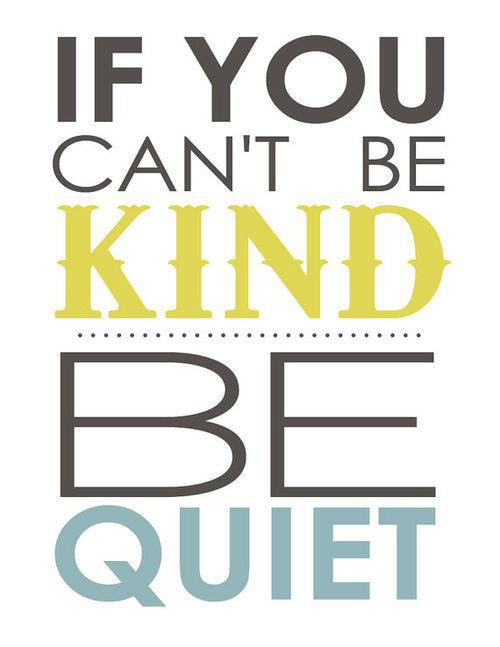
Be KindThere are a  number of students, staff, and faculty in my life who I have gotten to know along my academic and professional journey – as colleagues and as friends. I have been fortunate enough to experience college/university life as a student, professional, and instructor  at various types of institutions and in more than one country.  Each new experience has afforded me to work with insightful colleagues, learn about effective practices, understand a variety of student populations, and consider innovative ways to  support students, staff, and faculty.

In a recent Inside Higher Ed article I shared my thoughts on why our divisions in higher education need to think beyond their own areas. Some of the challenges ahead in higher education will require our departments/divisions to step our of their silos to collaborate and reach shared goals for our institutions. It does require some risk; however I think there are larger rewards for reaching out and conversing with others. In considering some of the opportunities and challenges in higher education – such as financial, legislative, staffing, and more – perhaps it is just the right time to sit down to chat and connect to others on campus. Institutional units will need to put their heads together to think creatively and collectively about some of these issues – if they are not doing so already. 

Over the last few weeks, I have been thinking about what a “kinder campus” means in higher education. I am currently participating in a Collaborative Learning Community (CLC) at UNT that brings students, staff, and faculty together to work towards a shared solution to a problem/challenge at our institution [more to be shared on this later]. Since we have diverse representation on this CLC, as the co-chair with another faculty member we have been considering the following needs to keep our group moving forward:

  • introductions are important – find out what everyone “does” on campus
  • use common language and define terms
  • establish purpose and goals for the CLC
  • share and distribute information/facts that are not known
  • establish a meeting time/day of the week
  • create agendas to guide, not limit the conversation/sharing
  • record meeting minutes for those who might be absent
  • online space for resource sharing 
  • flexibility and understanding for attendance is a must
  • define roles to guide actionable items & project initiatives
  • bringing food/treats is never a bad thing

Although cross-departmental meetings can be challenging, as it requires stepping outside our own domains and sharing across disciplinary boundaries, I have had some of the most productive conversations and ideas to emerge from these gatherings.


Are you part of a collaborative working group at your higher ed institution? What tips do you have to “be kind” and connect with colleagues outside your division/department?