Higher Education, MOOC, Open Education

New Social Learning … is It “New”?

Education rarely reinvents the wheel. This is not necessarily a bad thing. There are a number of great theorists, researchers, scholars, practitioners, and educators who have been utilizing connected and social learning ideas for decades.

In thinking about social learning for instructional design, I will turn to Bingham and Conner’s (2010) outline for how this is “new” in many of our organizations:

  • The new social learning is not just for knowledge workers – community-oriented.
  • Plays well with formal education to capture shared learning.
  • Compliments training and supplements development.
  • Similar but not the same as informal learning – more search and reading.
  • More than just online search and social networking.
  • Not like broadcasting information, more communal.
  • Allows for interaction and experiences to share ideas.

Image from Social Media Portal

Thomas and Brown (2011) inquire about the new culture of learning in their book, specifically asking: “What happens to learning when we move from stable infrastructure of the twentieth century to the fluid infrastructure of the twenty-first century, where technology is constantly creating and responding to change?”

I am thinking about this question a lot. A number of educators are looking for the “new” instead of asking questions and assessing the present practices. As a scholar-practitioner with perhaps faculty inklings, I have many concerns and questions for the future of our learning in higher education:

  1. Who (collaboratively) will best respond to the challenges and changes for our learning landscape on your campus?
  2. Why are educational changes and decisions being made? Is there assessment and evaluation? Data-driven decisions? Literature to support the change?
  3. What are we doing well & what can we improve upon in our face-to-face, online, and blended pedagogy in higher education?
  4. How are we thinking about connections, creativity, and social learning for our campus learning environments?
  5. When & how seek out the learner’s input for changes to our educational curriculum, campus programs, and student support services?

The idea of one idea, one thing, or one person to tackle the challenges/changes in higher education is ridiculous. If you think a “new” way to learn – perhaps a MOOC – will solve your university or college, then I am concerned about your strategic goals and learning outcomes. Take a gander at George Siemen’s recent #open13 talk [slides & video] to get a historical perspective on MOOCs (then and now), learning challenges, and other considerations for higher education pedagogy. [P.s. If you want to talk more MOOCs and research – y’all should come down to Texas for the 1st MOOC Research Conference in December]

One great take away from George’s talk (via a priest) about the upcoming shifts to higher education: “Don’t move away from things…because if you move away from things you don’t have a clue where you’re going to end up. Instead, move towards something.”

References

Bingham, T., & Conner, M. (2010). The new social learning: A guide to transforming organizations through social media. Berrett-Koehler Store.

Thomas, D., & Brown, J. S. (2011). A new culture of learning: Cultivating the imagination for a world of constant change (Vol. 219). Lexington, KY: CreateSpace.

Siemens, G. (2013, November 7). MOOCs: How did we get here? Elearnspace. Retrieved from http://www.elearnspace.org/blog/2013/11/07/moocs-how-did-we-get-here/

Open Education, OpenAccess

Open Education: Why #OER Needs to Be Our Business and Policy

A couple weeks ago, I attended the WCET hosted webinar on our campus – Open Education: The Business & Policy Case for #OER presented by the Director of global learning at Creative Commons,  Cable Green (@cgreen).

Wait – what the heck is OER?

I did take a few notes (a.k.a. Tweets) and thought I would share my thoughts from the session – and general thoughts for OER materials.

avatar
{Irony: Not all of the OER Commons is CC licensed}

The real issue is about sharing and making a case for open policy on campus that fits a “business model” in higher education. This webinar addressed concerns and practices to implement open access policy that is good for business. Currently, many educational institutions do not value  or support “open” as an option. I am fortunate to work at a university that supports the open access movement and encourages sharing of scholarly research and publications. I have been thinking about my role as an open educator for a while, and what it means for my research, publications, editing, teaching, and learner engagement.

In reviewing the UNT institutional OER involvement, I know there is some progress for resources, but like many campuses, we have a way to go. It would be great to see more departments, faculty, and units participate in sharing resources and joining the #OER movement.  By swapping educational resources and encouraging remixing of ideas, we might be able to create more opportunities for collaboration  to enhance our learner experiences, including:

  • faculty mentoring
  • new ways instructional design development
  • program evaluation
  • cross-training of staff and faculty
  • student innovation/involvement
  • affordable learning materials e.g. http://opencourselibrary.org/
  • interdisciplinary learning commons
  • building capacity within your institution

If you’re at a publicly funded institution, your educational resources should be openly licensed – this just makes sense. Does your institution encourage and promote Open Access? Do you share Open Educational Resources at your school? Please share how you are #OER.

Book Review, Higher Education, K-12, Open Education, PLN

10 Principles for the Future of Learning

While working on some late night treadmill mileage, I decided to catch up on documents and books I have been collecting on my Kindle. Last week I read The Future of Learning Institutions in a Digital Age, which was a precursor to The Future of Thinking: Learning Institutions in a Digital Age book published by the John D. and Catherine T. MacArthur Foundation. Although this material is a bit dated, I think that some of the pedagogy still applies for educational development.

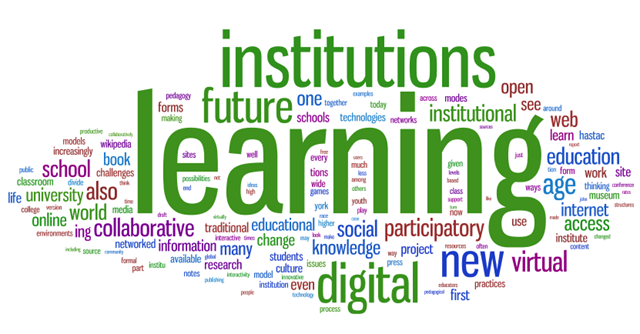
Image c/o Martin Hawksey (and his musings on this text as well). 

In the first collaborative project, the authors share ten principles to support the future of learning. Davidson and Goldberg (2009) presented these pillars of institutional pedagogy to help institutions rethink learning and meet the challenges that lie ahead for both K-12 and higher education:

  1. Self-Learning – discovering and exploring online possibilities
  2. Horizontal Structures – how learning institutions enable learning; from learning that to learning how; from content to process
  3. From Presumed Authority to Collective Credibility – shifting issues of authority to issues of credibility; understand how to make wise choices
  4. A De-Centered Pedagogy – adopt a more inductive, collective learning that takes advantage of our era and digital resources
  5. Networked Learning – socially networked collaborative learning stressing cooperation, interactivity, mutuality and social engagement
  6. Open Source Education – seeks to share openly and freely in the creation of culture and learning; provides a more collective model of interchange
  7. Learning as Connectivity and Interactivity – digital connection and interaction to produce sustainable, scaffolding ensembles
  8. Lifelong Learning – there is no finality to learning; learning is part of society and culture
  9. Learning Institutions as Mobilizing Networks – networks enable flexibility, interactivity, and outcome; new institutional organizations reliability and innovation
  10. Flexible Scalability and Simulation – new technologies allow for collaboration beyond distance or scale for productive interactions that warrant educational merit

Reference: Davidson, C.N. & Goldberg, D.T. (2009). The future of learning institutions in a digital age. Cambridge, MA: The MIT Press.

blogs, Learning Community, Open Education, Reflections

Education Bloggers Research – My Blog Survey

After reading @mweller ‘s blog survey for Alice Bell’s research on education bloggers, I thought that I might as well contribute to the study since I sometimes write about education, learning, and the likes here on TechKNOW Tools. From the post from Alice, it looks as though she will collect responses via e-mail (edubloggingstudy@gmail.com) or via your own blog (so you can share responses with your readers) – and send her the link. If you’re an education blogger, perhaps you too should contribute to the research. All responses are due by by the 15th of June. This sounds interesting and useful – I look forward to hearing about the analysis, but for now here is my blog survey…

Blog URL: techknowtools.wordpress.com 

What do you blog about? Learning networks & environments, academic advising, educational technology, higher education, doctoral stuff, research and writing, training and development, instructional pedagogy & design, social web & open access, podcasting, student affairs, and then some.

Are you paid to blog? No. Only in digital high fives and thanks.

What do you do professionally (other than blog)? Academic Counselor/Instructor & Doctoral Student

How long have you been blogging at this site? Since October 23, 2008 [say my WP Sitestats].

Do you write in other platforms? (e.g. in a print magazine?) I have published book chapters, academic papers, peer-reviewed journal publications, conference papers and proceedings, other blog contributions (like BreakDrink.com and personal blog), and online magazine contributions.

Can you remember why you started blogging? I started blogging personally in 2006 when I was working and travelling around to different countries (on another blogging website); and I started to blog here after reading a number of educational and learning blogs. This blog was created  as a space to share ideas and resources for a NACADA Technology Seminar learning community back in February 2009 – my friend Eric Stoller suggested I try out WordPress since I was using Blogger for my personal blog.  This blog soon evolved into a space where I curated content around what I was reading, writing, researching, or working on related to learning technologies and other issues related in education and training development.

What keeps you blogging? I enjoy it. My academic background in history and education might take some of the credit for blogging. I use my blog to reflect and think about things. It is also a great space to archive, document and curate what I am up to and what I am learning or reading about.  Now blogging is just part of my regular routine. I like starting the conversation here, sharing it in my networks and then learning what others think.

Do you have any idea of the size or character if your audience? How? My Google Feedburner says I have 61 subscribers & Sitestats says I have 29 follows on WP with 115,072 views from 49 countries. I might consider using Google Analytics to track this better in the future, but at the end of the day I think I blog for me than my audience. My audience is composed of higher education professionals, faculty, teachers and instructors from fields in training and development, marketing, management, technology, and education.

What’s your attitude to/ relationship with people who comment on your blog? Typically I have seen more shares of my blog posts on Twitter and Facebook. I have a great network and community that often engage on there more than here. Although the traffic and views are outside WP, I do appreciate and I am delighted to receive a blog comments on here from time to time (Thanks!). I would say that I have better relationships and interactions with those who comment “off the blog.” Some of my blogging prompts shared dialogues on other networks or with other peers who share similar interests.

Do you feel as if you fit into any particular community, network or genre of blogging? (e.g. schools, science, education, museums, technology) Sort of? I think technology and  learning – but I have been known to dive into training and development, organizational management, and higher education due to the nature of my academic program/professional interests.

If so, what does that community give you? I think this community is like the “Office Water Cooler” I have always wanted. It’s a great place to catch up, share interesting news, find out about new resources, swap great ideas, and stay in touch with my personal learning network.

What do you think are the advantages of blogging? What are its disadvantages/ limitations? I shared my thoughts in the “What Prompts You To Blog?” post last month => https://techknowtools.wordpress.com/2012/05/04/what-prompts-you-to-blog/

I think blogging has supported my digital scholarship as a transparent and open researcher and writer. There could be limitations to this, as I often share ideas and references before the referred journal article is published and there is that possibility that others could “borrow” it. The other challenge I can see is the need to publish or perish to make it through the academic ranks for jobs and tenure. Although my writing style is more informal and offers a variety of structure I do enjoy the practice of writing and processes what I am writing. Unfortunately blogging does not equate a journal article and I am aware of the need to contribute to traditional publications and peer-reviewed work to support my career path in academia.

Do you tell people you know offline that you’re a blogger? (e.g. your grandmother, your boss) I think most of my offline (i.e. not in social networks) family or friends know that I “do stuff with technology” and most have some idea of what a blog is. I share the odd blog post with a limited number folks who are not exposed to this blog regularly  (like my boss & parents) if there is a topic something that might interest them. I use another blog and a Flickr account to share more of my “life happenings” so my friends and family are not bored with any of my geek/nerd ramblings on this blog.

Is there anything else you want to tell me about I haven’t asked? I think you have covered most. Good luck with your research! I look forward to hearing how it goes. 🙂
EC&I831, eduMOOC, Higher Education, Learning Community, Learning Technologies, Open Education, PLN, Virtual Communities, Web Design

#mtmoot Opening Keynote: Digital Pedagogy to Engage

This morning I will be joining the Mountain MoodleMoot at Carroll College in Helena, MT to share some thoughts and ideas around engaged digital pedagogy. Our learners are connected; however  I think more educators and instructional designers need to support our students in developing effective learning skills to navigate this new culture of learning. For those of you interested in following along, be sure to tweet with hashtag  #mtmoot, check out my slides (below), and feel free to scope out the digital handout http://bit.ly/mtmoot12 I compiled for this session.


Today’s learners operate in a world that is informal, networked, and filled with technology. Connectivity and digital access is an increasing need for our students and a vital requirement to excel beyond structured learning environments. Our learners are now able to interact with information, learning materials, and peers from around the globe. There is an increasing need to expand and enhance our learners’ involvement in learning technology to support engagement in online learning environments.

With the emergence of collaborative, online tools, educators can take advantage of multidimensional and engaged participation to reach their learning outcomes. Social media creates a space where “everybody and anybody can share anything anywhere anytime” (Joosten, 2012, p.6). Educational paradigms are shifting to include new modes of online and collaborative learning and student-centered, active learning to challenge our students to connect curriculum with real life issues (Johnson, Adams & Cummins, 2012). As a new generation of learners begin to create and share content, educators need to understand how to effectively utilize social web resources to impact in instructional practice create a culture of online participatory learning.

Emerging technology platforms and devices are beginning to disrupt education as we know it. To coevolve and positively impact learner success, it is critical that instructors and instructional designers consider how digital pedagogy can support learning outcomes. This keynote plenary will share ideas and suggested practices to develop a richer learning experience and thrive in the changing digital learning frontier.

References

Johnson, L., Adams, S. & Cummins, M. (2012). The NMC Horizon Report: 2012 Higher Education Edition. Austin, TX: The New Media Consortium.

Joosten, T. (2012). Social Media for Educators. San Francisco, CA: Wiley/Jossey-Bass.