#phdchat, Dissertation

Dissertation Boot Camp, Part II

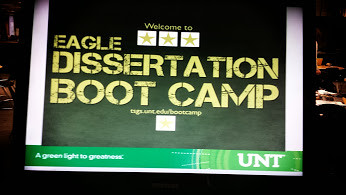
Last week I attended my second Eagle Dissertation Boot Camp. This was a three-day #ShutUpAndWrite session created for UNT graduate students to help us focus our time on our thesis/dissertation projects. My first Eagle Boot Camp was successful as I crafted a great chunk of my dissertation proposal and successfully defended said document in February.
#UNT Dissertation Boot Camp

My data analysis is complete, so my primary objective for this boot camp was to write up and explain the findings (Chapter 4). So, I am happy to report this chapter is almost complete with 28 new pages (which includes some large data graphs). I also spent the time reviewing edits and updates made to Chapter 1, 2 & 3 (my proposal). As many of my doctoral researching friends know — it’s not the page number — you write until you’re finished explaining your research.

I signed up for another boot camp because I enjoy the dedicated space, time, and peer support of these writing groups. Although my morning writing in solitary has been going well, I did appreciate a solid three days of concentration on my dissertation without disruption (texts, emails, etc). During the boot camp I also scheduled a few meetings with my major professor (Dr. Allen) and had a productive meeting with my new my co-chair (Dr. Evangelopoulos) and Dr. A. to review the scope of what I am reporting on for my dissertation. We had a great talk day #1 to review my data analysis, timeline for writing, and inclusions for my dissertation. I am thankful for the time and feedback each advisor has given me over the past few months.

Just like training for a marathon, it is critical to map out a realistic and effective training schedule. In this case, my training  = writing, reviewing, and editing. In planning for August graduation, I have to hit a few upcoming dates set by our graduate school, so my final dissertation defense date is on the near horizon.
DEFENSEphd040914s

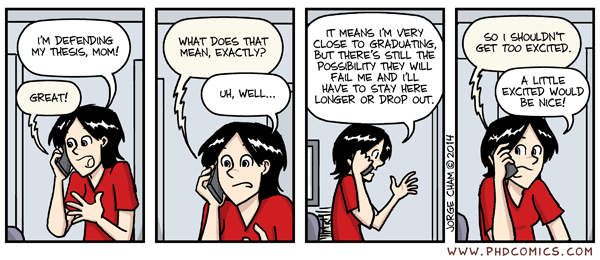
Photo c/o @PhDComics “Defending My Thesis

Dissertation Timeline

Date Task
Toulouse Graduate School Dissertation Boot camp:

Chapter 4: Data analysis review; Drafting updated analysis and findings from data productions

4/20/14-4/28/14 Chapter 5: Drafting concluding chapter discussions, social media guidelines & policy development, further research, etc.
4/28/14-5/5/14 Consult with Faculty advisors and dissertation committee to get feedback on first draft (as needed)


5/6/14 Final dissertation paper and PowerPoint ready – Mock defense with Dr. A & Dr. E
5/6/14-5/12/14 Review comments & feedback from Co-Major Professors; make edits or additions based on feedback

Consult with dissertation committee members as needed

5/12/14-5/20/14 Send to external editor: final edit and polish
5/20/14-5/27/14 Review edits and comments from editor on dissertation paper; adjust as needed
Clean up and prep final defense PPT
5/28/14 Send FINAL DISSERTATION to committee; officially schedule defense date for June 12, 2014
5/28/14-6/11/14 Edit presentation slide deck, meet with faculty advisors; meet with committee members to review/allow for questions
6/12/14 Dissertation Defense
6/27/14 All paperwork due to Toulouse Graduate School & FINAL COPY of dissertation sent to the Grad School Reader

It’s go time. Back to my “training” — write on, my PhD friends. Write on!
#AcWri, LPQ, LPQuarterly

Just Published: @LPQuarterly Volume 2, Issue 2

Happy 2014 to all my academic writing (#AcWri) friends! With the start of a new year, and academic semester comes a number of goals for writing and publishing. My short list of writing goals is ready … but I will share that later.

LPQ Facebook Banner

For many, you might be supporting other scholars through peer review and editing (like me!). It is my pleasure to present the Learning and Performance Quarterly (LPQ), Volume 2, Issue 2 for you and our readers as we enter our third year of publication:

“January is a common time for New Year’s resolutions centered on growth and transformation. The articles included in our January volume of The Learning and Performance Quarterly (LPQ) align with this spirit of change as they focus on the evolution of online learning, virtual communities and the effectiveness of the learning organization (Zimmerman et al., 2014, p. 1)”

On behalf of our editors and contributing authors, I invite you to review the LPQ 2(2) Table of Contents and abstracts here, and then visit our website to read the articles and items of interest.

Learning and Performance Quarterly
Vol 2, No 2 (2014)
Table of Contents

Editorial
——–
Expanding the Boundaries of Learning and Performance (1)
Tekeisha D. Zimmerman,  Laura A. Pasquini,      Jeff M. Allen

Invited Articles
——–
In Search of Ideal Relationships between Learning and Performance: Lessons
Learned from Balancing Two Identities (2-10)
Seung Won Yoon

Case Studies
——–
Internet and Society: A Hybrid Honors Course (11-27)
Mitzi E. Lewis, Mark Farris

Concept/Theory Paper
——–
Social Informatics and Virtual Communities: A Literature Review (28-36)
Andrew Jordan Miller

Research Articles
——–
Investigating the Research Trends of Learning Organization Studies between
1979 and 2011: An Approach of the Citation Network Research (37-63)
Ji Hoon Song,   Cho Hyun Park,  I-Pang Fu

Do you have goals to research, write, and publish in 2014? Our call for proposals is OPEN! Submit your manuscript to the journal TODAY!

You can review the previous article submissions in the LPQ Archives. We are seeking manuscript submissions for the following categories:

  • Research Articles – Qualitative/Quantitative
  • Concept/Theory Papers
  • Literature Reviews
  • Case Studies
  • Book or Media Reviews
  • Invited Articles
  • Editorials

If you have any questions about your potential article or would like to join our editorial team (peer-reviewing, copy editing, layout, etc.) please contact the Learning and Performance Quarterly Editors.

Happy reading,

Laura A. Pasquini, Editor (@laurapasquini)
Tekeisha D. Zimmerman, Assistant Editor (@TekeishaZ)
Dr. Jeff M. Allen, Managing Editor (@drjeffallen)
~~~~~~~~~~~~~~~~~~~~~~~~~
Learning and Performance Quarterly
University of North Texas
#phdchat, PhD, Reflections

The PhD: Troubles Talk… and Moan… and So On

As a PhD candidate, I am trying to be more cognizant  with my response when asked the following (common) questions:

  • “How’s your dissertation going?”
  • “When are you going to finish your PhD ?”
  • “Where have you been? I haven’t seen you in ages…”

phdFor those who are also “dissertating” like me, you understand how easy it is to offer a roll of the eyes, smile/nod combo, and “just great” to friends and family. When talking to fellow PhD candidates and scholarly researchers, we seem to be more open to dig right in to slag the our dragging timelines, cry about our progress, complain about our faculty support, identify dissertation distractions, and, of course, whine about the TIME we used or didn’t use productively.

I recently read an article by Dr. Inger Mewburn (a.k.a. The @ThesisWhisperer), who discussed such “troubling talk” among PhD candidates. Often it is the talk of troubles that brings PhD scholars together to form communities  of practice, like a learning network and/or support group. There has been a large growth in online blogging, tweeting, slidesharing, podcasting, and more from PhD and early career researchers. There’s an active online community that supports personal/professional development and sharing of resources.

One section in particular interested me as Inger shared her own experience with the transition from student to professional academic. Specifically Mewburn (2011) discusses how there is evidence for doctoral researchers who interact with one another often whine and encouraged this type of struggle storytelling with others, even if they were not having any challenges. In recounting experiences of PhD gatherings and discussion over lunch, Inger identifies with the camaraderie of a shared PhD struggle:

 “The recognition that others were struggling too certainly made me feel better, but at the same time my own role in the talk was strangely discomforting. I realised I was amplifying my writing trouble, making it into a ‘war story’  in order to make it amusing and interesting to others. I wondered: was my performance of an   ‘inept student’  in the kitchen a form of PhD student identity work? By talking about being ‘in trouble’ with my writing, I was positioning myself as ‘one of us’  (a student) and not ‘one of them’  (a professional academic)  which was closer to my lived experience. I began to wonder: did my fellow PhD students ever deliberately perform ‘non competence’  too? It’ s likely that many of them experienced good writing days, but I rarely, if ever, heard about them in the lunch room” (Mewburn, 2011, p. 322).

Which brings me to my own experiences, and thoughts about my PhD progress. Do I keep quiet or join in with the slagging if I am around others who are complaining about the struggle? Do I try to down play my advances in writing and publications with other grad students? Have I told any “war story” to entertain my peers, rather than the reality of my own research progress? It is easy to fall into this, especially when there are funny xckd.com images or brilliant PhDComics.com cartoons. Just posting something like this to get a like, RT, or share from others in my PhD community is commonplace with those of us who claim #GradStudentProblems:

grad student motivation graph

A number of blogs, such as The Thesis WhispererPhD Talk, and PhD2Published; and Twitter hashtag communities, like #phdchat#gradchat, and the @GradHacker community of bloggers/Tweeters, have actually been quite helpful for my PhD progress.  I appreciate theses online communities for sharing ideas, talking about writing resources, offering advice, and linking to research methodology. When thinking about my own approach to “catching up” with my social networks (online and in person), I’ll be sure to not just moan about things. Although I do value my online networks, there’s nothing better than having a bit of a chat with other doctoral students/candidates or researchers when we get a chance to meet up and socialize.

Let’s not just use these social moments to be A.B.M. (always be moaning). As PhD candidates, our lives aren’t THAT bad. We were selected to study and research in a field or discipline we want, and really if it’s not your cup of tea … then maybe it’s time for a change anyways. Much of our PhD negative self-talk or even group-think can stifle research and writing momentum. Sure – there’s going to be issues and challenges; however we need to celebrate the small victories along the way. I know we have more productive and interesting things to talk about when we get together (online or in person), so let’s collectively encourage, motivate, and positively influence each other with our research progress. We CAN do it!

Reference:

Mewburn, I. (2011). Troubling talk: Assembling the PhD candidate. Studies in Continuing Education, 33(3), 321-332.

#AcWri, #AcWriMo, Dissertation

#AcWriMo In Review: My Output

Many things come to an end as the month of November closes. See you later Thanksgiving, Fall 2013 semester, #Movember, and Academic Writing Month (#AcWriMo). (Actually – it’s more of a see you soon, really.) Officially, the month of November is dedicated to #AcWriMo; however a number of graduate students (including yours truly) used this past month to complete a good chunk of their dissertation to loose this moniker:

Why my weekends are filled with literature reviews, data collection & #acwri sessions... #acwrimo

Review of My November #AcWriMo Goals… and my Lessons Learned:

  1. Complete my doctoral dissertation proposal so that it is ready to DEFEND to my committee.  Almost there. I did get a good chunk of writing accomplished at the UNT Dissertation Boot Camp – so this helped #acwrimo my progress. Although drafted, my dissertation proposal is not ready to defend yet. In working on a new application for methodology for social science, I want to meet with a couple faculty members on campus to hash out specifics and needs for Chapter 3 (Methodology) and test some of this during the month of December. It looks like a January 2014 date is more realistic for my dissertation proposal defense. I’m okay with this – because once this proposal is approved then Chapters 1, 2, and 3 for my dissertation are DONE!

Lesson Learned: Dedicate the time for the dissertation. As a doctoral candidate you need to be selfish with your writing time. Since this is large project, you need to chunk out your research and writing time that is supported by realistic short- and long-term goals.

  1. Finish “Technology in Advising for Higher Education” manuscript to submit to the NACADA Journal. Since I started #AcWriMo a day later, I used December 1st to work on the #AdvTech research findings and drafting of this manuscript. I am not sure why this project was put on a back burner, but I definitely need to move forward and submit this in December 2013 for Spring 2014 publication eligibility. This goal is not complete, but I will plan on sharing it with my co-authors before the week is out so we can submit to the journal editors for review.

Lesson Learned: Finish your #acwri projects before taking others on. Sure the promise of more research and writing might be enticing, but how productive will you be on your own or with a collaborative writing team if you are not finishing your manuscripts and publishing them? Always be submitting.

  1. #iConf14 Social Media Expo – paper & video for conference. After a lunch brainstorm session with Andrew Miller (@findandrew) and @FiachraM last week, I found the momentum to draft the abstract for the #iConf14 proposal.  Although not submitted (just yet), the abstract is being wrapped up and edited this evening. The final video will be compiled tomorrow evening; however our team Dropbox is filled with photos and images, with Andrew to capture video tomorrow.

Lesson Learned: Innovative ideas come from interdisciplinary thinking and problem solving. Research that is participatory and collaborative drives my writing and efforts. Also, when you experience #acwri well with other scholars, be sure to include these researchers as conspirators for your common research interests and projects.

  1. Complete a minimum of 2 blog posts per week – on writing progress and projects. Done. Whether I was reading, researching, or writing – I was able to share what I was working on with my blog readers, and provide on-going updates about my #acwrimo progress.

Lesson Learned: Stating goals out loud and adding social pressure is great, but reflection and sharing always helps me to process ideas more. Although my “official” month of #acwrimo accountability is over, I am fortunate to have my blog to share and write about my research progress, dissertation progress, teaching methods, and more.

Overall…

This month of academic writing has been very productive for me. In looking at my contribution to the #AcWriMo Accountability in the Spreadsheet o’ Fun you can see I logged at least 35, 097 words, and have been dedicated to the daily habit of writing. It is not so much the word count, but really the completed projects, which are finished and not taking up real estate in my research/writing space. I am taking the #acwrimo lessons learned with me by continuing this #acwrimo habit in December by setting specific project goals, carving out dedicated writing time, and reflecting my progress via my blog.

How did #AcWriMo in November go for you? What have you learned from this academic writing month? Post a comment to share, or respond to this #AcWriMo Questionnaire (not mine).

#AcWri, #AcWriMo, #phdchat, PhD

#AcWriMo Peer Pressure: Time, Challenge/Support & Cheerleaders

As many of you know, I signed up and successfully completed my first UNT Eagle Dissertation/Thesis Boot Camp over that past few days. What did I accomplish? (you might ask). Here is my summary, in a tweet:

The boot camp structure helped me find time, space (physically & mentally), and support to dedicate 3 FULL DAYS of just writing and research for my dissertation. Dr. Oppong and the Toulouse Graduate School provided the group of doctoral students with advice on the PhD process, motivation, meals, and, of course, COFFEE! Boot camp let me be selfish with my time and required me to just SHUT UP AND WRITE my dissertation.

Shut Up & Write #AcWriMo Start of Dissertation Boot Camp

During the camp, I purposefully unplugged from all social streams, e-mail, phone, etc. Unless you were my faculty advisor,  my friend Paeng from our COI research lab, or my partner-in-crime – you probably did not hear from me much.

Similar to #AcWriMo November 2013, this boot camp included goal setting and accountability with our writing progress. Here’s my self-evaluation from camp:
Boot camp sel-evaluation. #acwrimo #phdchat #latergram

My main purpose for this boot camp was to finish my dissertation proposal for my committee to review. Essentially the dissertation proposal consists of Chapter 1 (Summary), 2 (Literature Review) & 3 (Methodology) for my final dissertation. Want to learn more about this writing process? Check out SAGE’s new resource: Do You Understand What is Required in a Doctoral Dissertation or Thesis? [PDF]

I managed to get most of these beginning chapters drafted, and have them loosely reviewed by my faculty advisor. I also put my writing drafts into the official UNT Dissertation format, and identified areas I need to edit and add to. I plan on using December to meet with a few faculty members to review my research methodology (the recipe for research), and then I will work with my faculty advisor to set up a time for my dissertation committee gather for review in early 2014.

Overall, this boot camp was a great experience, and I am quite pleased with my progress. I think that agraphia groups and writing support programs are invaluable for doctoral students. Events like this offer peer pressure, social support, and, most importantly, TIME for writing. I would like to attend the next UNT boot camp in February to write up Chapter 4 (Data Collection, Analysis, & Findings) and Chapter 5 (Conclusions) in the Spring.

Thanks for the challenge & support from the following tweeps: #AcWriMo writersinstigator of research ideas, and especially those of you who cheered me on. Always be writing…