Book Review, Higher Education, K-12, Open Education, PLN

10 Principles for the Future of Learning

While working on some late night treadmill mileage, I decided to catch up on documents and books I have been collecting on my Kindle. Last week I read The Future of Learning Institutions in a Digital Age, which was a precursor to The Future of Thinking: Learning Institutions in a Digital Age book published by the John D. and Catherine T. MacArthur Foundation. Although this material is a bit dated, I think that some of the pedagogy still applies for educational development.
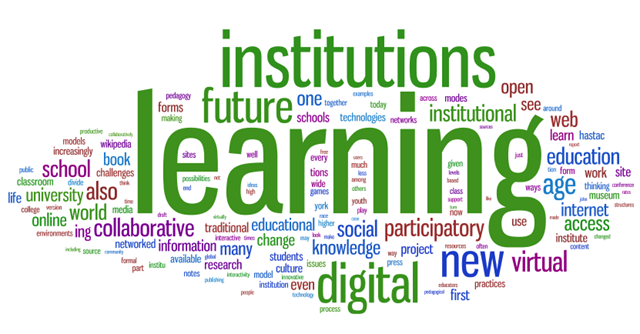
Image c/o Martin Hawksey (and his musings on this text as well). 

In the first collaborative project, the authors share ten principles to support the future of learning. Davidson and Goldberg (2009) presented these pillars of institutional pedagogy to help institutions rethink learning and meet the challenges that lie ahead for both K-12 and higher education:

  1. Self-Learning – discovering and exploring online possibilities
  2. Horizontal Structures – how learning institutions enable learning; from learning that to learning how; from content to process
  3. From Presumed Authority to Collective Credibility – shifting issues of authority to issues of credibility; understand how to make wise choices
  4. A De-Centered Pedagogy – adopt a more inductive, collective learning that takes advantage of our era and digital resources
  5. Networked Learning – socially networked collaborative learning stressing cooperation, interactivity, mutuality and social engagement
  6. Open Source Education – seeks to share openly and freely in the creation of culture and learning; provides a more collective model of interchange
  7. Learning as Connectivity and Interactivity – digital connection and interaction to produce sustainable, scaffolding ensembles
  8. Lifelong Learning – there is no finality to learning; learning is part of society and culture
  9. Learning Institutions as Mobilizing Networks – networks enable flexibility, interactivity, and outcome; new institutional organizations reliability and innovation
  10. Flexible Scalability and Simulation – new technologies allow for collaboration beyond distance or scale for productive interactions that warrant educational merit

Reference: Davidson, C.N. & Goldberg, D.T. (2009). The future of learning institutions in a digital age. Cambridge, MA: The MIT Press.


#phdchat, ATPI

What’s Your Research Methods Worldview?

This is the question we tackled in my Friday night class (Yes. It’s on Friday night from 5:30-8:20 pm = Awesome). #ATTD6480: Research Methods is one of my final courses in my doctoral program designed to help graduate students create an empirical research article and/or develop our dissertation proposal. I am looking forward to it – so far we started to talk about our preferred research methods and potential topics for the semester.

Cartoon image c/o Sheldon Comics

This was our opening activity. We had to read this cartoon and respond to this question: Are you more drawn to qualitative or quantitative research? Why?

My response is that I dabble in both areas. For areas of study and research, I really do need to take a mixed method approach. In class, I identified with the pragmatism and constructivism worldview philosophy for research. In looking around the table, I am fortunate to be the only one applying mixed methods based on my experiences in research, work and collaborating with some great authors. As a researcher, I seek to understand rather than test a theory (postpositivism), and I am usually looking to generate practical, real-world solutions with my research. Here is a quick breakdown of four world views of research from Creswell (2009, p. 6):

Postpositivism
Determinism
Reductionism
Empirical observation and measurement
Theory verification
Constructivism
Understanding
Multiple participant meaning
Social and historical construction
Theory generation
Advocacy/Participatory
Political
Empowerment Issue-oriented
Collaborative
Change-orientated
Pragmatism
Consequences of actions
Problem-centered
Pluralistic
Realist-world practice oriented

Where in the world does your research lie? What sort of research methods do you prefer? What strategies of inquiry do you apply for your qualitative, quantitative or mixed methods approach? I will continue to share ideas from this class and my first official qualitative class (#ANTH 5031: Ethnographic & Qualitative Methods) over the course of the semester. I welcome your research methods, applications and resources.

Reference:
Creswell, J.W. (2009). Research design: Qualitative, Quantitative, and Mixed Methods Approaches. Thousand Islands, CA: SAGE Publications Inc.
AcAdv, Career, UGST1000

Open Options: Choosing a Major With Road Trip Nation

With first year students, there are many new, exciting and scary things about starting college or university. Higher education offers a place to be intellectually challenged, develop socially, discover your interests, and engage with a variety of opportunities on campus and beyond. The road and journey are both wide open. The open road and the growing number of academic/career possibilities seems to be a bigger challenge to our student population. Besides the confusion of campus jargon and the navigation of a larger than high school institution, there seems to be more students and family members at orientation who are anxious about making the “right decisions now” for later. Many higher ed students have an idea or inkling of what they want to do, but most are not sure about their academic options, career path planning, and helpful resources to support their decision-making process.

For UNT students who enter into the undecided/undeclared program at UNT, the Office for Exploring Majors [where I work] utilizes the Roadtrip Nation (RTN) resources and has a  RTN project as part of the UGST 1000 – First Year Seminar class.

The Open Road for #UGST1000 Course Design The RTN project helps students explore their personal, academic, and career path. More importantly, it allows them to learn that there is more than one path to obtain their goals and dreams. In picking up  Roadtrip Nation: A Guide to Discovering Your Path in Life and Finding the Open Road: A Guide to Self-Construction Rather Than Mass Production – I was reminded about my own academic/career journey and questions I had in undergrad and after. There are a number of different professional journeys and narratives that provide readers a “path” of how to get to where you want to go.

Overall, I will be using Finding the Open Road stories and interviews (posted online) to help expose the pre-Journalism (News, Advertising, Strategic Communication & PR) and pre-Business (Entrepreneurship, Marketing, Management) students in UGST 1000 figure out how to navigate their own experience. I do like the strategies and ideas in the “Do It Yourself” section of the Roadtrip Nation book to help guide our students learning. The plan is to take the follow chapters and make them into easy-to-use guides for both the UGST 1000 instructors and students that follows the Roadtrip Nation Manifesto:

  1. First, Find Your Red Rubber Ball – What inspires you? What is your passion? Identifying interests, values, and likes.
  2. Whom Should You Meet? – tips on how to find people, being resourceful, using your personal network, how to reach out to new people
  3. Getting the Meeting – cold calls, the pitch, being persistent, communication strategies
  4. Preparing for the Interview – researching the person, their company, their work experience
  5. In the Meeting – what to talk about, suggested questions, informational interview samples, interview/meeting etiquette
  6. Closing – ending a meeting, sending thanks, developing a mentoring relationship

RTN asks....

References:

Marriner, M. & Gebhard, N. (2006). Roadtrip Nation: A guide to discovering your path in life. New York: Ballentine Books.

Marriner, M., McAllister, B. & Gebhard, N. (2005). Finding the open road: A guide to self-construction rather than mass production. Berkeley, CA: Ten Speed Press.

#phdchat, Professional Development

What Are You Reading This Summer? #summerreading

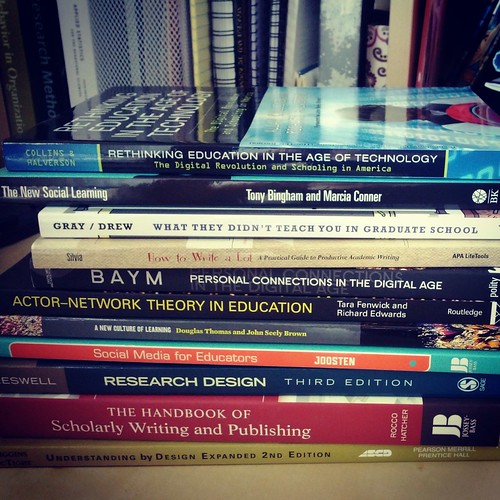
This year, the summer months are providing me space to read articles and books that I have been collecting on my #ToRead list. Below is the first stack of books I have started to read this summer. Since I am not working on any classes this summer,  the plan is to read and annotate  more articles, e-books, and other literary finds I have been collecting and storing in my Delicious and in my Good Reads account. Get ready for some EXTREME READING!

#summerreading

Although my goals are to move forward on my dissertation proposal, I know that I am not alone in setting reading goals for the summer months. Both the NY Times and Grad Hacker want to kick off the #summerreading social media campaign on June 7th. I was able start on my summer reading list early with the help of my recent travel plans – so I am always looking to add book recommendations (both for research and fun).

What books are you reading? What’s on YOUR #summerreading list? What books do you recommend?

#phdchat, Open Education, PhD, PLN, Professional Development

10 “Lessons” in Digital Scholarship from @mweller

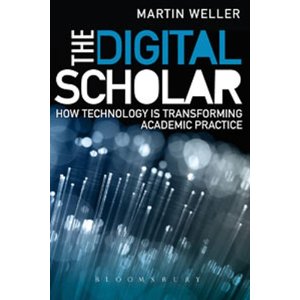
As a scholar who is lives digitally, connected & open, I have appreciated following along with Dr. Martin Weller’s as he tweets & blogs his ideas for similar philosophies. More recently he has published an open-access, creative commons book – The Digital Scholar.

I was just watching Martin’s recent talk with the LSE on how to engage in digital scholarship, i.e. scholarship that is open, networked and digital. Thanks to the Centre for Learning Technology at LSE for presenting the NetworkEd: Technology in Education Series, you can watch these “lessons” (a.k.a. general ideas and musings about how to be a connected & engaged scholar). @mweller has posted his 10 Digital Scholarship Lessons in 10 Videos to recap the presentation, slides and scoop it page as well:

  1. It’s not just for geeks
  2. Researchers are caught in a dilemma
  3. Interdisciplinary is the network
  4. We’re all broadcasters now
  5. We’re operating in an attention economy
  6. We can rethink research
  7. New skills will be required
  8. It’ll impact even if you ignore it
  9. It’s about alternatives
  10. Don’t focus just on risk

I think that Martin brings up some great ideas of what a digital scholar looks like – and there are many of them already out there. I hope to not only witness, but also be part of this academic revolution. The changing landscape of technology, information and communication is challenging higher education to rethink its approach to learning. Online resources are very social and collaborative, and I hope to see these emerging tools push the academic realm outside of the traditional boundaries and expectations. With current developments in educational technology, learning communities have the ability to enhance peer-to-peer connections, social learning, knowledge sharing, and critical thinking for researchers. When learners/researchers become creators, narrators and digital contributors of their own academic fields, many gain further in-depth meaning and purpose in the learning process.