Learning Technologies

Mind-Map It Out.

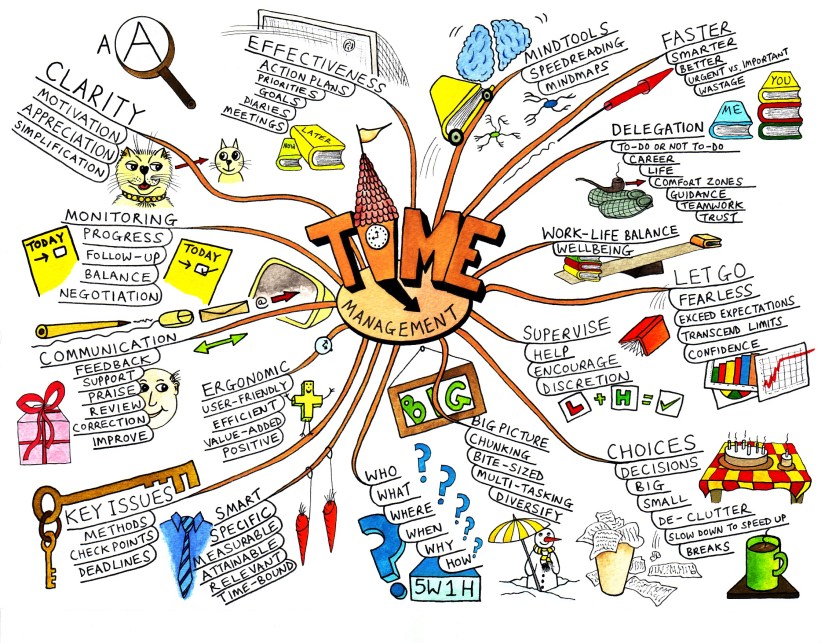
To help process information it is always great to introduce a mind map as an effective learning tool.

A mind map is a diagram used to represent words, ideas, tasks, or other items linked to and arranged around a central key word or idea. Mind maps are used to generate, visualize, structure, and classify ideas, and as an aid in study, organization, problem solving, decision making, and writing. (c/o Wikipedia.org)

mindmap_2

(c) Mind Tools Ltd

There are a few online tools that best support the mind-mapping approach for learning. Lifehacker.com recently reviewed the Five Best Mind-Mapping Applications for online mapping action. These tools are FREE & very user-friendly.

These resources are quite useful for both learning and teaching. There are plenty of online mind-mapping resources to support visual learners which makes mapping information fun!

Map on, my friends. Map on.

Learning Technologies

Technology Assists Learning.

Technology is often created to make things more efficient and our lives easier.  I also think that there has been excellent developments in the field of technology to support our various learning needs. 

New technology, such as the Kindle II e-reader, are supporting learners who have disabilities and also offer text-to-speech support.  I think I first viewed this gadget as a new reading toy, but this little device has such a greater purpose for supporting learners.

  Other technologies that are assisting the classroom include:

  • SMART Boards: interactive white boards engage learners
  • Free video lectures: streamed on the internet or downloadable
  • Class portal: lecture notes, slides & other course material; discussion board and option for virtual office hours

Students are using technologies that are often free, social and portable:

  • Accessible mobiles & PDAs
  • Laptops
  • Digital cameras (with CapturaTalk)
  • Screen shot readers
  • iPods or mp3 players to view recorded lectures

What are other new technologies that YOU have seen students utilizing at your institution to help them learn?


For other contributions about assistive technology tools used in education here are just a few links to check out:

Collaboration, Learning Technologies

For the Love of Google (& Learning)

drseuss09

When we first look for things online, we often turn to the popular search engine – Google.  But have you thought about what else Google can do for you?  Take a look at the various Google Apps that could be utilized for your practice in education, and an interesting article that supports use of Google  technology for learning.

Here are a few suggestions on how YOU can use Google as an educator with your learners or colleagues:

  • Google Scholar: encourage scholary research & utilizing online publications for students and professional development; accurate & credible resources; also a fan of Google Book Search for similar use
  • Google Earth: geo-tagging is all the rage in higher education; you may want to include Google Maps to this app to create collaborate landmarking & mapping
  • Google Notebook:  Interested in keeping those searched websites in an orderly fashion?  Great for research & archiving
  • Google Docs: store Word, PowerPoint & Excel documents online; share & collaborate with students, staff & faculty; excellent project management tool
  • Google Calendar: keep track of assignments, itemize lesson plans visually, and more to help with better time management
  • Blogger:  course contributions, themed journal writing, writing & development classes, and MORE!  Blogger has been used for a wide variety of contributions to learning. Here are some blog examples in Higher Ed.
  • Google Sites: plan meetings or lessons, share information on a secure website, collaborate on projects, or stay connected to learning communities; similar to website or wiki development; easy to use 
  • Google Reader:  lets you subscribe to web sites so that new content comes to you when it’s posted; similar to RSS feeds
  • Google Talk: send instant text messages, voice and/or video conference, chat from desktop or Gmail, send documents, files or hyperlinks; easy way to host “office hours” from any location

Go forth and Google.

Collaboration, Learning Community, Learning Technologies, Professional Development

Supporting Learning & Teaching

kmdi_logo_vert

I was introduced to the Lecture Series from KMDI at the University of Toronto from my former U of T colleague.  This series is free and open for live events to the viewing public by creating a log-in ID and password.  The other option would be to check out the Recently Published Events on the ePresence Presentation Portal.

Yesterday’s 2-hour lecture series was on the topic of  “Supporting Learning & Teaching.”  Three Curriculum Learning and Teaching presenters from OISE discussed various topics around this main idea for the viewers.  Here are the presentation topics and a few few notes/thoughts/questions that I had for each:

  1. New Ways of Teaching & Learning with Technology, by Jim Slotta
  2. Digital communication technologies: educational and social practices, by Claire Brett
  3. Technologies for Higher Education, by Jim Hewitt

 Here are some notes & references made during the webcast that caught my ear/eye:

  • The challenges to using technology in education is the evolution and perspective of social online resources.
  • Check out the WISE Project: http://wise.berkeley.edu/
  • Values in Education (Terry Anderson, 2008): Presence, notification, cooperative learning, student modelling, documenting and sharing
  • Technology & learning is understanding HOW to best utilize & embedd these technology resources into education and courses.
  • How do you reconcile the difference between education and cultural purposes of these tools??
  • Social vs. Technical integration; the GRAIL model: GRaduate Student Academic Identity on-Line – to help students see how their research and training is connected to their broader academic experience and relevance to their social life.
  • Higher education learning with powerpoint, clickers, podcasts & wiki:
  • Do students skip class if the lecture is available on podcast?
  • Havard study says NO; students use podcasts for key points in lectures, or could podcasts be used to replace lectures and use the lecture time for more in-depth review of matrial 
  • Clickers: “gateway” technology to expose more lecturers to the great uses of technology in their teaching practice. 
  • Clickers promote learning by: questioning, encourage peer to peer learning, take a vote/poll & discuss results with peers in the class
  • Clicker Results: Increased performance on test, decreased dropout rates & reduced failure rates (10-12% is now down to 4%)
  • Higher education needs to consider utilizing peer instruction/learning instead o f traditional teaching practices
  • MIT are going the way of Blackboard: http://www.nytimes.com/2009/01/13/us/13physics.html

Overall, these lectures provided a few insights and it is interesting to see what colleagues elsewhere are thinking about learing & teaching with technology.

A few technical notes, that you should keep in mind if you are to partake in these lecture series:

  • distance viewers are able to engage in online chat & questions
  • ensure you have a strong wireless connection for streaming video
  • attach  good set of speakers as the sound quality was low 
Collaboration, Learning Community, Learning Technologies

C4LPT Resource Centre

Looking for ideas on how to best utilize technology for learning?  Then I would recommend that you check out Jane Hart’s website:

 C4LPT Resource Centre
Here you will find a collection of technologies, tools and learning trends emerging in education.  There are a many links, bookmarks and collaborations to provide any educator with ideas on their technology projects for learning.  I especially enjoy Jane’s Pick of the Day, which is updated consistently in her blog. This website is divided into two main elements:

  1. The Resource Centre
  2. The Social Learning Network

The best part of this resource is Hart’s interest in collaboration for learning technologies.  She wants recommendations from YOU for the Top Tools of 2009.  This database of information is regularly updated and contributions come from various educators using technology.