Learning Community, Professional Development, UGST1000

Help My #ugstSTORY Class Tell Their Story

It seems that all is quiet on the TechKNOW Tools blog front… Sorry about that.

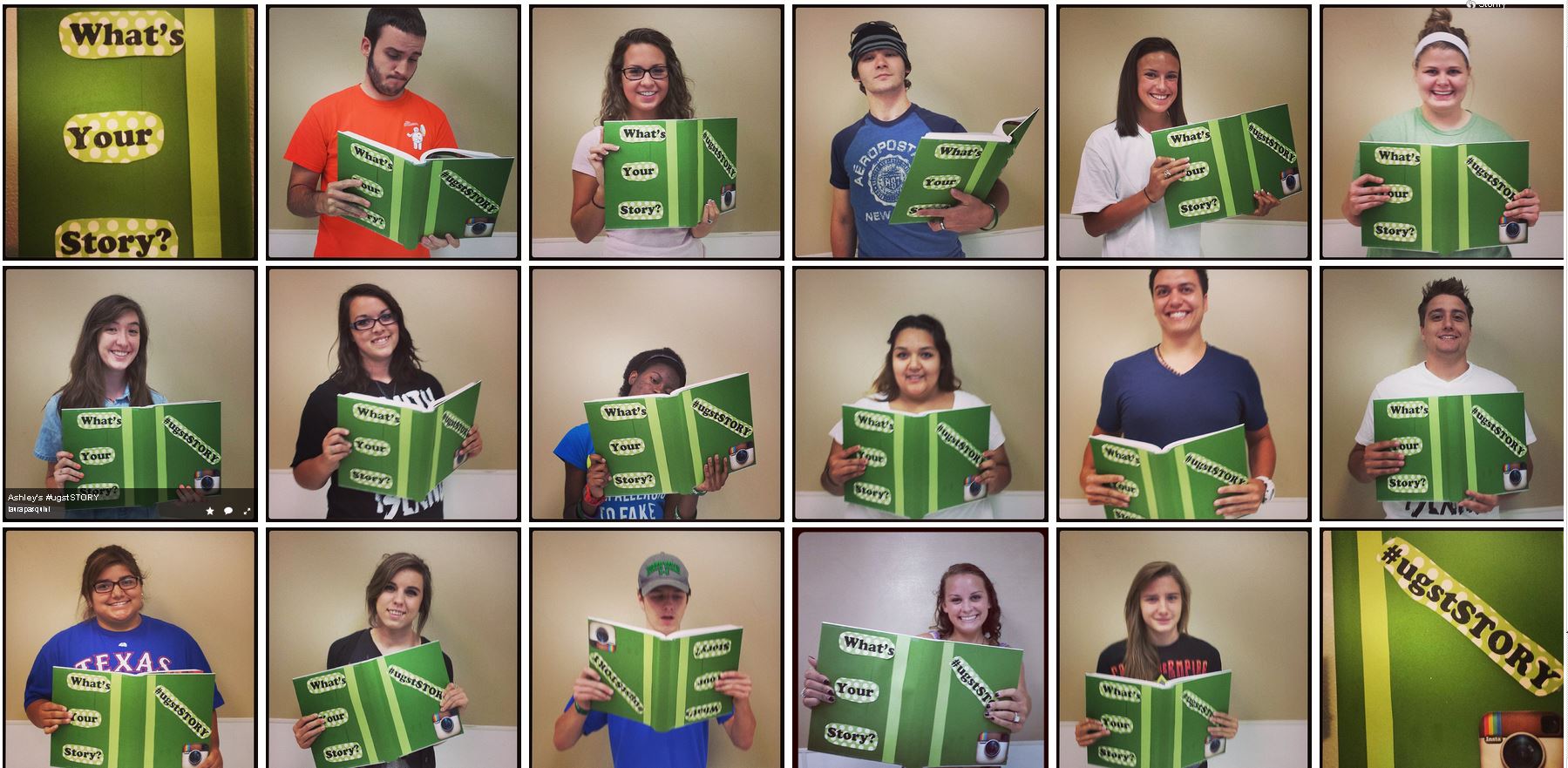
The start of the academic semester came fast and furious, and I have been busy engaging with and learning about my students’ stories for my #ugstSTORY class this Fall 2013 semester. This is my UGST 1000 – First Year seminar class where my students explore their major/career options, get support with transition to college, and learn more about themselves.  Feel free to follow along with our “story” this Fall if you would like:

ugstSTORY Pic

With this seminar class, a great portion of the focus is on self discovery and exploration for personal, academic, and career options. Like many students who are “undecided” or exploring their options, many of my #ugstSTORY students have more than one interest and want to make sure they are going down the right path for them. In learning about many of their talents and skills, I can see why it might be a challenge to just focus on one major. They are a creative and involved class who what to include what they VALUE in their future world of work and life.

What My #ugstSTORY Class Values
During the Fall 2013 semester, my #ugstSTORY students will leave a digital footprint, and will be encouraged to explore their personal and professional options. In their research to make an informed decision, a number of my students will reach out to professionals and industry leaders in the world of work to answer: “What do I want to do with my life?” and “How did you get to where you are?” I am not sure these BIG QUESTIONS will and/or can be answered in just one semester; however I think a few of the assignments and projects will hopefully get them started.

The first assignment, the Road Trip Nation (RTN) Project, is designed to help my students explore personal, academic, and career paths. More importantly, it allows them to understand that many directions will lead you towards your goals and dreams. Their recent blog posts identified what how to find their “Red Rubber Ball,” that is, where do they get their inspiration, passion, interests, values, and likes. Specifically, I asked what potential careers, professions or industries would they like to learn more about.  Here’s a short list from their in-depth blog posts this week:

Interview: Potential Careers & Industry

Interests & Passions

Journalism; Sports Journalism; Broadcaster Friends; Family; Hockey; Sports
Artist; Engineer; Philanthropist; Advertising; Therapist Stability; Helping Others
Journalism; Pre-Law; Psychologist Community Involvement; Travel; Family
Clinical Psych; Greenpeace Environment Activism; Animals; photography; food; language
High School Librarian Reading; books; writing
Engineering; Tourism; Economics Travel; Stability; Accomplishing goals
No Clue Relationships; Smile; Creativity; Individuality
Writer; Journalism Music; Belonging; Writing;
National Geographic; Journalism Travel; Photography;
Broadcaster/Journalism Sports Talking; Sports; Opinions to voice
Photojournalist; Forensics; Library Science Cartoons; Anime; Photography; Music
Psychology; Fashion Merchandising; Law People; Cultures; Travel;
Sales Engineering Music; Activism; Star Wars
Sports Analyst; Broadcaster/Journalist NFL Analyst; sports industry
Neurology; Psychology; Editor/Publishing Anime; Neuroscience; travel; career student; small business

The reason I am sharing more about my class with you is to get them connected beyond our class and the UNT campus. Since I have some phenomenal friends, family, and colleagues in my own learning and professional network, I thought a few of YOU might be able to provide some of your own experience and wisdom for their exploration, specifically by:

  1. SHARING A Resource: We tweet with the #ugstSTORY hashtag, so if you see a link, article, website or anything related to major and career exploration – cc: @ugstSTORY or just put the #ugstSTORY hashtag on it!
  2. READING Their Blog Posts: If you have time to read, comment & post on their WordPress blogs, that would be super rad. Although many are just blogging for the first time, a number of my #ugstSTORY students have very thoughtful and creative perspectives about life in college so far. It would be great if they got a response or two outside our #ugstSTORY class – drop them a comment or like. 🙂
  3. MENTOR Virtually: For the RTN Project a number of the #ugstSTORY learners will be seeking informational interviews with companies, professionals, and different organizations (listed above or might not be listed as they don’t know your about your occupation yet); if you OR someone you know is available and interested in sharing with my students what they do for a living and why they love it – LET ME KNOW!  Yes! I want to MENTOR a #ugstSTORY Student p.s. Pass this link onto a friend you might know as well. Thanks!
AcAdv

Implications for Use of Technology in Advising @NACADA 2011 National Survey

In Fall 2011, I was asked to review data collected from a national survey sponsored by The Global Community of Academic Advising (NACADA) and contribute to the chapter on advising technology. The survey posed a few questions about technology in advising, such as assessment of institutional advising types (e.g. online, on-campus, and blended), communication with advisees, and student information management practices. The entire 2011 NACADA National Survey results and chapters can be found in the NACADA Clearinghouse; and my chapter, “Implications for use of technology in advising 2011 National Survey” are available to read online.

One final sentiment I shared in the conclusion, was to push higher education administration to consider how they assess technology in advising as holistic process connected to other campus divisions:

“When assessing technology usage, postsecondary leadership must also consider future significant challenges such as economic pressures and new modes of scholarship (Johnson et al., 2012). Through researching these technological trends and challenges, conducting campus-wide assessments, and establishing strategic plans, advising stakeholders can effectively integrate technology in advising practices that support both advising units and institutional goals” (Pasquini, 2013).

I did include a few recommendations and guiding questions to consider when considering and  evaluating technology for advising:

“Many students bring expectations about using technology to campus, and therefore, many institutions participate in community advising approaches in which technological solutions provide seamless support and communication for academic planning and progression. When advising units address the use of technologies for both managing student information and communicating with students, they may impact student support and retention initiatives on campus. Higher education institutions, who deploy technologies for communication and information management, benefit from having both the data and ability to effectively connect to their student populations” (Pasquini, 2013).

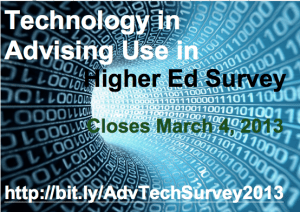
What was key from this data analysis, was that the advising and a number of student service providers lack specific information about the WHY, WHAT, and HOW technology is being used in the advising profession. With the 2011 NACADA survey and encouragement from the NACADA Executive Office, development of the 2013 Technology in Advising Use in Higher Education Survey (which is still OPEN FOR RESPONSES until March 4, 2013 at 11:55 pm CDT) was initiated. I hope that this instrument helps us critically evaluate HOW the field of advising IS using technology at colleges and universities around the globe.

#AdvTech Use in #HigherEd Survey… Launches on 02-18-2013

In developing this instrument, our working group discovered that, overall, any assessment of technology in advising was lacking. The last time information about advising and technology was collected was circa 2002, and a number of the instrument items are already obsolete (e.g. overhead projectors, Netscape web browser, and Palm Pilots). Needless to say, information about where the advising community and technology stood was missing, and the overarching idea about use, perceptions, and  the current state for technology in advising.

Here are the objectives for the 2013 Technology in Advising Use in Higher Education survey:

  1. Establish what the current use of technology in advising among the advising profession – student management, regular use, applications, software, etc.
  2. Understand how technology in advising is being used for communication purposes with students, professionals and faculty
  3. Identify the relevance of technology for advising on a global scale for the advising profession
  4. Understand the current perspectives and perceptions of how technology in advising is being utilized in the profession today

So far we have 523 responses to the survey. The data collected will help to better inform the advising profession beyond anecdotal assessment, and critically evaluate how technological solutions effectively support our advising practice.  Without any real assessment for technology use in advising, how can we determine what direction we should move forward? I hope that survey responses and data analysis can provide some of these answers. More to come…

Reference:

Pasquini, L. A. (2013). Implications for use of technology in advising 2011 National Survey. NACADA Clearinghouse. Retrieved from http://www.nacada.ksu.edu/Resources/Clearinghouse/View-Articles/Implications-for-use-of-technology-in-advising-2011-National-Survey.aspx

AcAdv

2013 Technology in Advising (#AcAdv) Use in #HigherEd [SURVEY]

Dear Academic Advising Professionals, Faculty & Administrators in Higher Education,

The division of Undergraduate Studies at the University of North Texas (UNT) is hosting the 2013 Technology in Advising Use in Higher Education survey to assess how technology in academic advising is being utilized in colleges and universities around the globe. The NACADA Technology in Advising Commission sponsored study is designed to examine the current use and perception of technology in advising among academic advising professionals, faculty advisors, and advising administrators in higher education.

#AdvTech Use in #HigherEd Survey

If you agree to participate, you will be asked to respond to a 20-question survey, which will take approximately 15-20 minutes to complete.  The questions will ask for your opinion of technology in advising use at your college and/or university institution, and your own perception about how technology is supporting the field of academic advising as a whole. Your responses are completely confidential and no individual participant will ever be identified with his/her answers.

SURVEY: 2013 Technology in Advising Use in Higher Education or cut and paste the following URL link into a web browser: http://bit.ly/AdvTechSurvey2013

This survey will close on Monday, March 4th at 11:55 pm CST.

If you have any questions or comments, please free to contact me. On behalf of the Global Community for Academic Advising (NACADA) and the advising profession, I would like to thank you for your time and input. Please pass this survey along to other advising faculty, professionals, and administrators at your college and/or university.

Thank you,

Laura Pasquini (@laurapasquini)

NACADA Technology in Advising Commission Chair 2011-2013

Academic Counselor, Office for Exploring Majors – Undergraduate Studies, UNT

This blog post is cross-posted at The Official NACADA Blog.

AcAdv, nacada

#UNT InHouse: Portrait Gallery

A couple weeks ago I was featured in the UNT InHouse Portrait gallery for my one of many hats I wear on campus. Here’s a bit more about the Portrait Gallery and my interview for the online publication:

It’s not possible to know everyone on a big, busy campus. So InHouse periodically publishes Portrait Gallery features to help us learn about our colleagues and their contributions to the university’s success. Send suggestions for Portrait Gallery subjects by email to InHouse with “Portrait Gallery” in the subject line.

Portrait Gallery: Laura Pasquini, Academic Counselor
Laura Pasquini helps students find an academic home as a mentor for undeclared majors. She’s also the first UNT representative to be chosen for the Emerging Leader Program with The Global Community for Academic Advising.  

What is your official title, and how long have you been at UNT?

I am an academic counselor and instructor for the Office for Exploring Majors in Undergraduate Studies and I have been working at the University of North Texas since June 2009.

What is your background?

I have been supporting students as an academic advisor/counselor with major or career decision-making since fall 2003. I have been fortunate to support a variety of student populations at Niagara University, Miami University, University of Toronto Scarborough, University of Texas Arlington and UNT. Before joining the new office for exploring majors team, I was an academic advisor with the College of Business Advising Office.

What will you do as a mentor?

I was selected as a mentor for the Emerging Leader Program with The Global Community for Academic Advising for the 2012-2014 class. As a mentor, I will collaborate with other advising professionals and faculty within the association from other institutions. I will help emerging leaders develop their connections to the advising profession, encourage leadership opportunities, assist colleagues in working toward their professional goals and give back to the professional association that has helped me thrive personally and professionally.

Has any of your experience at UNT helped you prepare for this position?

Both as an academic advisor in the College of Business and in my current role, I have been fortunate to connect with students, staff and faculty to support my own personal and professional development. As a former executive officer and member of the University Counselors Advisors Network, I was able to collaborate, learn, and connect to a wide variety of ideas that will enhance my mentoring. Most recently, I had the opportunity help coordinate the Spring 2011 Advising Retreat, the UNT Advising Conference and the Advisor Spring 2012 training day. I appreciate interacting with and learning from a variety of staff and faculty who love working with students on a daily basis.

Are you the first UNT representative to be a mentor for the Emerging Leader Program?

I am the first person at UNT to be an ELP Mentor; however Carol Pollard, senior counselor in the College of Music, was part of the inaugural ELP cohort in 2007-2009 as an Emerging Leader.

What do you do as an academic counselor for undecided majors?

The Office for Exploring Majors supports students in their journey to learn more about their major/career options. As a counselor, I help support students who are undecided, undeclared and uncertain about their degree options. We often work with new students who want to learn more about their academic choices; however we frequently work with students who want to change their major or transition to another path. I enjoy providing academic/occupational resources and information to empower our students to make choices, and support them in their exploration.

What commonalities/differences do undeclared majors share?

Our undeclared/undecided students are very intelligent, bright and interested in a number of options. These students often have too many choices and are undecided to allow some time to explore majors, meet faculty, understand degree requirements and discover more about their own interests. Over the last year, I have come to really appreciate the interest and enthusiasm that our students bring to the First Year Seminar, during workshops, or  counseling.

Do you have success stories?

A recent one would be with Lisandry Ortiz, who was in my First Year Seminar class Fall 2011.

Lisandry came into the class with different ideas about her major/career from her family, friends and others. During the course of the semester and in her first year, Lisandry went out to interview professionals, research occupational trends, and tried out a few classes to help her find her direction that would be best for her. She was interested in Biology, English, Creative Writing, Journalism, Kinesiology and Rehabilitation Studies with a double minor in Kinesiology and Addictions.

Although she had a challenging second semester at UNT, Lisandry managed to stay on top of her studies and credits the connections to friends and resources from the first year seminar class.

I am happy to say that Lisandry has earned junior class standing and has officially declared Rehabilitation Studies as her major with the College of Public Affairs & Community Service.

Along with her academic progress, Lisandry is working on campus as a housing ambassador in Maple Hall and she is now an Office for Exploring Majors Student Ambassador who will support undecided students with their major/career journey.

#AcWri, #phdchat, Book Review, LPQ, Social Media

Book Review: Social Media for Educators #summerreading

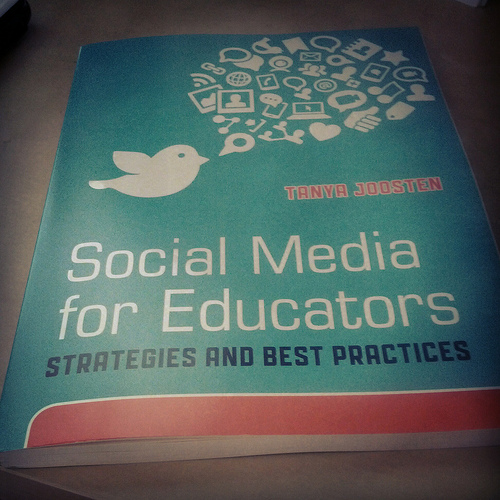
After reading, Social Media for Educators by Tanya Joosten (a.k.a. @tjoosten), I decided to complete an #AcWri book review in the Learning and Performance Quarterly 1(2). Since this journal is online and open access, I thought I would blog a few key ideas and highlights from this #summerreading book. Book Review: Social Media for Educators [PDF]

Abstract: Social Media for Educators is an excellent book that interweaves theory, applications, and current pedagogical experiences for learning environments. For those in the learning and performance industry, this book provides insights and ideas to help guide social media use for both educators and learners. Joosten provides current examples, benefits, and considerations throughout each chapter. Whether educators are beginning to design their learning curriculum or learners are considering social media for organizational development, this book presents helpful insights and experiences that will potentially influence and shape effective engagement and learning with social media.

Keywords: Social Media, Education, Strategies, Practices Although I have previously blogged about strategies for developing social media guidelines — I thought I’d share a few other suggestions for social media engagement from the book. Here are a few ideas, but really I would just recommend reading the book if you’re interested in social media for learning, training or development.

Part One: Background I appreciate how Tanya Joosten lays out the history and evolution of what we now know as social media. Social media is defined by a number of educators and summarized as “A virtual place where people share; everybody and anybody can share anything anywhere anytime” (Joosten, 2012, p. 6). Social media encompasses Web 2.0 tools, social networking sites, and user-generated content where individuals engage and contribute to these digital spaces. This section introduces readers to how social media is being used to build a network, establish support systems, and grow relationships among peers. There are a number of examples where professionals can “get their feet wet” for using social media for professional/personal use. Finally, this section wraps up with implementation considerations and identifying the following pedagogical needs (Joosten, 2012, p. 30):

  1. Increasing communication and contact
  2. Engaging students through rich, current media
  3. Gathering and providing feedback
  4. Creating cooperative and collaborative learning opportunities
  5. Providing experiential learning opportunities

Part Two: Social Media: What to Do With It? I enjoyed how this section of the book presented practical case studies and useful ideas for social media communication and instructional design. The examples and “how to” guides for using social media are very helpful when considering how to enhance the learning environment. Many of these examples are excellent models for various types of learning experiences (in class, online, blended, etc.) and training opportunities (professional associations, affiliations, etc.). As an instructor/student, I agree with Joosten’s thoughts on how social media helps facilitate peer instruction and greater interactions. I also agree that social media features and characteristics often provide a richer learning experience (Joosten, 2012, p. 54), including:

  1. Provides a virtual space for storing, archiving, and retrieving
  2. Facilitates rich and current information
  3. Increases the ability to aggregate resources to share
  4. Offers immediate access to information through mobile apps or through RSS feeds

Part Three: Other Considerations in Implementation The last section of this book deals issues that often accompany social media in education, including policy, administrative and IT support, cost, user-generated media, support for educators, training needs, effective evaluation practices, and challenges for implementation and use. The last few chapters guides educators on how to go forth and create their own social media instructional plan at their home institution. Dr. Joosten provides evaluation instruments, suggestions for establishing learning outcomes, and assessment ideas for using social media in education.

References

Joosten, T. (2012). Social media for educators. San Francisco, CA: Wiley/Jossey-Bass.

Pasquini, L. A. (2012). Book review: Social media for educators. Learning and Performance Quarterly, 1(2); 83-84.