BreakDrink, CTCX, Learning Technologies, Podcast, Professional Development

iPads, Nooks & e-Readers… Oh My!

Digital literacy & e-textbooks have been on my mind… (for some time)

I have been pondering e-books, e-readers & online learning materials since the beginning of this academic semester. I am still contemplating a purchase of an e-reader or tablet before the year is out – so this is where my research & review takes me in the #edtech world. My main question is: What does it mean to take the tactile and make it digital for our learners?

Here are a few thoughts I shared during today’s webinar with Higher Ed Hero on just this topic:

A few questions and thoughts to ponder as e-books & e-readers enter our campus environments:

  • Will engagement in the digital material require new instructional methods?
  • Will our textbooks be dynamic & interactive?
  • How doe faculty connect and manage this transition?
  • How do learners retain information from real books vs. e-books?
  • Can faculty ‘win’ in the classroom & academic sphere with digital literacy?
  • How will higher motivate and impact this change?
  • Will there be control over content & learning materials?
  • How can faculty support students  more to make them comfortable with e-books for learning?

In my own research and article collection, I have managed to collected in a few resources in a Google Doc about the topics of e-readers, e-books & e-literacy and discussed it on latest edition of the Campus Tech Connection podcast #18 – E-Books & E-Readers with @jacksonj & @jefflail from BreakDrink. My quest for reading digitally continues…

AcAdv, BreakDrink, CTCX, Podcast, Social Media

Delicious Indulgences in Social Media with Campus Tech & @micala

If you were a fan of the 80’s party line chats, you might like last week’s Campus Tech Connection (#CTCX) podcast #17 with Shannon Ritter (a.k.a.@micala). IRC might have sparked her interests, however Shannon grew to love the power of online interaction and collaboration over the interwebs.

Here’s a quick snapshot of what @micala is all about c/o her posterous account:

Since the #CTCX agrees with both her “thumbs up” and “thumbs down” criterion, we seemed to have quite the engaging chat that included the following topics:

Of course, this list is not exhausted when it comes to the Campus Tech podcast. Many other side topics and tangents entered into our conversation. Listen for yourself HERE. It was a pretty fun episode…. and might we even say, delicious?

Photo c/o micala on Flickr

Besides thanking Shannon for joining us on our last October 2010 podcast, we also want to give her credit for coining the NEW & IMPROVED Campus Tech Connection hashtag that we’ll now be using: #CTCX Thanks @micala!

astd, ATPI, Reflections, Training

Talkin’ ‘Bout My Generation…

So I was talkin’ ’bout my generation (and other generations) in the workplace for this week’s ATTD 6210 trend report, and it had me thinking about the generation gap. There are now four different generations working side-by-side in the workforce – which has not happened before. This means it’s probably a good idea for organizations to take a look at who is actually sitting around the board room table and better understand how to manage this group effectively.
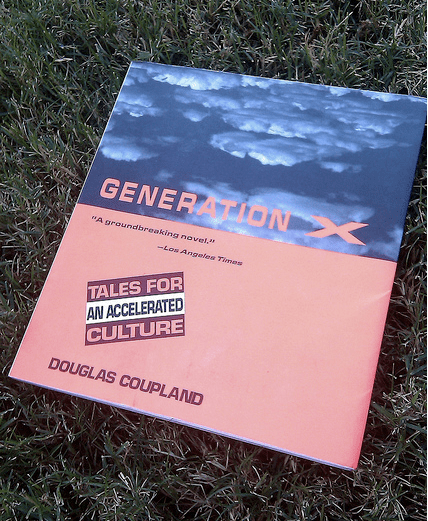
I am a Generation X kid. After reading the ASTD article, Guiding Generation X to Lead, I very much identified with all these Gen X perspectives:

  • resourceful and hardworking
  • meet commitments and take employability seriously
  • value self-reliance.
  • well-honed survival skills and nurtured networks prepare them to handle whatever happens
  • are comfortable in a global and digital world
  • adopted the collaborative technology to reshape how we work and live
  • has an unconscious acceptance of diversity
  • uncanny ability to redefine issues and question reality
  • skeptical and innovative
  • look for different ways to move forward
  • prepared to serve as pragmatic managers
  • options thinkers – like choices
  • like to develop multiple skills because that provides them with the opportunity to move in various directions

Although I identify with the Gen X’ers I still test high in the next generation with my “How Millennial Are You?” survey results sitting at 93%. I suppose I have worked and studied amongst Generation Y for sometime, and it is quite possible that I may have picked up on a habits or two.

There may be some differences between generations, however it is critical to find suitable practices, structures and methods for management that meet the needs of the entire team. This just means good management practices can help support generational differences, communication, group dynamics, staff training and retention of employees. The competition for talent will be initially addressed in the array of benefits to attract the top talent from across the generations (Rowe, 2010). It is also costly to replace experienced and skilled labor, so organizations should consider the creation of programs to encourage workers to stay or partially retire to help employee retention.
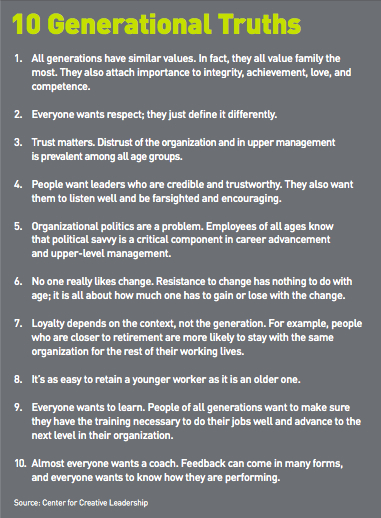
(Erickson, 2010)

Engagement, communication and inclusion of all employees across the generational groups is the key to long-term success. The following approaches to dealing with multigenerational workplaces was suggested from the the 2004 Society of Human Resources Management Generational Differences Survey that still hold true today:

  • communicating information in multiple ways
  • promoting collaborative discussion, decision making or problem solving
  • using team-building activities
  • offering different types of training to accommodate different generations
  • creating mentoring program between generations
  • training managers on dealing with generational differences

References:

Coupland, D. (1991). Generation X: Tales of an Accelerated Culture. New York, NY: St. Martin’s Press.

Erickson, T.G. (2010, August). Guiding Generation X to Lead. Training + Development Magazine, 16.

Rossi, J. (2007, November). What Generation Gap?: Are generational difference in the workplace a myth? ASTD Training + Development Magazine, 10-11.

Rowe, K.A. (2010, March). Managing Across Generations. Infoline: Tips, Tools, and Intelligence for Trainers. Volume 27, Issue 1003.

AcAdv, BreakDrink, CTC, Learning Community, NACADA Tech

Who is Your Tech BFF?

Q: “How do you stay on top of all things technology and remain current with online trends?”

A: “My Technology B.F.F. (Best Friend Forever), of course!”

The term BFF is often used by “the kids” these these days, but after reflecting on where I learn and engage in technology, this became the best term I can use. Sure my Tech BFF is a mentor, guide, coach, instructor and instigator – but most of all this individual is a friend. My Tech BFF helps introduce me to useful ideas, connects me to other people, engages me in the social network to challenge me both personally and professionally.

Flickr Photo c/o Hoodlumpr

Okay. I am cheating. I have a few of these Tech BFF’s in my life. This collaborative helps to inform what I do and how I learn. I am able to connect, collaborate, question and play with online group on a regular basis. Today I will highlight one of the esteemed members from my personal learning network – let me introduce one of my Tech BFF’s: Mr. @EricStoller

I was fortunate to connect with Eric during our faculty stint at NACADA for the 1st EVER Technology Seminar at the end of 2008 with Karen Thurmond & George Steele. My initial interaction with Eric was via e-mail, Skype and on via the interwebs. This seems appropriate since he has been one of many to inspire me to further embrace the power of online connection for social justice and collaborative partnerships. Since this first meet up (where I discovered Eric was much taller than he appeared on webcam), I have been fortunate to be supported by this colleague as we transition in our careers and pursue our dreams.

I proudly present to you the latest & greatest Campus Tech Connection podcast #16 that features Eric Stoller and his recent happenings. In this podcast we discuss the following items:

Thanks for your support, ideas and friendship. May our tech connection live long and prosper.

The question is: Who’s your (tech) Jedi master?

BreakDrink, CTCX, Podcast

The Power of Podcasting

Podcasting is online audio content that is delivered via an RSS feed, almost like radio-on demand. Listeners can determine the time and the place when they will access this audio (and even video) content they want to hear with the podcast archive.

Podcasting is a powerful learning and training resource for any educators tool box. It’s an easy and simple way to share information, describe a concept or dialog about a relevant topic. Even better, this format of learning is mobile, accessible and a handy application that allows learners to return to for review later.

This photograph is c/o Flickr member martin.canchola

In a previous life at the University of Toronto Scarborough Academic Advising & Career Centre, I helped to initiate a pilot program that developed academic & career vodcasts.  I was fortunate to have a group of great students and staff who were interested in producing podcasts to help optimize our advising & career resources for our office. Word of our podcasting got out, and soon other departments like the ESL Cafe & Writing Centre were interested in joining in on the podcasting fun.

Some of the key reasons we started to podcast included:

  • Same FAQs from students were basic and advisors/counselors wanted deeper, meaningful questions
  • Accessible, bite-sized information
  • Mobile resources “on-the-go” for our large commuter student population
  • New design: beyond the PDF handout – add a new multi-media dimension to our website
  • To archive presentations and information that is shared at a single time in the year
  • Tutorials to help empower our students for their academic & career planning

My first introduction to podcasting started when I attended the NACADA conference in Baltimore & met a couple of Academic Advisors who were doing it well. The Campus Tech Connection podcast #15 shares the story of these advisor podcasting pioneers who were interested in meeting the needs of students in a new digital way:

Podcasting: So easy even a student affairs professional can do it. Guest Clay Schwenn and Kurt Xyst joined us to talk podcasting and Academic Advising. Their podcast has over 14,000 subscribers (that is 1398 more than this podcast). They are both Undergraduate Academic Counselors with the Gateway Center at the University of Washington. They do not have a tech background, but were looking for creative ways to reach students.

Speaking of podcasts…

Stay tuned for tonight’s episode of the Campus Tech Connection as we welcome @EricStoller to the program. Here’s how to listen & participate: