CTCX

CTCX #57: Getting Connected in Higher Ed, Part II

Join the Campus Tech Connection (#CTCX) podcast LIVE today (2/13) from 12-1 pm CST as we have an action-packed line up of guests to share how to get connected in Higher Education. Our guests include:

#CTCX #SAtech Highlight of the week:

@katieschmalzel and @jjwil325 from the @SAFirstYears team will tell us about their blogging adventures at Student Affairs – the First Years. This blog connects first year professionals and graduate students share their stories and experiences of life, work, and play in student affairs. Learn about how the 10 writers post each week to attract over 2,000 on their blog.


Bob Ertischek [@profology] founder of Profology a professional social network created exclusively for higher education faculty, staff and administrators. Bob has been an adjunct and full-time faculty member, teaching classes in Political Science and Business Law at Monroe Community College in Rochester, NY. He has also worked in non-faculty roles in higher education in distance and online learning as a faculty developer and instructional technologist at Rochester Institute of Technology. Bob was a member of the Horizon Project Advisory Board in 2004. Prior to working in Higher Education, Bob practiced law and received his Juris Doctor degree from Temple University School of Law in Philadelphia. Bob is married to Faith and has two daughters, Lily and Miranda. Learn how this social network is evolving to connect our higher education peers!


Mark Mruss [@MarkAtAndromo] is a developer at Andromo – a free and easy-to-use professional Android app maker. He’s been programming ever since his parents got him CoCo 3 computer for Christmas. Mark majored in Computer Science at the University of Manitoba, and joined Indigo Rose shortly after graduation. He spent about ten years writting software in C++ designed for Windows developers, and then in early 2011 the company decided to look in a different direction to began mobile development. Although Mark taught himself Python & blogged about it – he does get a chance to leave his nerd behind while hanging out with his son, listening to music,  and riding his bike to work (in the summer – because Winnipeg is COLD). Mark is a beer lover who has been homebrewing for the last two and a half years, and he even grows hops in his own backyard. Come learn how a non-programmer can create an mobile app!

How to connect to #CTCX:

This blog post is cross-posted at BreakDrink.com 
Learning Community, MGMT6820

Population Ecology & the Evolution of Our Learning Organizations

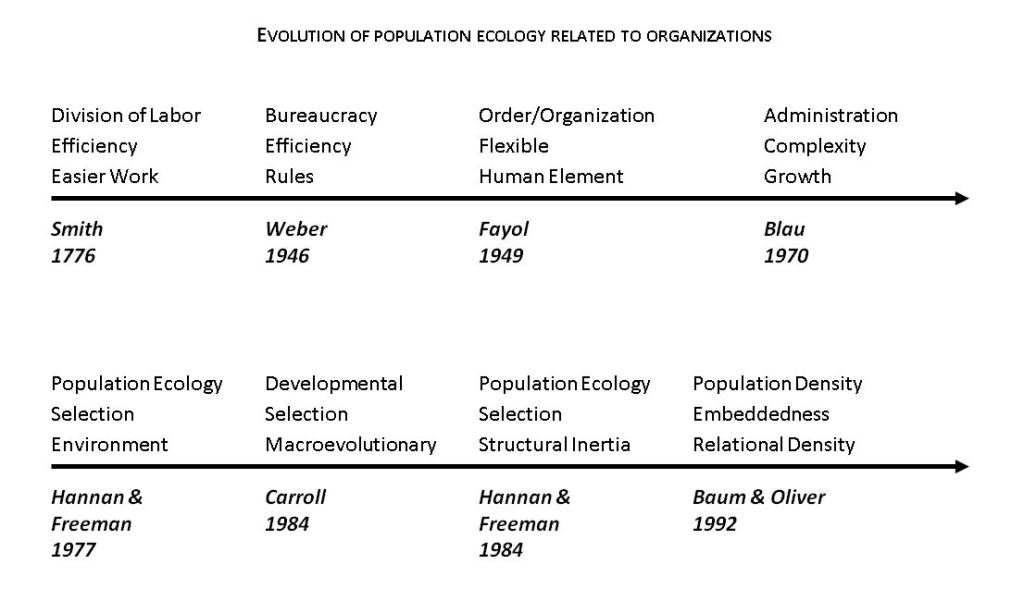
During last week’s organizational theory seminar, I helped lead a discussion about population ecology. As defined by Colyvan (2008), a population is a collection of individual of the same species that live together in a region. Population ecology is the study of populations (especially population abundance) and how they change over time.” Organizations are often classified into different “species” that coexits in an environment that change over time and space. These changes that occur at the environmental level, lead to selection of the best fitting organizations.  In other words, the organizations who survive will be those who best fit the environment and are therefore selected.  There are other arguments in population ecology that imply adaptation and sustainable systems may be alternative routes for survival.  Here is a quick snap shot of the population theories we reviewed that explains the evolution:
After examining the dynamics of populations and how populations interact with the environment, it is easy to see how this is currently impacting learning organizations. Learning networks are both changing and challenging what traditional learning looks like. Beyond the influence of technology, there are paradigm shifts within education – both in the K-12 and higher education environment. The focus is now student-centered with engaged and experiential learning. More educators include authentic, problem-based, and self-regulated learning opportunities into their curriculum. When the classroom is flipped, learners are encouraged to be part of the cooperative learning program. As learning population ecology evolves it also gives way to new players that impact the environment, such as P2PU and Udacity. It is relevant to consider how the open learning environment will interact with traditional educational models. Will these seats be filled for long?  How can open and connected learning environments “play well” with the current educational models?

Many of these issues are being reviewed at different organizational levels to determine the efficiency and value added.  For sustainability of learning and to support our learners needs, it is important for more institutions to think broadly about the impact of population ecology for learning. Are we considering the rational organizational system as a function of accountability? Or do we need to consider how resources are being adapted to support creation and our changing learner needs?

When applying population ecology theory to current learning organizations, it often provides more questions than solutions.  I do not have answers for these issues yet; however I think they are quite relevant and more educators need to consider what the future learning environments will look like. 

Population Ecology Resources:

Smith, Adam (1776) Of the division of labour. In Shafritz and Ott (eds.), (1987) Classics of Organization Theory, 2nd edition, chapter 2, 30-35.  (chp 2, 6th ed)

Fayol, Henri (1949) General principles of management. In Shafritz and Ott (eds.), (1987) Classics of Organization Theory, 2nd edition, chapter 6, 51-66. (chp 5, 6th ed)

Weber, Max (1946) Bureaucracy. In Shafritz and Ott (eds.), (1987) Classics of Organization Theory, 2nd edition, chapter 8, 81-87. (chp 7, 6th ed)

Blau, P. M. (1970) A formal theory of differentiation in organization. American Sociological Review, 35, 201-218

Hannan, M. T. & Freeman, J. (1977). The population ecology of organizations. American Journal of Sociology 82(5): 929-964

Carroll, Glenn R. (1984). Organizational ecology. Annual Review of Sociology 10: 71-93.

Baum, J. A. & Oliver, C. (1992). Institutional embeddedness and the dynamics of organizational populations. American Sociological Review 57(4): 540-559.

Hannan, M.T. & Freeman, J. (1984) Structural inertia and organizational change. American Sociological Review, Vol.49, 149-164.


Additional readings

Gulick, L. (1937) Notes on the theory of organization. In Shafritz and Ott (eds.), (1987) Classics of Organization Theory, 2nd edition, chapter 9, 87-97. (chp 8, 6th ed)

Burns, T. & Stalker, G. M. (1961) Mechanistic and organic systems. In Shafritz & Ott

Thompson, J. D. (1967) Organizations in action. In Shafritz & Ott

Lawrence, P.R. & Lorsch, J.W. (1969) Organization-environment interface. In Shafritz & Ott

Stinchombe, A.L. (1959) Bureaucratic and craft administration of production: a comparative study. Administrative Science Quarterly, Sept. 168-87.

Van Witteloostuijn, A. (2000). Organizational ecology has a bright future. Organization Studies, 21(2): V-XV. Editorial

Amburgey, T. L. & Rao, Hayagreeva (1996). Organizational ecology: Past, present, and future directions. Academy of Management Journal 39(5): 1265-1286.

Singh, J. V. & Lumsden, C. J. (1990). Theory and research in organizational ecology. Annual Review of Sociology 16(1990): 161-195.

Kearney, R. C. (2003). Patterns of union decline and growth: An organizational ecology perspective. Journal of Labor Research 24(4): 561-578.

Salimath, M. S. & Jones, R. (2011) Population Ecology Theory: Implications for Sustainability. Management Decision, 49 (6): 874-910.

BreakDrink, CTCX

#CTCX No. 56: Getting Connected in Higher Ed, Part I

Join the Campus Tech Connection (#CTCX) today LIVE from 12-1 pm CST as we talk about the latest tech news and discuss how higher education is getting more connected by the minute with our guests. 

#CTCX #SATech Highlight of the Week: #SAsearch
Laura Megivern – thesasearch.org  – @thesasearch 

#CTCX Guest: Mike Petroff (@mikepetroff)

EDUTweetups (originally at edutweetups.com) was acquired by Inside Higher Ed, and we’re currently building out a section on their site to
be the Twitter Calendar for Higher Ed. Learn how it will be promoting events, weekly chats and hashtags.

Also learn about the NEW FollowEDU network. This is a searchable directory of Twitter users in higher ed. Learn how Mike started this project from with developers from Stamats Catchfire and hear more about how the recent launch is going.

Join us today:

This blog post is cross-posted on @BreakDrink 
astd, ATPI, Learning Technologies, LPQ, Open Education

Introducing the NEW Learning and Performance Quarterly (LPQ) Journal

CALL FOR PAPERS: LPQ, VOL. 1, ISSUE 1

The Center for Knowledge Solutions at the Department of Learning Technologies, University of North Texas is proud to announce the first Call for Papers for the inaugural issue of the Learning and Performance Quarterly (LPQ) journal.

The Learning and Performance Quarterly (LPQ) is currently accepting submissions for the inaugural issue. We are welcoming any article submissions that detail the definition, history and evolution of learning and performance in its broadly conceived terms including instructional design, performance improvement, learning innovations, training and development and educational technology for both public and private sectors: http://bit.ly/LPQv1i1 

The deadline for submissions is Friday, February 10, 2012.

For detailed submission guidelines and instructions on how to make a submission, please visit Author Guidelines. Editors, Laura Pasquini and Dr. Jeff Allen, will gladly answer any questions or concerns regarding submissions via e-mail: LPquarterly@gmail.com. We look forward to receiving your submissions.

Please share this announcement with other colleagues and researchers who might be interested in publishing for the Learning and Performance Quarterly. Thanks!

MGMT6820

More Than [One] Word[s] #oneword2012 #fantabulous

The new year is upon us and my PLN has already been quite busy setting goals and making new year’s resolutions. During some of this new year happenings, came the appearance of  the #oneword2012 movement. I thought  – how can I find just one word to represent the  year ahead. There are just so many things I want to do this year. How can I accomplish everything in just ONE WORD? After reflecting, reviewing the dictionary/thesaurus, and consulting Fiachra – truth is I can’t.  [He indicated that I could do much better than scholarship, motivation & completion.] I agree.

During my first class tonight [MGMT 6820: Seminar in Organizational Theory], I was inspired to consider my word of the year from Dr. Salimath:

#fantabulous

During our meeting, Dr. Salimath reminded our class that we are in the business of “expanding the frontiers of knowledge” and “generating ideas.” She wants us to aim for great things. With a very small percentage of the world’s population possess a Ph.D., it is the responsibility of researchers in our respective fields to represent the sphere of influence and change. It is only suitable that an innovative, created word “fantabulous” is the best fit for my #oneword2012. Here are a few ways that Dr. Salimath suggested our scholarship should unfold  within our class and as researcher this year:

  1. Research high quality information.
  2. Extract “value” from what you read, consume and research.
  3. Develop the capacity to be an “innovative” thinker.
  4. Examine questions with rigor and soundness – think deep and with detail.
  5. Synthesize and apply to address problems and find solutions.
  6. Make meaningful “connections” to reality – ground abstractions and concepts.

How will you be fantabulous this year? Inspire & challenge me.

For those of you interested in Organizational Theory, I will be sure to post a weekly reflection about the readings and discussions from this course. Stay tuned.