Last month I joined Dustin from The Student Affairs Spectacular Podcast, to talk about the impact online learning will have on student support for our learners. Much of what is happening in distance education, which includes online learning, blended learning, hybrid courses, and more, will impact how to student affairs educators work. As we discussed how online learning will be relevant to student affairs, I shared a few resources to get listeners stated and shared these resources in the show notes (below). Thanks for the invite Dustin, and happy listening:
If you are teaching a course or conducting a training, those providing and taking ALWAYS want to know how you will measure success, learning, and performance. ALWAYS. What’s the bottom line? What’s the ROI? What’s the learning outcome? How will we know our learners have learned or our training participants “get it”? GRADES. SCORES. NUMBERS. STATISTICS.
I am tardy in this post for a number of reasons (#et4online and #Fiachra40Fest, I’m looking at you). Without even knowing it, we actually had a late night discussion post-fire pit sing-song at the #et4online conference. {How did you get in our heads, Dave? Well done, sir.} Let me share a bit of that post-ukulele, harmonizing chat for you here.
If you think about it, our learners are programmed to believe a grade informs their knowledge but is this actually the case? Grades evaluate an outcome; however it might not really mean learning. Do you know if your learners make meaning, identify value, or apply their knowledge beyond the assignment or specific course requirement? Grades have been there to offer benchmarks, set standards of evaluation, and help instructors measure FOREVER.
“You actually believe in grades?” asked Pete (a.k.a. @allistelling)
Great question. I thought about it. My response: Not really. As a faculty member, I have to provide an outcome or a grade for my students – but that is the university requirement and standard for our department. Our academic institutions require a numbered measurement to move forward in degree programs; however it is really the process of development, fine-tuning, and involvement where I see my students “learn” the most. For our students, a number is easy. It places them in a particular level or understanding of “how am I doing in the course?” Often they look at their learning in comparison to one another, and to figure out if they are “measuring” up to the learning standards. We could do better to “show you know” in other ways beyond a numbered evaluation. Really.
I am thinking more about the grades or non-grades in a couple of my courses. Two of my online courses are very much project/portfolio based, where the final product is built throughout the whole semester. My presentation class #LTEC4121 has a “TED” talk and short demonstration video, and my instructional design/facilitation #LTEC4440 class is building a 5-week online training proposal. Both of these assignments are very applied and relevant for my students; however a number of my learners are being pushed outside the comfort zone for their projects. Although most of the course evaluation (the numbers) are weighted towards the final projects, a few students will leave this course or give up based on early grade assignments. They are concerned about their GPA in this course, their cumulative GPA, etc. Those who stick past the first few weeks actually stop asking me about the numbers. Which is great! They want to know more about shooting film and editing, or considerations for putting media into their training course program. At the end of the course, I am impressed by their projects and final videos they deliver, here are a few examples of technical demonstration created last Fall 2014 :
In our fireside conversation, we talked about the value of developing artifacts, engaging in the peer-review process, how collaborative input matters, and working through revisions leads to understanding. With grades or marks (I’ll be inclusive to my Canadian & US colleagues), educators (myself included) often forget to model learning as a process. Learning should be developmental. As instructors, we need to remember to have our learners build upon previous knowledge and apply their learning beyond our course. There should be an opportunity for our learners to take risks, make mistakes, and pick up the pieces for the course and beyond. Making learning as not a number is not easy – for both the instructor and the students. There will be confusion and possibly frustration; however you have to be willing to work through the learning process with your students. I am thinking of just grading early items as complete or not, and providing feedback for their final projects. I am also considering what really needs to be accounted for in a letter or percentage grade, with regards to their final project developments. Finally, I do want to give credit for my students who have collaborated and learned on a local level. I have witnessed a number of connections thrive beyond a semester or course, as they support one another in work, life, and then some. Perhaps it is time to get rid of a few numbers to meaure what matters for learning for my next term… it would help with all the grading that I am now going to work on now.
As I regroup from last week’s Emerging Technologies for Online Learning (#et4online) conference, I am filled with ideas and inspiration. Inviting a group of teaching, learning, and researching friends invested in supporting online pedagogy is a fantastic way to wrap up April.With the help of a fab #et4online steering committee (especially that co-chair Michelle), we were pleased to bring OLC to my current hometown, Dallas, TX.
Thanks to ALL who contributed to the #et4online program. I was genuinely impressed by the quality of content, interactions, and engagement in the conference workshops, sessions, #et4women dinner, panels, and more! I was told time and time again, how much participants enjoyed the program and felt motivated to bring these ideas back to campus. Way to bring your A-game to Dallas, #et4online! BIG THANKS and shout out to the #et4online Program Track Chairs (@adesinamedia, @amichaelberman, @ajsalts, @JLeafstedt, @Profpatrice, & @unatdaly) and our proposal readers for putting this together!
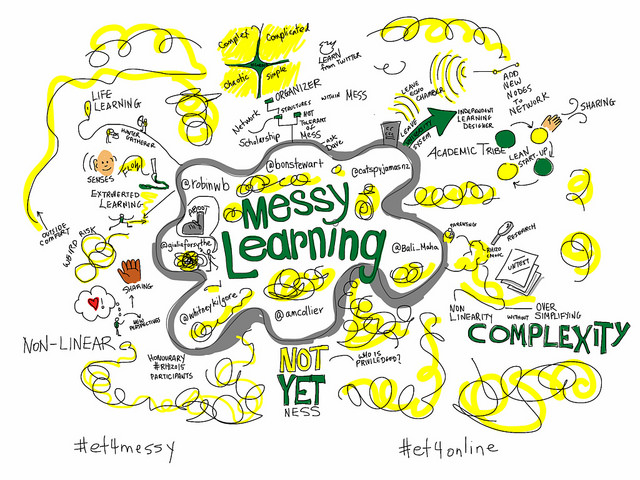
The conversations and interactions at #et4online really provided momentum for supporting my online learners. I am already thinking about ways to improve my own online teaching and learning, to include action-based pedagogy, #et4messy learning, and reconsider assessment in my curriculum. It was also a treat to listen to our #et4online keynote & plenary speakers reflect and share research, projects, and developments in the follow areas of technology emergence – thank you so much:
I am grateful for the collaborative and sharing spirit of the #et4online participants. I was so pleased by a number of new initiatives and happenings at the conference – which also left me contemplating and considering a few things ahead, including:
Interactive learning from the #TvsZ Game and presentations at #et4online. By modeling and infusing action-based pedagogical ideas into the conference, this group provided examples and ways to blend learning spaces between and during their 3 conference sessions.
The value of wrapping up a conference with #unet4online the ET4Online Unconference hosted in Canvas facilitated by @Jessifer & @slamteacher (About & remote support @Bali_Maha) + Tweets. Although I was exhausted at the end of the conference, this was – BY FAR – one of my ET4 conference highlights. The discussions were very fruitful and active in the #unet4online room. It was nice to connect with a few new folks, and walk away with a few new ideas after this thoughtful debriefing session.
Hybrid participation in a conference with the #et4buddy pilot projectwith @Bali_Maha & @rjhogue – Submit feedback for the #et4buddy and #et4buddy video playlist. I am still thinking about this hybrid engagement for a few and its impact for others at the conference. What does it mean to be present at a conference? How does this type of digital involvement make meaning for in-person interactions? How does this interaction help or hinder everyone’s conference experience? Can this meta conference be the “same” or does it have to be?
The purpose of the Teacher Tank (Launch Pad) to #et4online, and beyond an entertainment value – how does this really serve #et4online participants? The ideas for this new program feature was to have ed tech startup’s provide a solution for teaching and learning by sharing their results & preliminary feedback. After processing with the startups, judges, and reviewing the #et4snark meta backchannel, many agreed the format/concept has little value-added to the program. During the #unet4online conference, we had a great talk about a hackspace and/or collaboration to provide a more meaningful concept — so I look forward to our next meeting about this in May to re-purpose the “shark tank.”
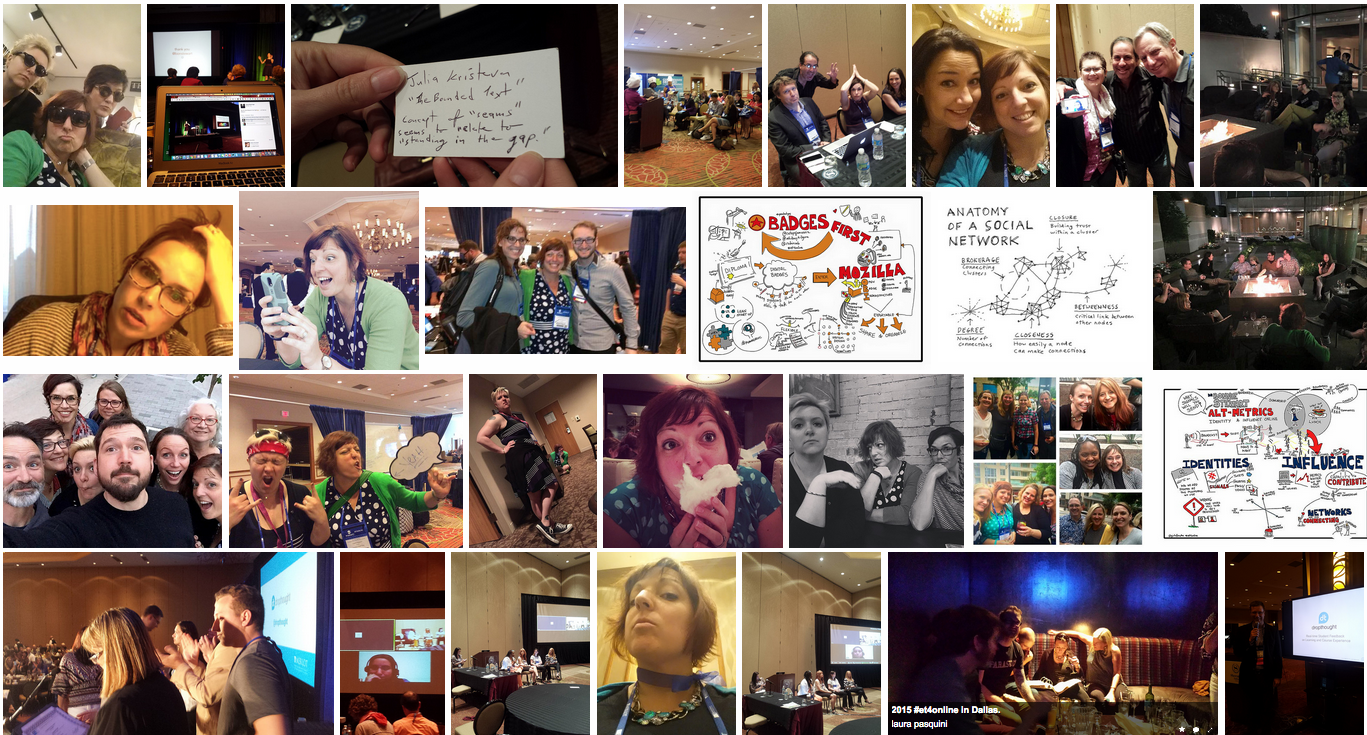
The after conference social times that included #et4Bonfire Sing-Songs, dinners, karaoke, 1st Ukulele Lessons #moocalele & harmonizing with peers. These impromptu lessons & creative spaces should have a bigger place for professional development and learning at our conferences. I want to think more about this for next year. How can the non-sessions provide a great space to dialog, learning & engage? Where could and should this fit into a future conference?
A HUGE thanks goes out to the on-going efforts and developments of the OLC Technology Test Kitchen. The addition of the hands-on demonstrations by the Technology Test Kitchen Chefs #et4TTK was brilliant. I would like to give a shout out to @jlknott & @scragg_OSU for their efforts on organizing this play/maker space! Thank you.
I am continuing to absorb and read others reflections about #ET4Online from tweets and in the blogosphere – thanks for sharing Adam, Patrice, Maha, Jeff, Rebecca, and others to come. Please continue to post your blog reflections, write comments, and share your general thoughts. Also remember to complete the post-conference evaluation so we can better understand your impression of #et4online and improve future events. This survey will take less than 5 minutes, and the #et4online steering committee will use this information to learn about your experiences and utilize this for planning ahead:
This was my 3rd and last #et4online conference. Like the ones before it, ET4 did not fail to deliver quality memories and interactions. Next year #et4online will be replaced by the NEW OLC Innovate Conference 2016 in New Orleans, LA from April 20-22, 2016.
We will be taking ideas from both #et4online and #blend15 for the OLC Innovate 2016 event. Are you interested in getting involved in planning this new event? Want to contribute to planning the program or being a member of the steering committee? Interested in being a program proposal reader? Do you have an idea or suggestions for Innovate 2016? Let me know – complete this Google Form:
As an educator, we get caught up with the standard Learning Objective slant for teaching and learning. Learning objectives (sometimes referred to as intended learning outcomes or course-specific goals) are clear statements to describe the competencies learners should possess upon completion of a course (Simon & Taylor, 2009; Harder, 2002; Kennedy, 2007). An effective learning objective identifies what a student would know and be able to demonstrate along with the depth of learning expected from the curriculum.
With #Rhizo15 the lack of learning objectives provides a lot of freedom to explore ideas, connect to meaning, and identify new ways of knowing. I think a learning subjective is when students are encouraged to make their own learning personal. I felt bad for a delayed blog post on this topic — but then I remembered — being subjective means individualizing and customizing my own way to learn. Subjective learning allows for more preference and flexibility, which provides dynamic ways to engage in uncertain patterns and developments from within a course. Learning objectives provide well-defined outcomes and intentions for learning. The openness of learning subjectives provides opportunities for students to drive the course agenda and direct their interests for topics. For some teachers and students, learning subjectives might place education out of its comfort zone to consider what a curriculum could be if defined by all those involved. I think
For many teachers and students, learning subjectives might place all outside of our educational comfort zones. Consider what your course and curriculum would be like if you showed up to class on the first day and asked everyone in the room to design & be a participant in your course? Bring on the blank stares. I suspect many students would walk out of the room or drop your online class. Not for the ability or empowerment of being part of the learning design process, but more out of the fear of the unknown. I think Tania‘s metaphor explained it best: a jigsaw puzzle. This daunting task of figure out where to put the pieces together for ambiguous learning is complicated and requires a lot of work. Are you ready to commit for this complicated and multi-layered task? Am I? Who knows? But I am willing to give it a try. [If I am overwhelmed by the #rhizo15 learning swarm – I always have Keith to ask. :)]
My learning subjective for #Rhizo15 will be en par with how I prefer to travel, e.g. backpacking across Europe. Travel light. Show up to the airport or train station. Select a random place to go. Identify a few things I might see or do. Be open to new adventures and experiences. Sure. I might get lost or not know the language – but I will figure it out or it will be an experience at least. The not knowing what is ahead is okay. I will find the way with others, as there are a number of locals and travelers I can have a chat with. Only memories (a few photos & blog posts) and connections will follow me home as souvenirs.
#TBT from 2006 London – {Note To Self: I need to digitize my earlier travel photogs.}
I am looking forward to bumping into a few #Rhizo15 friends as I travel through this course. My learning pack is ready, and I want to explore. Some of you I will see soon (in person), others online, and then — who knows — I might even travel to a location near YOU soon (get your guest room or couch ready)! For now, I look forward to our learning travels online. Stay in touch!
References:
Harden, R. M. (2002). Learning outcomes and instructional objectives: Is there a difference?. Medical teacher, 24(2), 151-155.
From A Practical Guide to Rhizo15: “Rhizomatic learning is one story for how we can think about learning and teaching in a complex world.” Dave Cormier (@davecormier) has been thinking “in the rhizo” for a while and expressing ideas of the community as curriculum for teaching and learning. Cormier (2011) believes a curriculum for a course can be created in time, while a course is happening, specifically “… to be rhizomatic involves creating a context, maybe some boundaries, within which a conversation can grow.”
Sometimes learning can be messy. The rhizome concept is often uncertain as it maps in any direction, starts at any point, and grows or spreads with experimentation within a context. From this idea and others shared at the #ALN14 keynote (Pasquini, 2014), I gathered a number of valuable ideas to shape learning contracts for my own students and encouraging learners to map their own ways of knowing and evaluations (Brubaker, 2010). This talk directly impacted a new course I am teaching this term. Much of the content needed life infused into it, and learners did not seem connected to ideas for effective training and development facilitation from the previous iteration. I turned to my learners to ask them to make meaning and apply these concepts to practical situations, workplace experiences, and relevant examples they might encounter. From the class discussions, curation of readings, and developments of training/instruction, a number of my learners felt more empowered and felt as though they were part of their learning process. That being said – it does not mean things were clean and easy. There were a few bumps along the way; however this process of evaluating the learning structure helped me consider the process of knowing and supporting a collaborative curriculum down the road.
Based on my own interest in learning, and the hashtag (#) map of #rhizo15 conversation, I figured #rhizo15 would be a great place to connect and explore this concept further. [Thanks for recommending Socioviz to meet & greet with the community, Dave. Great idea!]
If you did not hear great things about the conversations, questions, and sharing from the #rhizo14 group – then you must have lived under an Internet rock last year. The #rhizo14 community often shared a number of valuable insights and resources. Although I tried to play in the sandbox with this active, online community, something got in the way of my participation (I’m looking at you dissertation). I am looking forward to the #rhizo15 camp that officially kicks off on April 15th for 6 weeks o’ fun as the participants build the curriculum. Here’s to playing in the unknown and building our learning out with fresh perspectives and gentle pushes from the #rhizo15 learning network.
Interested in joining the #rhizo15 fun? Here’s a few ways you can engage:





 techKNOWtools
You must be logged in to post a comment.