
PhD, Virtual Communities

Actor-Network Theory in Education

Give Me Some Theory... #LitReview

Actor-Network Theory has recently been referred to by Law (2007, p. 595) as  the ‘diaspora’ of

“tools sensibilities and methods of analysis that treat everything in the social and  natural worlds as a continuous generated effect of the webs of relations within which they are located. It assumes that nothing has reality or for outside the enactment of those relations.”

Further research in this theory helps scholars and researchers discover new approaches to a number of educational issues. In considering educational research, with regards to schools, universities/colleges, community agencies, corporate training organizations, and professional affiliations, ANT merges knowledge as situated, embodied and distributed.

Fenwick and Edward (2010) share how ANT challenges a number of assumptions that lie in educational conceptions of development, learning , agency, identity, knowledge and teaching. ANT identifies rich interconnections in both social and cognitive activity. As shared in the book, Neyland (2006, p. 45) has the ability to contribute to educational understanding of:

“mundane masses (the everyday and the humdrum that are frequently overlooked), assemblages (descriptions of things holding together), materiality (that which does or does not endure), heterogeneity (achieved diversity within assemblage), and flows/fluidity (movement without necessary stability).”

For those interested in reading the book in more detail, you will appreciate how Fenwick and Edward (2010) utilize ANT in education as a source of research practices, to consider:

  1. Concepts, approaches, and debates around ANT as a resource for educational research.
  2. Showcase studies in education that have employed ANT methods and comparing ANT approaches in other disciplines/fields.
  3. After ANT developments that challenges presumptions and limitations of ANT research.

Reference:

Fenwick, T. & Edwards, R. (2010). Actor-network theory in education. New York, NY: Routledge.

Law, J. (2007). Making a mess with method, in W. Outhwaite & S.P. Turner (Eds.). The Sage Handbook of Social Science Methodology, Beverly Hills, CA: Sage. pp. 595-606.

Neyland, D. (2006). Dismissed content and discontent: an analysis of the strategic aspects of actor-network theory, Science, Technology and Human Values, 31(1); 29-51.

EC&I831, eduMOOC, Higher Education, Learning Community, Learning Technologies, Open Education, PLN, Virtual Communities, Web Design

#mtmoot Opening Keynote: Digital Pedagogy to Engage

This morning I will be joining the Mountain MoodleMoot at Carroll College in Helena, MT to share some thoughts and ideas around engaged digital pedagogy. Our learners are connected; however  I think more educators and instructional designers need to support our students in developing effective learning skills to navigate this new culture of learning. For those of you interested in following along, be sure to tweet with hashtag  #mtmoot, check out my slides (below), and feel free to scope out the digital handout http://bit.ly/mtmoot12 I compiled for this session.


Today’s learners operate in a world that is informal, networked, and filled with technology. Connectivity and digital access is an increasing need for our students and a vital requirement to excel beyond structured learning environments. Our learners are now able to interact with information, learning materials, and peers from around the globe. There is an increasing need to expand and enhance our learners’ involvement in learning technology to support engagement in online learning environments.

With the emergence of collaborative, online tools, educators can take advantage of multidimensional and engaged participation to reach their learning outcomes. Social media creates a space where “everybody and anybody can share anything anywhere anytime” (Joosten, 2012, p.6). Educational paradigms are shifting to include new modes of online and collaborative learning and student-centered, active learning to challenge our students to connect curriculum with real life issues (Johnson, Adams & Cummins, 2012). As a new generation of learners begin to create and share content, educators need to understand how to effectively utilize social web resources to impact in instructional practice create a culture of online participatory learning.

Emerging technology platforms and devices are beginning to disrupt education as we know it. To coevolve and positively impact learner success, it is critical that instructors and instructional designers consider how digital pedagogy can support learning outcomes. This keynote plenary will share ideas and suggested practices to develop a richer learning experience and thrive in the changing digital learning frontier.

References

Johnson, L., Adams, S. & Cummins, M. (2012). The NMC Horizon Report: 2012 Higher Education Edition. Austin, TX: The New Media Consortium.

Joosten, T. (2012). Social Media for Educators. San Francisco, CA: Wiley/Jossey-Bass.

AcAdv, Collaboration, Higher Education, Learning Community, SAchat, StudentAffairs, Virtual Communities

Creating Digital Communities of Practice to Enhance #StudentAffairs & #HigherEd

Last year, I wrote a piece for the NASPA Technology Knowledge Community (TKC) after responding to a post made by the TKC Chair @JedCummins via the TKC Facebook Group. I was just noticing that the Summer 2012 call for submissions is coming up and Osvaldo is looking for submissions (due June 8/12 – see the Facebook Page for further details). Although the TKC publication is geared towards a newsletter format, I think it provides Student Affairs professionals an opportunity to write and share about their technology trials, tribulations, and accomplishments on campus.

Little did I know that my submission would go into the #NASPA12 Knowledge Communities publication (my piece can be found on pages 50 & 51) that was distributed at the conference. Thanks for sharing it beyond and sending me copies via “snail mail,” Jed! I appreciate it.

The overall just of this piece describes how the social web and emerging media is  coevolving with the changes and developments of higher education and the Student Affairs profession. New learning environments and networks allow higher education professionals and faculty to connect, curate, and collaborate beyond on our college campus. It is exciting to see how online networks afford new joiners in the field of student affairs, advising, and MORE to access information, contribute to the conversation, and develop a digital footprint. Whether you call it a PLN, PLE, hangout, community of practice, network, gathering space, or “water cooler” chat — there are great things happening in social, online spaces to enrich the work we do at our institutions with ourselves and our students. I like where this informal learning and development is going. This is probably also why @julieclarsen and I decided to share our “Developing Your Network” presentation one last time at today’s #UNTAdv12 Conference for the advising professionals as well:

There are amazing things that lie ahead for these informal networks in higher education. This is an exciting time. I look forward to participating and learning where these digital communities of practice, including as #SAchat, #SAtech (hoo-ray for the new chat!), #AcAdv Chat and others go. With this fine group of educators and practitioners, I am sure these networks have the potential to move mountains. I would challenge and encourage participants in these communities to use these spaces to think critically, solve problems, create innovative ideas, develop effective practices, share knowledge, and support one another.

#phdchat, PhD, Virtual Communities

Organizational Learning Constructs

The nature of learning at the organizational level is a challenge to measure. Huber (1991) defines  organizational learning as the development of new knowledge or insights that have the potential to influence behavior.

There are a number of human resource development articles that reflect the individual learning experience and objectives. In considering the organizational learning process, I began to look at the organization level for learning in online communities of practice for an organizational science perspective.

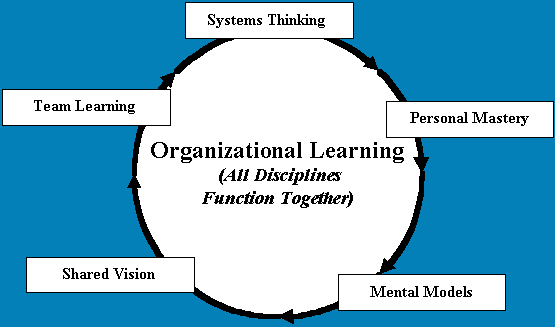
Image via Organizational Learning Software… <http://www.sqakki.com/LearningOrg/>

In researching and working on my final organizational theory paper, I began to assess how learning characteristics can be evaluated in online learning networks and communities of practice. There are a number of models and evaluation instruments to assess learning in organizations; however the constructs established by Yang, Watkins, and Marsick (2004) provide a solid framework for methodology and empirical assessment:

Systems Thinking – Senge (1990) identifies a learning organization as an organization that has the ability to creat alternative futures and possesses the following five disciplines: team learning, shared visions, mental models, personal mastery and system thinking. 

Learning Perspective – The learning organization is an “organization that facilitates the learning of all of its members and continuously transforms itself in order to meet its strategic goals” (Pedler, Burgoyne & Boydell, 1991). Eleven areas are identified through which this occurs: a learning approach to strategy, participative policymaking, informating, formative accounting and control,, internal exchange , reward flexibility, enabling structures, boundary workers as environmental scanners, inter-company learning, learning climate and self-development for all.

Strategic Perspective – a learning organization requires an understanding of the strategic internal drivers necessary for building learning capacity. Goh (1998) identifies five core strategics building blocks: clarity and support for mission and vision, shared leadership and involvement, a culture that encourages experimentation, the ability to transfer knowledge across organizational boundaries, and teamwork and cooperation.

Integrative Perspective – the concept of the learning organization is “on that learns continuously and transforms itself..Learning is continuous, strategically used process – integrated with and running parallel to work” (Watkins & Marsick, 1996).

These constructs will help define and lay the ground work to establishing a solid theoretical framework for assessment. I welcome any and other suggestions to reviewing online communities of practice with regards to organizational learning.

References

Huber, G.P. (1991). Organizational learning: The contributing processes and the literature. Organization Science, 2; 88-115.

Goh, S. C. (1998). Toward a learning organization: The strategic building blocks. S.A. M. Advanced Management Journal, 63(2); 15-20.

Peddler, M., Burgoyne, J., & Boydell, T. (1991). The learning company: A strategy for sustainable development. New York: McGraw-Hill.

Senge, P. M. (1990). The fifth discipline: The art and practice of the learning organization. New York: Random House

Watkins, K.E. & Marsick, V. J. (1996). In action: Creating the learning organization. Alexandria, VA: American Society for Training and Development.

Yang, B., Watkins, K. E., & Marsick, V.J.(2004). The construct of the learning organization: Dimensionsmeasurement, and validation. Human Resource Development Quarterly, 15(1); 31-55.

BreakDrink, CTCX, Virtual Communities

Talking Social Justice with the @BreakDrink #CTCX Crew

The @BreakDrink Campus Tech Connection (#CTCX)podcast posse discussed our thoughts on social justice and technology today. If you missed the recent podcast you can take a listen HERE and/or read the show notes that have been Storify-ed. A few of the key themes we touched upon include:

I.  How Technology is Created & Used – the global impact & consumerism.

II.  BYOD & Social Economic Status for Students on Campus – no student left technologically behind.

III. How Technology Can Support Issues & Causes – how to engage our learners.

Listen to internet radio with BreakDrink on Blog Talk Radio

https://www.blogtalkradio.com/breakdrink

We had many questions about what others in higher education and student affairs thought about social justice and technology:

  • Does technology provide our students with tools for revolution or activism?
  • What does our technology & consumption mean for our students and educators?
  • Who has access to technology on campus?
  • Are we really contributing and engaging in the global community with a RT or Like?
  • How can we have better collaborative and collective modes of technology paired with social justice actions at our institutions?

We just touched the tip of the talks for what it means for technology & social justice. 

What got me thinking further was an interesting presentation by @maymaym (Meitar Moscovitz) at the 8th Public Anthropology Conference titled “Dreaming of Compassion”. This talk discusses how the internet now affords social changes and issues to come together and be valued beyond cultural, geographical, economic, and political boundaries to the entire human race in our connected realities.

“In the network economy, the more plentiful things become, the more valuable they become.” Kevin Kelly 

This principle of “the more, the merrier” brings into question of how we value of different relationship types in the social network and how our objectives can be intertwined with others social pursuits and needs in the world. Similar social networks provide both connections and shared intelligence. There is a great amount of power that can be influenced and perpetuated in a collective organization. A few examples we discussed include:

Open Ideas http://www.openideo.com/

Ideavibes http://www.ideavibes.com/

And I also think there are a few good resources shared by Dr. @courosa for education & action for social justice+technology.

Since social networks and viral activity have the ability to spreads news and information at an accelerated rate, it is possible that online action can start an actual reaction. The question we put back out there is to find out how other educators engage learners to move their connections of goodness  beyond a  RTs or Like, and put it into action?