Higher Education, Professional Development, Reflections

Digesting #dLRN15: Making Sense of Higher Ed

In the midst of the death of higher ed headlines,the  disruption of HE,  and all the higher ed is broken rhetoric tossed out, a few of us took a pause last week to discuss how to deal with the issues and challenges facing the post-secondary education sector at #dLRN15. I felt fortunate to be able to connect with a number of colleagues to talk behind the buzzwords, and dig into a the real issues challenges our colleges and universities face. It’s time and there is a need to take time for making change in higher education (thanks for the prompt post, @KateMfD). I am not sure that “change” was made, but I am proud to be part of the discussion and momentum that will move some of it forward.

pre-con QaMany thanks to the conference organizers for bringing a few smart kids around the table to discuss the following issues:

  • Ethics of collaboration
  • Individualized learning
  • Systemic impacts
  • Innovation and work
  • Sociocultural implications

The panels, sessions, and keynotes left me with more questions than answers – and that is a good thing. Beyond the formal program, the sidebar chats over coffee/snacks/pints were not to be dismissed As Mike Caufield said, I will need to process discussions had at #dLRN15 for weeks. There were some deep discussions into complex issues that could not be dealt with in just two days.

In our pre-conference meeting, each group picked a question/issue based on the themes the conference was focused on (see above). One the groups developed a question that resonated with me the most:

keyquestionWe always want to push forward with big change and innovative ideas in higher ed, but really do we sometimes forget to recognize the incremental changes occurring within our institutions? How do we acknowledge the slow movements and progress we make in HE or that it is an on-going process of change? There are many micro-movements occurring within our learning spaces to help us evolve. I know there are a number of amazing things happening within our colleges and universities — sometimes it’s these slow contributions that make the difference and we often fail to recognize this gradual progress. Slow and steady does win the race.
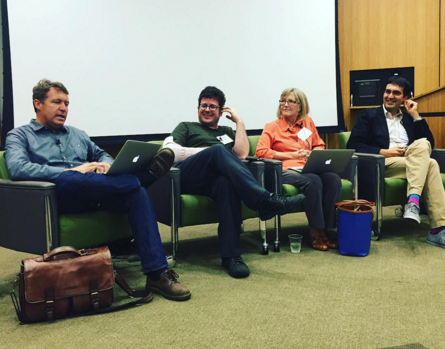
FinalPanel

Ethics of Collaboration & Closing Remarks: Random Dude, Mike, Barbara & George

Fast-forward to the end of the conference, after a number of thoughtful conversations, this final panel reminded all of us of the call to action => to provide evidence for higher ed to shift. George Siemens asked us to utilize research to fuel the fight around the issues raised. Beyond collaboration, what are we really going to do with what we’ve talked about now? It’s great to hear that we are not alone in our discussions however we need empirical evidence to support the change ahead in higher education. I appreciated how this panel spoke about getting beyond the dichotomies and encouraged us to think about research in collaboration with our students and work. We really need to listen to our students and amplify their story/voice in the research we do. It’s easier to move and change when there is already momentum for systemic change, and perhaps #dLRN15 titled the scale for a few. There are a number of challenges and questions from #dLRN15 to consider with our research in higher education, including:

  • What were the foundational assumptions and purpose we thought about at the #dlrn15 ?
  • How do the threads of the conference fit together in a framework to support advancing higher ed? 
  • What does it mean to have a US-centrist focus in higher education? How does it impact HE on a global scale? Does it?
  • Was there enough systems-level research or research on systems change at #dLRN15?
  • Is there a need for systematic-change at all levels to advert change in higher ed?
  • How can higher ed research impact practitioner-based work?
  • Is research is the lever for change for us? And does empirical evidence have the potential to change the higher ed system?
  • How can we create a true design jam process — where research is reviewed and reflected?
  • Why should we trust the researchers?
  • We are able to get learners to the institution, but just not to get them through
  • economics of higher education — and the future of higher ed
  • Do we have enough divergent thoughts or ideas shared? Is this an echo chamber or do we need to invite others into the room/discussion for HE? 

This conversation (thankfully) is not over. Here’s a snapshot of my #dLRN15 Reading List with reflections and then some. Let’s keep this conversation and momentum going.


Learning, Reflections, Rhizo15, Teaching

Measure This, #Rhizo15!

If you are teaching a course or conducting a training, those providing and taking ALWAYS want to know how you will measure success, learning, and performance. ALWAYS. What’s the bottom line? What’s the ROI? What’s the learning outcome? How will we know our learners have learned or our training participants “get it”? GRADES. SCORES. NUMBERS. STATISTICS.

This week Dave reminds #Rhizo15: “Learning is a not a counting noun.”

I am tardy in this post for a number of reasons (#et4online and #Fiachra40Fest, I’m looking at you). Without even knowing it, we actually had a late night discussion post-fire pit sing-song at the #et4online conference. {How did you get in our heads, Dave? Well done, sir.} Let me share a bit of that post-ukulele, harmonizing chat for you here.

FireSide

If you think about it, our learners are programmed to believe a grade informs their knowledge but is this actually the case? Grades evaluate an outcome; however it might not really mean learning. Do you know if your learners make meaning, identify value, or apply their knowledge beyond the assignment or specific course requirement? Grades have been there to offer benchmarks, set standards of evaluation, and help instructors measure FOREVER.

“You actually believe in grades?” asked Pete (a.k.a. @allistelling)

Great question. I thought about it. My response: Not really. As a faculty member, I have to provide an outcome or a grade for my students – but that is the university requirement and standard for our department. Our academic institutions require a numbered measurement to move forward in degree programs; however it is really the process of development, fine-tuning, and involvement where I see my students “learn” the most. For our students, a number is easy. It places them in a particular level or understanding of “how am I doing in the course?” Often they look at their learning in comparison to one another, and to figure out if they are “measuring” up to the learning standards. We could do better to “show you know” in other ways beyond a numbered evaluation. Really.

I am thinking more about the grades or non-grades in a couple of my courses. Two of my online courses are very much project/portfolio based, where the final product is built throughout the whole semester. My presentation class #LTEC4121 has a “TED” talk and short demonstration video, and my instructional design/facilitation #LTEC4440 class is building a 5-week online training proposal. Both of these assignments are very applied and relevant for my students; however a number of my learners are being pushed outside the comfort zone for their projects. Although most of the course evaluation (the numbers) are weighted towards the final projects, a few students will leave this course or give up based on early grade assignments. They are concerned about their GPA in this course, their cumulative GPA, etc. Those who stick past the first few weeks actually stop asking me about the numbers. Which is great! They want to know more about shooting film and editing, or considerations for putting media into their training course program. At the end of the course, I am impressed by their projects and final videos they deliver, here are a few examples of technical demonstration created last Fall 2014 :

In our fireside conversation, we talked about the value of developing artifacts, engaging in the peer-review process, how collaborative input matters, and working through revisions leads to understanding. With grades or marks (I’ll be inclusive to my Canadian & US colleagues), educators (myself included) often forget to model learning as a process. Learning should be developmental. As instructors, we need to remember to have our learners build upon previous knowledge and apply their learning beyond our course. There should be an opportunity for our learners to take risks, make mistakes, and pick up the pieces for the course and beyond. Making learning as not a number is not easy – for both the instructor and the students. There will be confusion and possibly frustration; however you have to be willing to work through the learning process with your students. I am thinking of just grading early items as complete or not, and providing feedback for their final projects. I am also considering what really needs to be accounted for in a letter or percentage grade, with regards to their final project developments. Finally, I do want to give credit for my students who have collaborated and learned on a local level. I have witnessed a number of connections thrive beyond a semester or course, as they support one another in work, life, and then some. Perhaps it is time to get rid of a few numbers to meaure what matters for learning for my next term… it would help with all the grading that I am now going to work on now.

p.s. If you are into learning about learning, it’s not too late to join the #Rhizo15 conversation… better late than never.

Higher Education, Reflections, Teaching

Rethinking Office Hours

Office hours were designed to offer a space and place for learners to meet with their faculty. The practice of holding a “office hours” at every higher education campus, and even within a single department, varies drastically. Some institutions/departments set guidelines, whereas others see this as a service expectation that will automatically be assumed by the faculty member.

silly questions

Image c/o Flame @ KZK

The basic idea of faculty office hours was to carve out time to be available for your students. This set time each was is designated for the instructor to be in a physical, set space to offer support and assistance for courses, research, etc. In reality we know that only “a small number of students take advantage of office hours, [and] typically those who show up are not those who most need to be there (Weimer, 2015a). With increased use of technological communications, our students prefer to send a quick electronic message [email, learning management system (LMS) message, discussion board, text, tweet, etc.], to ask a question, seek advice, or get help.  So how do we “meet and reach” our students who are often juggling more than just school and cannot make the typical “office hour” on campus?  How do we make getting support more convenient for both the instructor and the student?

As an online instructor, I have experimented with a few approaches  the last couple of semesters. Although I work with online, adult learners – I think these strategies could also be useful for other faculty who instruct face-to-face (F2F) or blended learning environments.

A Few Ideas to Rethink Office Hours:

  1. Offer a standard “Office Hour” time slot at least 1-2x per week. This might be the day before assignments are due, or perhaps an evening hour after the typical 9-5 work day. You can indicate availability in your own office, by Skype/phone, IM, or via a web conferencing platform. You decide!
  2. Identify YOUR preferred mode of contact/communication. Let them know HOW and WHEN you will be checking and responding to their messages. Be sure to consider your own communication workflow – then share these expectations for your learners about your preferred protocol for related course communications.  Here are the best ways (in order) for students to contact me:
    • EMAIL: This is BY FAR the recommended method. My students know they will get a response from me within 24-48 hours by e-mail, and they are to include their course name, section, and ID in messages. This also allows me to track and keep a record of our conversations in a student file I save in Outlook.
    • Skype/Google Chat: A few of them have also utilized Skype/Google Chat for a quick instant message (IM) if I am Available (“green”) online.
    • Bb Learn Messaging/Email: I have decided to close the LMS messages on Bb Learn this term, to organize all incoming inquiries from students into my institutional email account.
    • Google Voice: I use a number set up here as my primary office number. Students have used it to leave web voicemails and/or text messages every now and then.
    • Twitter: I have also welcomed the odd Tweet here and there – but often these get tossed into another space for more than 140-characters. More so this is used to share news, information & articles via the course hashtags e.g. #LTEC4440, #LTEC4121, #LTEC4070 and #LTEC3010
  3. Require 1:1 meetings early in the semester (Weimer, 2015b). If possible, have a 1:1 meeting planning in your course schedule to discuss a final project/assignment. You can use this time to check in and allow your students to ask question. This introduces students to your “space” and often encourages them to follow up. Pro Tip: This takes time and organization for your own schedule. Only consider 1:1’s if you can manage it (30 students or less recommended), and if there is a specific purpose within your course design and learning objectives.
  4. Offer class meetings for group advising and support. Provide semi-regular meetings for your students. Ask your learners when a good class meeting time is via Doodle poll to help establish most available times during the semester to host these meetings. My courses often met in the evenings between 6-8 pm and online in a web conference platform (e.g. GoToMeeting, Zoom, etc.) room. These meetings were designed to offer information, updates, and a bite-sized instructional piece for my learners. In previous F2F courses, I had offered this sort of “meet up” after a campus event, in a seminar room, or even an off-campus coffee shop. For my graduate students in smaller classes, we would even conduct peer-review sessions in Google+ hangouts. Include an agenda for the meeting with the topics that will be covered and open discussion. Always solicit questions from your students in advance & leave time for Q & A at the end.
    • Pro Tip: Take questions you received from emails and include them into the class meeting advising sessions. Often learners might be afraid to ask during an open Q & A time, so “plant the question seed.” Students learn from other learner’s questions.
    • My incentives to attend our online (non-required) course meetings = advice on projects/assignments, helpful “how to” or demonstrations, and guest speakers (A BIG thanks goes out to Jess, Josie & Paul this term!).
    • Offer a recording and class notes for those who cannot attend, but want the supplemental information and resources.
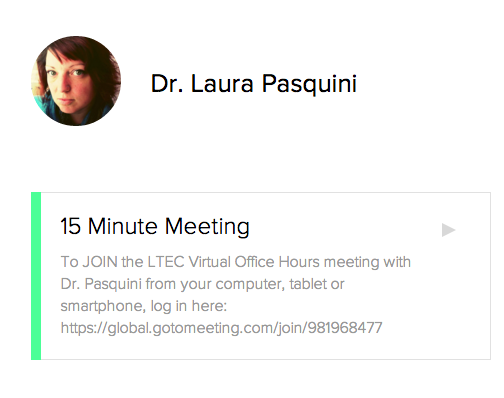
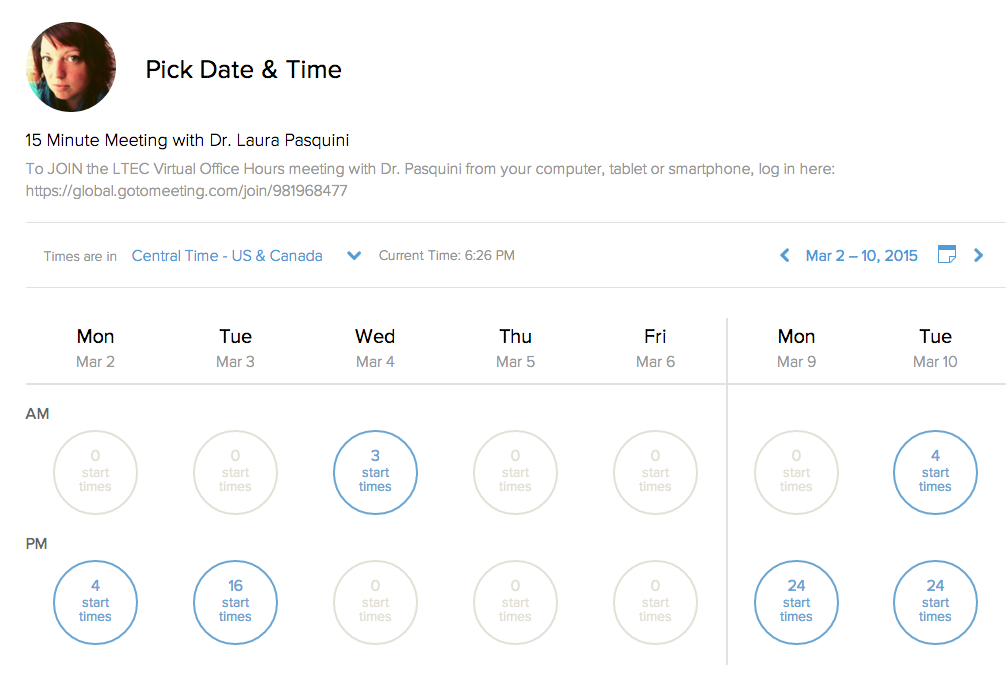
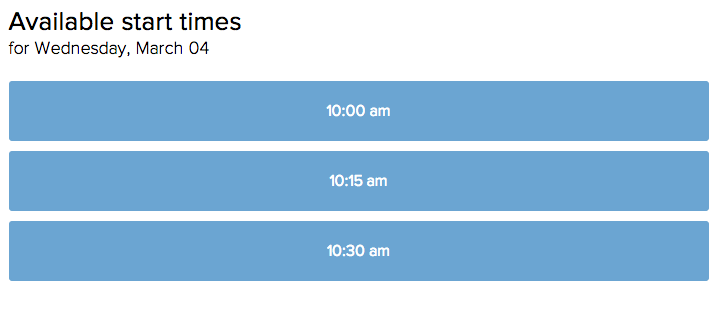
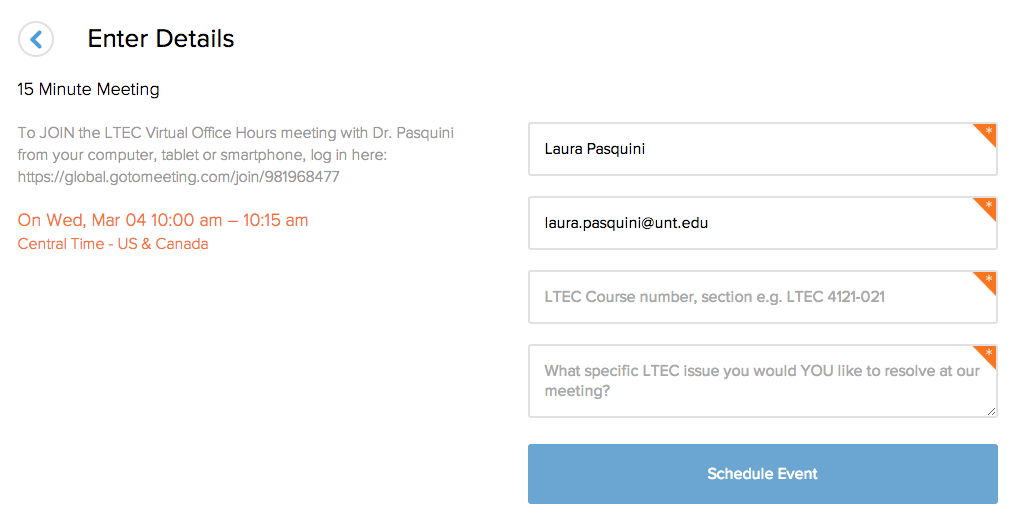
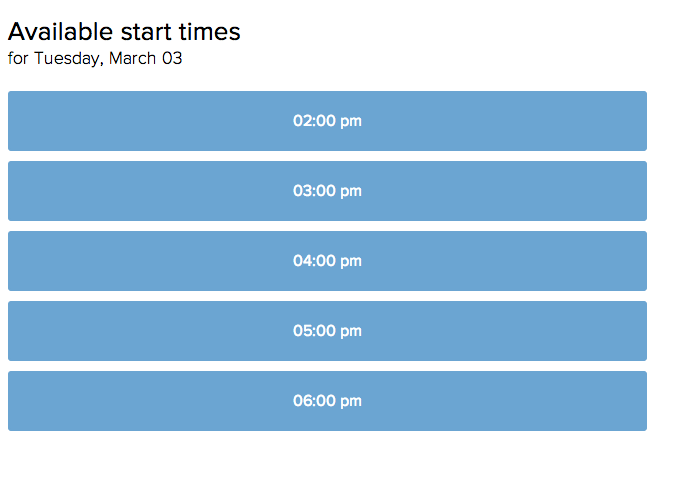
  5. Try offering “on demand” office hours. I use helpful scheduling websites with my Google Calendar to set up student meetings. Both youcanbook.me and calendly offer easy ways for learners to schedule 15-, 30- or 60-minute meetings, depending on my own personal work/travel schedule. Example of the calendly appointment scheduler below:

Step ONE

Screen Shot 2015-02-28 at 6.26.18 PM


Step TWOsched


Step THREE

book
 Step FOUR

Screen Shot 2015-02-28 at 6.51.51 PM

  • ProTip: Be sure have your students identify the purpose of the meeting. E.g. I ask, “What specific issue you would YOU like to resolve at our meeting?
  • Dedicated meeting location: Since I lecture online, I decided to keep all my office hour meetings in a set GoToMeeting space that is standard for all my courses. This is included on the course syllabus, class announcements, and, most importantly, it is an accessible location – students can use their web or phone:

LTEC Virtual Office Hours with Dr. Pasquini” Please join my meeting from your computer, tablet or smartphone. https://global.gotomeeting.com/join/981968477

  • You can also dial in using your phone.United States (Long distance): +1 (213) 289-0012
    Access Code: 981-968-477 

I am still evaluating my own office hour approaches for my distance learners, so please feel free to share your strategies with me. How do you support your learners? What ways have you encouraged your students to connect with you for office hours? Do you have suggestions that I might want to consider for online office hours? Post your suggestions below!

References

Weimer, M. (2015a, February 17). Office hours alternative resonates with students. Faculty Focus. Retrieved from http://www.facultyfocus.com/articles/teaching-and-learning/office-hours-alternative-resonates-students/

Weimer, M. (2015b, February 18). Office hours redux. Faculty Focus. Retrieved from http://www.facultyfocus.com/articles/teaching-professor-blog/office-hours-redux/ 

blogs, Reflections

2014: My Blog in Review

The WordPress.com stats helper monkeys prepared a 2014 annual report for this blog. Since WP put in the effort, I thought I would review my stats from the year — seems like the annual thing to do and all.

Here’s an excerpt:

The concert hall at the Sydney Opera House holds 2,700 people. This blog was viewed about 22,000 times in 2014. If it were a concert at Sydney Opera House, it would take about 8 sold-out performances for that many people to see it.

Who Views

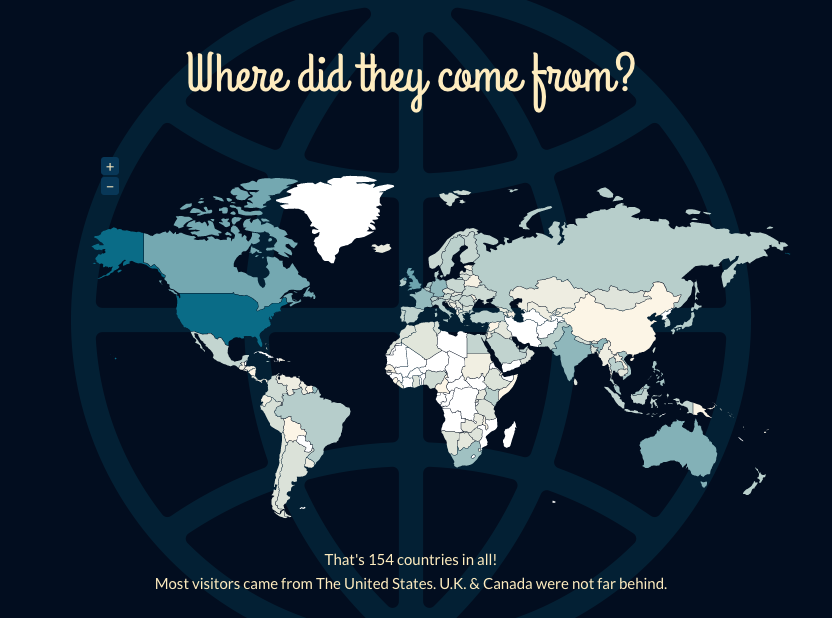
No surprise that America is my biggest audience — as that is where I live. I wonder how US-centric WordPress is in general, and how that impacts those who blog, write, share, and produce content here. I’ve been pondering content sharing online since that talk Laura Czerniewicz (@Czernie) gave on visibility and presence in scholarship in #scholar14.

“Some of your most popular posts were written before 2014. Your writing has staying power! Consider writing about those topics again.”

Maybe I was more interesting from 2010-2013? Or at least my post topics or titles were. Based on my click view stats from this year, compared to the last few years, my overall readership has decreased. Then again, it looks like I posted 48 blog posts total, which is down from from 59 post in 2013 and 62 posts in 2012. Perhaps I was a tad busy writing other things in 2014 (*ahem* Dissertation *cough*). It is no wonder why a number of readers decided to look back into the archives of this blog – top 5 hits included:

I am not concerned. I started and continue to blog to share ideas, reflect on learning and put a few things out there with regards to my own teaching, service and research scholarship. I blog for myself, and the community of practice who shares similar sentiments and values. It’s quality not quantity, right? I am honored to have a number of new followers and loyal subscribers from my PLN who read, respond, and engage.

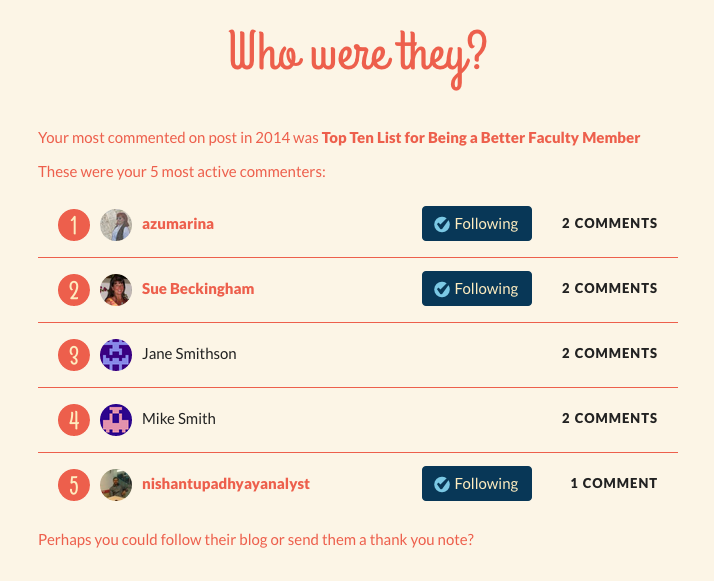
Top Commenters for 2014

I’d much prefer to get comments and thoughts shared on posts then just click views any day. Plus you never know what a blog post might lead to. Often it has been a new connection, collaborative writing, and even research fun – OH MY! {Yes – this even includes random meet ups and spontaneous dance/beach parties. True story.} Beyond my blog reflections, is where the real networked magic happens. These posts are really just a springboard to more learning, fun, and research.

If you care to learn more about the TechKNOW Tools stats from 2014, feel free to click here to see the complete report. Thanks to the many social platform links and even a shout out to Josie for referrals here. Happy blogging to all in 2015! Blog on.

p.s. Why the heck would I want to use the new WP editor? I much prefer the classic wp-admin mode ANY day for my blogging experience. Seriously.

Reflections, TBT Posts

#TBT Blog #2: Happy Christmas and the Holiday Comic Strip

Over the past seven years, Fiachra and I have created an annual holiday comic strip for Christmas cards to recap our year. This year we broke the tradition and did not create one. I know. Sad. Maybe we ran out of James Bond themes, or perhaps far too much has happened in 2014 to contain our year events in just one comic strip.

2014 was a full year of great events. Both Fiachra and I completed the academic leg of our lives, as we graduated over the summer with our MBA in Decision Sciences and PhD in Learning Technologies, respectively. After this accomplishment we decided to take a break by taking an EPIC road trip to explore the US southwest. This 5-week journey showcased a number of gorgeous landscapes, outdoor adventures, eclectic attractions, and, most importantly, time to spend with each other and also a chance to catch up with family and friends. Here is a quick spotlight to highlight our travels and year in review:

On behalf of Fiachra and myself, we want to thank you SO MUCH for all your love and support this year. We are so grateful for everything. We wish you and your loved ones a very Happy Christmas, and all the best for 2015!
xo
L and F