Professional Development, Reflections, Social Media

Taking a Tech-cation

As a student, educator and professional in higher education I am usually “always on” and connected. This serves my research and practice well, however I often find I need to preserve space to unplug. 

An NPR  Fresh Air episode “Digital Overload: Your Brain On Gadgets” describes how the psychological rational, intermittent reinforcement, is the reason why we check our e-mail constantly, rely on applications and glance at our mobile devices at inappropriate times. Information Overload is Not Unique to the Digital Age, however society has consumed more information than ever since it is easy and accessible online. It is now easier than ever to fall victim to what Matt Ritchel identifies as the “screen invasion.” The NYT’s spent some time examining the impact on how individuals juggle information through their series known as, Your Brain on Computers. Much of what is talked about in both journalism pieces includes the following concerns: stress, impatience, limited memory, mediocre performance, and developmental issues/concerns.

In order to prevent burn out from life and professional work, I often take what I call self-imposed “tech-cations.” It’s true:

Here are a few suggestions on how to break from the constant information flow. Be sure to shut down all screens and then go forth (which includes all forms of computers, TV,  & mobile devices). Here are a few suggestions of activities for a screen-free holiday:
  • Take a break for self-care – eat well, exercise and just BE
  • Read  – there has to be at least 1 book at your house/local library you have wanted to read
  • Listen to a podcast and/or radio show
  • Play a game – cards, Scrabble, Chess, Apples to Apples, etc
  • Go for a run, walk, hike or sit in the park – get some fresh air!
  • Pen to paper – when’s the last time you have reflected in a journal?
  • Clean your space & de-clutter – house, office, car, closet… you decide.
  • Try a new recipe (and taste it).
  • Go exploring – Visit a local museum, art gallery or tourist attraction.
  • Hang out with friends … sans your mobile. Yes you CAN do it!
These are just a few suggestions to help you re-charge and re-fuel yourself from the connected world we live in. Being connected is great. I am huge proponent of connection and connected activity, however digital consumption is good in moderate doses. To be effective and purposeful in education, it is necessary to step away from the screen and just be. 
Collaboration, Learning Community, PLE, Professional Development, Social Media, Virtual Communities

#Hashtag + Community = Learning?

Photo c/o Flickr User drips

Hashtag – The Definition [and then some]

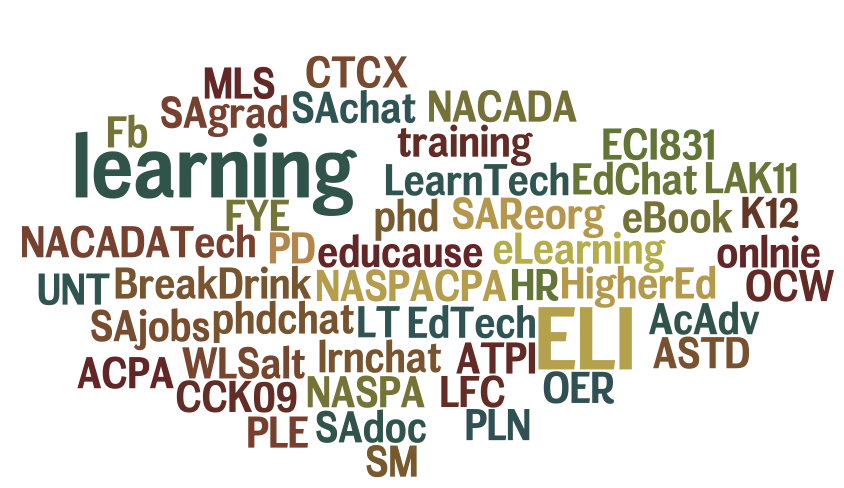
I value my learning networks and those communities I engage, listen, follow and participate in online on a regular basis. In thinking about my PLN, I often rely on a few of #hashtags for information, resources, support and more! Here’s a quick visual c/o Wordle:

In thinking about my initial involvement with #hashtags and learning communities I often ponder people, categories, and the learning groups I am an active member in. Earlier in my involvement with a few #hashtag groups, I am reminded of preliminary tweets from various groups and consider newbie reactions to the community who might share initial uncertainty of involvement and question what is happening and how the conversation evolves:

It isn’t until later that I have engaged with these communities and realized the potential for my own learning and development – personally and professionally. This evening, I was fondly reminded of the impact and appreciation during the #AcAdv Chat and how a simple #hashtag can unite and connect an online learning community :

A question I threw out to my Twitter friends this evening was – “Pondering my hashtags this evening… what ones do you follow to learn, engage, connect, etc? Please share.” Here was the quick response:

A combination of ideas initiated after these immediate query & response on Twitter – is it the #hashtag, person or community you are engaged with? Will your #hashtag live on? How do you form effective learning networks on Twitter? What combination of people & #hashtags will meet the need in ones PLN? These are further investigation areas I will consider to ponder in my research and studies. Your thoughts and ideas are always welcome.

Conference, CTCX, Higher Education, Professional Development, SAchat

Stopping by #SxSW

#SxSW has attracted the interactive, film and music fans from around the world to Austin, TX every March. This year @julieclarsen decided to drop into the interactive part – #SxSWi – since we are only 3.5 hours north of the fun.

Although our road trip was short, we managed to soak in all that #SXSW was offering for the interactive time. There are loads of events and happenings for non-registered fans, and it gave us a sample of what we might attend next year – because we’re very interested in playing & engaging with some of the great panel sessions too.

Here are a few #SxSW highlights from the rogue attendees:

  • There’s an app for that! – Many new startups, apps and more begin to shine at #SxSW. We were texting beside the CEO/Founder, Mike, of Hashable & also met the developers from PunchTab who just launched their online reward program 5 days before #SxSWi.
  • FREE! is the name of the game – There are loads of fun things to do & see for the frugal-minded geek. Many happenings were found on the street or at an RSVP gathering within the 4th-6th Street limits.
  • Time to Play Ping pong, Foursquare, Geek Games from Mashable &  frolicking is key for the #SxSWi. Loads of events happening on the street, in a parking lot and around town to enjoy. And there is tonnes of fun being tweeted & broadcasted about what is happening around town.
  • Celebrity Sighting – If you want to see a few stars, they are sure to appear in front of a camera or microphone for an interview near you (on the street). We saw Danny Devito interview for an upcoming film he’s producing, but other friends met Conan O’Brien, Dane Cook, Juno, Mike Tyson and then some.
  • Ideas, Solutions & Blue Skies – There are loads of great panels, talks and discussions about what’s to come in the techie realm.
  • Points to Ponder – This event had my mind spinning for ideas to research, develop, and create. Imagine if I attended more of the convention. Unreal.
  • BEST PART = Meet & Greet – There are loads of people in Austin on the street who are open to chatting & gathering. I recommend a local cafe or watering hole such as South Congress Cafe, Fado, Stubbs BBQ or The Gingerman. It was a great weekend to connect & meet a few #SAChat friends IRL.

Besides meeting @EdCabellon, Julie & I met up with a few #SAChat friends such as @bradpopiolek, @jeffjackson, @SueBecks, @lizgross144@marlenabh, @reyjunco, @stephwint, @PetePereira, @lynnellison & @LauraLambeth (who took some fab photogs from the #SASxSW TweetUp because I was too chatty and less of a photographer :)) at Rudy’s BBQ. We feasted & chatted over some Texas finest BBQ. Our meeting was cut short by my scholastic obligations (who puts a test on Saturday night of Spring Break?), however I do hope to connect and visit with more local & faraway #SAChat friends in the future.

BIG kudos goes out to Brad, our Austin host with the most, and Julie, the ultimate road warrior. Here’s to more gatherings of technology and fun in the future! Learning is best when it’s crowd-sourced & IRL.

Collaboration, Learning Community, PhD, PLE, Professional Development, Reflections, Virtual Communities

Thoughts On My PLN

I have been pondering the value of my Personal Learning Network (PLN) for quite sometime. I value educators, professionals and researchers in higher education who share, connect and collaborators with me online and IRL (in real life).

Not too long ago @clintlalonde interviewed me for his masters thesis research paper on learning networks. I agreed to this Skype interview, as PLN is a strong interested on my own research thread. A BIG thanks goes out to Clint for having me reflect on my PLN. After reviewing the transcripts from our interview, I thought I would highlight a few thoughts I shared about my PLN:

  • a shared space where I connect and engage with a community of peers
  • this group is a sort of a scaffold & sounding board
  • a place go to for resources and ideas
  • usually related to my interests or areas I want to expand upon
  • technology did not create my PLN, but is is now a great and easy medium to cultivate it
  • resources for personal and professional development is in the network
  • 140 characters really does have value in my own educational development
  • my network is varied and there is never a dull moment – this is why I stay engaged
  • it has different themes within different nodes & groups
  • crowd-sourcing – starts the conversation, inspires project development and collaborative initiatives
  • it can evolve and it can change  – the medium may change but the messages & info is always there
  • I never stop learning…that’s why I heart my PLN!

Here are a few great articles and resources from educators in my PLN:

Have you grown YOUR PLN lately?

BreakDrink, CTCX, Learning Technologies, Podcast, Professional Development

iPads, Nooks & e-Readers… Oh My!

Digital literacy & e-textbooks have been on my mind… (for some time)

I have been pondering e-books, e-readers & online learning materials since the beginning of this academic semester. I am still contemplating a purchase of an e-reader or tablet before the year is out – so this is where my research & review takes me in the #edtech world. My main question is: What does it mean to take the tactile and make it digital for our learners?

Here are a few thoughts I shared during today’s webinar with Higher Ed Hero on just this topic:

A few questions and thoughts to ponder as e-books & e-readers enter our campus environments:

  • Will engagement in the digital material require new instructional methods?
  • Will our textbooks be dynamic & interactive?
  • How doe faculty connect and manage this transition?
  • How do learners retain information from real books vs. e-books?
  • Can faculty ‘win’ in the classroom & academic sphere with digital literacy?
  • How will higher motivate and impact this change?
  • Will there be control over content & learning materials?
  • How can faculty support students  more to make them comfortable with e-books for learning?

In my own research and article collection, I have managed to collected in a few resources in a Google Doc about the topics of e-readers, e-books & e-literacy and discussed it on latest edition of the Campus Tech Connection podcast #18 – E-Books & E-Readers with @jacksonj & @jefflail from BreakDrink. My quest for reading digitally continues…