Higher Education, Open Education

Open Access For All #oa12unt

Yesterday, I attended the 3rd Annual Open Access Symposium at UNT (#oa12unt). It was a full day of talking about open data, sharing research and collaborative efforts and examples in #highered. The open access process is not as simple as you think. It was interesting to hear from researchers, academics, librarians, industry partners, and data managers about what it means to be “open” and accessible for others. Here are a few open notes I took and a Storify I curated from the day.

I think the concluding remarks (and other notes) made by Brian Schottlaender (@ucsdBECS) helped to summarize the key points that were  both said and were not said during the day, including the following topics:

  • Data Preservation
  • Data Aggregation
  • Attribution
  • Citation
  • Publication
  • Data Ecology
  • Peer Review
  • Discovery & Delivery
  • Data Governance
  • Exhortations to Librarians

These final thoughts left me questioning about how higher education will engage in open access and consider what academic tenure/promotion will look like in the future. The open movement is present in my learning network, among the Social and Open Educators like @courosa and academic contributors who want to End Knowledge Cartels in publication such as @academicdave, There are many open and transparent academics/educators contributing to the open movement – but there needs to be more. And more importantly, academic institutions need to recognize and accept open scholarship.

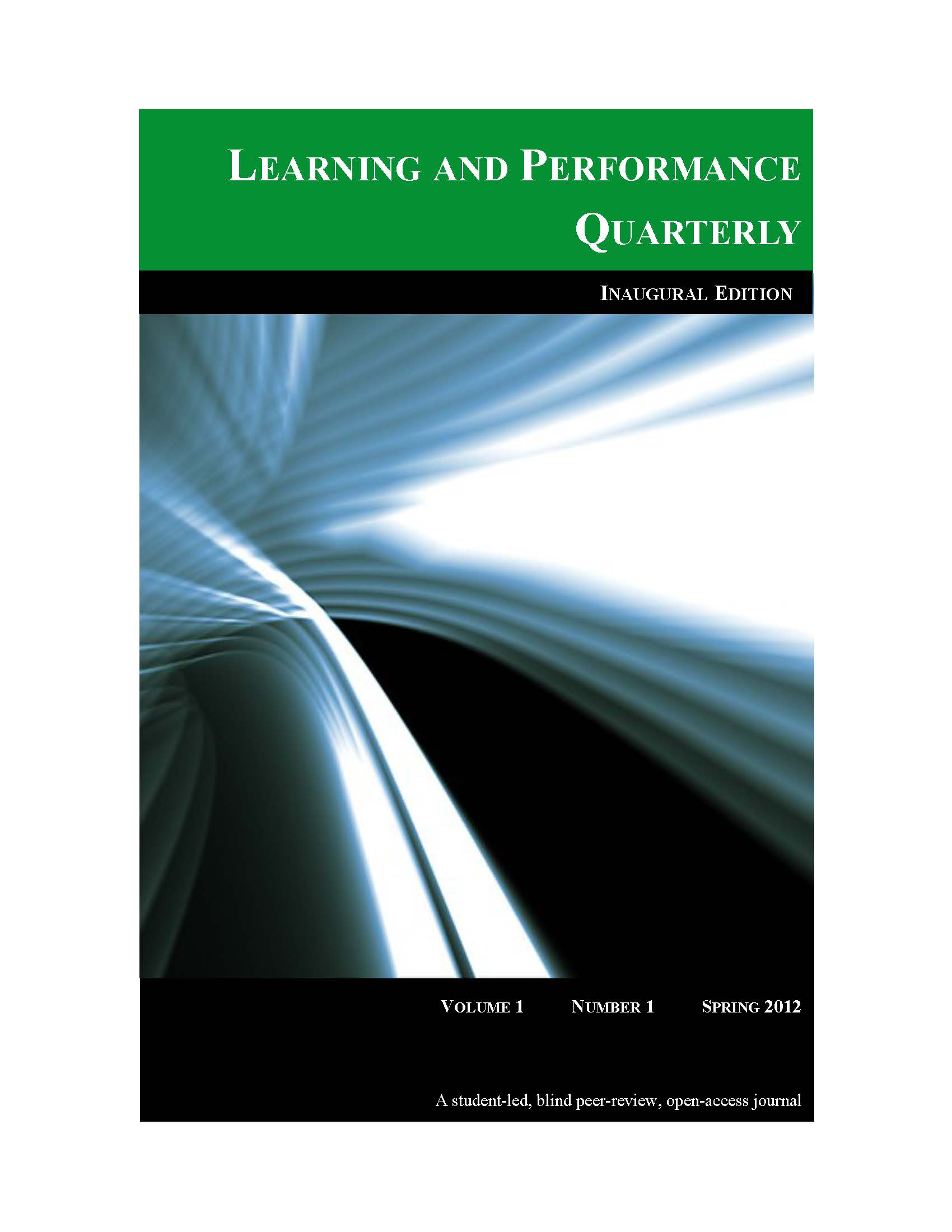
I know the #oa12unt symposium lit the fire for me to finish the layout and publish the first issue of the Learning and Performance Quarterly. This student-lead, open access  journal is an open access publication that I am proud to edit and coordinate with a phenomenal group of reviewers and a great editorial team. The inaugural issue was JUST published online today, and is available for your reading and sharing pleasure HERE.
What have you done openly lately in #highered? Please share.

#phdchat, Open Education, PhD, PLN, Professional Development

10 “Lessons” in Digital Scholarship from @mweller

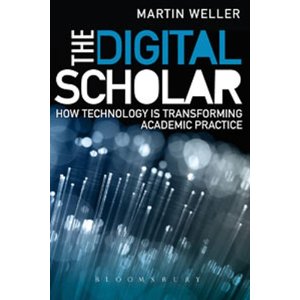
As a scholar who is lives digitally, connected & open, I have appreciated following along with Dr. Martin Weller’s as he tweets & blogs his ideas for similar philosophies. More recently he has published an open-access, creative commons book – The Digital Scholar.

I was just watching Martin’s recent talk with the LSE on how to engage in digital scholarship, i.e. scholarship that is open, networked and digital. Thanks to the Centre for Learning Technology at LSE for presenting the NetworkEd: Technology in Education Series, you can watch these “lessons” (a.k.a. general ideas and musings about how to be a connected & engaged scholar). @mweller has posted his 10 Digital Scholarship Lessons in 10 Videos to recap the presentation, slides and scoop it page as well:

  1. It’s not just for geeks
  2. Researchers are caught in a dilemma
  3. Interdisciplinary is the network
  4. We’re all broadcasters now
  5. We’re operating in an attention economy
  6. We can rethink research
  7. New skills will be required
  8. It’ll impact even if you ignore it
  9. It’s about alternatives
  10. Don’t focus just on risk

I think that Martin brings up some great ideas of what a digital scholar looks like – and there are many of them already out there. I hope to not only witness, but also be part of this academic revolution. The changing landscape of technology, information and communication is challenging higher education to rethink its approach to learning. Online resources are very social and collaborative, and I hope to see these emerging tools push the academic realm outside of the traditional boundaries and expectations. With current developments in educational technology, learning communities have the ability to enhance peer-to-peer connections, social learning, knowledge sharing, and critical thinking for researchers. When learners/researchers become creators, narrators and digital contributors of their own academic fields, many gain further in-depth meaning and purpose in the learning process.

astd, ATPI, Learning Technologies, LPQ, Open Education

Introducing the NEW Learning and Performance Quarterly (LPQ) Journal

CALL FOR PAPERS: LPQ, VOL. 1, ISSUE 1

The Center for Knowledge Solutions at the Department of Learning Technologies, University of North Texas is proud to announce the first Call for Papers for the inaugural issue of the Learning and Performance Quarterly (LPQ) journal.

The Learning and Performance Quarterly (LPQ) is currently accepting submissions for the inaugural issue. We are welcoming any article submissions that detail the definition, history and evolution of learning and performance in its broadly conceived terms including instructional design, performance improvement, learning innovations, training and development and educational technology for both public and private sectors: http://bit.ly/LPQv1i1 

The deadline for submissions is Friday, February 10, 2012.

For detailed submission guidelines and instructions on how to make a submission, please visit Author Guidelines. Editors, Laura Pasquini and Dr. Jeff Allen, will gladly answer any questions or concerns regarding submissions via e-mail: LPquarterly@gmail.com. We look forward to receiving your submissions.

Please share this announcement with other colleagues and researchers who might be interested in publishing for the Learning and Performance Quarterly. Thanks!

eduMOOC, Learning Community, Open Education, PLN, Virtual Communities

Online Learning Today with #eduMOOC

Last week, the #eduMOOC course with over 2, 500 participants located in over 60 countries participated in the first session topic Online Learning Today for the Online Learning Today… and Tomorrow course.
I will be honest – the massive, open and online courses format will not be taking first year undergraduate courses by storm. Many of my incoming students are concerned with transition from high school to higher education, and often stay clear of online courses in their first semester. In contrast, as a graduate student and self-proclaimed life-long learner, I like the autonomy and independence a MOOC has to offer. I like to connect, share and learn informally with others, so this is probably why I signed up for the course.  The first week’s session (Thursday 1-2 pm CT) was recorded and the PDF slides were archived for those who could not attend the live session. Here are a few key questions and ideas discussed from the panel:

Who do we serve in online learning today?

Online learning has typically met the needs of our non-traditional learners; however with the impacts and growth in emerging technology for education online learning is becoming a staple at most higher education institutions. As we are encouraged to “do more with less,” online learning is now required to meet the continuum of learners and learning pedagogues are not quite developed for many campus learning environments. Although online learning is just another dimension of learning, more higher education technology leaders need to identify methods for effective design and high-quality curriculum delivery.

Is the nature of how we learn changing? How? Why?

Both the learners and learner environments have evolved over the past 30 years. The delivery, medium, and evaluation of learning has impacted today’s higher education classroom. Emerging methods of curriculum execution and faculty instruction are beginning to increase learner engagement beyond our campuses. Online learning allows for fluid participation and continuous experiences. Learning has always been social; however new mediums now increase our learning networks across the globe and enhanced how learning objectives are reached.  

In order to meet the needs of global learners in higher education, more institutions will have to move forward with technology or be left behind. Other questions that were discussed by the panel include: 

  • How do for-profit vs. not for profit higher education institutions impact online learning? 
  • We may have one the access war, but have we won the accessibility war with online learning?
  • Are we considering universal design for learning
  • Is there still cannibalization of online learning? Disrupting College http://t.co/Jg8egj0 via @amprog
  • How are faculty, instruction & evaluations designed to review impacts for online learning?
  • What are the challenges for online learning today in 2011?
Captain Obvious point: Online learning is growing and many institutions are behind in their development and support for this type of learning. This fact is apparent. Take a look at most higher education course offerings online and how these courses are designed. Online learning IS growing, in terms of, demand, quality, global reach, resources, and access. What I am more interested is HOW higher education institutions will meet the demand of online learning? Institutions are currently struggling with decreased budgets, low enrollment numbers and maintaining staffing needs to support our student populations – just to name a few challenges.
 
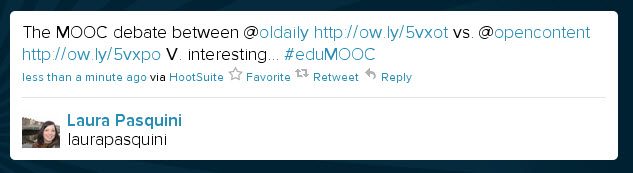
In reflecting about the session, I can not say that I came away from it learning a whole lot of new ideas – more these questions will shape what lies ahead in this course for the weeks to come. I was sort of disappointed that the panel did not represent any global educational leaders in the #edtech field as planned – but hopefully this will change in future sessions. And I did take note of the debates around the actual value of this #eduMOOC and other MOOCs for education and learning in a few blogs, Twitter and other online entities of the social web – which also has contributed to my learning. 

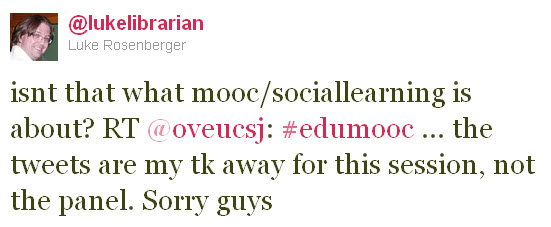
It’s this sort of discourse that most challenges me to think and really, a MOOC is similar to a personal learning network and what you decide to make of it. As a seasoned-learner, I find great value in on-going discourse that occurs on the #eduMOOC backchannel on Twitter, on the eduMOOC Fb group or just reading blog posts that share ideas and resources about the course topics. I encourage others to engage by following a few key hashtags [#onlinelearning #eduMOOC #elearning] and start a dialogue with your classmates. I still think the best types of learning from MOOCs comes from the community of learners and those participating in the learning network. As it was said best:

BreakDrink, CTCX, Open Education, Reflections

Is The Internet YOUR Playground?

This past week on @BreakDrink the Campus Tech Connection (#CTCX) podcast we discussed online filters and search, and how this impacts our knowledge, perception and view. The initial discussion was sparked by the Eli Pariser’s TED Talk about online “filter bubbles” but our conversation cycled into the retrieval and sharing of information within our personal and professional worlds. [Sorry @jefflail – I know you are not a fan of TED, but it was an “idea worth spreading” for the #CTCX show on Monday.]

On the show, we discussed if it was possible to seek unbiased information through our search results, consumption of media and varied perspectives on a topic.  As a History major, I was encouraged to review and assess my sources and citations. It was important to ensure there was an unbiased perspective and account of the information shared. Now that we have the ease of Google, Yahoo, Bing and other online search engines, few people take into account how or where this information is aggregated during search. To test the limitations to online filters, @jeffjackson, @jefflail & I spent some time Googling and contemplating if the internet was actually our playground. Ideas around search engine optimization, online experience, controlled sharing and the openness of our internet were key concepts discussed. It was a pretty good conversation about information collection and filtering – which shall continue throughout my research and professional work. 

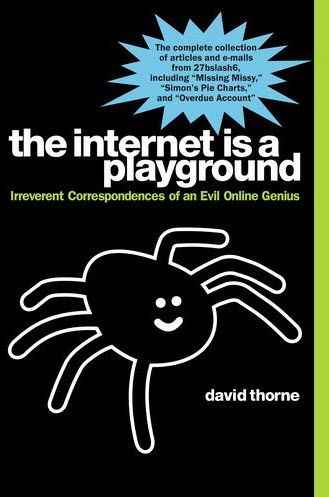
For now, I will divert to someone who decided to take back the internet playground. David Thorne is a writer who decided to push the envelop one day through funny personal email exchanges (that not everyone might find funny, but he sure did). Thorne’s most famous exchange with a spider drawing went viral in 2008 which increased traffic to his personal website. To fund the server for this website David decided to create a book calledThe Internet Is My Playground, to share more online interactions. 

Thanks to NPR All Tech Considered for the great piece on David Thorne.

This blog post is also cross-posted on BreakDrink.com => Campus Tech Connection | Live Googling & Filter Bubbles