Collaboration, Learning Community, PLE, Professional Development, Social Media, Virtual Communities

#Hashtag + Community = Learning?

Photo c/o Flickr User drips

Hashtag – The Definition [and then some]

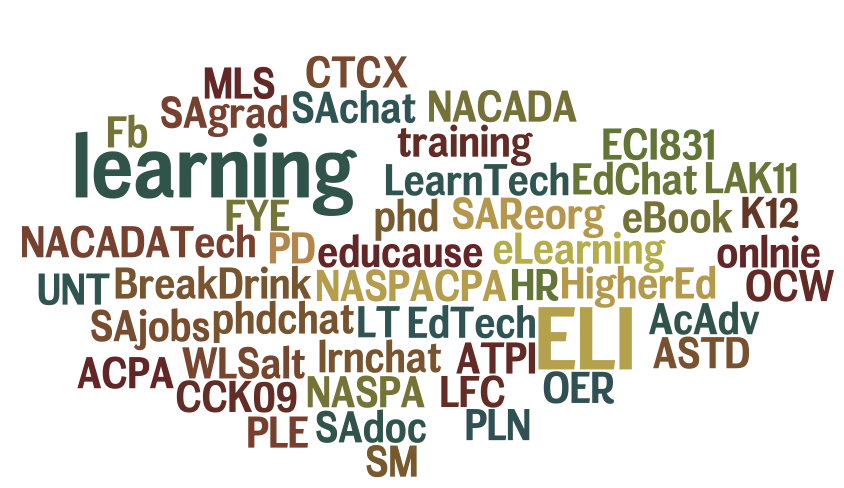
I value my learning networks and those communities I engage, listen, follow and participate in online on a regular basis. In thinking about my PLN, I often rely on a few of #hashtags for information, resources, support and more! Here’s a quick visual c/o Wordle:
In thinking about my initial involvement with #hashtags and learning communities I often ponder people, categories, and the learning groups I am an active member in. Earlier in my involvement with a few #hashtag groups, I am reminded of preliminary tweets from various groups and consider newbie reactions to the community who might share initial uncertainty of involvement and question what is happening and how the conversation evolves:

It isn’t until later that I have engaged with these communities and realized the potential for my own learning and development – personally and professionally. This evening, I was fondly reminded of the impact and appreciation during the #AcAdv Chat and how a simple #hashtag can unite and connect an online learning community :

A question I threw out to my Twitter friends this evening was – “Pondering my hashtags this evening… what ones do you follow to learn, engage, connect, etc? Please share.” Here was the quick response:

A combination of ideas initiated after these immediate query & response on Twitter – is it the #hashtag, person or community you are engaged with? Will your #hashtag live on? How do you form effective learning networks on Twitter? What combination of people & #hashtags will meet the need in ones PLN? These are further investigation areas I will consider to ponder in my research and studies. Your thoughts and ideas are always welcome.


Collaboration, Learning Community, PhD, PLE, Professional Development, Reflections, Virtual Communities

Thoughts On My PLN

I have been pondering the value of my Personal Learning Network (PLN) for quite sometime. I value educators, professionals and researchers in higher education who share, connect and collaborators with me online and IRL (in real life).

Not too long ago @clintlalonde interviewed me for his masters thesis research paper on learning networks. I agreed to this Skype interview, as PLN is a strong interested on my own research thread. A BIG thanks goes out to Clint for having me reflect on my PLN. After reviewing the transcripts from our interview, I thought I would highlight a few thoughts I shared about my PLN:

  • a shared space where I connect and engage with a community of peers
  • this group is a sort of a scaffold & sounding board
  • a place go to for resources and ideas
  • usually related to my interests or areas I want to expand upon
  • technology did not create my PLN, but is is now a great and easy medium to cultivate it
  • resources for personal and professional development is in the network
  • 140 characters really does have value in my own educational development
  • my network is varied and there is never a dull moment – this is why I stay engaged
  • it has different themes within different nodes & groups
  • crowd-sourcing – starts the conversation, inspires project development and collaborative initiatives
  • it can evolve and it can change  – the medium may change but the messages & info is always there
  • I never stop learning…that’s why I heart my PLN!

Here are a few great articles and resources from educators in my PLN:

Have you grown YOUR PLN lately?

AcAdv, BreakDrink, CTC, Learning Community, NACADA Tech

Who is Your Tech BFF?

Q: “How do you stay on top of all things technology and remain current with online trends?”

A: “My Technology B.F.F. (Best Friend Forever), of course!”

The term BFF is often used by “the kids” these these days, but after reflecting on where I learn and engage in technology, this became the best term I can use. Sure my Tech BFF is a mentor, guide, coach, instructor and instigator – but most of all this individual is a friend. My Tech BFF helps introduce me to useful ideas, connects me to other people, engages me in the social network to challenge me both personally and professionally.

Flickr Photo c/o Hoodlumpr

Okay. I am cheating. I have a few of these Tech BFF’s in my life. This collaborative helps to inform what I do and how I learn. I am able to connect, collaborate, question and play with online group on a regular basis. Today I will highlight one of the esteemed members from my personal learning network – let me introduce one of my Tech BFF’s: Mr. @EricStoller

I was fortunate to connect with Eric during our faculty stint at NACADA for the 1st EVER Technology Seminar at the end of 2008 with Karen Thurmond & George Steele. My initial interaction with Eric was via e-mail, Skype and on via the interwebs. This seems appropriate since he has been one of many to inspire me to further embrace the power of online connection for social justice and collaborative partnerships. Since this first meet up (where I discovered Eric was much taller than he appeared on webcam), I have been fortunate to be supported by this colleague as we transition in our careers and pursue our dreams.

I proudly present to you the latest & greatest Campus Tech Connection podcast #16 that features Eric Stoller and his recent happenings. In this podcast we discuss the following items:

Thanks for your support, ideas and friendship. May our tech connection live long and prosper.

The question is: Who’s your (tech) Jedi master?

AcAdv, EC&I831, Learning Community, NACADA Tech, nacada10, Social Media

Advising Is the Sum Of All Parts With Technology

I took a bit of a Tech-cation after returning from #nacada10 last week. There was so much social media involvement at the 2010 NACADA annual conference, that I thought it was very important to be social in real life (IRL) and get back to the daily grind at the office.

After over a week away from blogging, I thought I would share some of my ‘deep thoughts’ about NACADA10 and the brilliant advising community. It was a pretty fun experience to be part of the NACADA10 Social Media Dream Team.

My NACADA #SM accomplice, @bradpopiolek, helped to fuel the 1st Official NACADA 2010 blog and backchannel at the annual conference last week. This was a great opportunity for pictures, videos and tweets both as an archive to the conference, and it was an easy way to share the NACADA10 happenings with other Academic Advising folks near and far.

The opening keynote speaker, @reyjunco, brought some interesting ideas to the NACADA attendees during his talk about  student engagement, social media & change. This sparked many conversations and questions on how to best utilize these resources for our students in our advising profession, etc.

The 1st ever NACADA TweetUp was a success. I had a blast meeting all my academic advising friends from Twitter IRL. It was a great to connect & chat with everyone including: @vcuesposito, @bradpopiolek, @JPKirchmeier, @howardsj, @peacox, @Ahjim,@USMAccAdv, @adamduberstein, @amy0631, @reyjunco & @KellyJBailey.

For those fantastic #AcAdv tweeps on my NACADA-AdvAdv List who couldn’t attend the NACADA TweetUp that night at Rix, I was fortunate to meet you throughout the conference. Excellent discussions and introductions made with fellow tweeters like @UOAdvDir, @sally_garner, @jadana17, @jbarkemeyer & more! For those of you on “the list” I look forward to a tweetup sometime in the future. For now we will continue to learn & share on Twitter.

My NACADA10 takeaways:

  • learning is continuous & not a specific location – many #AcAdv joined the conversation from afar
  • advising peers sharing experiences/resources is always a good thing
  • my personal learning network (PLN) at NACADA continues to challenge & support me
  • academic advisors are a great group of #highered professionals
  • #nacada has a WEALTH of information & resources (we need to share these MORE effectively)
  • conversations at conferences are THE reason why you go to a conference
  • sometimes social media can make you less social IRL – balance is good

Being part of a great association and meeting at an annual conference is grand, but I truly value the resources and contributions my network of #nacada peers share online and always. Whether it’s an article posted on a blog, to a comment on twitter, my PLN best contributes to my educational and professional life. Thank you. Keep up the fine work.

I will leave you with a great quote from Dr. Rick Schwier (@schwier), an #edtech faculty from the University of Saskatchewan, who shared these thoughts #during a recent #eci831 lecture about the history of learning networks:

“You can’t separate the network [from learning],

the network is learning.”

Hey #AcAdv PLN – let’s keep collaborating, connecting & learning together. See you in the social media-sphere.

Learning Community, PhD, Reflections

Engaging Tomorrow’s Learners

While reading articles for an assignment, I stumbled upon a decent read in the T+D Magazine put out by ASTD called “The Time Has Come to Embrace Millennial Perspectives.” The article linked up to an interesting white paper about Millennials from Millennial Inc.

The white paper shared strategies and ideas of how to best engage Generation Y in the workplace. This got me thinking that a similar list could be applied to our learners. It is critical  and how we engage our students inside and outside the classroom at our institutions.

Here are a few ideas on how to meet our Millennial learners in higher education (adopted from the business workplace 10 core principles):
  1. Encourage open collaboration across the campus.
  2. Ask more from each student, faculty & staff.
  3. Recognize and reward good ideas, wherever they exist on campus.
  4. Use technology to customize services, resources and to personalize communications.
  5. Maintain high-quality learning curriculum and student services.
  6. Integrate responsibility on your campus.
  7. Connect to students in authentic, relevant, and meaningful ways.
  8. Keep two-way communication open by partnering with your students.
  9. Create opportunities that encourage students to share their positive experiences, leveraging word-of-mouth interest, and increase involvement on campus.
  10. Continually search, evolve, and find new ways of learning.