Higher Education, Reflections, StudentAffairs

A Kinder Campus to Collaborate

Be KindThere are a  number of students, staff, and faculty in my life who I have gotten to know along my academic and professional journey – as colleagues and as friends. I have been fortunate enough to experience college/university life as a student, professional, and instructor  at various types of institutions and in more than one country.  Each new experience has afforded me to work with insightful colleagues, learn about effective practices, understand a variety of student populations, and consider innovative ways to  support students, staff, and faculty.

In a recent Inside Higher Ed article I shared my thoughts on why our divisions in higher education need to think beyond their own areas. Some of the challenges ahead in higher education will require our departments/divisions to step our of their silos to collaborate and reach shared goals for our institutions. It does require some risk; however I think there are larger rewards for reaching out and conversing with others. In considering some of the opportunities and challenges in higher education – such as financial, legislative, staffing, and more – perhaps it is just the right time to sit down to chat and connect to others on campus. Institutional units will need to put their heads together to think creatively and collectively about some of these issues – if they are not doing so already. 

Over the last few weeks, I have been thinking about what a “kinder campus” means in higher education. I am currently participating in a Collaborative Learning Community (CLC) at UNT that brings students, staff, and faculty together to work towards a shared solution to a problem/challenge at our institution [more to be shared on this later]. Since we have diverse representation on this CLC, as the co-chair with another faculty member we have been considering the following needs to keep our group moving forward:

  • introductions are important – find out what everyone “does” on campus
  • use common language and define terms
  • establish purpose and goals for the CLC
  • share and distribute information/facts that are not known
  • establish a meeting time/day of the week
  • create agendas to guide, not limit the conversation/sharing
  • record meeting minutes for those who might be absent
  • online space for resource sharing 
  • flexibility and understanding for attendance is a must
  • define roles to guide actionable items & project initiatives
  • bringing food/treats is never a bad thing

Although cross-departmental meetings can be challenging, as it requires stepping outside our own domains and sharing across disciplinary boundaries, I have had some of the most productive conversations and ideas to emerge from these gatherings.


Are you part of a collaborative working group at your higher ed institution? What tips do you have to “be kind” and connect with colleagues outside your division/department?

Higher Education, Social Media, StudentAffairs

How Social Is YOUR Student Handbook, Higher Ed?

Today I contributed to a webinar about student handbooks in higher education for Paperclip Communications. In thinking about my own student experience and searching for other suggested practices, the key question I asked was…Where can I find YOUR student handbook?” Can you answer that question?

Often times college and university policies, procedures, responsibilities, and codes of conduct are buried on the institutional website, masked in “legalize,” and typically struggle to be shared with the target population – the students. I shared a few suggested practices for usability, access, web design, and using social (media) sharing for student codes of conduct. If you missed out, don’t worry – there’s an open & shared Google Doc for that:  http://bit.ly/studenthandbooks

 
I think our institutions need to consider compliance, codes of conduct, and informed legal practices – but more importantly, they need to put these student rights and responsibilities into action. Making our student handbooks social and engaging helps to educate our students, communicate to others at our institution (faculty, staff, etc), and it sets the tone for developing community standards on campus. I recommended involving students in the process of the student handbook development and getting their insight into sharing this information to understand what their needs are, where thy find information, and questions/challenges they have about your student handbook.

Here’s just one example of how UNT Housing & 720 is being proactive with the UNT student handbook information:


How do YOU share information, policy, and guidelines at your institution? Do you have a Facebook Page? Blog? Twitter Account? Please share HOW you share about student rights & responsibilities.

Book Review, Higher Education, K-12, Open Education, PLN

10 Principles for the Future of Learning

While working on some late night treadmill mileage, I decided to catch up on documents and books I have been collecting on my Kindle. Last week I read The Future of Learning Institutions in a Digital Age, which was a precursor to The Future of Thinking: Learning Institutions in a Digital Age book published by the John D. and Catherine T. MacArthur Foundation. Although this material is a bit dated, I think that some of the pedagogy still applies for educational development.

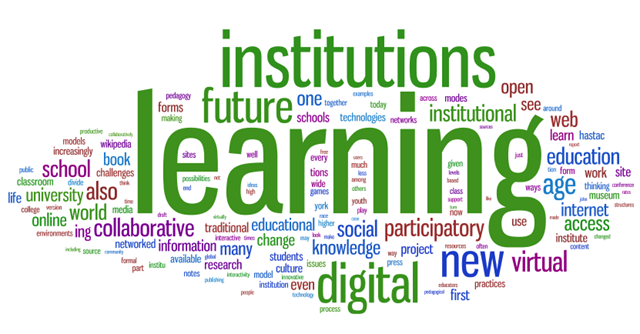
Image c/o Martin Hawksey (and his musings on this text as well). 

In the first collaborative project, the authors share ten principles to support the future of learning. Davidson and Goldberg (2009) presented these pillars of institutional pedagogy to help institutions rethink learning and meet the challenges that lie ahead for both K-12 and higher education:

  1. Self-Learning – discovering and exploring online possibilities
  2. Horizontal Structures – how learning institutions enable learning; from learning that to learning how; from content to process
  3. From Presumed Authority to Collective Credibility – shifting issues of authority to issues of credibility; understand how to make wise choices
  4. A De-Centered Pedagogy – adopt a more inductive, collective learning that takes advantage of our era and digital resources
  5. Networked Learning – socially networked collaborative learning stressing cooperation, interactivity, mutuality and social engagement
  6. Open Source Education – seeks to share openly and freely in the creation of culture and learning; provides a more collective model of interchange
  7. Learning as Connectivity and Interactivity – digital connection and interaction to produce sustainable, scaffolding ensembles
  8. Lifelong Learning – there is no finality to learning; learning is part of society and culture
  9. Learning Institutions as Mobilizing Networks – networks enable flexibility, interactivity, and outcome; new institutional organizations reliability and innovation
  10. Flexible Scalability and Simulation – new technologies allow for collaboration beyond distance or scale for productive interactions that warrant educational merit

Reference: Davidson, C.N. & Goldberg, D.T. (2009). The future of learning institutions in a digital age. Cambridge, MA: The MIT Press.

Career, Higher Education, Learning Technologies, Social Media

Using LinkedIn with First Year Students #UGST1000

For many of my career and employment friends in higher education, LinkedIn is often a great professional networking website that many students explore later in their academic careers. Since “career development” is a process, a couple of instructor from UNT thought it might be helpful to expose our first year students to this learning network earlier in their degree programs.

Image c/o Melissa Venable’s Blog

This fall term, at least one section of the UGST 1000 – First Year Seminar will be using LinkedIn to help explore major and career options. This small seminar class is part of a learning community, where these same students are also classmates in two larger business classes: ECON 1100 – Microeconomics and BUSI 1340 – Managing the Business Enterprise. This UGST 1000 instructors (Allyson & Roxanne) thought using LinkedIn as a social networking website might provide more help for this group of undecided/undeclared students as  they research career/occupation options, understand the skills needed in the business industry, and connect to helpful ideas while exploring their majors in the first semester.

Here is the information about LinkedIn for the UGST 1000 class syllabus:

About LinkedIn: We are using LinkedIn as it is an important form of social media for business professionals. LinkedIn operates the world’s largest professional network on the Internet with 161 million members in over 200 countries and territories.  Additionally, LinkedIn counts executives from all 2011 Fortune 500 companies as members and its corporate hiring solutions are used by 82 of the Fortune 100 companies.  Basic LinkedIn accounts are free and can be created by visiting www.linkedin.com. By default, all information on your LinkedIn account will be public.  All information on our group’s page will be set to private; only members in our group will be able to read them. 

Here are some ideas of HOW students will use LinkedIn over the course of the term:

  • Build a Professional Student LinkedIn Profile – complete with a photo, information headline, listing educational/work experience, identify specialties, and establish a unique URL
  • Understanding the Value of Their Network for Learning & Experience – ability review their current network and identify how they want to grow their personal/professional connections on campus, online and within industries of interest to help support effective major/career decision-making.
  • Job Search – aware of the current job markets and trends in LinkedIn vs. how they compare to the O*NET and US Bureau of Labor Statistics.
  • Groups and Associations – Connect to a variety of LinkedIn Groups and associations related to their potential major/career interests.
  • References – Collect LinkedIn recommendations from previous instructors, employers or affiliations.
  • Understand LinkedIn Netiquette – updating your profile, posting appropriate status updates, acceptable ways to connect with others, asking for introductions, understanding what groups to join
  • Get Social – Connect any social outlets where they include professional work artifacts, thoughtful blog posts, personal or work websites, or avenues potential employers might like to see.
  • Group Discussions in LinkedIn Groups – private group discussion where students will lead the topic with an article, resource and question for their peers to respond.
  • Roadtrip Nation Group Project – outreach to professionals and companies to interview for the RTN project.
  • Major/Career Research Paper – informational interviews are part of this final paper assignment so LinkedIn will be able to provide students with potential interview contacts

We are currently collecting helpful links, articles, and information about LinkedIn use for learning and networking HERE, and we would LOVE to add MORE resources to our list. Please leave a comment and share your thoughts below. Thanks!

EC&I831, eduMOOC, Higher Education, Learning Community, Learning Technologies, Open Education, PLN, Virtual Communities, Web Design

#mtmoot Opening Keynote: Digital Pedagogy to Engage

This morning I will be joining the Mountain MoodleMoot at Carroll College in Helena, MT to share some thoughts and ideas around engaged digital pedagogy. Our learners are connected; however  I think more educators and instructional designers need to support our students in developing effective learning skills to navigate this new culture of learning. For those of you interested in following along, be sure to tweet with hashtag  #mtmoot, check out my slides (below), and feel free to scope out the digital handout http://bit.ly/mtmoot12 I compiled for this session.


Today’s learners operate in a world that is informal, networked, and filled with technology. Connectivity and digital access is an increasing need for our students and a vital requirement to excel beyond structured learning environments. Our learners are now able to interact with information, learning materials, and peers from around the globe. There is an increasing need to expand and enhance our learners’ involvement in learning technology to support engagement in online learning environments.

With the emergence of collaborative, online tools, educators can take advantage of multidimensional and engaged participation to reach their learning outcomes. Social media creates a space where “everybody and anybody can share anything anywhere anytime” (Joosten, 2012, p.6). Educational paradigms are shifting to include new modes of online and collaborative learning and student-centered, active learning to challenge our students to connect curriculum with real life issues (Johnson, Adams & Cummins, 2012). As a new generation of learners begin to create and share content, educators need to understand how to effectively utilize social web resources to impact in instructional practice create a culture of online participatory learning.

Emerging technology platforms and devices are beginning to disrupt education as we know it. To coevolve and positively impact learner success, it is critical that instructors and instructional designers consider how digital pedagogy can support learning outcomes. This keynote plenary will share ideas and suggested practices to develop a richer learning experience and thrive in the changing digital learning frontier.

References

Johnson, L., Adams, S. & Cummins, M. (2012). The NMC Horizon Report: 2012 Higher Education Edition. Austin, TX: The New Media Consortium.

Joosten, T. (2012). Social Media for Educators. San Francisco, CA: Wiley/Jossey-Bass.