Dissertation, PhD, Social Media

Your Higher Ed Website + Search: “Social Media Guidelines” or “Social Media Policy” = A Database for My Dissertation Research

Yes. I know that this may be my  LONGEST blog post title ever. I created it for one reason. It is the equation which will help me move my research forward for my dissertation.

featuredimages_socialmedia

You may recall a previous request for this from an earlier blog post: Gathering #SocialMedia Guidelines from #HigherEd. So, basically what I’m saying is…

I NEED YOUR HELP! => Submit Your Social Media Guidance Please!

My dissertation research methodology (good ol’ Chapter 3) will involve text mining analysis for reviewing all these many social media guidelines (policies, strategies, beliefs, regulations, etc. included) I am gathering right now. The caveat for this type of research is –  I need to build a large enough database of documents to examine and evaluate. BONUS: After collecting all of these documents, I will share this Social Media Guidance database AND my research findings for you here: http://socialmediaguidance.wordpress.com/

As of today (4:30 pm CT), I have collected approximately 176 Social Media Guidance documents from 13 different countries. Hoo-ray!

Check to see if your institution is listed below, and if it is not – please SEARCH YOUR COLLEGE OR UNIVERSITY WEBSITE to see if you might just happen to have social media guidelines, a policy, a directory, and/or anything that might be related to social media. Thank you!

Social Media

Do You Have Social Media Goals?

After participating in today’s Social Media Metrics in Government Using GSA Guidelines webinar hosted by Hootsuite, I began to think more about the WHY and HOW social media guidelines and policies develop. This session discussed how the government developed their guidelines around their GSA social media goals which were connected to their strategic communication plan and web presence.

Obviously this webinar had a focus on measurement and assessment for social media use using both free and paid tools, like Hootsuite; however it offered some sound advice to organizations that are just developing social media guidance or for those who are re-thinking their social media policy. Instead of starting with a policy, strategy, or guideline list of what to do or not do, it would be more helpful for institutions to think through the WHY of social media. This process provides organizations focus, sets out objectives, and creates a rationale for social media use and how these goals might be measured and assessed. For example, the GSA wanted to use social media and social data goals, included:

  • Be more effective in how they distribute critical information to citizens & communities
  • Engage citizens to help shape to public programs
  • Better inform strategies leading to greater efficiency
  • Increase use of innovative tools and services to further development

It is important to consider your institutional goals when organizing your social media guidance, here a few suggestions given from the webinar – but I am sure your organization has many others.

Internal Considerations:

  • Collaboration
  • Knowledge sharing
  • Cost saving & cost avoidance strategy
  • To be transparent
  • Talent acquisition

External Considerations:

  • Citizen engagement – Active use and participation (2-ways)
  • Promote services and resources
  • Provide customer service – feedback
  • Provide real-time resources – expand upon current communication channels

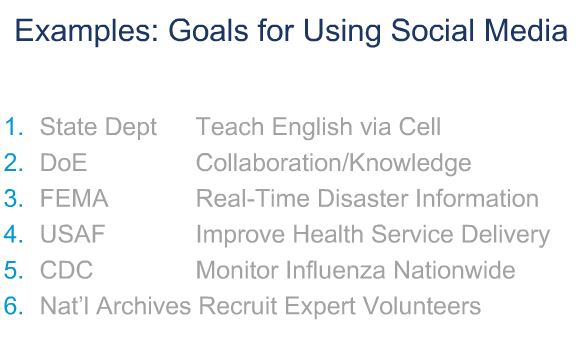
Here are a couple of examples shared from the GSA for their use of social media goals:

Example of Goals for Using Social Media in Government

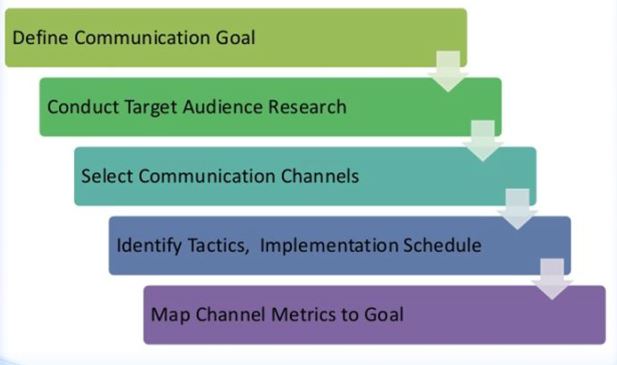
Another reason to consider developing social media goals before establishing your guidelines is to consider how you will evaluate social media use for your organization. Social media management of your resources is critical. To help assess social media engagement and use it will be helpful to align your goals to evaluation as part of your strategic communication plan. Social media analytics and metrics through different 3rd party tools and social dashboards; however what will be relevant for your organization to track and use for assessment purposes. You want to connect your goals to your key performance indicators (KPI) and desired evidence-based outcomes.

Planning for Measurement

One example was the use of hashtags from the Twitter for Public  Health case study to outline a clear system for planning social media management. This public health group utilized a hashtag, #SM4PH, to build hype around the start of a regular, organized Twitter chat and to launch a hashtag for community development. Their goal was to measure the impact of the hashtag use, conversation, and community involvement before, during, and after this first chat to assess the long tail of this campaign.

Does your organization or institution have social media goals? How do these goals support your social media spaces? How do you assess and measure your social media goals? Let me know.

Reference:

Macey, B. (2013, November 14). Social media metrics in government: Using GSA Guidelines – Webinar. HootSource. Retrieved from http://blog.hootsuite.com/social-metrics-gsa-guidelines/

UPDATE 11-19-13: If interested, this webinar is available for viewing on demand.

#phdchat, Book Review, Higher Education, PhD

I’m “On the [Job] Market”: The Application Process

As academic job postings and other employment opportunities are becoming available, I decided it was time to prepare my own application materials and announce that I’m ON THE JOB MARKET. It should be no surprise to many as I am ABD (not a title), and I have been diligently working on my dissertation— so there is really no better time for a job search.

Well I was going to save this for holiday reading...but it looks like I'm On The Market NOW #phdchat I’ll be honest. I’m quite accustomed to the thrill of the job hunt (I am in my 3rd position of employment, since I have moved to Texas 5 years ago); however the academic job search has upped the ante. My future career planning involves a potential re-location (either in the US or abroad) and new career beginnings (either as a junior faculty member, research or other), which means this job search and application process is being treated like a job itself.

To prepare for my job search and career planning…

I have been talking to many researchers in the field, administrators in higher education, companies who seek my support, current faculty (off and on campus), mentors, and peers over the past year [Thank you for these discussions and talks – you know who you are]. More than not, many are quite open to offer advice, share professional experiences, edit my application materials, provide a reference, or send potential job postings my way (hint, hint). In my spare time, I have been reading Barnes’ (2007) “On the Market: Strategies for a Successful Academic Job Search,” specifically,  Chapter 4: The Application Process. This section of the book includes great questions to ask and think about before the application process, and examples of deciphering what academic job postings mean to decide what I want. Here are some current, pre-application questions I am currently pondering:

  • What type of position am I most interested in?
  • What sort of institution or organization do I want to work for?
  • Where do I want to live?
  • Do I want to apply for administrative or faculty track positions?
  • Who will write my reference letters?
  • Will my academic search focus on research or teaching institutions?
  • What is my best academic “fit” for department?
  • Do I want to look beyond higher education & academia?
  • Who will I connect to discussion the application process?
  • What is my timeline and schedule for applications?
  • How will I best organize a joint career search with my partner in crime?

Fortunately, most of my academic application requirements are “works in progress” from my doctoral program and portfolio requirements (Thanks #untLT department!) these past few years. My current objectives are to edit and prepare materials I have for my academic job search and application, including:

  1. Cover Letter
  2. Curriculum Vita
  3. Letters of Recommendation
  4. Writing Samples and Other Supporting Documents
  5. Teaching Portfolio (Dossier)
  6. Social Media Spaces & Places
  7. Application Schedule – to track applications & submissions

This chapter also includes helpful templates for CV’s and cover letter formats. I plan on re-tooling and modifying my current application materials based on position type and job description, so a review of these examples were helpful. Here are a few suggestions for cover letter writing items to include – 17 elements for the academic cover letter:

17 elements of the academic cover letter. #phdchat

Do you have academic job search advice? Tips on the application process? Considerations for the academic research and faculty positions? Potential openings I might be interested at your institution? Let me know. Academic job search advice is welcome.


Reference:

Barnes, S. L. (2007). On the market: Strategies for a successful academic job search. Lynne Rienner Publishers.
Higher Education, MOOC, Open Education

New Social Learning … is It “New”?

Education rarely reinvents the wheel. This is not necessarily a bad thing. There are a number of great theorists, researchers, scholars, practitioners, and educators who have been utilizing connected and social learning ideas for decades.

In thinking about social learning for instructional design, I will turn to Bingham and Conner’s (2010) outline for how this is “new” in many of our organizations:

  • The new social learning is not just for knowledge workers – community-oriented.
  • Plays well with formal education to capture shared learning.
  • Compliments training and supplements development.
  • Similar but not the same as informal learning – more search and reading.
  • More than just online search and social networking.
  • Not like broadcasting information, more communal.
  • Allows for interaction and experiences to share ideas.

Image from Social Media Portal

Thomas and Brown (2011) inquire about the new culture of learning in their book, specifically asking: “What happens to learning when we move from stable infrastructure of the twentieth century to the fluid infrastructure of the twenty-first century, where technology is constantly creating and responding to change?”

I am thinking about this question a lot. A number of educators are looking for the “new” instead of asking questions and assessing the present practices. As a scholar-practitioner with perhaps faculty inklings, I have many concerns and questions for the future of our learning in higher education:

  1. Who (collaboratively) will best respond to the challenges and changes for our learning landscape on your campus?
  2. Why are educational changes and decisions being made? Is there assessment and evaluation? Data-driven decisions? Literature to support the change?
  3. What are we doing well & what can we improve upon in our face-to-face, online, and blended pedagogy in higher education?
  4. How are we thinking about connections, creativity, and social learning for our campus learning environments?
  5. When & how seek out the learner’s input for changes to our educational curriculum, campus programs, and student support services?

The idea of one idea, one thing, or one person to tackle the challenges/changes in higher education is ridiculous. If you think a “new” way to learn – perhaps a MOOC – will solve your university or college, then I am concerned about your strategic goals and learning outcomes. Take a gander at George Siemen’s recent #open13 talk [slides & video] to get a historical perspective on MOOCs (then and now), learning challenges, and other considerations for higher education pedagogy. [P.s. If you want to talk more MOOCs and research – y’all should come down to Texas for the 1st MOOC Research Conference in December]

One great take away from George’s talk (via a priest) about the upcoming shifts to higher education: “Don’t move away from things…because if you move away from things you don’t have a clue where you’re going to end up. Instead, move towards something.”

References

Bingham, T., & Conner, M. (2010). The new social learning: A guide to transforming organizations through social media. Berrett-Koehler Store.

Thomas, D., & Brown, J. S. (2011). A new culture of learning: Cultivating the imagination for a world of constant change (Vol. 219). Lexington, KY: CreateSpace.

Siemens, G. (2013, November 7). MOOCs: How did we get here? Elearnspace. Retrieved from http://www.elearnspace.org/blog/2013/11/07/moocs-how-did-we-get-here/

#AcWri, #AcWriMo

My #AcWriMo Goals for November

acwrimo1-01

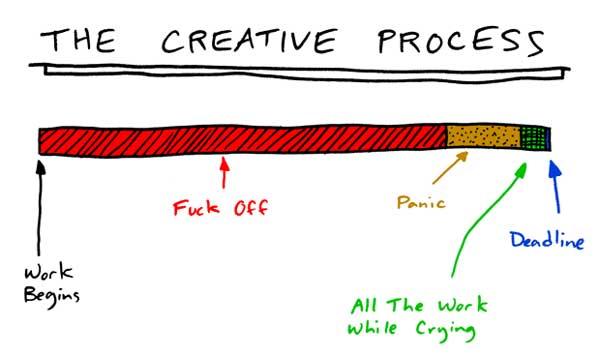
Happy Academic Writing Month (#AcWriMo)! November IS #AcWriMo… however as a student every month is #acwrimo… BUT in an effort move forward on a few writing deadlines and projects I thought this accountability would change my typical “creative process.”

The Creative Process

#AcWriMo main features include:

  • Setting academic writing goals
  • Writing down said goals & tracking (see the AcWriMo 2013 Writing Accountability Spreadsheet) collectively
  • Strategy sharing for #AcWri
  • Sharing my progress (will be weekly for me)
  • WRITE!!!! (most important)
  • Show results (see spreadsheet & future blog posts)

I have participated in this #acwrimo in the past, and I thought that this type of peer/social pressure was very productive. I liked the idea of declaring goals, being accountable and tracking my writing progress in chunks. I also think that this will be a very useful practice to step up my word count and complete writing projects that need to be completed.

My #AcWriMo Goals for November:

  1.  Complete my doctoral dissertation proposal so that it is ready to DEFEND to my committee.
  2. Finish Technology in Advising for Higher Education manuscript to submit to the NACADA Journal.
  3. #iConf14 Social Media Expo – paper & video for conference.
  4. Complete a minimum of 2 blog posts per week – on writing progress and projects.

Here is how I plan on achieving these goals:

  1. Write for a minimum of two 60 minute time blocks per day.
  2. Have a total of 750 words per day written.
  3. Logging my projects, words written, and more to the #acwrimo accountability spreadsheet.
  4. My Tweeps & other social networks can call me out and inquire at ANY time to see how I’m doing.

Are you going to JOIN IN THE #AcWriMo FUN? You should!