Higher Education, Social Media, StudentAffairs

Reflecting on Values & Identity from #Dalton13

Over the past few days at the 2013 Dalton Institute, I have been encouraged to think about the cross-section of how our cultural norms, use of technology, and institutional practices intersect to support students. Educational reform for higher education is not new; however it was refreshing to have a group of graduate students, faculty, scholars, and practitioners to be part of a thoughtful collective to think deeper about these challenges.

Although the institute’s focus was self-promotion, social media, and student development, it was great to hear a number of conversations emerge about the disruptive forces and potential opportunities to embrace change in Student Affairs. The philosophical narratives and analysis of technology’s impact on identity was enriched by listening to personal perspectives and such varied experiences.
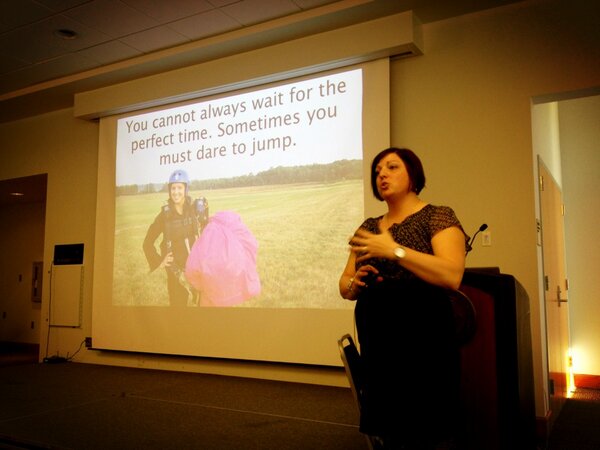
Dare to Jump

Photo c/o @DaltonInstitute {Thanks @vanessaballer!}

As the final keynote of the institute, I gave my “triple threat” perspective as a student, instructor, and professional in higher education. My goal was to share ideas and practices to develop a richer learning experiences; specifically ones that I have valued as an active scholar. So, doing my best to follow the amazing #dalton13 featured speakers – I shared my own narrative, critiques, and insights on how emerging technology can support and challenge student development. I gave some tangible examples and ideas of how to move beyond the gadget, application, or “next big tech thing” by considering ways educators can be actively pushing their learners. I talked about everything from exploration to collaboration, specifically by empowering students to be part of the solution to our institutional challenges.

My #Dalton13 Keynote – Notes & Then Some! (thanks for the photos & tweets #dalton13 backchannel!)

I appreciated the conversations (although some were far too brief!) around identity and student values that  I had with a number of #Dalton13 attendees, especially the FSU HESA graduate students. Although a number of ideas were shared at the institute, I am still left thinking and reflecting about these key questions:

  • How are student values demonstrated in a digital environment?
  • Can educators have an impact on the character development of learners?
  • Is student development really impacted by technology? How so?
  • Does there need to be a shift in how we support our student population on campus?
  • How can our graduate programs do a better job of challenging and supporting scholar-practitioners with “self-promotion” questions?
  • Will higher education cultural norms and institutional practices be changed, or will we be left behind?
Reflections, Social Media, StudentAffairs

#Dalton13 – Google + Interview & Keynote Teaser

Thanks so much to the Dalton Institute (@DaltonInsitute) coordinators, Jessica Dean (@j_deanSAys) & Emily Fox (@EmilyFox526), for hosting my Google + Interview on Tuesday (1/9). I appreciate the great questions from the both of them, and the #Dalton13 backchannel. Everyone really made me reflect and ponder my own technology and student development path – so thanks!


In watching the video recording (which I rarely do), it helped me think more about my talk and how to best shape the focus. Here’s a sneak peak at my #dalton13 keynote title and abstract, for those of you who will be attending the session on February 2nd:

Here is my 2013 Dalton Institute Character Clearinghouse Interview and a preview to my keynote next week:

Title: 

Student Development 2.0: Optimizing Social Media to Connect Your Campus

Abstract: Today’s college student operates in a world that is informal, networked, and filled with technology. Digital interactions are influencing both our students’ characters and values, with increasing access to information and continual contentedness  With the emergence of social web resources, student development professionals and faculty have the ability to engage in experiential and applied learning objectives for their campus environments. Social media creates a space where “everybody and anybody can share anything anywhere anytime” (Joosten, 2012, p.6). Educational paradigms are shifting to include new modes of online and collaborative learning and student-centered, active learning to challenge our students to connect curriculum with real life issues (Johnson, Adams & Cummins, 2012). As new generations of students create and share content on campus, college educators need to realize the potential social media has to construct a culture of participatory, open learning. Emerging technology platforms and devices are beginning to disrupt higher education as we know it. To co-evolve and positively impact our learners’ success, it is critical that we consider the influence and impact social media has on our student populations. This keynote plenary will share ideas and suggested practices to develop a richer learning experience to help students thrive in the changing digital frontier.

References

Johnson, L., Adams, S. & Cummins, M. (2012). The NMC Horizon Report: 2012 Higher Education Edition. Austin, TX: The New Media Consortium.

Joosten, T. (2012) Social media for educators. San Francisco: Jossey Bass.

Higher Education, Learning Community

A Vision of Students Today.

Here is an archived clip I was reminded of today about the current state of our learners.  Although this video past posted back in 2007, I think that the “vision” or purpose of the message still holds true as we support technology & learning.

This video is brought to you by Kansas State University, who has a working group led by Dr. Michael Wesch.  This group is dedicated to exploring and extending the possibilities of digital ethnography.  You can follow along at Media Cultures or @mwesch.

Learning Community, Micro-Blogs

Teaching with Twitter

Some college students may be introduced to instructors & courses that ENCOURAGE micro blogging with Twitter.

Twitter is becoming a fast buzz in both media and celebrity circles, however, I think that more teachers are beginning to realize the power this social media tool for learning.

Here are a few benefits for professors who experiment with Twitter as a teaching tool:

  • source of news
  • opinions of peers
  • gain knowledge from experts
  • live & archived tweeting in class
  • capture lecture content
  • add depth to lecture material
  • build a learning community inside & beyond the classroom

For those faculty/instructors who might consider tweeting in class, I might recommend that you start up your own Twitter account and play with it. Also, be sure to read up about strategies &tools that to optimize learning with Twitter.

I personally like TweetDeck (an Adobe Air-based app) to organize & categorize my tweets. I can clearly see my messages, replies and content areas I am interested in at a quick glance.  Some categories I use for tweets include Higher Ed, Web Tools, Career Research, T.O., Students, etc.

Are YOU tweeting with your students? If so, please share!