Dissertation, PhD, Social Media

Your Higher Ed Website + Search: “Social Media Guidelines” or “Social Media Policy” = A Database for My Dissertation Research

Yes. I know that this may be my  LONGEST blog post title ever. I created it for one reason. It is the equation which will help me move my research forward for my dissertation.

featuredimages_socialmedia

You may recall a previous request for this from an earlier blog post: Gathering #SocialMedia Guidelines from #HigherEd. So, basically what I’m saying is…

I NEED YOUR HELP! => Submit Your Social Media Guidance Please!

My dissertation research methodology (good ol’ Chapter 3) will involve text mining analysis for reviewing all these many social media guidelines (policies, strategies, beliefs, regulations, etc. included) I am gathering right now. The caveat for this type of research is –  I need to build a large enough database of documents to examine and evaluate. BONUS: After collecting all of these documents, I will share this Social Media Guidance database AND my research findings for you here: http://socialmediaguidance.wordpress.com/

As of today (4:30 pm CT), I have collected approximately 176 Social Media Guidance documents from 13 different countries. Hoo-ray!

Check to see if your institution is listed below, and if it is not – please SEARCH YOUR COLLEGE OR UNIVERSITY WEBSITE to see if you might just happen to have social media guidelines, a policy, a directory, and/or anything that might be related to social media. Thank you!

Social Media

Do You Have Social Media Goals?

After participating in today’s Social Media Metrics in Government Using GSA Guidelines webinar hosted by Hootsuite, I began to think more about the WHY and HOW social media guidelines and policies develop. This session discussed how the government developed their guidelines around their GSA social media goals which were connected to their strategic communication plan and web presence.

Obviously this webinar had a focus on measurement and assessment for social media use using both free and paid tools, like Hootsuite; however it offered some sound advice to organizations that are just developing social media guidance or for those who are re-thinking their social media policy. Instead of starting with a policy, strategy, or guideline list of what to do or not do, it would be more helpful for institutions to think through the WHY of social media. This process provides organizations focus, sets out objectives, and creates a rationale for social media use and how these goals might be measured and assessed. For example, the GSA wanted to use social media and social data goals, included:

  • Be more effective in how they distribute critical information to citizens & communities
  • Engage citizens to help shape to public programs
  • Better inform strategies leading to greater efficiency
  • Increase use of innovative tools and services to further development

It is important to consider your institutional goals when organizing your social media guidance, here a few suggestions given from the webinar – but I am sure your organization has many others.

Internal Considerations:

  • Collaboration
  • Knowledge sharing
  • Cost saving & cost avoidance strategy
  • To be transparent
  • Talent acquisition

External Considerations:

  • Citizen engagement – Active use and participation (2-ways)
  • Promote services and resources
  • Provide customer service – feedback
  • Provide real-time resources – expand upon current communication channels

Here are a couple of examples shared from the GSA for their use of social media goals:
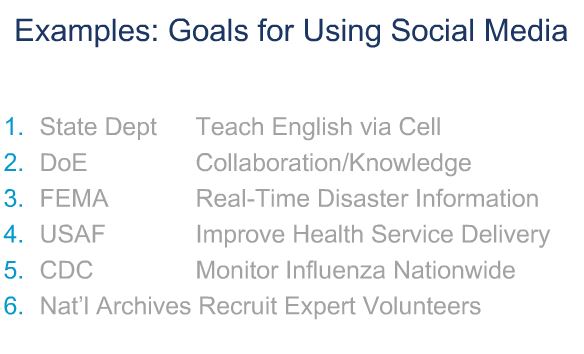
Example of Goals for Using Social Media in Government

Another reason to consider developing social media goals before establishing your guidelines is to consider how you will evaluate social media use for your organization. Social media management of your resources is critical. To help assess social media engagement and use it will be helpful to align your goals to evaluation as part of your strategic communication plan. Social media analytics and metrics through different 3rd party tools and social dashboards; however what will be relevant for your organization to track and use for assessment purposes. You want to connect your goals to your key performance indicators (KPI) and desired evidence-based outcomes.
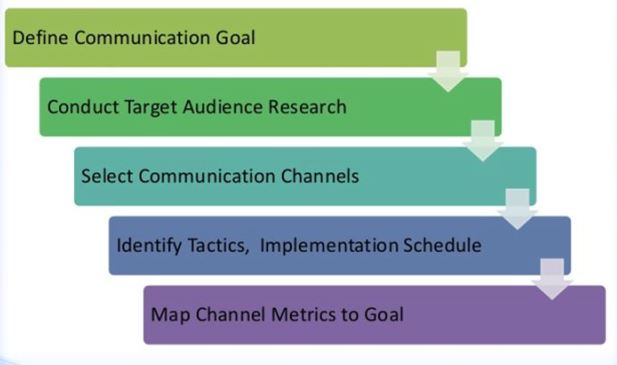
Planning for Measurement

One example was the use of hashtags from the Twitter for Public  Health case study to outline a clear system for planning social media management. This public health group utilized a hashtag, #SM4PH, to build hype around the start of a regular, organized Twitter chat and to launch a hashtag for community development. Their goal was to measure the impact of the hashtag use, conversation, and community involvement before, during, and after this first chat to assess the long tail of this campaign.

Does your organization or institution have social media goals? How do these goals support your social media spaces? How do you assess and measure your social media goals? Let me know.

Reference:

Macey, B. (2013, November 14). Social media metrics in government: Using GSA Guidelines – Webinar. HootSource. Retrieved from http://blog.hootsuite.com/social-metrics-gsa-guidelines/

UPDATE 11-19-13: If interested, this webinar is available for viewing on demand.
Higher Education, Social Media

Guiding Social Media at Our Institutions [ARTICLE]

Remember last fall when Tanya Joosten (@tjoosten), Lindsey Harness (@LindseyHarness) and I asked for your input on how your institution guides social media? No? Too long ago to remember? 🙂 Well regardless, we appreciated those who could respond as it helped us gather information on what we are (or are not) doing to direct social media use in higher education.

The results from the research are in, and published! Here is the recently published, peer-reviewed article for the Society for College and University Planning (SCUP).

Access the article in PDF form here.

This article expands on Chapter 6 from Social Media for Educators to understand how higher education is guiding social media use. Through our open-ended questions, we learned more about how institutions are supporting and guiding social media. Often we see social media used a broadcast medium and there has also been a shift to designate new roles or responsibilities to support its use on campus.

Thanks to the SCUP Change-Disruption Mojo for featuring some of the findings as this week’s topic, specifically to Alexandria Stankovich (@thinkstank) for sharing both sides of the issue:

  • Concerns: monitoring online behavior, identity thief, privacy, FERPA/FIPPA, maintaining university image, control, ownership, required trainings

  • Benefits: interaction and engagement beyond the formal learning environment

Want to learn more about the research and/or article findings?

Key takeaways:

  • Social media is often used as a “broadcast channel”
  • We should engage and develop a culture through the use of social media tools
  • Institutions need fluid access to information regardless of the technology
  • Simplicity principle to build capacity for the social web
  • We need to develop models of effective practice for LEARNING!
  • Trust the faculty you hire – they have some great ideas
  • Recognize that learners are MORE than sponges
  • Match technology with task & building digital literacy opportunities
  • Is social media in your strategic plan? Is social media or technologies part of your learning outcomes on campus? THIS is where your efforts need to be
  • Institutional encouragement is needed for collaboration ON YOUR CAMPUS to identify how to best guide social media models & effective practices
“The pedagogical benefit of social media use beyond its application as a motivational technique continues to be unaddressed by many universities.”

This study was just the tip of the iceberg. There is definitely more research on learning, social media use, and higher education to be done. Time to get at it! Back to the dissertation proposal grind…

Reference:

Joosten, T., Pasquini, L. A., & Harness, L. (2013). Guiding social media at our institutions. Society for College and University Planners – Integrated Planning for Higher Education, 41(2), 1-11.