#phdchat, PhD

My #Dissertation Defense

This Thursday two epic events kick off:

  1. The 2014 World Cup (3 pm CT)
  2. My FINAL Dissertation Defense (2:30 pm CT)

Conveniently, I found this @PhDComics cartoon (circa 2010) shared in my network:
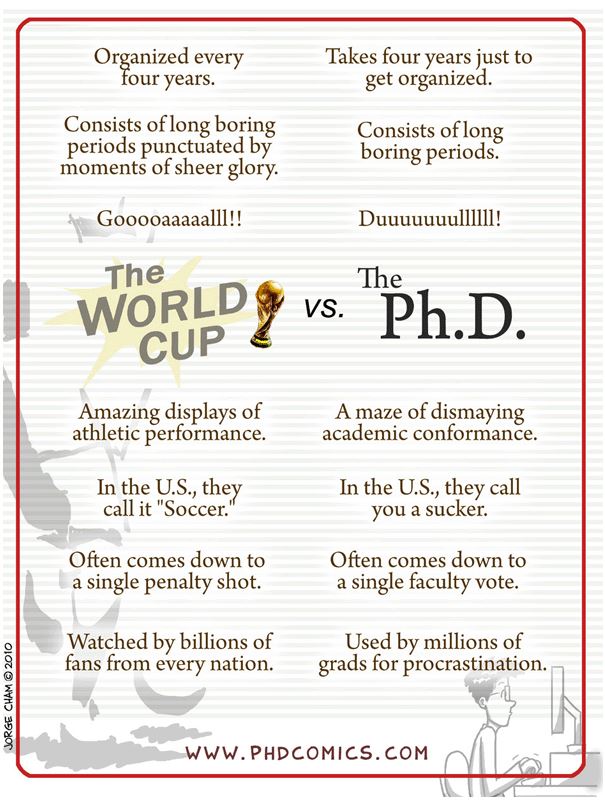
World cup soccer and PhD

c/o PhD Comics: World Cup vs. PhD

Here is my dissertation title and abstract:

Pasquini, Laura A. Organizational Identity and Community Values: Determining Meaning in Post-Secondary Education Social Media Guideline and Policy Documents. Dissertation Abstract, Doctor of Philosophy (Applied Technology and Performance Improvement), August 2014.

With the increasing use of social media by students, researchers, administrative staff, and faculty in post-secondary education (PSE), a number of institutions have developed guideline and policy documents to set standards for use. Social media platforms and applications have the potential to increase communication channels, support learning, enhance scholarship, and encourage community engagement in higher education. As social media implementation and administration has developed in the PSE sector, there has been minimal assessment of the substance of social media guideline and policy documents (McNeil, 2012).

The first objective of this research study was to examine an accessible, online database (corpus) comprised of 24, 243 atomic social media guideline and policy text documents from 250 PSE institutions representing 10 countries to identify central attributes. To determine text meaning from topic extraction, a rotated latent semantic analysis (rLSA) method was applied (Evangelopoulos & Polyakov, 2014). The second objective of this investigation was to determine if the distribution of topics analyze in the corpus differ by PSE institution geographic location. To analyze the diverging topics, the researcher utilized an iterative consensus-building algorithm (Winson-Geideman & Evangelopoulos, 2013).

Through the maximum term frequencies, LSA determined a rotated 36-factor solution that identified common attributes and topics shared among the 24,243 social media guideline and policy atomic documents. This initial finding produced a list of 36 universal topics discussed in social media guidelines and policies across all 250 PSE institutions from 10 countries. Continually, the applied chi-squared tests, that measured expected and observed document term counts, identified distribution differences for the content related factors between US and Non-US PSE institutions.

This investigation offered a concrete analysis for unstructured text data dealing with of social media guidance. This resulted in a comprehensive list of recommendations for developing social media guidelines and policies, and a database of social media guideline and policy documents for the PSE sector and other related organizations that guide social media use and implementation.

Additionally, this research stimulated important theoretical development for how organizations socially construct a semantic structure within a community of practice (Wenger, 1998). By assessing the community of practice, comprised of PSE 250 institutions that direct social media use, a corpus of documents created unstructured data to evaluate the community. The spontaneous participation and reification process of the social media guideline and policy document database reaffirmed that a corpus-creating community of practice can instinctively form a knowledge-sharing organization that provides meaning, values, and identity. These findings should stimulate further research contributions, and provide practitioners and scholars with tools to measure, understand, and assess semantic space for artifacts developed within a community of practice in other industries, organizations, or distributed associations.

My doctoral dissertation committee from the University of North Texas:

Co-Major Professors:

  • Dr. Jeff M. Allen – Department of Learning Technologies, College of Information
  • Dr. Nicholas Evangelopoulos – Department of Information Technology & Decision Sciences, College of Business

Committee Member:

  • Dr. Kim Nimon – Department of Learning Technologies, College of Information

Minor Professor:

  • Dr. Mark Davis – Department of Management, College of Business

Updates to my dissertation research methods, social media guideline and policy document database, and more can be found on my dissertation website:

http://socialmediaguidance.wordpress.com/

If you are interested in attending my dissertation defense, my meeting is scheduled:

Thursday, June 12, 2014 at 2:30 pm at Discovery Park, Department of Learning Technologies (Room G150)

Side note: I really hope a certain football fan I know attends my defense. I am sorry these two events were timed so close together. 🙂

References

McNeill, T. (2012). ‘‘Don’t affect the share price’’: social media policy in higher education as reputation management. Research in Learning Technology, 20.

Wenger, E. (1998). Communities of practice: Learning, meaning, and identity. New York, NY: Cambridge University Press.

Winson-Geideman, K., & Evangelopoulos, N. (2013). Topics in Real Estate Research, 1973-2010: A Latent Semantic Analysis. Journal of Real Estate Literature21(1), 59-76.

Evangelopoulos, N., & Polyakov, S. (2014). Indexing with rotated latent semantic dimensions. Manuscript submitted for publication.
#phdchat, Reflections

So You’re Thinking About a PhD…

In talking to my exploring major students on campus and other professionals in the field — I often share about my Ph.D. experience and talk about what it means to be a doctoral researcher.  Often I am asked about my Ph.D. program, my line of research, and how “I like it.” I often say I’m too close to it to really give advice, but I’m happy to talk about my experience and answer questions as I can or refer to others.

phd
Last fall at the #nacada13 conference in Salt Lake City, UT, I was part of a doctoral researcher panel on this topic: 
How To Hack Your Ph.D.: Being a Doctoral Student & Academic Advisor and a few #HackPhD Notes on Storify

It was a full house. Not surprised. There has been a growing interest among colleagues interested in pursuing a Ph.D. I am often asked about my Ph.D. research, progress, and if others should get into the same program or even start a Ph.D. To be honest, I am not sure I have the answers to these questions. I am too near the subject right now…

I’ve read a great number of books on the topic of graduate work, Ph.D. survival, writing, publishing, research, and more – but really, it was for my own inquiry and nerdy interest.  Like any good academic/career counselor, I usually ask those interested in a Ph.D. about their own motivations and rationale for the interest in doctoral research.

So you’re thinking about a Ph.D.? I have 10 questions AND prompts for you! I am not sure it will help — but I thought I might as well put these “you wanna pursue a Ph.D.” questions out there others who are considering the Ph.D. track. Take these questions with you as you ponder your Ph.D. goals, research potential graduate programs, apply to potential programs, and, even, start your first semester of your doctorate program:

  • What career goals do you have? List both your short-term and long-term goals in a statement. Write them out, read, and reflect.
  • How does your current work experience (resume/CV) relate to your career goals and interest in a Ph.D. program? Reflect on your relevant experience.
  • How your master’s degree or other educational credentials relate to and support your career goals? Describe your academic experience and background.
  • If you were going to seek out letters of recommendation for your Ph.D. program, who would write your letters of recommendation? Why? What might they say about you? List at least three individuals who would be your academic reference, and consider what they might say about your application to a scholarly program.
  • Do you have any scholarly or peer-reviewed writing samples? If so, please consider how they might be submitted and reviewed by a potential Ph.D. program. If not, what articles or journals interest you in your area. Research!
  • What is your research interest? Often you will have to complete a “Statement of Research Interest” so explain the areas or topics you want to study. If applicable, also consider for research:
      • Any specific theories or models of interest?
      • What seminal work in the field have you read?
      • What will you use to guide your research focus? Authors? Disciplines?
      • What is your preferred research methodology?
      • What is your research methods “worldview”?
  • What will you contribute to the doctoral research and your Ph.D. program? Explain the unique knowledge and skills you will bring into a doctoral program as a potential student
  • What will you contribute to the doctoral research and your Ph.D. program? Explain the unique knowledge and skills you will bring into a doctoral program as a potential student.
  • Where do you want to study? This question is for both geographic location and specific discipline home (e.g. education, sociology, economics, etc.).
  • How will your basic needs be met? Financial, emotional, and social support. It is important to think about your budget, personal relationships, professional objectives, and more when plotting for doctoral work. This will be a few years of your life — so be sure this how you want to spend it. Have this discussion with family, partners, and friends in advance. Be informed about scholarships and funding costs.
  • When is the right time? I doubt this ever has a great answer – but you need to determine this for you after answering the above questions. Decide if the Ph.D. route is right for you, and then if the timing is right or can be right. You can always make it work if you want it. [p.s. Did I say you should WANT to do a Ph.D.? That’s the only way to finish.]
Bonus Question: Who will mentor you through your Ph.D. progress? Faculty advisors at your campus will be great, but who else will you consider as part of your doctoral experience. Peers? Colleagues? Researchers in the field? Scholars, you admire/read?Doctoral candidates and early career researchers? Build your Ph.D. learning network NOW.
#phdchat, PhD, Reflections

Defending My Dissertation Proposal

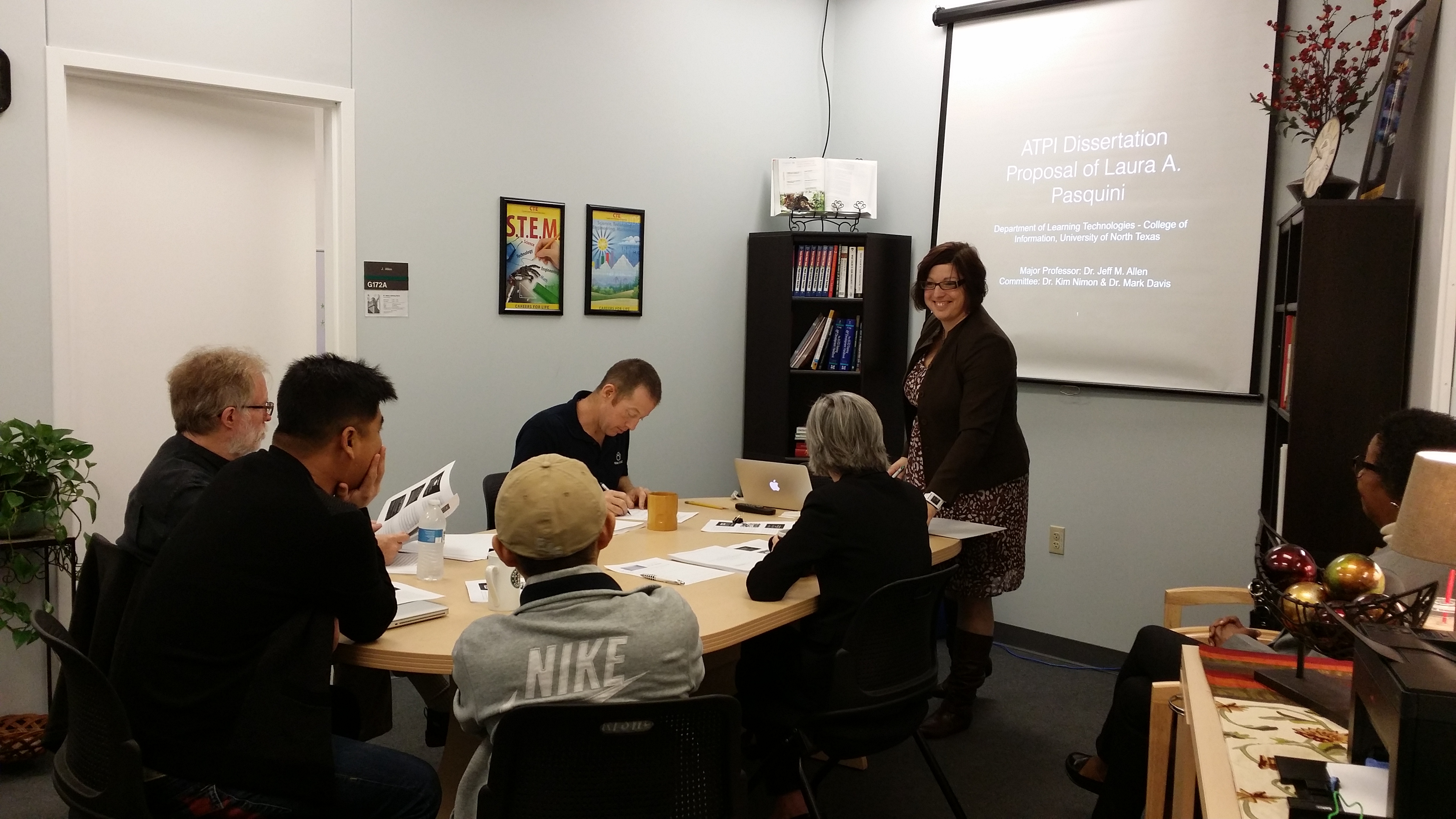
Well there you have it. I successfully defended my dissertation proposal to my faculty committee on Tuesday. My proposal represents Chapters 1, 2, & 3 of my dissertation.

This slide deck might give you some insight, but probably not enough to cover my 89-page proposal. Really, this was just a visual to talk about my research plan. From this meeting, I have some helpful notes, comments, and questions to answer before moving forward with my data analysis. After I clean a few things up, I will be sure to detail more about my these chapters, specifically the literature review and research methods.

20140225_104145Our department also invites other researchers, including students, faculty and visiting scholars, to our dissertation proposal and final dissertation defenses. This open forum style provides other doctoral researchers with ideas and examples for their own research and defense. I have attended a few proposals (and final defenses) before presenting my own. These defenses are great learning opportunities to gain insight and ideas for the doctoral process. During this post defense meeting, I really do appreciate the SUPPORT and FEEDBACK given by my scholarly peers (near and far). Thank you all!

Although it is not the end (just one FINAL defense left), my faculty advisor told me to celebrate. Take heed of important milestones. It is important to recognize steps throughout the doctoral experience since it is a long journey. I am not finished; however my dissertation proposal lays the ground work for Chapter 4: Results and Chapter 5: Discussion, a.k.a. my contract to freedom and to finish my PhD. It’s go time.

#phdchat, PhD, Reflections

The PhD: Troubles Talk… and Moan… and So On

As a PhD candidate, I am trying to be more cognizant  with my response when asked the following (common) questions:

  • “How’s your dissertation going?”
  • “When are you going to finish your PhD ?”
  • “Where have you been? I haven’t seen you in ages…”

phdFor those who are also “dissertating” like me, you understand how easy it is to offer a roll of the eyes, smile/nod combo, and “just great” to friends and family. When talking to fellow PhD candidates and scholarly researchers, we seem to be more open to dig right in to slag the our dragging timelines, cry about our progress, complain about our faculty support, identify dissertation distractions, and, of course, whine about the TIME we used or didn’t use productively.

I recently read an article by Dr. Inger Mewburn (a.k.a. The @ThesisWhisperer), who discussed such “troubling talk” among PhD candidates. Often it is the talk of troubles that brings PhD scholars together to form communities  of practice, like a learning network and/or support group. There has been a large growth in online blogging, tweeting, slidesharing, podcasting, and more from PhD and early career researchers. There’s an active online community that supports personal/professional development and sharing of resources.

One section in particular interested me as Inger shared her own experience with the transition from student to professional academic. Specifically Mewburn (2011) discusses how there is evidence for doctoral researchers who interact with one another often whine and encouraged this type of struggle storytelling with others, even if they were not having any challenges. In recounting experiences of PhD gatherings and discussion over lunch, Inger identifies with the camaraderie of a shared PhD struggle:

 “The recognition that others were struggling too certainly made me feel better, but at the same time my own role in the talk was strangely discomforting. I realised I was amplifying my writing trouble, making it into a ‘war story’  in order to make it amusing and interesting to others. I wondered: was my performance of an   ‘inept student’  in the kitchen a form of PhD student identity work? By talking about being ‘in trouble’ with my writing, I was positioning myself as ‘one of us’  (a student) and not ‘one of them’  (a professional academic)  which was closer to my lived experience. I began to wonder: did my fellow PhD students ever deliberately perform ‘non competence’  too? It’ s likely that many of them experienced good writing days, but I rarely, if ever, heard about them in the lunch room” (Mewburn, 2011, p. 322).

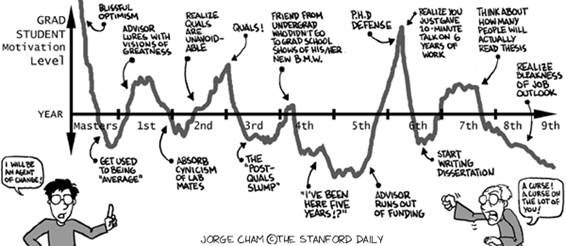
Which brings me to my own experiences, and thoughts about my PhD progress. Do I keep quiet or join in with the slagging if I am around others who are complaining about the struggle? Do I try to down play my advances in writing and publications with other grad students? Have I told any “war story” to entertain my peers, rather than the reality of my own research progress? It is easy to fall into this, especially when there are funny xckd.com images or brilliant PhDComics.com cartoons. Just posting something like this to get a like, RT, or share from others in my PhD community is commonplace with those of us who claim #GradStudentProblems:

grad student motivation graph

A number of blogs, such as The Thesis WhispererPhD Talk, and PhD2Published; and Twitter hashtag communities, like #phdchat#gradchat, and the @GradHacker community of bloggers/Tweeters, have actually been quite helpful for my PhD progress.  I appreciate theses online communities for sharing ideas, talking about writing resources, offering advice, and linking to research methodology. When thinking about my own approach to “catching up” with my social networks (online and in person), I’ll be sure to not just moan about things. Although I do value my online networks, there’s nothing better than having a bit of a chat with other doctoral students/candidates or researchers when we get a chance to meet up and socialize.

Let’s not just use these social moments to be A.B.M. (always be moaning). As PhD candidates, our lives aren’t THAT bad. We were selected to study and research in a field or discipline we want, and really if it’s not your cup of tea … then maybe it’s time for a change anyways. Much of our PhD negative self-talk or even group-think can stifle research and writing momentum. Sure – there’s going to be issues and challenges; however we need to celebrate the small victories along the way. I know we have more productive and interesting things to talk about when we get together (online or in person), so let’s collectively encourage, motivate, and positively influence each other with our research progress. We CAN do it!

Reference:

Mewburn, I. (2011). Troubling talk: Assembling the PhD candidate. Studies in Continuing Education, 33(3), 321-332.

#AcWri, #AcWriMo, Dissertation

#AcWriMo In Review: My Output

Many things come to an end as the month of November closes. See you later Thanksgiving, Fall 2013 semester, #Movember, and Academic Writing Month (#AcWriMo). (Actually – it’s more of a see you soon, really.) Officially, the month of November is dedicated to #AcWriMo; however a number of graduate students (including yours truly) used this past month to complete a good chunk of their dissertation to loose this moniker:

Why my weekends are filled with literature reviews, data collection & #acwri sessions... #acwrimo

Review of My November #AcWriMo Goals… and my Lessons Learned:

  1. Complete my doctoral dissertation proposal so that it is ready to DEFEND to my committee.  Almost there. I did get a good chunk of writing accomplished at the UNT Dissertation Boot Camp – so this helped #acwrimo my progress. Although drafted, my dissertation proposal is not ready to defend yet. In working on a new application for methodology for social science, I want to meet with a couple faculty members on campus to hash out specifics and needs for Chapter 3 (Methodology) and test some of this during the month of December. It looks like a January 2014 date is more realistic for my dissertation proposal defense. I’m okay with this – because once this proposal is approved then Chapters 1, 2, and 3 for my dissertation are DONE!

Lesson Learned: Dedicate the time for the dissertation. As a doctoral candidate you need to be selfish with your writing time. Since this is large project, you need to chunk out your research and writing time that is supported by realistic short- and long-term goals.

  1. Finish “Technology in Advising for Higher Education” manuscript to submit to the NACADA Journal. Since I started #AcWriMo a day later, I used December 1st to work on the #AdvTech research findings and drafting of this manuscript. I am not sure why this project was put on a back burner, but I definitely need to move forward and submit this in December 2013 for Spring 2014 publication eligibility. This goal is not complete, but I will plan on sharing it with my co-authors before the week is out so we can submit to the journal editors for review.

Lesson Learned: Finish your #acwri projects before taking others on. Sure the promise of more research and writing might be enticing, but how productive will you be on your own or with a collaborative writing team if you are not finishing your manuscripts and publishing them? Always be submitting.

  1. #iConf14 Social Media Expo – paper & video for conference. After a lunch brainstorm session with Andrew Miller (@findandrew) and @FiachraM last week, I found the momentum to draft the abstract for the #iConf14 proposal.  Although not submitted (just yet), the abstract is being wrapped up and edited this evening. The final video will be compiled tomorrow evening; however our team Dropbox is filled with photos and images, with Andrew to capture video tomorrow.

Lesson Learned: Innovative ideas come from interdisciplinary thinking and problem solving. Research that is participatory and collaborative drives my writing and efforts. Also, when you experience #acwri well with other scholars, be sure to include these researchers as conspirators for your common research interests and projects.

  1. Complete a minimum of 2 blog posts per week – on writing progress and projects. Done. Whether I was reading, researching, or writing – I was able to share what I was working on with my blog readers, and provide on-going updates about my #acwrimo progress.

Lesson Learned: Stating goals out loud and adding social pressure is great, but reflection and sharing always helps me to process ideas more. Although my “official” month of #acwrimo accountability is over, I am fortunate to have my blog to share and write about my research progress, dissertation progress, teaching methods, and more.

Overall…

This month of academic writing has been very productive for me. In looking at my contribution to the #AcWriMo Accountability in the Spreadsheet o’ Fun you can see I logged at least 35, 097 words, and have been dedicated to the daily habit of writing. It is not so much the word count, but really the completed projects, which are finished and not taking up real estate in my research/writing space. I am taking the #acwrimo lessons learned with me by continuing this #acwrimo habit in December by setting specific project goals, carving out dedicated writing time, and reflecting my progress via my blog.

How did #AcWriMo in November go for you? What have you learned from this academic writing month? Post a comment to share, or respond to this #AcWriMo Questionnaire (not mine).