
Book Review, Higher Education, K-12, Open Education, PLN

10 Principles for the Future of Learning

While working on some late night treadmill mileage, I decided to catch up on documents and books I have been collecting on my Kindle. Last week I read The Future of Learning Institutions in a Digital Age, which was a precursor to The Future of Thinking: Learning Institutions in a Digital Age book published by the John D. and Catherine T. MacArthur Foundation. Although this material is a bit dated, I think that some of the pedagogy still applies for educational development.
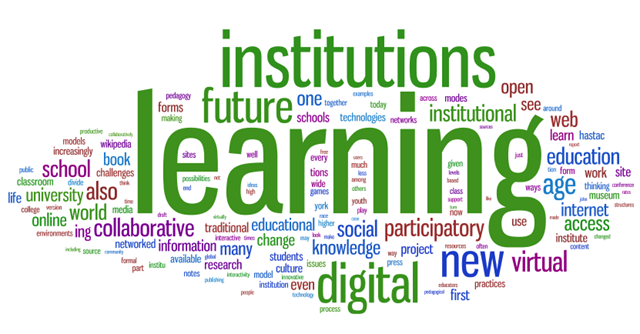
Image c/o Martin Hawksey (and his musings on this text as well). 

In the first collaborative project, the authors share ten principles to support the future of learning. Davidson and Goldberg (2009) presented these pillars of institutional pedagogy to help institutions rethink learning and meet the challenges that lie ahead for both K-12 and higher education:

  1. Self-Learning – discovering and exploring online possibilities
  2. Horizontal Structures – how learning institutions enable learning; from learning that to learning how; from content to process
  3. From Presumed Authority to Collective Credibility – shifting issues of authority to issues of credibility; understand how to make wise choices
  4. A De-Centered Pedagogy – adopt a more inductive, collective learning that takes advantage of our era and digital resources
  5. Networked Learning – socially networked collaborative learning stressing cooperation, interactivity, mutuality and social engagement
  6. Open Source Education – seeks to share openly and freely in the creation of culture and learning; provides a more collective model of interchange
  7. Learning as Connectivity and Interactivity – digital connection and interaction to produce sustainable, scaffolding ensembles
  8. Lifelong Learning – there is no finality to learning; learning is part of society and culture
  9. Learning Institutions as Mobilizing Networks – networks enable flexibility, interactivity, and outcome; new institutional organizations reliability and innovation
  10. Flexible Scalability and Simulation – new technologies allow for collaboration beyond distance or scale for productive interactions that warrant educational merit

Reference: Davidson, C.N. & Goldberg, D.T. (2009). The future of learning institutions in a digital age. Cambridge, MA: The MIT Press.

Learning Community, Learning Technologies, Professional Development

Exploring the Future of Courses

Exploring the Future of Courses: From Course to Dis/Course is a short, online (FREE) conference May 14 & 15, 2009. Anyone is able to join in the session presentations & discussions that delve into the topic of online learning and course content that is shared in Elluminate & in Moodle.

Current course models of development, creation and sharing is in question for our learners. Many challenges and changes to digital technologies will impact how to best design course content.

Today’s presentations included:

Most of the sessions discussed how educators are managing the challenges new technology presents and its effect on current course models, data-driven material and learner needs in a digital.

For those of you who could not attend today, be sure to join in online tomorrow OR catch up with the conversation online. If are not able to tune in live, be sure to follow along in Twitter, Delicious or blogs with the hash tag – #disc09

[The sessions in Elluminate will be recorded and archived shortly.]

Great question posed by George Siemens, towards the end of his presentation, to further ponder:

“What is the vital currency of education in a world where the information cycle is no longer controllable?”


Horizon Report, NACADA Tech Seminar 2009

My Slant About What’s On the Horizon (Report 2009)

I have posted about on the NACADA Tech website, however check out the recent publication of the 2009 Horizon Report as posted on the other blog today.

I think that there are some super rad things educators should consider with respect to these new technologies in higher education:

  • increased use of games as learning & instructional tools
  • collective intelligence being on the forefront of university life
  • improved means of communication & teaching through M-learning
  • impacts to educating students about the global community
  • skill development for information & technical literacy
  • changes to dated learning means & materials
  • reviewing assessment & evaluation practices
  • delivery of student support services & resources

And many, many more transitions to what we currently know. Are you ready for what lies ahead?