- Question – ask challenging questions that take on common wisdom to create new directions
- Observe – watch the behavior of customers, suppliers and competitors the way an anthropologist would identify new ways of doing things
- Network – talk to people with different life experiences and perspectives to spark new ideas
- Experiment – construct interactive experiences and build prototypes to provide unorthodox responses and gain new insights
- Associate – draw unexpected connections between questions, problems or ideas from unrelated fields
My Prolegomenon to Technology
A few weeks ago, @JenniferKeegin posted to the #SAWTT Blog with the prompt – What got me interested in Technology?
I think that my prolegomenon to technology was definitely the Commodore 64. I was introduced to this machine at a young age, thanks to my father.
For those who do not know, my father taught high school economics, business, and computers. Beyond having a great collection of books in his office, I was often drawn to his Commodore 64 and I am fortunate that I was able to dabble with device at home. The black screen and green text provided me with the backdrop to my first writing drafts, school projects, pong quests, and weather war game battles.
Around the time this prompt was posted, we sadly said our RIPs to Jack Tramiel, the father of the Commodore 64. Although I have no personal connection to him, this made me sit back and reflect. I felt very fortunate to be introduced to Mr. Tramiel’s machine, and how lucky I was as a child to have the opportunity to tap these keys (along with a few typewriter keys) when technology might not have been as common at home. Of course, I owe a debt of gratitude to my father for exposing my siblings and me to computers at a young age. He challenged us to be curious and explore with technology early on. Thanks the introduction and challenging us to think beyond the possible, Dad.
Organizational Learning Constructs
The nature of learning at the organizational level is a challenge to measure. Huber (1991) defines organizational learning as the development of new knowledge or insights that have the potential to influence behavior.
There are a number of human resource development articles that reflect the individual learning experience and objectives. In considering the organizational learning process, I began to look at the organization level for learning in online communities of practice for an organizational science perspective.
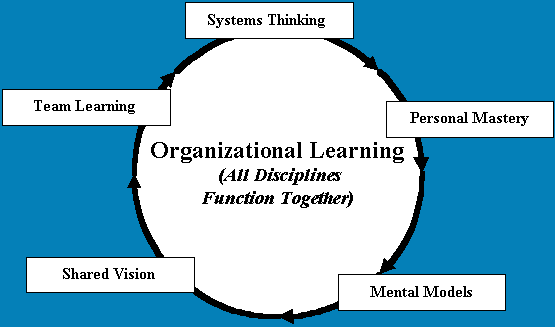
Image via Organizational Learning Software… <http://www.sqakki.com/LearningOrg/>
In researching and working on my final organizational theory paper, I began to assess how learning characteristics can be evaluated in online learning networks and communities of practice. There are a number of models and evaluation instruments to assess learning in organizations; however the constructs established by Yang, Watkins, and Marsick (2004) provide a solid framework for methodology and empirical assessment:
Systems Thinking – Senge (1990) identifies a learning organization as an organization that has the ability to creat alternative futures and possesses the following five disciplines: team learning, shared visions, mental models, personal mastery and system thinking.
Learning Perspective – The learning organization is an “organization that facilitates the learning of all of its members and continuously transforms itself in order to meet its strategic goals” (Pedler, Burgoyne & Boydell, 1991). Eleven areas are identified through which this occurs: a learning approach to strategy, participative policymaking, informating, formative accounting and control,, internal exchange , reward flexibility, enabling structures, boundary workers as environmental scanners, inter-company learning, learning climate and self-development for all.
Strategic Perspective – a learning organization requires an understanding of the strategic internal drivers necessary for building learning capacity. Goh (1998) identifies five core strategics building blocks: clarity and support for mission and vision, shared leadership and involvement, a culture that encourages experimentation, the ability to transfer knowledge across organizational boundaries, and teamwork and cooperation.
Integrative Perspective – the concept of the learning organization is “on that learns continuously and transforms itself..Learning is continuous, strategically used process – integrated with and running parallel to work” (Watkins & Marsick, 1996).
These constructs will help define and lay the ground work to establishing a solid theoretical framework for assessment. I welcome any and other suggestions to reviewing online communities of practice with regards to organizational learning.
References
Huber, G.P. (1991). Organizational learning: The contributing processes and the literature. Organization Science, 2; 88-115.
Goh, S. C. (1998). Toward a learning organization: The strategic building blocks. S.A. M. Advanced Management Journal, 63(2); 15-20.
Peddler, M., Burgoyne, J., & Boydell, T. (1991). The learning company: A strategy for sustainable development. New York: McGraw-Hill.
Senge, P. M. (1990). The fifth discipline: The art and practice of the learning organization. New York: Random House.
Watkins, K.E. & Marsick, V. J. (1996). In action: Creating the learning organization. Alexandria, VA: American Society for Training and Development.
Yang, B., Watkins, K. E., & Marsick, V.J.(2004). The construct of the learning organization: Dimensions, measurement, and validation. Human Resource Development Quarterly, 15(1); 31-55.

Talking to Tech Vendors
Technology and tech vendors are all around us. Whether at a conference or reading a blog, you cannot help but stumble upon the many enterprise solutions or ed tech start ups that are flooding the higher education market. I don’t think that this is necessarily a bad thing; however I have had a number of professionals and faculty ask me how to “talk the tech talk” with vendors. Many want to know that they are asking the “right” questions, determining if this IT resource is the best solution, and understanding what the product/software/application can be utilized for at their institution. Often, I inquire if technology is the right solution to the problem and what the needs assessment indicated – but I will leave that topic for a follow up post.
Photo by AmyGaines on Etsy
Last year my consulting skills class shared ideas for effectively partnering with clients to support their interest in design, development, or external enterprise solution interests. I was discussing a few ideas with the instructor of that course this weekend, and I was reminded about a great article I read from Campus Technology – 13 Secrets of the Deal. Here are a few highlights and suggestions from the article that I know I have used when talking to vendors. What are your tips? Please share!
-
Talk to all stakeholders on campus before you go shopping.
- all three groups need to be at the discussion table: users (faculty/staff/students), IT, and the purchasing department
- Spend time on the needs assessment, business analysis and strategic plan for implementation.
- avoid picking a system that looks like one that is owned; instead step back and review for an ideas system
- encourage stakeholders to be invested in the process/decision-making – more helpful for implementation
- Participate in your local (state/province/region/country) purchasing consortium.
- In the US, some institutions belong to volunteer on a technology committee/group on campus or in the region
- Have the expertise of the consortium /group help you move forward with your decision
- Only buy what you need – make just-in-time purchases.
- the price of hardware will decrease and the performance of it will increase
- buy what you need and grow into it; add later to avoid paying maintenance on something not being used
- Encourage competition. Ask for bids from at least two competitors.
- firms tend to work harder when in a competitive situation
- advise everyone at a product demonstration to put on their “poker faces”
- complete comprehensive evaluations; however do not ask for final decisions
- R-E-S-P-E-C-T. Vendors are people too.
- good working relationships with vendors can lead to price breaks
- treat them as you would like to be treated – be conscious of timeline, deadlines & holidays
- ask vendors where trouble dealing with your group lies
- Opt for a demo instead of a lengthy request for proposal (RFP).
- ability to guide vendor through business process & current practices to allow for vendor to take notes & tailor specs
- vendors will show you their capabilities & interests based on your questions and what you want to see in a demo
- Considering the contract. Negotiations are not all about pricing.
- consider deals on the little stuff that adds up, i.e. shipping, longer warranties, multiple address for shipping, training, faster delivery, support, etc.
- collective purchasing – talk with existing customers to participate in the deal – ASK FOR REFERENCES!
- Avoid signing a contract straight from the vendor. They protect the vendor more than they protect you.
- a good reason to work with a buying consortium and other organizations who negotiate vendor contracts & take the customer interests into account.
- alternative: hire an independent consulting firm to help you understand the terms and to represent your own interests
- Long term investment costs. Limit and control escalation factors.
- usually an escalation clause in a maintenance contract that specifies how much fees will increase each year – think long term on % increases
- How much support is needed? Determine training and consulting needs.
- the purchase of new technology frequently needs to cover additional vendor services
- additional vendor services are often either over or underbid – includes travel costs, cancellation,
- talk with other institutions who have purchased the same technology/software/hardware/system to get a realistic expectation of service & support required
- Look at alternative service providers.
- you do not need to purchase services from the same company you purchased gear/software from
- by not committing to services upfront, you can tell the company you are going to another vendor for support
- Should I stay or should I go now? Walk away if you do not find the right deal.
- if things do not mesh or the terms are not in the same range of your budget – let it be
- wait 6 to 18 months from now, as something more suitable might come along or your budget may change
10 “Lessons” in Digital Scholarship from @mweller
As a scholar who is lives digitally, connected & open, I have appreciated following along with Dr. Martin Weller’s as he tweets & blogs his ideas for similar philosophies. More recently he has published an open-access, creative commons book – The Digital Scholar.
I was just watching Martin’s recent talk with the LSE on how to engage in digital scholarship, i.e. scholarship that is open, networked and digital. Thanks to the Centre for Learning Technology at LSE for presenting the NetworkEd: Technology in Education Series, you can watch these “lessons” (a.k.a. general ideas and musings about how to be a connected & engaged scholar). @mweller has posted his 10 Digital Scholarship Lessons in 10 Videos to recap the presentation, slides and scoop it page as well:
- It’s not just for geeks
- Researchers are caught in a dilemma
- Interdisciplinary is the network
- We’re all broadcasters now
- We’re operating in an attention economy
- We can rethink research
- New skills will be required
- It’ll impact even if you ignore it
- It’s about alternatives
- Don’t focus just on risk
I think that Martin brings up some great ideas of what a digital scholar looks like – and there are many of them already out there. I hope to not only witness, but also be part of this academic revolution. The changing landscape of technology, information and communication is challenging higher education to rethink its approach to learning. Online resources are very social and collaborative, and I hope to see these emerging tools push the academic realm outside of the traditional boundaries and expectations. With current developments in educational technology, learning communities have the ability to enhance peer-to-peer connections, social learning, knowledge sharing, and critical thinking for researchers. When learners/researchers become creators, narrators and digital contributors of their own academic fields, many gain further in-depth meaning and purpose in the learning process.


You must be logged in to post a comment.