Career, coaching, work

Imagine Your Future Self

The pandemic, inflation, and changes in our economy, has brought about so many challenges and changes to our lives. As work is a huge piece of that life pie, how and where it happens matters. Over the past few years, we may have been pushed into new ways of working. And much to our surprise and expectations, we’ve gone beyond what we thought we could do. Some things were in our control, and in other aspects of our work lives we might have had little to no agency. But, what would happen if we had a choice? What if we just took a beat to think about possibilities? What opportunities do you envision for your future self? What if we imagined what our future work and life looked like? 

Borrowed from one of my favorite podcasters/writers/people, Manoush Zomorodi and her ZigZag Pod, I drafted a “future self” visioning exercise for my coaching clients and teams. I want others to think about the “what ifs” and future life they want to lead — and work is a big part of that vision. 

Let’s pause today to daydream about what life looks like on the horizon. Grab a pen and paper, open a new document on your desktop or start a new note on your phone — we are going to do some quiet reflective writing. You might want to close your eyes and listen to the prompts and questions in this Future Self Visualization, to help you imagine what lies ahead. 

Future Self Visualization: Audio

Close your eyes and let’s picture yourself in the future. It’s exactly five years from now. It’s [insert MONTH] 2027. Imagine what your life is like. Picture what you WANT it to look like. We are going to walk through a typical work day. I want you to visualize what is happening,  as I walk you through the following prompts and questions: 

  • You wake up: How are you starting your day?
  • What’s the weather like?
  • What are you wearing? 
  • Today you’re getting ready to go into the office for a team summit. 
  • Where are you going? 
  • How do you commute to work? 
  • What do you do when you get there? 
  • As you grab your favorite morning beverage to answer emails before the team meeting — you look around your office space. What does it look like? What do you notice?
  • Going back to your “to do” list — What will be 1 or 2 things you prioritize today?
  • Thinking about your role and the work you do: What is your job? What actions & verbs describe what you do?
  • What’s something surprising about the work you do?
  • What impact do you make in your organization?
  • You walk into the conference room to meet your team: How do you engage with your colleagues? What are you contributing to this meeting? What is your role on the team?
  • After some collaboration, discussion, brainstorming, and planning you end the day: What did you learn? What did you accomplish? What are you most proud of? What direction are you leading on this team?
  • As you leave the office, you decide to do something you enjoy before you head home: What is that? What fun things do you have planned? What activities are you involved in? If this activity involves others, who do you meet?

Now open your eyes and take 3-5 minutes to write down a few bullet points of what you just visualized about your future self. What was interesting to you? What did you learn?

  • What was interesting to you?
  • What did you learn?
  • What did you notice about your day?
  • What are the verbs or actions you found yourself thinking about doing at work?
  • What was interesting about your day?
  • What are the projects, problems, or initiatives you are working on?
  • What work activities and tasks make you feel alive?
  • What are you proud of?

Feel free to write, doodle, job down bullet points, and capture ALL your thoughts, ideas and answers to these questions/prompts. Just write and reflect for as long as you can remember what you thought about in this visualization. Save this for later — we will talk about what you discovered in our next coaching session. See you soon!

What does your future self look like?

Want to debrief this future self exercise with me? Book a FREE coaching exploration session to learn more!
#diglit, #NMChz, Digital Literacy, Higher Education, highered, Horizon Report, literacy, postgraduates, publication, report, Research, survey, technology, Training, work, Workplace

The Future of Work: Technology and Robots and Digital Literacy… OH MY!

Q: When will robots be able to do my job?A: Not yet… (at least not all of it).

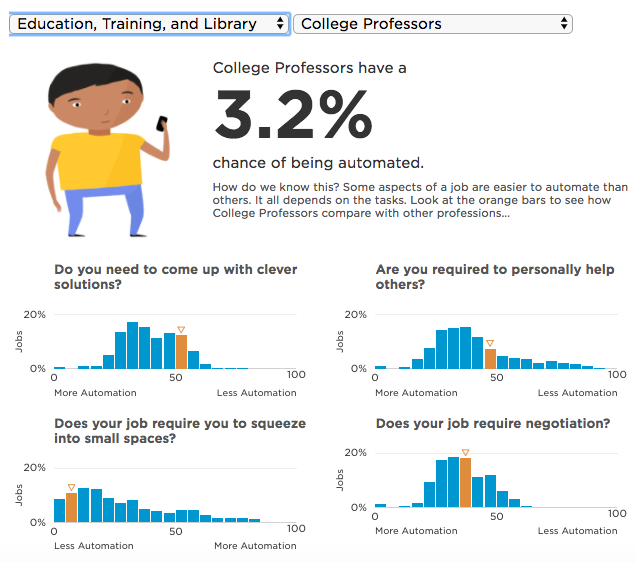
I’ve been thinking about how technology is and will impact the world of work. Thanks to NPR’s Planet Money calculator: Will Your Job Be Done By A Machine? and perhaps an empirical search on automation in teaching literature I’ve been reviewing for George … I might have robots on my mind. The calculator says my professional role is not likely to be fully replaced, but I have my doubts.

I can see ways we are already automating instruction, grading, peer review, etc. So career planning for many occupational roles will shift over time as technology is infused into the labor market. As I instruct a career planning course, Personal/Professional Development (#LTEC3010), I am quite concerned with how we are preparing (or not preparing) learners to thrive in an evolving career economy.  To support occupational preparation of the unknown, I have been picking up a few books on the future of work to add to the course– here’s what  on my book #shelfie that I read/reviewed (again) this past summer:

Although robots and technology will not take over ALL jobs in the future, the working economy will need new skill sets and agile employees. We know an increasing number of curricular and co-curricular programs in higher education are striving to include “Nonacademic Skills” and some programs are attempting to prepare learners for jobs that may not even exist yet. We hope the value of a postsecondary degree goes beyond a transcript; however, we have rarely looked ahead to align occupational preparation with the six driving factors and the needs for future work skills 2010 (Davis, Fidler, Gorbis, 2011):

  1. Life longevity: By 2025, the number of Americans older than 60 will increase by 70%.
  2. The rise of smart machines & systems: Technology can augment & extend own capabilities & workplace automation is killing the repetitive job.
  3. Computational world: Increases in sensors & processing makes the world a programmable system; data gives us the ability to see things on a scale.
  4. New media ecology: New communication tools require media literacies beyond text; visual communication media is becoming a new vernacular.
  5. Superstructure organizations: Social technologies drive new forms of production & value creation; social tools allow organizations to work at scale.
  6. Globally connected world: Diversity and adaptability are at the center of operations–US and Europe no longer hold a monopoly on job creation, innovation, and political power.

Based on these changes to the world of work, a degree and employment experience will NOT set anyone apart from the competition in the new job economy. You will have to continue to improve upon your skills, adapt to the changing environment, and plan for ongoing professional development throughout your career. Here are the top 10 skills needed for the workforce of 2020 identified by Davis et al., 2011:

  1. Sensemaking: The ability to determine the deeper meaning or significance of what is being expressed. 
  2. Social intelligence: The ability to connect to others in a deep and direct way, to sense and stimulate reactions and desired interactions. 
  3. Novel and adaptive thinking: Proficiency at thinking and coming up with solutions and responses beyond that which is rote or rule-based.
  4. Cross-cultural competency: The ability to operate in different cultural settings.
  5. Computational thinking: The ability to translate vast amounts of data into abstract concepts and to understand data-based. 
  6. Digital literacy and information fluency: The ability to critically assess and develop content that uses new media forms, and to leverage these media for persuasive communication. 
  7. Interdisciplinary mindset: Literacy in and ability to understand concepts across multiple disciplines. 
  8. Design thinking: The ability to represent and develop tasks and work processes for desired outcomes. 
  9. Cognitive load management: The ability to discriminate and filter information for importance, and to understand how to maximize cognitive functions. 
  10. Virtual Collaboration: The ability to work productively, drive engagement, and demonstrate presence as a member of a virtual team. 

As I review/edit materials in my courses, I am thinking more about digital literacy that encourage my learners to PRODUCE, CREATE, and SHARE before they graduate.  Much of HOW we prepare our learners TODAY, will impact how they function in the future job economy.  Are we thinking beyond the requirement of a course? Can we apply learning to occupational environments or non-academic settings? What ways have we been encouraging digital literacy and information fluency at our campuses? What have you required your students to create, produce, and share using different mediums or platforms? These are just a few questions I have been thinking about for course design, and I am pondering even more after drafting the latest New Media Consortium (@NMCorg) survey/report over the summer. Read more here:

2017 Digital Literacy Impact Study An NMC Horizon Project Strategic Brief  [Download: nmc.org/digilit-impact]

The 2017 Digital Literacy Impact Study: An NMC Horizon Project Strategic Brief uncovers the learner’s perspective of how digital literacy training influences work life after graduation. As a complement to the definitions and frameworks outlined in the 2017 strategic brief on digital literacy in higher education, this study examines digital literacy in action as learners enter the workforce. More than 700 recent graduates from 36 institutions responded to an NMC survey that addressed the experiences they gained at colleges and universities, and how their proficiencies or lack thereof have affected their careers. Funding for this independent research endeavor and publication was provided by Adobe.

Reference:

Adams Becker, S., Pasquini, L. A., and Zentner, A. (2017). 2017 Digital Literacy Impact Study: An NMC Horizon Project Strategic Brief. Volume 3.5, September 2017. Austin, Texas: The New Media Consortium.