#phdchat, Professional Development

What Are You Reading This Summer? #summerreading

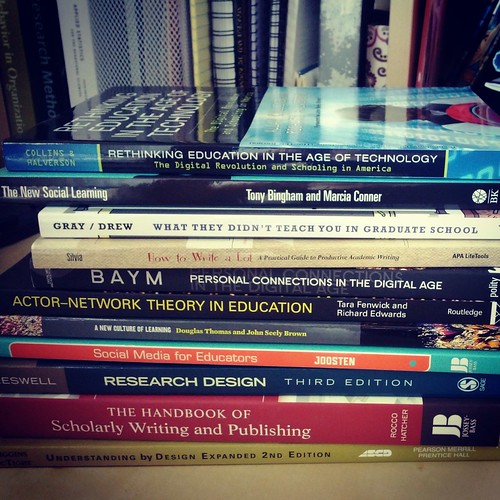
This year, the summer months are providing me space to read articles and books that I have been collecting on my #ToRead list. Below is the first stack of books I have started to read this summer. Since I am not working on any classes this summer,  the plan is to read and annotate  more articles, e-books, and other literary finds I have been collecting and storing in my Delicious and in my Good Reads account. Get ready for some EXTREME READING!

#summerreading

Although my goals are to move forward on my dissertation proposal, I know that I am not alone in setting reading goals for the summer months. Both the NY Times and Grad Hacker want to kick off the #summerreading social media campaign on June 7th. I was able start on my summer reading list early with the help of my recent travel plans – so I am always looking to add book recommendations (both for research and fun).

What books are you reading? What’s on YOUR #summerreading list? What books do you recommend?

Collaboration, Professional Development

How Do You Cultivate Mentoring Opportunities?

During our session at the #UNTAdv12  Conference last week, our panel hosted a discussion on the topic of mentoring in higher education. We talked about what formal and informal mentoring looks like on our college and university campuses, specifically to support our faculty, develop our staff members and engage our students students. Here are the key words that were shared during the discussion:

It is important for campus communities to consider the potential of mentoring. There are a number of benefits to supporting mentoring at a college or university. Some might be interested in connecting our students to their learning environment, while other institutions might be interested in helping new faculty transition. A number of mentoring programs provide return on investment for employees, which includes increased retention, career development, and professional engagement. By developing a culture of mentoring, organizations have the ability to increase collaborative learning and support sustainable leadership.

What sort of mentoring is happening on your campus or within your organization? Please feel free to add your mentoring program or resources to the open google doc: http://bit.ly/MentoringMatters

blogs, PhD, Professional Development, Reflections

What Prompts You To Blog?

Blog prompts are all around me. I started blogging in 2006 to share travel tales and I continued to blog to tell a different story and share my academic journey and musings. I typically blog to share ideas, research, and reflect on what I’m doing, learning, or experiencing – at least on this blog space.
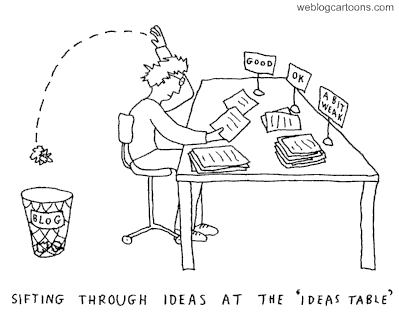
Image c/o <http://www.weblogcartoons.com/cartoons/sifting-through-ideas.gif>

Sometimes my blog ideas get filtered. I don’t always have time to write these thoughts out, so I often have to save this blog-worthy idea for later in my Delicious account, a WP draft post, or, most commonly, in WP, in a Gmail draft or Google Doc. During the crunch time of year, when all academic and professional deadlines seem to merge, my attention tends to drift. I find myself looking for interesting things to read and I seem to be more inspired to write blogs. I consider this digression to be a form of “productive procrastination.”

Inspired by the blog post from @InnovativeEdu, I thought I would share where I get my blog ideas from and what prompts me to blog:

  1. My regular online reading locations – I typically check my Google Reader, Twitter streams/hashtags, Google Alerts, social feeds, Percolate, and regular listservs/news feeds first thing in the morning. Sometimes there is a gem that I want to talk about in greater detail than just sharing it in a 140 tweet.
  2. Things I have to read “for school” – I am sure that no one is shocked to learn that you consume a hefty amount of reading while you’re a doctoral student. Beyond the “required reading” for class, I also stumble upon other finds when researching, compiling articles for my literature review and writing articles. Blogging helps me annotate and remember these theories, articles, and references in a synthesized portion to recall and use later.
  3. From conversations with peers & my PLN – I am fortunate to interact with a number of thoughtful and challenging peers on Facebook, Twitter, G-Chat, my campus, LinkedIn, Skype, and by phone. At least once a week (usually more often) I am fortunate to dialogue about something that makes me think and I want to write about in a blog to share
  4. Great finds for technology, learning ,and engagement I just want to share – Sharing – it was a good lesson I learned in kindergarten and have taken with me along the way.
  5. A photo or video that inspires me – I am a fairly active Flickr user, and  think that there are a great groups and community members that share visual inspirations that create a blogging spark. Lately Instagram, YouTube, Vimeo, and the odd infographic (there are too many of them now) have triggered ideas for blogging projects and shares.
  6. Professional & personal development opportunities – Whether it is a workshop on campus, a webinar online or an open learning session in the community, there are loads of ideas to reflect and bring back to my personal learning network (PLN).
  7. A question or request for advice – Sometimes I get an email, IM or call from individuals who want to talk about an issue or idea. When questions about technology in advising, education challenges, research process, or academic experience advice come up, I think how sharing this information in a blog post could be helpful to others who just have not asked.
  8. A Tweet – 140 characters shared on Twitter from either from me or someone else can inspire a blog draft. A tweet might include a quote, question, argument, Twitter chat, link, or random thought.
  9. Reading other posts & threaded comments – In reading a threaded discussion on someone’s blog, Facebook wall or open discussion in LinkedIn challenges me to consider my own perspective to later process it through a blog post.
  10. My own curiosity – If I want to learn more about a product, tool. vendor, process, or topic, I typically share what I have found on my blog.
  11. Contributions or things I produce – I document things I create for publications, podcasts, and presentations. Part of this is for my doctoral portfolio (ATPI is similar to the ECMP portfolio requirements, so I try to archive my work/experiences) and the other part is to share training and learning sessions. Why not put these ideas out there to extend to the audience that could not attend?
  12. Writing, writing and MORE writing – I write regularly. I started using 750words to keep me writing regularly to keep me writing. This activity helps weave my thoughts and develop new ones. Continuous writing allows me to practice my craft and improve how and what I write about.
  13. Cultivation of resources – My research interests vary and are interdisciplinary, so I collect a load of  resources – this could also be a direct result of #1, 2, 4, 6, & 8. Blogging helps me to  connect and process my thoughts to share with peers in these academic and professional fields.

I am sure there are other reasons, but those were the first few that came to my head. So the question for you is… what prompts YOU to blog? Please share. 
Higher Education, Professional Development

The Productive & Disruptive Innovation of EDU

The Innovator’s DNA: Mastering the Five Skills of Disruptive Innovators, identifies key behaviors to find innovative solutions to impact organizations, products, and services. Christensen and Gregersen (2011) share five skills that leaders need to innovate their way out of problems and into opportunities:
  1. Question – ask challenging questions that take on common wisdom to create new directions
  2. Observe – watch the behavior of customers, suppliers and competitors the way an anthropologist would identify new ways of doing things
  3. Network – talk to people with different life experiences and perspectives to spark new ideas
  4. Experiment – construct interactive experiences and build prototypes to provide unorthodox responses and gain new insights
  5. Associate – draw unexpected connections between questions, problems or ideas from unrelated fields
In education, both K-12 and higher ed, we need to spend a more time mastering these disruptive skills and improving our productivity. By adding these tools, educators will be able to consider different possibilities to support our learners and find new solutions to educational issues. This new approach to education requires innovation, organizational collaboration, and teamwork on the fly. It’s great to see that there are innovative ideas brewing, such as #change11,  BigIdeas and #EmergentEDU.
How are YOU using these 5 disruptive skills for education?
#phdchat, Open Education, PhD, PLN, Professional Development

10 “Lessons” in Digital Scholarship from @mweller

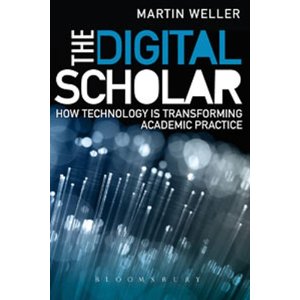
As a scholar who is lives digitally, connected & open, I have appreciated following along with Dr. Martin Weller’s as he tweets & blogs his ideas for similar philosophies. More recently he has published an open-access, creative commons book – The Digital Scholar.

I was just watching Martin’s recent talk with the LSE on how to engage in digital scholarship, i.e. scholarship that is open, networked and digital. Thanks to the Centre for Learning Technology at LSE for presenting the NetworkEd: Technology in Education Series, you can watch these “lessons” (a.k.a. general ideas and musings about how to be a connected & engaged scholar). @mweller has posted his 10 Digital Scholarship Lessons in 10 Videos to recap the presentation, slides and scoop it page as well:

  1. It’s not just for geeks
  2. Researchers are caught in a dilemma
  3. Interdisciplinary is the network
  4. We’re all broadcasters now
  5. We’re operating in an attention economy
  6. We can rethink research
  7. New skills will be required
  8. It’ll impact even if you ignore it
  9. It’s about alternatives
  10. Don’t focus just on risk

I think that Martin brings up some great ideas of what a digital scholar looks like – and there are many of them already out there. I hope to not only witness, but also be part of this academic revolution. The changing landscape of technology, information and communication is challenging higher education to rethink its approach to learning. Online resources are very social and collaborative, and I hope to see these emerging tools push the academic realm outside of the traditional boundaries and expectations. With current developments in educational technology, learning communities have the ability to enhance peer-to-peer connections, social learning, knowledge sharing, and critical thinking for researchers. When learners/researchers become creators, narrators and digital contributors of their own academic fields, many gain further in-depth meaning and purpose in the learning process.